Introduction
Lakehouse Platforms combine the strengths of data lakes and data warehouses into a single architecture. They are designed to support both structured analytics (like SQL reporting) and unstructured or semi-structured data processing (like logs, images, IoT, and streaming data).
A lakehouse architecture eliminates the traditional gap between low-cost storage (data lakes) and high-performance analytics (data warehouses) by unifying them into one system.
These platforms are widely used in AI/ML pipelines, real-time analytics, big data processing, and enterprise data engineering.
Common use cases include:
- Real-time analytics dashboards
- Machine learning and AI model training
- IoT and streaming data processing
- Business intelligence reporting
- Unified data architecture for enterprises
- Data engineering pipelines
Key evaluation criteria:
- Unified storage and compute architecture
- Support for structured and unstructured data
- Query performance (SQL + analytics workloads)
- Scalability for big data processing
- Streaming + batch processing support
- Integration with AI/ML tools
- Data governance and security features
- Cloud-native and multi-cloud support
Best for: Data engineers, AI/ML teams, analytics platforms, and enterprises managing large-scale data ecosystems.
Not ideal for: Simple transactional systems or lightweight applications.
Key Trends in Lakehouse Platforms
- Convergence of data lakes + data warehouses
- Rise of open table formats (Delta Lake, Iceberg, Hudi)
- Strong adoption in AI/ML pipelines and GenAI systems
- Real-time + batch unified processing
- Cloud-native lakehouse architectures
- Serverless lakehouse platforms gaining popularity
- Improved data governance and lineage tracking
- Integration with streaming engines (Kafka, Flink)
- Multi-cloud and hybrid data lakehouse deployments
- Increased focus on cost-efficient storage formats
How We Selected These Tools (Methodology)
- Adoption in enterprise and AI ecosystems
- Support for unified lakehouse architecture
- Performance for both batch and streaming workloads
- Scalability for petabyte-scale datasets
- Integration with analytics and BI tools
- AI/ML ecosystem compatibility
- Cloud-native and hybrid deployment support
- Open-source and industry adoption strength
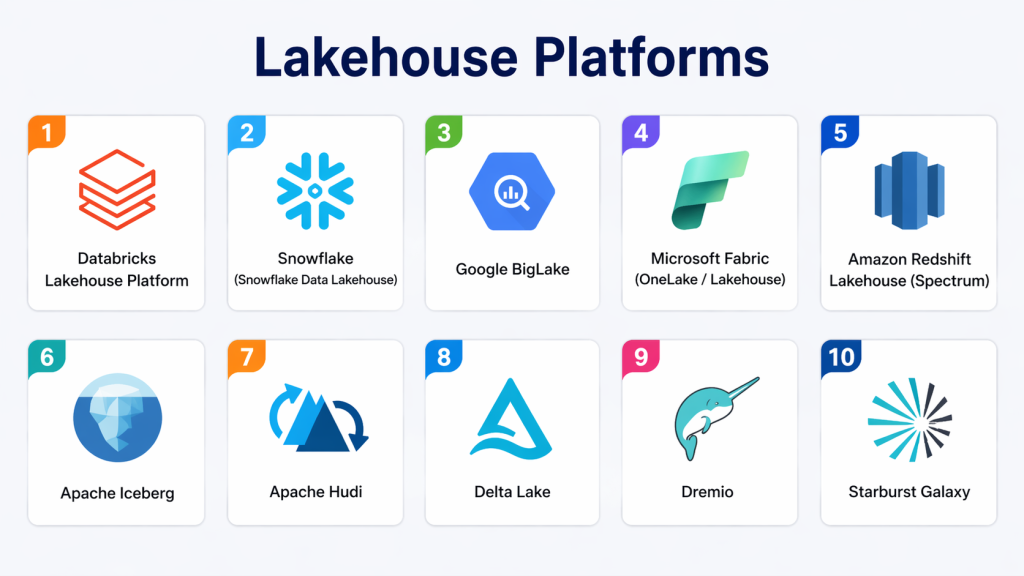
Top 10 Lakehouse Platforms
#1 — Databricks Lakehouse Platform
A leading unified data platform that combines data lakes and warehouses with strong AI/ML capabilities.
Key Features
- Delta Lake storage layer
- Unified batch + streaming
- Built-in ML and AI tools
- SQL analytics engine
- Scalable Spark-based processing
Pros
- Industry leader in lakehouse architecture
- Strong AI/ML integration
Cons
- Complex for beginners
- Cost increases with scale
Platforms / Deployment
Cloud
Security & Compliance
Encryption, governance tools; Not publicly stated
Integrations & Ecosystem
- Apache Spark
- BI tools
- ML frameworks
Support & Community
Strong enterprise support
#2 — Snowflake (Lakehouse Capabilities)
A cloud data platform evolving into a lakehouse with support for structured and semi-structured data.
Key Features
- External tables for data lakes
- Scalable compute-storage separation
- Data sharing features
- Support for multiple data formats
- High concurrency analytics
Pros
- Highly scalable and easy to use
- Strong cross-cloud capabilities
Cons
- Cost management complexity
- Not fully open architecture
Platforms / Deployment
Cloud
Security & Compliance
Strong encryption and RBAC; Not publicly stated
Integrations & Ecosystem
- BI tools
- ETL platforms
- Cloud services
Support & Community
Strong enterprise ecosystem
#3 — Google BigLake
A unified analytics platform combining data lake and warehouse capabilities on Google Cloud.
Key Features
- Unified data access layer
- BigQuery integration
- Multi-format data support
- Serverless architecture
- Real-time analytics support
Pros
- Seamless Google Cloud integration
- Serverless scalability
Cons
- Google Cloud dependency
- Cost complexity
Platforms / Deployment
Cloud
Security & Compliance
Google Cloud security; Not publicly stated
Integrations & Ecosystem
- BigQuery
- Vertex AI
- Data tools
Support & Community
Strong Google support
#4 — Microsoft Fabric (OneLake Lakehouse)
A unified data platform from Microsoft combining analytics, data engineering, and lakehouse capabilities.
Key Features
- OneLake unified storage
- Integrated analytics workspace
- Power BI integration
- Real-time data processing
- AI-powered insights
Pros
- Strong Microsoft ecosystem integration
- Unified analytics platform
Cons
- Azure dependency
- Complex feature set
Platforms / Deployment
Cloud
Security & Compliance
Enterprise-grade security; Not publicly stated
Integrations & Ecosystem
- Power BI
- Azure services
- Data pipelines
Support & Community
Strong Microsoft support
#5 — Amazon Redshift Lakehouse (Spectrum)
A hybrid data warehouse and lakehouse solution within AWS.
Key Features
- Query data in S3 directly
- Spectrum for lake integration
- MPP architecture
- AWS ecosystem integration
- SQL-based analytics
Pros
- Strong AWS integration
- Good hybrid architecture
Cons
- AWS lock-in
- Requires optimization
Platforms / Deployment
Cloud
Security & Compliance
AWS encryption; Not publicly stated
Integrations & Ecosystem
- AWS S3
- BI tools
- ETL pipelines
Support & Community
Strong AWS support
#6 — Apache Iceberg
An open table format for large-scale data lakes supporting high-performance analytics.
Key Features
- Open table format
- Schema evolution support
- Time travel queries
- Partition evolution
- Engine compatibility
Pros
- Highly flexible open standard
- Strong interoperability
Cons
- Requires external engines
- Not a full platform
Platforms / Deployment
Cloud / On-premise
Security & Compliance
Depends on implementation; Not publicly stated
Integrations & Ecosystem
- Spark
- Flink
- Trino
Support & Community
Strong open-source adoption
#7 — Apache Hudi
A data lake framework designed for incremental data processing and real-time ingestion.
Key Features
- Incremental data processing
- Real-time ingestion
- Upserts and deletes support
- Streaming + batch support
- Time travel queries
Pros
- Great for real-time pipelines
- Efficient data updates
Cons
- Complex setup
- Requires Spark ecosystem
Platforms / Deployment
Cloud / On-premise
Security & Compliance
Depends on stack; Not publicly stated
Integrations & Ecosystem
- Spark
- Kafka
- Hadoop
Support & Community
Open-source community
#8 — Delta Lake
A storage layer that brings reliability and performance to data lakes.
Key Features
- ACID transactions
- Schema enforcement
- Time travel
- Scalable metadata handling
- Spark integration
Pros
- Reliable data lake foundation
- Strong Databricks integration
Cons
- Best within Spark ecosystem
- Requires setup knowledge
Platforms / Deployment
Cloud / On-premise
Security & Compliance
Depends on implementation; Not publicly stated
Integrations & Ecosystem
- Apache Spark
- Databricks
- BI tools
Support & Community
Strong open-source support
#9 — Dremio
A data lakehouse platform focused on self-service analytics and SQL-based querying.
Key Features
- SQL query engine
- Data virtualization
- Acceleration layer
- Support for multiple sources
- Self-service analytics
Pros
- Easy for BI teams
- Fast query performance
Cons
- Limited deep data engineering features
- Enterprise features require licensing
Platforms / Deployment
Cloud / On-premise
Security & Compliance
Encryption and RBAC; Not publicly stated
Integrations & Ecosystem
- BI tools
- Data lakes
- APIs
Support & Community
Active community
#10 — Starburst Galaxy
A lakehouse analytics platform built on Trino for high-performance distributed SQL queries.
Key Features
- Distributed SQL engine
- Multi-source data access
- High-speed query processing
- Cloud-native architecture
- Data federation
Pros
- Excellent distributed querying
- Strong performance on large datasets
Cons
- Requires tuning
- Not a full storage system
Platforms / Deployment
Cloud
Security & Compliance
Enterprise security; Not publicly stated
Integrations & Ecosystem
- Data lakes
- BI tools
- APIs
Support & Community
Strong enterprise support
Comparison Table (Top 10)
| Tool Name | Best For | Platform(s) Supported | Deployment | Standout Feature | Public Rating |
|---|---|---|---|---|---|
| Databricks | AI + lakehouse | Multi | Cloud | Unified analytics | N/A |
| Snowflake | Cloud analytics | Multi | Cloud | Elastic compute | N/A |
| BigLake | Google ecosystem | Multi | Cloud | Unified access layer | N/A |
| Microsoft Fabric | Enterprise analytics | Multi | Cloud | OneLake system | N/A |
| Redshift Spectrum | AWS hybrid | Multi | Cloud | S3 integration | N/A |
| Iceberg | Open lake format | Multi | Cloud/On-prem | Schema evolution | N/A |
| Hudi | Streaming data | Multi | Cloud/On-prem | Incremental updates | N/A |
| Delta Lake | Data reliability | Multi | Cloud/On-prem | ACID on lake | N/A |
| Dremio | BI analytics | Multi | Cloud/On-prem | Self-service SQL | N/A |
| Starburst | Distributed SQL | Multi | Cloud | Fast federation | N/A |
Evaluation & Scoring of Lakehouse Platforms
| Tool Name | Core | Ease | Integrations | Security | Performance | Support | Value | Total |
|---|---|---|---|---|---|---|---|---|
| Databricks | 10 | 8 | 10 | 9 | 10 | 9 | 8 | 9.1 |
| Snowflake | 10 | 9 | 10 | 9 | 10 | 9 | 8 | 9.3 |
| BigLake | 9 | 9 | 10 | 9 | 9 | 9 | 8 | 8.9 |
| Microsoft Fabric | 10 | 8 | 10 | 9 | 9 | 9 | 8 | 9.0 |
| Redshift Spectrum | 9 | 8 | 9 | 9 | 9 | 9 | 8 | 8.7 |
| Iceberg | 9 | 7 | 9 | 8 | 9 | 8 | 10 | 8.6 |
| Hudi | 9 | 7 | 9 | 8 | 9 | 8 | 9 | 8.4 |
| Delta Lake | 9 | 8 | 9 | 8 | 9 | 9 | 9 | 8.7 |
| Dremio | 9 | 8 | 9 | 8 | 9 | 8 | 8 | 8.5 |
| Starburst | 9 | 8 | 9 | 9 | 9 | 9 | 8 | 8.7 |
Which Lakehouse Platform Should You Choose?
Solo / Developer
Delta Lake or Iceberg
SMB
Dremio or Snowflake
Mid-Market
Databricks or Microsoft Fabric
Enterprise
Snowflake, Databricks, Starburst
AI/ML Workloads
Databricks + Delta Lake
Open Ecosystem
Iceberg or Hudi
Frequently Asked Questions (FAQs)
1. What is a Lakehouse platform?
A Lakehouse platform combines the capabilities of data lakes and data warehouses into a single architecture for unified analytics and storage.
2. Why is Lakehouse architecture important?
It removes the separation between storage and analytics, enabling faster, cheaper, and more flexible data processing.
3. What is the difference between a data lake and a lakehouse?
A data lake stores raw data, while a lakehouse adds structure, governance, and analytics capabilities on top of it.
4. What is Delta Lake?
Delta Lake is an open-source storage layer that adds reliability and ACID transactions to data lakes.
5. Is Snowflake a lakehouse platform?
Snowflake is evolving into a lakehouse by supporting external tables and semi-structured data.
6. What is Apache Iceberg used for?
It is an open table format used to manage large-scale data lakes efficiently.
7. Can lakehouses handle real-time data?
Yes, many lakehouse platforms support streaming and batch processing together.
8. Which lakehouse is best for AI?
Databricks is widely used for AI and machine learning workloads.
9. Are lakehouse platforms cloud-based?
Most modern lakehouse platforms are cloud-native or cloud-optimized.
10. Do lakehouse platforms replace data warehouses?
Not fully, but they often reduce dependency by combining lake + warehouse capabilities.
Conclusion
Lakehouse Platforms represent the next evolution of modern data architecture, combining the scalability of data lakes with the performance and structure of data warehouses. They are becoming essential for organizations dealing with AI, real-time analytics, and large-scale data engineering workloads. From Databricks and Snowflake to open frameworks like Iceberg and Delta Lake, each platform plays a unique role in building flexible and scalable data ecosystems. The right choice depends on your architecture, cloud strategy, and analytics requirements. Ultimately, lakehouse platforms enable organizations to build a unified, cost-efficient, and AI-ready data foundation for the future.
