Introduction
DDI (DNS, DHCP, and IP Address Management) Platforms are integrated solutions that combine three core network services into a single unified system. DNS resolves domain names, DHCP assigns IP addresses dynamically, and IPAM manages and tracks IP address space. Together, these components form the backbone of modern network infrastructure.
As organizations scale across hybrid, multi-cloud, and distributed environments, managing these services separately becomes inefficient and risky. DDI platforms centralize control, automate provisioning, enhance visibility, and strengthen security. They are critical for maintaining uptime, preventing IP conflicts, and ensuring seamless network operations.
Common Use Cases
- Centralized management of DNS, DHCP, and IPAM services
- Automated IP address allocation and tracking
- Network visibility and reporting across environments
- Security enforcement and threat detection
- Multi-cloud and hybrid infrastructure management
What Buyers Should Evaluate
- Unified DDI capabilities and integration depth
- Automation and orchestration features
- Multi-vendor and multi-cloud support
- Scalability across global networks
- Security features (RBAC, DNSSEC, logging)
- API and Infrastructure-as-Code support
- Reporting and analytics capabilities
- Deployment flexibility (cloud, on-prem, hybrid)
- Ease of use and implementation
Best for: Enterprises, service providers, network engineers, and IT teams managing large-scale or distributed infrastructure.
Not ideal for: Small networks with limited IP requirements or environments where DNS and DHCP are fully managed by cloud providers.
Key Trends in DDI (DNS/DHCP/IPAM) Platforms
- Convergence of networking and security within DDI platforms
- Automation-first DDI management reducing manual tasks
- Cloud-native DDI solutions for hybrid environments
- AI-driven anomaly detection for DNS and IP conflicts
- Integration with DevOps and Infrastructure-as-Code workflows
- Real-time visibility and analytics dashboards
- Zero Trust alignment for secure network access
- API-first architectures enabling extensibility
- Centralized multi-cloud network management
How We Selected These Tools (Methodology)
- Strong enterprise adoption and market credibility
- Comprehensive DDI feature integration
- Proven performance and scalability
- Availability of automation and APIs
- Security capabilities such as RBAC, DNSSEC, logging
- Support for hybrid and multi-cloud environments
- Integration with networking and DevOps ecosystems
- Quality of documentation and vendor support
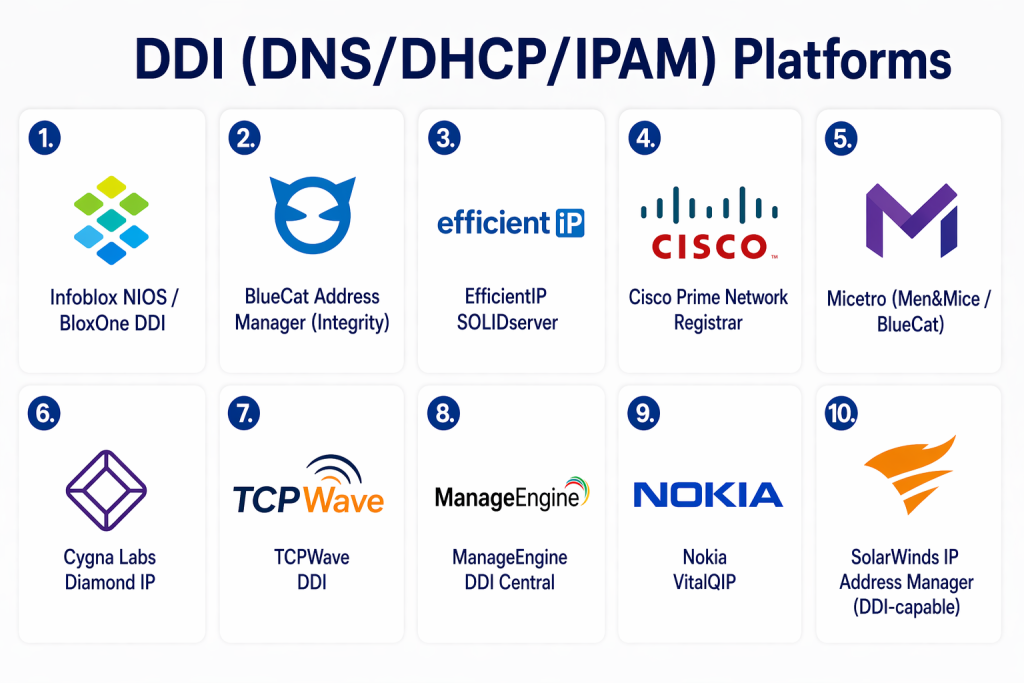
Top 10 DDI (DNS/DHCP/IPAM) Platforms
#1 — Infoblox NIOS / BloxOne DDI
Short description:
A leading enterprise-grade DDI platform offering centralized management, automation, and strong security features across hybrid environments.
Key Features
- Unified DNS, DHCP, and IPAM
- Automated IP allocation
- Network discovery and visibility
- High availability architecture
- DNS security and analytics
- API-driven automation
- Multi-cloud support
Pros
- Industry-leading DDI capabilities
- Strong security and automation
Cons
- Premium pricing
- Requires training and expertise
Platforms / Deployment
Appliance / Cloud / Hybrid
Security & Compliance
RBAC, DNS security, audit logs (certifications not publicly stated)
Integrations & Ecosystem
Integrates with cloud platforms, SIEM tools, and APIs.
- Cloud providers
- Security platforms
- DevOps tools
Support & Community
Enterprise-level support and strong documentation
#2 — BlueCat Address Manager (Integrity)
Short description:
A powerful DDI solution focused on automation, visibility, and control for enterprise networks.
Key Features
- Centralized DDI management
- Automation workflows
- Network modeling and planning
- API-first architecture
- High availability
- Policy enforcement
Pros
- Strong automation capabilities
- Highly scalable
Cons
- Complex setup
- Premium pricing
Platforms / Deployment
Cloud / On-premises / Hybrid
Security & Compliance
RBAC, access control, logging
Integrations & Ecosystem
Strong API and integration support.
- Cloud platforms
- DevOps pipelines
Support & Community
Enterprise support
#3 — EfficientIP SOLIDserver
Short description:
A DDI platform designed for automation, security, and hybrid cloud integration.
Key Features
- Unified DDI platform
- Automation and orchestration
- Real-time monitoring
- DNS security features
- API integration
- Multi-cloud support
Pros
- Strong automation and visibility
- Cloud-ready architecture
Cons
- Learning curve
- Enterprise-focused pricing
Platforms / Deployment
Cloud / Hybrid
Security & Compliance
RBAC, encryption, DNS security
Integrations & Ecosystem
Integrates with cloud and security tools.
Support & Community
Enterprise support
#4 — Cisco Prime Network Registrar
Short description:
A scalable DDI platform focused on service provider and enterprise environments.
Key Features
- DNS and DHCP services
- High-performance IP management
- Automation capabilities
- Scalability
- Policy enforcement
Pros
- High performance
- Reliable for large environments
Cons
- Limited IPAM features compared to others
- Complex setup
Platforms / Deployment
On-premises / Appliance
Security & Compliance
Not publicly stated
Integrations & Ecosystem
Integrates within Cisco ecosystem
Support & Community
Enterprise support
#5 — Micetro (Men&Mice / BlueCat)
Short description:
A centralized DDI management platform that works across multiple DNS and DHCP systems.
Key Features
- Centralized DDI control
- Multi-vendor support
- Automation workflows
- Reporting and analytics
- API access
Pros
- Flexible multi-vendor support
- Strong visibility
Cons
- Requires integration setup
- Premium pricing
Platforms / Deployment
Cloud / On-premises / Hybrid
Security & Compliance
RBAC, audit logs
Integrations & Ecosystem
Supports integration with multiple DNS/DHCP platforms
Support & Community
Enterprise support
#6 — Cygna Labs Diamond IP
Short description:
An enterprise DDI solution focused on automation, compliance, and network visibility.
Key Features
- Unified DDI management
- Automation workflows
- Compliance reporting
- IP tracking
- Analytics
Pros
- Strong compliance features
- Enterprise scalability
Cons
- Complex deployment
- Limited community
Platforms / Deployment
On-premises / Hybrid
Security & Compliance
RBAC, logging
Integrations & Ecosystem
Integrates with enterprise systems
Support & Community
Enterprise support
#7 — TCPWave DDI
Short description:
A modern DDI platform offering automation, cloud support, and security features.
Key Features
- DNS, DHCP, IPAM integration
- Automation capabilities
- Cloud support
- Network visibility
- API integration
Pros
- Flexible deployment
- Strong automation
Cons
- Smaller ecosystem
- Limited brand recognition
Platforms / Deployment
Cloud / Hybrid
Security & Compliance
Encryption, access controls
Integrations & Ecosystem
API-based integrations
Support & Community
Vendor support
#8 — ManageEngine DDI Central
Short description:
A centralized DDI solution offering simplified management for SMB and mid-market organizations.
Key Features
- Unified DDI dashboard
- IP tracking and allocation
- Automation tools
- Reporting
- Integration with IT tools
Pros
- Easy to use
- Cost-effective
Cons
- Limited advanced features
- Smaller enterprise capabilities
Platforms / Deployment
Cloud / On-premises
Security & Compliance
RBAC, encryption
Integrations & Ecosystem
Integrates with ManageEngine ecosystem
Support & Community
Reliable support
#9 — Nokia VitalQIP
Short description:
A telecom-grade DDI solution designed for large-scale service providers.
Key Features
- High scalability
- DNS and DHCP services
- IP management
- Automation
- Policy enforcement
Pros
- Telecom-grade reliability
- Scalable architecture
Cons
- Complex deployment
- Enterprise-focused
Platforms / Deployment
On-premises / Hybrid
Security & Compliance
Not publicly stated
Integrations & Ecosystem
Integrates with telecom systems
Support & Community
Enterprise support
#10 — SolarWinds IP Address Manager (DDI-capable)
Short description:
A network management tool with IPAM and partial DDI capabilities suitable for mid-sized environments.
Key Features
- IP tracking and allocation
- DHCP and DNS monitoring
- Alerts and reporting
- Subnet management
- Automation tools
Pros
- Easy to use
- Good for mid-sized networks
Cons
- Limited full DDI capabilities
- Requires additional tools
Platforms / Deployment
Windows / On-premises
Security & Compliance
RBAC, audit logs
Integrations & Ecosystem
Integrates with SolarWinds ecosystem
Support & Community
Strong support
Comparison Table (Top 10)
| Tool Name | Best For | Platform(s) Supported | Deployment | Standout Feature | Public Rating |
|---|---|---|---|---|---|
| Infoblox | Enterprise | Multi-platform | Hybrid | Full DDI suite | N/A |
| BlueCat | Enterprise | Multi-platform | Hybrid | Automation | N/A |
| EfficientIP | Enterprise | Multi-platform | Hybrid | Cloud integration | N/A |
| Cisco Prime | Service providers | Appliance | On-prem | Performance | N/A |
| Micetro | Multi-vendor | Multi-platform | Hybrid | Flexibility | N/A |
| Cygna Labs | Compliance | Multi-platform | Hybrid | Reporting | N/A |
| TCPWave | Modern DDI | Multi-platform | Hybrid | Automation | N/A |
| ManageEngine | SMB | Multi-platform | Hybrid | Ease of use | N/A |
| Nokia VitalQIP | Telecom | Multi-platform | Hybrid | Scalability | N/A |
| SolarWinds | Mid-market | Windows | On-prem | Simplicity | N/A |
Evaluation & Scoring of DDI Platforms
| Tool Name | Core | Ease | Integrations | Security | Performance | Support | Value | Weighted Total |
|---|---|---|---|---|---|---|---|---|
| Infoblox | 10 | 6 | 9 | 9 | 10 | 9 | 6 | 8.8 |
| BlueCat | 9 | 6 | 9 | 9 | 9 | 8 | 6 | 8.4 |
| EfficientIP | 9 | 6 | 8 | 9 | 9 | 8 | 6 | 8.3 |
| Cisco Prime | 8 | 6 | 7 | 7 | 9 | 7 | 6 | 7.5 |
| Micetro | 9 | 7 | 9 | 8 | 8 | 8 | 7 | 8.2 |
| Cygna Labs | 8 | 6 | 7 | 8 | 8 | 7 | 6 | 7.5 |
| TCPWave | 8 | 7 | 7 | 8 | 8 | 7 | 7 | 7.7 |
| ManageEngine | 7 | 8 | 7 | 7 | 7 | 7 | 8 | 7.5 |
| Nokia | 9 | 5 | 7 | 8 | 9 | 7 | 6 | 7.7 |
| SolarWinds | 7 | 7 | 7 | 7 | 7 | 7 | 8 | 7.3 |
Interpretation:
These scores reflect comparative performance across features, usability, and value. Enterprise platforms score higher in automation and security, while SMB tools offer better ease of use and cost efficiency.
Which DDI Platform Is Right for You?
Solo / Freelancer
- Not typically required
SMB
- ManageEngine DDI Central
- Focus on simplicity and affordability
Mid-Market
- TCPWave, Micetro
- Balanced flexibility and scalability
Enterprise
- Infoblox, BlueCat, EfficientIP
- Advanced automation and compliance
Budget vs Premium
- Budget: ManageEngine
- Premium: Infoblox, BlueCat
Feature Depth vs Ease of Use
- Deep features: Infoblox
- Ease of use: ManageEngine
Integrations & Scalability
- Strongest: BlueCat, Infoblox
Security & Compliance Needs
- Best: Infoblox, EfficientIP
Frequently Asked Questions (FAQs)
1. What is a DDI platform?
A DDI platform integrates DNS, DHCP, and IPAM into a unified solution for managing network services.
2. Why is DDI important?
It centralizes control, improves efficiency, and reduces network errors.
3. Can DDI platforms automate network management?
Yes, they provide automation for IP allocation and DNS/DHCP operations.
4. Are DDI platforms secure?
Most include RBAC, logging, and DNS security features.
5. Do they support cloud environments?
Yes, modern platforms support hybrid and multi-cloud setups.
6. What is the difference between IPAM and DDI?
IPAM manages IP addresses, while DDI includes DNS and DHCP as well.
7. Are open-source DDI tools available?
Few exist, most DDI platforms are enterprise solutions.
8. How scalable are DDI platforms?
They are designed for large-scale environments.
9. What integrations are important?
Cloud, DevOps, and security integrations are critical.
10. What mistakes should be avoided?
Avoid tools that lack automation or scalability.
Conclusion
DDI platforms are a foundational component of modern network infrastructure, bringing together DNS, DHCP, and IP address management into a unified system that improves visibility, automation, and control. As networks grow more complex across hybrid and multi-cloud environments, managing these services independently is no longer efficient or sustainable.
The right DDI platform depends heavily on your organization’s scale, operational complexity, and security requirements. Enterprise solutions provide deep automation, advanced security, and global scalability, while mid-market options focus on ease of use and cost efficiency. Each platform offers unique strengths, and selecting the right one requires a clear understanding of your infrastructure and long-term goals.
Instead of choosing based on brand recognition alone, it’s important to evaluate how well a platform integrates with your existing ecosystem, supports automation, and scales with your growth. Shortlisting a few options and testing them in real-world scenarios will help ensure a successful implementation and a resilient network foundation.
