Introduction
Cloud Access Security Broker (CASB) solutions act as a security control point between users and cloud services, helping organizations enforce policies, protect data, and monitor cloud usage. They provide visibility into SaaS, IaaS, and PaaS environments while ensuring compliance and preventing threats.
As businesses increasingly rely on cloud applications, traditional security tools fail to provide adequate control. CASBs bridge this gap by offering data protection, access control, threat prevention, and compliance monitoring across distributed cloud environments.
Use Cases:
- Discovering and managing shadow IT
- Securing SaaS applications like Microsoft 365 and Google Workspace
- Preventing data leakage across cloud apps
- Enforcing access and identity policies
- Monitoring user behavior and cloud risks
What buyers should evaluate:
- Cloud app visibility and discovery
- Data loss prevention (DLP) capabilities
- API vs proxy-based deployment
- Integration with IAM, SIEM, and SOAR
- Real-time threat detection
- Compliance and reporting features
- Ease of deployment and scalability
- Multi-cloud and SaaS coverage
Best for: Enterprises, cloud-first organizations, DevSecOps teams, and companies with heavy SaaS usage.
Not ideal for: Organizations with minimal cloud adoption or relying only on on-prem infrastructure.
Key Trends in Cloud Access Security Brokers (CASB)
- Convergence into SSE and SASE platforms
- API-based CASB for SaaS visibility
- AI-driven threat detection and anomaly analysis
- Integration with Zero Trust architectures
- Real-time monitoring of user activity
- Expansion into SaaS-to-SaaS security
- Identity-centric security models
- Automation of policy enforcement
- Unified dashboards across cloud services
- Reduced reliance on standalone CASB tools
How We Selected These Tools (Methodology)
- Market adoption and vendor reputation
- Coverage across SaaS, IaaS, and PaaS
- Depth of security features and analytics
- Integration ecosystem and APIs
- Security and compliance capabilities
- Ease of deployment and usability
- Scalability across enterprise environments
- Innovation in cloud security
- Customer fit across SMB and enterprise
- Support and documentation quality
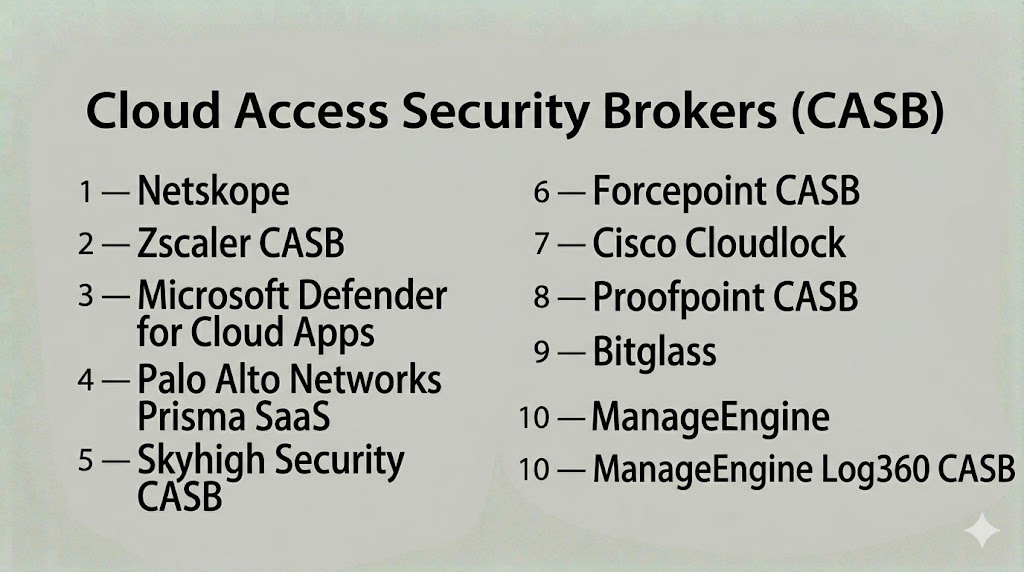
Top 10 Cloud Access Security Brokers (CASB) Tools
#1 — Netskope
A cloud-native CASB platform offering deep visibility, data protection, and threat prevention across cloud applications.
Key Features
- Cloud app discovery
- Data loss prevention
- Threat protection
- User activity monitoring
- Real-time policy enforcement
Pros
- Strong cloud-native architecture
- Comprehensive visibility
Cons
- Complex setup
- Premium pricing
Platforms / Deployment
- Web
- Cloud
Security & Compliance
- SSO, MFA, encryption
- Not publicly stated
Integrations & Ecosystem
Supports SaaS apps, cloud platforms, and security tools.
- Microsoft 365, Google Workspace
- SIEM, SOAR tools
Support & Community
Enterprise support and strong documentation.
#2 — Zscaler CASB
A cloud-delivered CASB integrated into Zscaler’s Zero Trust platform.
Key Features
- SaaS visibility
- Data protection
- Threat detection
- Policy enforcement
- Shadow IT discovery
Pros
- Fully cloud-native
- Strong scalability
Cons
- Requires Zscaler ecosystem
- Pricing complexity
Platforms / Deployment
- Web
- Cloud
Security & Compliance
- SSO, MFA
- Not publicly stated
Integrations & Ecosystem
- Cloud apps
- Security tools
Support & Community
Enterprise support available.
#3 — Microsoft Defender for Cloud Apps
A CASB solution tightly integrated with Microsoft security ecosystem.
Key Features
- SaaS monitoring
- Risk-based access control
- Threat detection
- Compliance monitoring
- Activity analytics
Pros
- Seamless Microsoft integration
- Easy deployment
Cons
- Limited outside Microsoft ecosystem
- Requires tuning
Platforms / Deployment
- Web
- Cloud
Security & Compliance
- SSO, MFA, RBAC
- Not publicly stated
Integrations & Ecosystem
- Microsoft 365, Azure
Support & Community
Enterprise support and documentation.
#4 — Palo Alto Networks Prisma SaaS
A CASB solution within Prisma platform offering deep cloud security capabilities.
Key Features
- SaaS security posture management
- Threat detection
- User behavior analytics
- Data protection
- Policy enforcement
Pros
- Strong security ecosystem
- Advanced analytics
Cons
- Complex configuration
- Premium pricing
Platforms / Deployment
- Web
- Cloud
Security & Compliance
- SSO, MFA
- Not publicly stated
Integrations & Ecosystem
- Palo Alto ecosystem
- Cloud apps
Support & Community
Enterprise support.
#5 — Skyhigh Security CASB (McAfee MVISION Cloud)
A CASB platform providing data protection, compliance, and threat prevention.
Key Features
- Data protection
- Threat analytics
- Compliance monitoring
- Access control
- Cloud visibility
Pros
- Strong compliance capabilities
- Multi-mode deployment
Cons
- Learning curve
- Requires expertise
Platforms / Deployment
- Web
- Cloud / Hybrid
Security & Compliance
- SSO, MFA
- Not publicly stated
Integrations & Ecosystem
- SaaS apps
- Security tools
Support & Community
Enterprise support available.
#6 — Forcepoint CASB
A behavior-driven CASB solution focusing on data protection and user analytics.
Key Features
- Behavior analytics
- Data protection
- Threat detection
- Policy enforcement
- Real-time monitoring
Pros
- Strong analytics
- Flexible deployment
Cons
- Complex setup
- Learning curve
Platforms / Deployment
- Web
- Cloud / Hybrid
Security & Compliance
- SSO, MFA
- Not publicly stated
Integrations & Ecosystem
- Security tools
Support & Community
Enterprise support.
#7 — Cisco Cloudlock
An API-based CASB solution focused on SaaS security and compliance.
Key Features
- API-based monitoring
- Data protection
- Threat detection
- Compliance monitoring
- Activity tracking
Pros
- Easy deployment
- Strong SaaS integration
Cons
- Limited inline capabilities
- Smaller feature set
Platforms / Deployment
- Web
- Cloud
Security & Compliance
- Not publicly stated
Integrations & Ecosystem
- SaaS platforms
Support & Community
Vendor support available.
#8 — Proofpoint CASB
A CASB solution combining cloud security with threat intelligence and data protection.
Key Features
- Threat intelligence
- Data protection
- Compliance monitoring
- Risk analysis
- User activity tracking
Pros
- Strong threat detection
- Easy integration
Cons
- Limited standalone features
- Requires ecosystem integration
Platforms / Deployment
- Web
- Cloud
Security & Compliance
- Not publicly stated
Integrations & Ecosystem
- Email security tools
- Cloud platforms
Support & Community
Enterprise support.
#9 — Bitglass (Forcepoint)
A cloud security platform offering CASB capabilities with strong data protection and encryption.
Key Features
- Data encryption
- Access control
- Threat detection
- Shadow IT discovery
- Real-time monitoring
Pros
- Strong data protection
- Cloud-first approach
Cons
- Limited ecosystem
- Requires configuration
Platforms / Deployment
- Web
- Cloud
Security & Compliance
- Not publicly stated
Integrations & Ecosystem
- SaaS apps
- Security tools
Support & Community
Vendor support available.
#10 — ManageEngine Log360 CASB
A unified security platform integrating CASB with SIEM and analytics.
Key Features
- Cloud visibility
- Threat detection
- Compliance monitoring
- Log analysis
- User behavior analytics
Pros
- Integrated platform
- Cost-effective
Cons
- Limited advanced features
- SMB-focused
Platforms / Deployment
- Web
- Cloud / On-prem
Security & Compliance
- Not publicly stated
Integrations & Ecosystem
- SIEM tools
- Cloud apps
Support & Community
Good documentation and support.
Comparison Table (Top 10)
| Tool Name | Best For | Platform(s) Supported | Deployment | Standout Feature | Public Rating |
|---|---|---|---|---|---|
| Netskope | Enterprise | Web | Cloud | Cloud-native CASB | N/A |
| Zscaler | Enterprise | Web | Cloud | Zero Trust integration | N/A |
| Microsoft Defender | Enterprise | Web | Cloud | Microsoft ecosystem | N/A |
| Prisma SaaS | Enterprise | Web | Cloud | Advanced analytics | N/A |
| Skyhigh CASB | Enterprise | Web | Hybrid | Compliance features | N/A |
| Forcepoint | Enterprise | Web | Hybrid | Behavior analytics | N/A |
| Cisco Cloudlock | SMB/Enterprise | Web | Cloud | API-based security | N/A |
| Proofpoint | Enterprise | Web | Cloud | Threat intelligence | N/A |
| Bitglass | Enterprise | Web | Cloud | Data encryption | N/A |
| ManageEngine | SMB | Web | Hybrid | SIEM integration | N/A |
Evaluation & Scoring of Cloud Access Security Brokers (CASB)
| Tool Name | Core (25%) | Ease (15%) | Integrations (15%) | Security (10%) | Performance (10%) | Support (10%) | Value (15%) | Weighted Total (0–10) |
|---|---|---|---|---|---|---|---|---|
| Netskope | 9 | 7 | 9 | 9 | 9 | 8 | 7 | 8.5 |
| Zscaler | 9 | 8 | 8 | 9 | 9 | 8 | 7 | 8.4 |
| Defender | 8 | 8 | 8 | 8 | 8 | 7 | 7 | 7.9 |
| Prisma | 9 | 7 | 8 | 9 | 9 | 8 | 7 | 8.3 |
| Skyhigh | 8 | 7 | 7 | 8 | 8 | 7 | 7 | 7.8 |
| Forcepoint | 8 | 7 | 7 | 8 | 8 | 7 | 7 | 7.8 |
| Cloudlock | 7 | 8 | 6 | 7 | 7 | 7 | 8 | 7.4 |
| Proofpoint | 8 | 8 | 7 | 8 | 8 | 7 | 7 | 7.9 |
| Bitglass | 8 | 7 | 7 | 8 | 8 | 7 | 7 | 7.8 |
| ManageEngine | 7 | 8 | 6 | 7 | 7 | 7 | 8 | 7.3 |
Scores are comparative and reflect strengths in visibility, data protection, integrations, and overall value.
Which Cloud Access Security Broker (CASB) Tool Is Right for You?
Solo / Freelancer
CASB tools are generally not required unless managing multiple SaaS environments.
SMB
ManageEngine and Cisco Cloudlock offer cost-effective solutions.
Mid-Market
Zscaler and Forcepoint provide balanced features and scalability.
Enterprise
Netskope, Prisma, and Microsoft Defender deliver comprehensive capabilities.
Budget vs Premium
Budget tools focus on visibility; premium tools provide advanced threat detection and automation.
Feature Depth vs Ease of Use
Advanced platforms offer deeper insights but require expertise.
Integrations & Scalability
Choose tools compatible with your SaaS ecosystem and security stack.
Security & Compliance Needs
Ensure alignment with regulatory frameworks and governance policies.
Frequently Asked Questions (FAQs)
What is a CASB?
A CASB is a security layer between users and cloud services that enforces policies and protects data.
What are the core functions of CASB?
Visibility, data security, threat protection, and compliance.
Why is CASB important?
It helps secure cloud usage and protect sensitive data in SaaS applications.
Can CASB detect shadow IT?
Yes, it identifies unsanctioned cloud applications.
Is CASB part of SASE?
Yes, CASB is a core component of SASE and SSE architectures.
Does CASB support compliance?
Yes, it helps enforce regulatory policies and monitor compliance.
Can CASB integrate with other tools?
Yes, it integrates with SIEM, IAM, and SOAR platforms.
Is CASB cloud-based?
It can be cloud, on-prem, or hybrid.
What are common mistakes?
Ignoring policy configuration and failing to monitor alerts.
Are CASB tools scalable?
Yes, they are designed for enterprise cloud environments.
Conclusion
Cloud Access Security Brokers are essential for securing modern cloud environments by providing visibility, control, and policy enforcement across SaaS applications. They act as a critical layer between users and cloud services, ensuring data protection and compliance.
As cloud adoption continues to grow, CASB tools have evolved into integrated platforms within broader security architectures like SASE and SSE. This allows organizations to manage security centrally while maintaining flexibility.
Choosing the right CASB depends on your cloud ecosystem, integration needs, and organizational scale. Enterprise platforms offer deep analytics and automation, while simpler tools provide ease of deployment.
