Introduction
Identity Verification (IDV) Tools are platforms that help businesses verify that users are who they claim to be using technologies like document verification, facial biometrics, and database checks. These tools are critical for preventing fraud, enabling secure onboarding, and ensuring compliance in industries like fintech, banking, and eCommerce.
Modern IDV platforms leverage AI, biometrics, liveness detection, and global data sources to validate identities in seconds while reducing friction for legitimate users . They go beyond simple ID checks by incorporating risk scoring, fraud detection, and compliance automation into onboarding workflows.
Common use cases include:
- Customer onboarding and KYC verification
- Fraud prevention and identity theft protection
- Account recovery and authentication
- Age verification and access control
- Regulatory compliance (KYC/AML)
Key evaluation criteria:
- Document verification accuracy
- Biometric authentication (face match, liveness)
- Global coverage and ID support
- AI/ML fraud detection capabilities
- Integration (API, SDK, mobile/web)
- Speed of verification and user experience
- Compliance and audit readiness
- Scalability for high-volume onboarding
Best for: Fintech companies, banks, crypto platforms, marketplaces, SaaS platforms, and any business requiring secure digital onboarding.
Not ideal for: Businesses with no digital onboarding or minimal fraud risk exposure.
Key Trends in Identity Verification Tools
- AI-driven identity verification and fraud detection
- Biometric authentication and liveness detection becoming standard
- Real-time identity verification in seconds
- Global identity coverage across hundreds of countries
- Integration with KYC/AML and fraud detection systems
- Low-friction onboarding experiences
- API-first platforms for developers
- Continuous identity monitoring vs one-time checks
- Deepfake detection and anti-spoofing technologies
- Explainable AI for compliance transparency
How We Selected These Tools (Methodology)
- Strong adoption across fintech, banking, and SaaS
- Coverage of identity verification + fraud prevention
- Proven accuracy and reliability
- AI/ML and biometric capabilities
- Integration ecosystem (APIs, SDKs)
- Global identity coverage
- Security and compliance readiness
- Fit across SMB, mid-market, and enterprise
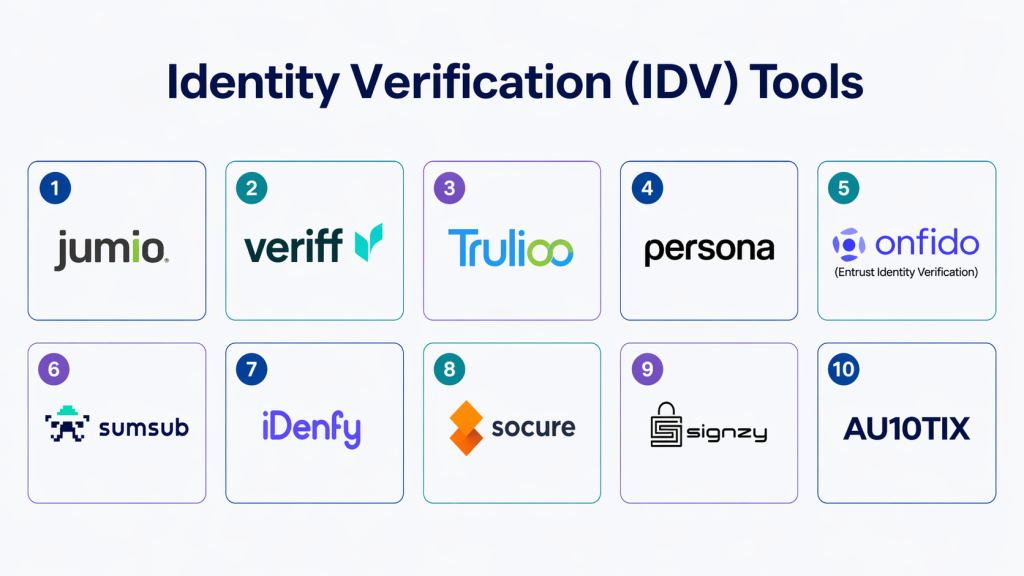
Top 10 Identity Verification (IDV) Tools
#1 — Jumio
Short description: A leading identity verification platform offering document verification, biometric authentication, and AI-powered fraud detection for secure onboarding.
Key Features
- Document verification
- Facial recognition & liveness detection
- Risk scoring and fraud detection
- AML screening
- Real-time identity checks
Pros
- Strong biometric verification
- High fraud detection accuracy
Cons
- Premium pricing
- Enterprise-focused
Platforms / Deployment
Cloud
Security & Compliance
Encryption, biometric security; Not publicly stated
Integrations & Ecosystem
- APIs
- Banking systems
- SaaS platforms
Support & Community
Enterprise-grade support
#2 — Veriff
Short description: An AI-powered IDV platform designed for global onboarding with fast verification and high accuracy across multiple document types.
Key Features
- Document and identity verification
- Biometric authentication
- Global coverage
- Risk scoring
- AML screening
Pros
- Supports thousands of ID types globally
- Fast verification speeds
Cons
- Pricing varies
- Requires integration
Platforms / Deployment
Cloud
Security & Compliance
Encryption; Not publicly stated
Integrations & Ecosystem
- APIs
- Mobile apps
- SaaS tools
Support & Community
Strong support
#3 — Trulioo
Short description: A global identity verification platform offering KYC and AML compliance across multiple countries and industries.
Key Features
- Global identity verification
- AML screening
- Business verification
- API integrations
- Risk scoring
Pros
- Wide global data coverage
- Flexible API
Cons
- Integration effort
- False positives possible
Platforms / Deployment
Cloud
Security & Compliance
Encryption; Not publicly stated
Integrations & Ecosystem
- APIs
- Payment systems
- Banking platforms
Support & Community
Enterprise support
#4 — Persona
Short description: A customizable identity verification platform focused on flexible workflows and privacy-first identity checks.
Key Features
- Custom verification workflows
- Document verification
- Risk scoring
- Privacy controls
- API integrations
Pros
- Highly customizable
- Developer-friendly
Cons
- Requires technical setup
- Not beginner-friendly
Platforms / Deployment
Cloud
Security & Compliance
Encryption; Not publicly stated
Integrations & Ecosystem
- APIs
- SaaS tools
- Data systems
Support & Community
Good support
#5 — Onfido (Entrust IDV)
Short description: An AI-based identity verification platform combining document verification and biometric checks for secure onboarding.
Key Features
- Document verification
- Facial biometrics
- Fraud detection signals
- Risk scoring
- AML checks
Pros
- Strong AI verification models
- Global coverage
Cons
- Pricing varies
- Setup complexity
Platforms / Deployment
Cloud
Security & Compliance
Encryption; Not publicly stated
Integrations & Ecosystem
- APIs
- Mobile SDKs
- SaaS platforms
Support & Community
Enterprise support
#6 — Sumsub
Short description: An all-in-one identity verification platform combining KYC, AML, and fraud detection in a unified solution.
Key Features
- Identity verification
- AML screening
- Transaction monitoring
- Fraud detection
- Compliance automation
Pros
- All-in-one platform
- Easy integration
Cons
- Pricing varies
- Customization needed
Platforms / Deployment
Cloud
Security & Compliance
Encryption; Not publicly stated
Integrations & Ecosystem
- APIs
- Fintech tools
- Payment systems
Support & Community
Good support
#7 — iDenfy
Short description: A cloud-based IDV platform offering identity verification, fraud prevention, and compliance tools with fast deployment.
Key Features
- Identity verification
- AML screening
- Fraud detection
- Risk scoring
- Reporting
Pros
- Easy to deploy
- Affordable
Cons
- Limited enterprise depth
- Smaller ecosystem
Platforms / Deployment
Cloud
Security & Compliance
Encryption; Not publicly stated
Integrations & Ecosystem
- APIs
- SaaS tools
- Identity platforms
Support & Community
Good support
#8 — Socure
Short description: A digital identity platform focused on predictive identity verification and fraud prevention using AI and data analytics.
Key Features
- Identity verification
- Risk scoring
- Fraud detection
- Data intelligence
- Compliance tools
Pros
- Strong predictive analytics
- AI-driven decisions
Cons
- Enterprise-focused
- Limited SMB support
Platforms / Deployment
Cloud
Security & Compliance
Encryption; Not publicly stated
Integrations & Ecosystem
- APIs
- Fintech platforms
- Data systems
Support & Community
Enterprise support
#9 — Signzy
Short description: A digital onboarding and compliance platform offering identity verification, AML screening, and fraud detection.
Key Features
- Video KYC
- Document verification
- AML screening
- Fraud detection
- Compliance automation
Pros
- Strong AI capabilities
- Emerging market focus
Cons
- Regional focus
- Requires setup
Platforms / Deployment
Cloud
Security & Compliance
Encryption; Not publicly stated
Integrations & Ecosystem
- APIs
- Banking systems
- Fintech platforms
Support & Community
Growing support
#10 — AU10TIX
Short description: A high-performance identity verification platform offering automated document verification and fraud detection with strong compliance capabilities.
Key Features
- Document verification
- Biometric authentication
- Fraud detection
- Risk scoring
- Compliance tools
Pros
- Fast verification speeds
- High accuracy
Cons
- Enterprise pricing
- Complex setup
Platforms / Deployment
Cloud
Security & Compliance
Encryption; Not publicly stated
Integrations & Ecosystem
- APIs
- Data platforms
- SaaS tools
Support & Community
Enterprise support
Comparison Table (Top 10)
| Tool Name | Best For | Platform(s) Supported | Deployment | Standout Feature | Public Rating |
|---|---|---|---|---|---|
| Jumio | Enterprise IDV | Web | Cloud | Biometrics + AI | N/A |
| Veriff | Global onboarding | Web | Cloud | Wide ID coverage | N/A |
| Trulioo | Global compliance | Web | Cloud | Data coverage | N/A |
| Persona | Custom workflows | Web | Cloud | Flexibility | N/A |
| Onfido | AI verification | Web | Cloud | Biometrics | N/A |
| Sumsub | All-in-one | Web | Cloud | Unified platform | N/A |
| iDenfy | SMB | Web | Cloud | Ease of use | N/A |
| Socure | Predictive ID | Web | Cloud | AI analytics | N/A |
| Signzy | Digital onboarding | Web | Cloud | Video KYC | N/A |
| AU10TIX | High accuracy | Web | Cloud | Fast verification | N/A |
Evaluation & Scoring of Identity Verification Tools
| Tool Name | Core (25%) | Ease (15%) | Integrations (15%) | Security (10%) | Performance (10%) | Support (10%) | Value (15%) | Weighted Total (0–10) |
|---|---|---|---|---|---|---|---|---|
| Jumio | 9 | 7 | 9 | 9 | 9 | 9 | 6 | 8.4 |
| Veriff | 9 | 8 | 8 | 9 | 9 | 8 | 7 | 8.3 |
| Trulioo | 8 | 7 | 9 | 8 | 8 | 8 | 7 | 8.0 |
| Persona | 8 | 7 | 8 | 8 | 8 | 7 | 7 | 7.8 |
| Onfido | 9 | 8 | 8 | 9 | 8 | 8 | 7 | 8.2 |
| Sumsub | 8 | 8 | 8 | 8 | 8 | 8 | 8 | 8.0 |
| iDenfy | 7 | 9 | 7 | 7 | 7 | 7 | 8 | 7.6 |
| Socure | 8 | 7 | 8 | 9 | 8 | 8 | 7 | 8.0 |
| Signzy | 8 | 8 | 7 | 8 | 8 | 7 | 8 | 7.8 |
| AU10TIX | 9 | 6 | 8 | 9 | 9 | 8 | 6 | 8.1 |
How to interpret scores:
- 8+ → Enterprise-grade platforms
- 7–8 → Balanced mid-market tools
- Below 7.5 → SMB-focused tools
These scores are comparative and should be validated through real-world testing.
Which Identity Verification Tool Is Right for You?
Solo / Freelancer
Use simple ID verification tools with basic KYC features
SMB
iDenfy and Signzy provide affordability and quick deployment
Mid-Market
Sumsub and Veriff offer balanced features and scalability
Enterprise
Jumio, Onfido, and Socure deliver advanced AI and global coverage
Budget vs Premium
- Budget → Basic ID verification
- Premium → AI + biometrics + compliance
Feature Depth vs Ease of Use
- Advanced tools → More control
- Simple tools → Faster onboarding
Integrations & Scalability
Choose tools that integrate with fintech, CRM, and payment systems
Security & Compliance Needs
Highly regulated industries should prioritize biometric and AML features
Frequently Asked Questions (FAQs)
1. What are Identity Verification tools?
They verify a user’s identity using documents, biometrics, and databases.
2. Why are IDV tools important?
They prevent fraud, ensure compliance, and enable secure onboarding.
3. How do these tools work?
They use document scanning, facial recognition, and AI analysis to confirm identity
4. How much do they cost?
Pricing varies based on volume and features.
5. How long does implementation take?
Cloud tools can be deployed quickly, while enterprise setups take longer.
6. What are common mistakes?
Ignoring integration needs and choosing overly complex tools.
7. Do IDV tools use AI?
Yes, AI and biometrics are core components of modern IDV platforms
8. Can they integrate with apps?
Yes, most tools provide APIs and SDKs for integration.
9. Are they secure?
They include encryption, biometrics, and fraud detection capabilities.
10. Can they scale with growth?
Yes, most platforms are built for high-volume onboarding.
Conclusion
Identity Verification (IDV) tools have become essential for digital businesses, enabling secure onboarding, fraud prevention, and regulatory compliance. As fraud techniques evolve, organizations must adopt AI-driven, biometric-based verification systems to stay ahead of threats.
Modern platforms combine document verification, facial recognition, and real-time analytics to deliver both security and user convenience. However, the best solution depends on your business needs—global coverage, integration capabilities, and compliance requirements all play a key role.
Enterprises often need advanced analytics and scalability, while smaller businesses should prioritize simplicity and speed. The goal is to balance security, accuracy, and user experience without introducing friction.
Start by identifying your requirements, shortlist a few platforms, and run pilot tests to evaluate performance. This ensures you choose a solution that strengthens trust, improves onboarding efficiency, and supports long-term growth.
