Introduction
Graph Database Platforms are specialized databases designed to store data as nodes (entities), edges (relationships), and properties. Unlike traditional relational databases, they focus on relationships-first data modeling, making them ideal for highly connected datasets.
They are widely used in social networks, fraud detection, recommendation engines, knowledge graphs, cybersecurity, and AI systems, where understanding relationships is more important than storing flat records.
Graph databases use query languages like Cypher, Gremlin, and SPARQL to efficiently traverse complex relationships at scale.
Common use cases include:
- Social network analysis
- Recommendation systems
- Fraud detection
- Knowledge graphs for AI
- IT infrastructure mapping
- Identity and access management
Key evaluation criteria:
- Relationship traversal speed
- Scalability for large datasets
- Query language flexibility
- Real-time analytics capability
- Cloud and hybrid deployment support
- Indexing and performance optimization
- Security and access control
- Ecosystem and integrations
Best for: AI engineers, data scientists, cybersecurity teams, and organizations working with highly connected data.
Not ideal for: Simple transactional systems or flat structured data use cases.
Key Trends in Graph Database Platforms
- AI-driven knowledge graphs powering LLM applications
- Hybrid graph + vector database systems
- Real-time fraud detection using relationship mapping
- Cloud-native distributed graph databases
- Graph analytics in cybersecurity and identity systems
- Multi-model databases combining graph + document + key-value
- Edge computing support for low-latency graph processing
- Increased use in recommendation engines and personalization
- Integration with machine learning pipelines
- Growing adoption in enterprise data intelligence systems
How We Selected These Tools (Methodology)
- Strong industry adoption and enterprise usage
- Performance in relationship traversal and graph queries
- Scalability for large and complex datasets
- Support for graph query languages (Cypher, Gremlin, SPARQL)
- Cloud and on-premise deployment flexibility
- Integration with AI, analytics, and data platforms
- Security and compliance readiness
- Developer ecosystem and ease of use
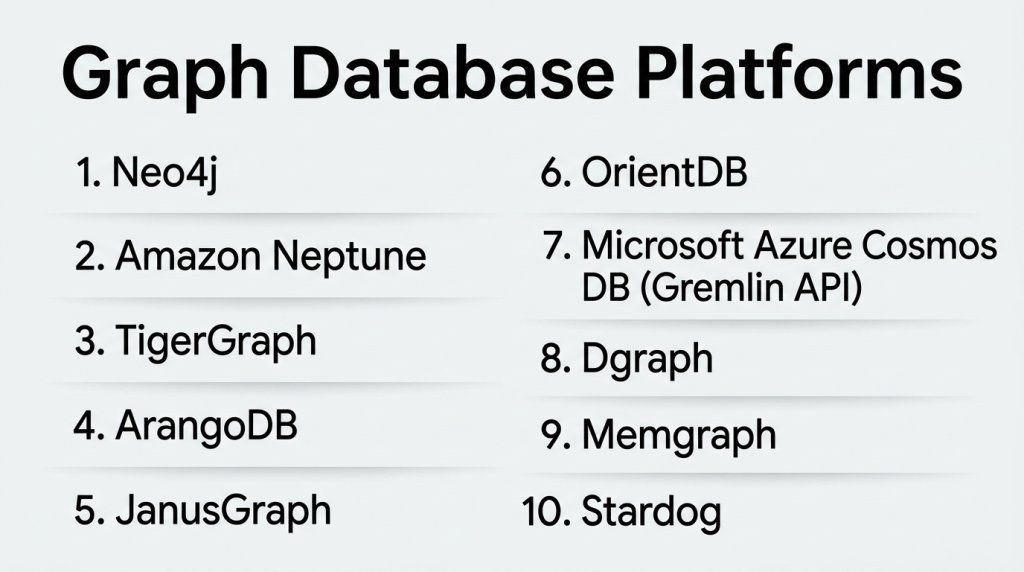
Top 10 Graph Database Platforms
#1 — Neo4j
A leading graph database known for its powerful Cypher query language and high-performance relationship traversal.
Key Features
- Native graph storage engine
- Cypher query language
- Real-time graph traversal
- Visualization tools
- ACID compliance
Pros
- Industry-leading graph database
- Strong ecosystem and community
Cons
- Enterprise licensing cost
- Memory-heavy at scale
Platforms / Deployment
Cloud / On-premise
Security & Compliance
Encryption and RBAC; Not publicly stated
Integrations & Ecosystem
- AI tools
- Data pipelines
- APIs
Support & Community
Strong global community
#2 — Amazon Neptune
A fully managed AWS graph database supporting property graph and RDF models.
Key Features
- Multi-model graph support
- High availability
- AWS integration
- Scalable architecture
- Managed backups
Pros
- Fully managed cloud service
- Strong AWS ecosystem
Cons
- AWS lock-in
- Limited offline flexibility
Platforms / Deployment
Cloud
Security & Compliance
AWS-grade encryption; Not publicly stated
Integrations & Ecosystem
- AWS services
- APIs
- Analytics tools
Support & Community
Strong AWS support
#3 — TigerGraph
A high-performance distributed graph database designed for deep link analytics and real-time processing.
Key Features
- Parallel graph processing
- Real-time analytics
- GSQL query language
- Distributed architecture
- Deep link analysis
Pros
- Extremely fast analytics
- Built for large-scale graphs
Cons
- Complex learning curve
- Enterprise pricing
Platforms / Deployment
Cloud / On-premise
Security & Compliance
Encryption support; Not publicly stated
Integrations & Ecosystem
- AI platforms
- Big data tools
- APIs
Support & Community
Strong enterprise support
#4 — ArangoDB
A multi-model database combining graph, document, and key-value capabilities.
Key Features
- Multi-model architecture
- AQL query language
- Graph traversal engine
- Horizontal scaling
- Real-time queries
Pros
- Flexible multi-model design
- Developer-friendly
Cons
- Performance tuning required
- Smaller ecosystem
Platforms / Deployment
Cloud / On-premise
Security & Compliance
Encryption support; Not publicly stated
Integrations & Ecosystem
- APIs
- Web frameworks
- Data tools
Support & Community
Active open-source community
#5 — JanusGraph
A scalable open-source graph database built for distributed big data systems.
Key Features
- Distributed graph storage
- Gremlin query support
- Hadoop integration
- Horizontal scalability
- Big data compatibility
Pros
- Highly scalable
- Open-source flexibility
Cons
- Complex setup
- Requires external systems
Platforms / Deployment
Cloud / On-premise
Security & Compliance
Depends on backend systems; Not publicly stated
Integrations & Ecosystem
- Hadoop ecosystem
- Cassandra
- APIs
Support & Community
Open-source community
#6 — OrientDB
A multi-model database supporting graph, document, and object-oriented models.
Key Features
- Multi-model support
- Graph traversal engine
- SQL-like queries
- Distributed architecture
- ACID transactions
Pros
- Flexible data modeling
- Hybrid workload support
Cons
- Smaller adoption
- Limited ecosystem
Platforms / Deployment
Cloud / On-premise
Security & Compliance
Basic encryption; Not publicly stated
Integrations & Ecosystem
- Java apps
- APIs
- Enterprise systems
Support & Community
Moderate community
#7 — Azure Cosmos DB (Gremlin API)
A globally distributed multi-model database supporting graph workloads.
Key Features
- Global distribution
- Gremlin API support
- Multi-model database
- Low latency access
- Auto-scaling
Pros
- Strong global scalability
- Azure integration
Cons
- Cost complexity
- Azure dependency
Platforms / Deployment
Cloud
Security & Compliance
Azure encryption; Not publicly stated
Integrations & Ecosystem
- Azure services
- APIs
- Enterprise systems
Support & Community
Strong Microsoft support
#8 — Dgraph
A distributed graph database built for real-time GraphQL-based applications.
Key Features
- GraphQL-native support
- Distributed architecture
- Real-time queries
- Horizontal scaling
- Built-in indexing
Pros
- Fast GraphQL queries
- Scalable design
Cons
- Smaller ecosystem
- Learning curve
Platforms / Deployment
Cloud / On-premise
Security & Compliance
Encryption support; Not publicly stated
Integrations & Ecosystem
- GraphQL tools
- APIs
- Cloud systems
Support & Community
Growing community
#9 — Memgraph
An in-memory graph database designed for real-time analytics and streaming data.
Key Features
- In-memory processing
- Real-time analytics
- Cypher support
- Streaming ingestion
- High-speed traversal
Pros
- Extremely fast
- Real-time processing
Cons
- Memory intensive
- Smaller ecosystem
Platforms / Deployment
Cloud / On-premise
Security & Compliance
Encryption support; Not publicly stated
Integrations & Ecosystem
- Streaming tools
- APIs
- AI systems
Support & Community
Active community
#10 — Stardog
An enterprise knowledge graph platform focused on semantic data and AI applications.
Key Features
- Knowledge graph management
- Semantic reasoning
- SPARQL + SQL support
- Data virtualization
- AI integration
Pros
- Strong knowledge graph capabilities
- Advanced reasoning
Cons
- Complex setup
- Enterprise pricing
Platforms / Deployment
Cloud / On-premise
Security & Compliance
Enterprise security; Not publicly stated
Integrations & Ecosystem
- AI systems
- Data platforms
- APIs
Support & Community
Strong enterprise support
Comparison Table (Top 10)
| Tool Name | Best For | Platform(s) Supported | Deployment | Standout Feature | Public Rating |
|---|---|---|---|---|---|
| Neo4j | General graph use | Multi | Cloud/On-prem | Cypher language | N/A |
| Amazon Neptune | AWS users | Multi | Cloud | Managed graph DB | N/A |
| TigerGraph | Analytics | Multi | Cloud/On-prem | Parallel processing | N/A |
| ArangoDB | Multi-model apps | Multi | Cloud/On-prem | Graph + document | N/A |
| JanusGraph | Big data graphs | Multi | Cloud/On-prem | Distributed design | N/A |
| OrientDB | Hybrid systems | Multi | Cloud/On-prem | Multi-model DB | N/A |
| Cosmos DB | Global apps | Multi | Cloud | Global scaling | N/A |
| Dgraph | GraphQL apps | Multi | Cloud/On-prem | GraphQL-native | N/A |
| Memgraph | Real-time apps | Multi | Cloud/On-prem | In-memory speed | N/A |
| Stardog | Knowledge graphs | Multi | Cloud/On-prem | Semantic reasoning | N/A |
Evaluation & Scoring
| Tool Name | Core | Ease | Integrations | Security | Performance | Support | Value | Total |
|---|---|---|---|---|---|---|---|---|
| Neo4j | 10 | 9 | 9 | 9 | 9 | 9 | 8 | 9.0 |
| Amazon Neptune | 9 | 9 | 9 | 9 | 9 | 9 | 8 | 8.8 |
| TigerGraph | 10 | 7 | 9 | 9 | 10 | 9 | 7 | 8.7 |
| ArangoDB | 9 | 8 | 9 | 8 | 9 | 8 | 9 | 8.6 |
| JanusGraph | 9 | 6 | 8 | 9 | 9 | 8 | 9 | 8.3 |
| OrientDB | 8 | 7 | 8 | 8 | 8 | 8 | 8 | 8.0 |
| Cosmos DB | 9 | 8 | 10 | 9 | 9 | 9 | 7 | 8.7 |
| Dgraph | 9 | 8 | 9 | 8 | 9 | 8 | 8 | 8.5 |
| Memgraph | 9 | 8 | 8 | 8 | 10 | 8 | 8 | 8.5 |
| Stardog | 9 | 7 | 9 | 9 | 9 | 9 | 7 | 8.4 |
Which Graph Database Should You Choose?
Beginners
Neo4j or Memgraph
Developers
Dgraph or ArangoDB
Enterprises
TigerGraph, Stardog, Cosmos DB
Cloud Users
Amazon Neptune
Real-Time Analytics
Memgraph or TigerGraph
FAQs
1. What is a graph database?
A graph database stores data as nodes and relationships, focusing on how data is connected rather than structured tables. It is ideal for relationship-heavy data.
2. Where are graph databases used?
They are used in social networks, fraud detection, recommendation systems, and knowledge graphs. Any system with complex relationships benefits from them.
3. How is a graph database different from SQL?
SQL databases store data in tables, while graph databases store relationships directly. Graph databases are faster for relationship-based queries.
4. What is Cypher?
Cypher is a query language used by Neo4j to traverse and query graph structures efficiently.
5. What is Gremlin?
Gremlin is a graph traversal language used across multiple graph databases for querying connected data.
6. Are graph databases scalable?
Yes, many modern graph databases support distributed and horizontal scaling for large datasets.
7. Can graph databases be used in AI?
Yes, they are widely used in AI for knowledge graphs, recommendations, and semantic search systems.
8. What is a knowledge graph?
A knowledge graph is a structured representation of real-world entities and their relationships, often used in AI systems.
9. Do graph databases support real-time data?
Yes, many platforms like Memgraph and TigerGraph support real-time analytics and streaming data.
10. Are graph databases replacing SQL?
No, they complement SQL databases. Both are used together depending on use cases.
Conclusion
Graph Database Platforms are becoming a core foundation for modern data-driven and AI-powered systems. Their ability to model and analyze relationships makes them essential for applications like fraud detection, recommendation engines, and knowledge graphs. As data becomes more connected and complex, graph databases are evolving into high-performance, cloud-native, and AI-integrated systems. Each platform offers unique strengths—Neo4j for general graph use, TigerGraph for large-scale analytics, and Stardog for enterprise knowledge graphs. Choosing the right solution depends on your workload, scalability needs, and ecosystem. Ultimately, graph databases unlock the power of connected data intelligence, enabling smarter, faster, and more contextual applications.
