Introduction
Privacy Management Tools help organizations discover, manage, and protect personal data while ensuring compliance with global privacy regulations. These platforms centralize privacy operations such as consent management, data mapping, risk assessments, and regulatory reporting across complex digital ecosystems.
With rising data volumes, stricter compliance requirements, and increasing consumer awareness, privacy management has shifted from a legal checkbox to a core business function. Modern tools now integrate automation, AI-driven data discovery, and real-time monitoring to simplify compliance and reduce risk.
Common use cases include:
- GDPR, CCPA, and global privacy compliance
- Consent and preference management
- Data discovery and classification
- Third-party risk and vendor assessments
- Data subject request (DSR) handling
Key evaluation criteria:
- Data discovery and classification capabilities
- Consent and preference management features
- Automation and workflow orchestration
- Integration with enterprise systems
- Scalability and performance
- Security and compliance readiness
- Reporting and audit trails
- Ease of use and implementation
Best for: Compliance teams, legal departments, data protection officers, and enterprises handling large volumes of personal data across regions.
Not ideal for: Small teams with minimal regulatory exposure or businesses that do not process sensitive personal data at scale.
Key Trends in Privacy Management Tools
- AI-powered data discovery and classification
- Automation of data subject rights workflows
- Real-time privacy monitoring and alerts
- Integration with security and governance platforms
- Expansion of global regulatory coverage
- Privacy-by-design frameworks embedded in workflows
- Increased focus on third-party risk management
- Consent orchestration across web and mobile platforms
- Cloud-native deployments for scalability
- Usage-based pricing models
How We Selected These Tools (Methodology)
- Strong market presence and enterprise adoption
- Comprehensive privacy lifecycle coverage
- Proven scalability and reliability
- Robust security and compliance capabilities
- Integration flexibility with enterprise ecosystems
- Usability and workflow efficiency
- Support for multiple regulatory frameworks
- Fit across SMB, mid-market, and enterprise segments
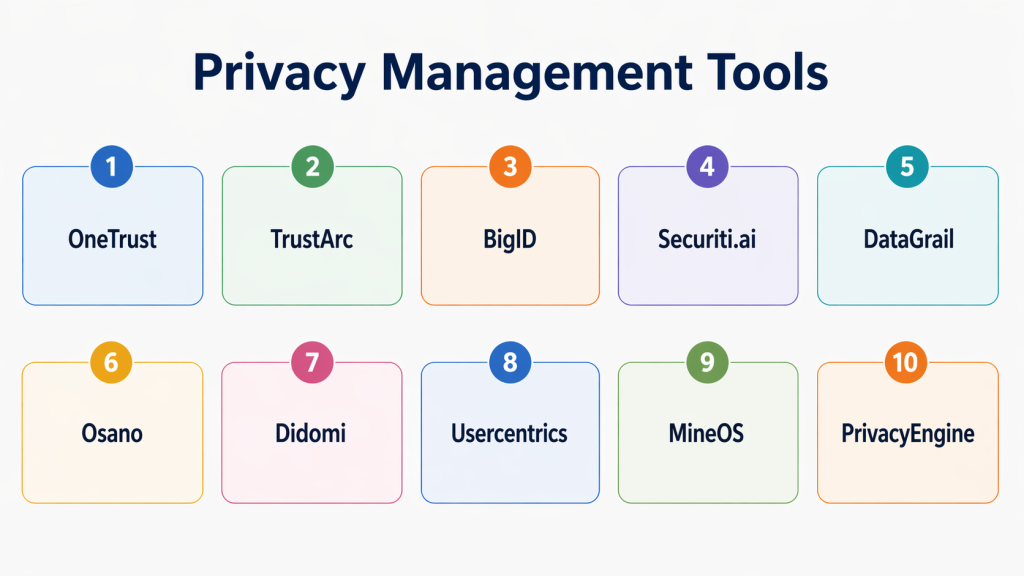
Top 10 Privacy Management Tools
#1 — OneTrust
Short description: A widely adopted privacy management platform offering end-to-end compliance solutions. It supports data mapping, consent management, and regulatory reporting across global privacy frameworks.
Key Features
- Data mapping and discovery
- Consent and preference management
- Risk and impact assessments
- Regulatory compliance tracking
- Third-party risk management
- Reporting dashboards
Pros
- Comprehensive feature set
- Strong enterprise adoption
Cons
- Complex implementation
- Premium pricing
Platforms / Deployment
Cloud
Security & Compliance
Encryption, RBAC, audit logs; Not publicly stated
Integrations & Ecosystem
Extensive integration ecosystem supporting enterprise tools
- APIs
- CRM systems
- Cloud platforms
- Security tools
Support & Community
Strong enterprise support with training resources
#2 — TrustArc
Short description: A mature privacy platform focused on compliance automation and risk management. It helps organizations streamline privacy programs and maintain regulatory alignment.
Key Features
- Data inventory management
- Privacy assessments
- Consent management
- Risk monitoring
- Compliance reporting
Pros
- Strong compliance capabilities
- Established market presence
Cons
- UI can feel outdated
- Setup complexity
Platforms / Deployment
Cloud
Security & Compliance
Encryption; Not publicly stated
Integrations & Ecosystem
Supports integrations with enterprise systems
- APIs
- Data sources
- Governance tools
Support & Community
Good enterprise support and onboarding
#3 — BigID
Short description: A data intelligence platform specializing in privacy, security, and governance. It provides deep data discovery and classification across structured and unstructured environments.
Key Features
- Data discovery and classification
- Data risk analysis
- Privacy automation
- AI-driven insights
- Data subject rights management
Pros
- Strong data intelligence capabilities
- Advanced analytics
Cons
- Requires technical expertise
- Higher cost
Platforms / Deployment
Cloud / Hybrid
Security & Compliance
Encryption, access controls; Not publicly stated
Integrations & Ecosystem
Integrates with enterprise data systems
- APIs
- Data warehouses
- Security platforms
Support & Community
Enterprise support with technical onboarding
#4 — Securiti.ai
Short description: A unified data privacy and governance platform that automates compliance processes and enables real-time visibility into data usage.
Key Features
- Data intelligence and mapping
- Consent management
- Risk assessments
- Automation workflows
- Regulatory compliance
Pros
- Strong automation
- Scalable architecture
Cons
- Learning curve
- Requires configuration
Platforms / Deployment
Cloud
Security & Compliance
Encryption, RBAC; Not publicly stated
Integrations & Ecosystem
Supports integrations with enterprise tools
- APIs
- Cloud services
- Data platforms
Support & Community
Enterprise-grade support
#5 — DataGrail
Short description: A privacy platform focused on simplifying data subject requests and consent management. Designed for fast deployment and ease of use.
Key Features
- DSR automation
- Consent management
- Data mapping
- Risk monitoring
- Reporting
Pros
- Easy to implement
- Strong automation
Cons
- Limited advanced analytics
- Not ideal for large enterprises
Platforms / Deployment
Cloud
Security & Compliance
Encryption; Not publicly stated
Integrations & Ecosystem
Strong integration support for SaaS tools
- CRM systems
- Marketing tools
- APIs
Support & Community
Good support for growing teams
#6 — Osano
Short description: A privacy management platform focused on consent management and compliance monitoring. Suitable for organizations prioritizing website compliance.
Key Features
- Consent management
- Compliance monitoring
- Vendor risk management
- Data mapping
- Reporting dashboards
Pros
- Easy to use
- Strong consent features
Cons
- Limited enterprise depth
- Fewer advanced analytics
Platforms / Deployment
Cloud
Security & Compliance
Encryption; Not publicly stated
Integrations & Ecosystem
Integrates with web and SaaS platforms
- APIs
- Website tools
- Marketing platforms
Support & Community
Good documentation and support
#7 — Didomi
Short description: A consent and preference management platform designed for global compliance across websites and applications. Focuses on user experience and transparency.
Key Features
- Consent collection
- Preference management
- Compliance frameworks
- User experience tools
- Reporting
Pros
- Strong UX
- Global compliance support
Cons
- Limited full privacy suite features
- Focused primarily on consent
Platforms / Deployment
Cloud
Security & Compliance
Encryption; Not publicly stated
Integrations & Ecosystem
Supports integration with digital platforms
- APIs
- Web applications
- Mobile apps
Support & Community
Good support for digital teams
#8 — Usercentrics
Short description: A consent management platform focused on websites and apps. Helps businesses manage user consent and comply with global privacy laws.
Key Features
- Consent banners
- Preference management
- Compliance automation
- Reporting
- Integrations
Pros
- Easy setup
- Strong web compliance tools
Cons
- Limited enterprise features
- Narrow focus
Platforms / Deployment
Cloud
Security & Compliance
Encryption; Not publicly stated
Integrations & Ecosystem
Integrates with web and marketing tools
- APIs
- CMS platforms
- Analytics tools
Support & Community
Good support and documentation
#9 — MineOS
Short description: A privacy automation platform designed to simplify data subject requests and data mapping. Focuses on operational efficiency and automation.
Key Features
- Data discovery
- DSR automation
- Data mapping
- Workflow automation
- Reporting
Pros
- Strong automation
- Modern interface
Cons
- Limited enterprise features
- Smaller ecosystem
Platforms / Deployment
Cloud
Security & Compliance
Encryption; Not publicly stated
Integrations & Ecosystem
Supports integration with SaaS tools
- APIs
- Cloud platforms
- Data tools
Support & Community
Growing support ecosystem
#10 — PrivacyEngine
Short description: A privacy management platform focused on compliance and risk management. Suitable for organizations handling sensitive data and regulatory requirements.
Key Features
- Compliance management
- Risk assessments
- Data mapping
- Reporting tools
- Privacy workflows
Pros
- Strong compliance features
- Structured workflows
Cons
- Limited integrations
- Smaller market presence
Platforms / Deployment
Cloud
Security & Compliance
Encryption; Not publicly stated
Integrations & Ecosystem
Basic integrations with enterprise tools
- APIs
- Data systems
- Compliance tools
Support & Community
Varies by plan
Comparison Table (Top 10)
| Tool Name | Best For | Platform(s) Supported | Deployment | Standout Feature | Public Rating |
|---|---|---|---|---|---|
| OneTrust | Enterprise compliance | Web | Cloud | End-to-end privacy suite | N/A |
| TrustArc | Risk management | Web | Cloud | Compliance automation | N/A |
| BigID | Data intelligence | Web | Cloud/Hybrid | Data discovery | N/A |
| Securiti.ai | Automation | Web | Cloud | Data intelligence | N/A |
| DataGrail | SMB privacy ops | Web | Cloud | DSR automation | N/A |
| Osano | Website compliance | Web | Cloud | Consent management | N/A |
| Didomi | Consent UX | Web | Cloud | User consent tools | N/A |
| Usercentrics | Web compliance | Web | Cloud | Consent banners | N/A |
| MineOS | Automation | Web | Cloud | Workflow automation | N/A |
| PrivacyEngine | Compliance | Web | Cloud | Risk management | N/A |
Evaluation & Scoring of Privacy Management Tools
| Tool Name | Core (25%) | Ease (15%) | Integrations (15%) | Security (10%) | Performance (10%) | Support (10%) | Value (15%) | Weighted Total (0–10) |
|---|---|---|---|---|---|---|---|---|
| OneTrust | 9 | 7 | 9 | 9 | 9 | 9 | 6 | 8.4 |
| TrustArc | 8 | 7 | 8 | 8 | 8 | 8 | 7 | 7.9 |
| BigID | 9 | 6 | 9 | 9 | 9 | 8 | 6 | 8.3 |
| Securiti.ai | 9 | 7 | 8 | 9 | 8 | 8 | 7 | 8.2 |
| DataGrail | 7 | 9 | 7 | 7 | 8 | 8 | 8 | 7.9 |
| Osano | 7 | 9 | 7 | 7 | 7 | 7 | 8 | 7.6 |
| Didomi | 7 | 9 | 7 | 7 | 7 | 7 | 8 | 7.6 |
| Usercentrics | 7 | 9 | 7 | 7 | 7 | 7 | 8 | 7.6 |
| MineOS | 7 | 8 | 7 | 7 | 7 | 7 | 8 | 7.5 |
| PrivacyEngine | 7 | 7 | 6 | 7 | 7 | 7 | 7 | 7.0 |
These scores are comparative and reflect overall capabilities across features, usability, integrations, and value. Higher scores indicate stronger overall offerings, but the right choice depends on your organization’s size, regulatory exposure, and technical needs.
Which Privacy Management Tool Is Right for You?
Solo / Freelancer
Tools like Osano or Usercentrics are ideal for basic compliance needs and website consent management.
SMB
DataGrail and Didomi offer strong automation with easy deployment for growing teams.
Mid-Market
TrustArc and Securiti.ai provide balanced capabilities for scaling privacy operations.
Enterprise
OneTrust and BigID deliver advanced data intelligence and global compliance coverage.
Budget vs Premium
Budget tools focus on ease of use, while premium tools provide deeper analytics and enterprise-grade capabilities.
Feature Depth vs Ease of Use
Advanced platforms require more setup but offer deeper insights; simpler tools reduce onboarding effort.
Integrations & Scalability
Choose tools that integrate with your existing ecosystem and scale with data growth.
Security & Compliance Needs
Highly regulated industries should prioritize tools with strong compliance and audit capabilities.
Frequently Asked Questions (FAQs)
1. What are Privacy Management Tools used for?
These tools help organizations manage personal data, ensure compliance with regulations, and handle consent and user rights efficiently.
2. How much do privacy tools cost?
Pricing varies depending on features, scale, and deployment. Many platforms offer subscription-based or usage-based pricing models.
3. Are these tools necessary for small businesses?
Not always, but businesses handling customer data or operating in regulated regions may benefit from basic privacy tools.
4. How long does implementation take?
Cloud-based tools can be implemented quickly, while enterprise platforms may take longer depending on complexity.
5. What are common mistakes when choosing a tool?
Ignoring integration needs, underestimating data volume, and choosing overly complex solutions are common mistakes.
6. Do privacy tools support automation?
Yes, most modern platforms automate workflows like data subject requests and compliance reporting.
7. How secure are these tools?
Most tools offer encryption, access controls, and audit logs. Always verify vendor security capabilities before adoption.
8. Can these tools integrate with existing systems?
Yes, most tools support integration with CRM, cloud platforms, and enterprise applications.
9. Can I switch privacy tools easily?
Switching can be complex due to data migration and workflow differences. Proper planning is essential.
10. Are there alternatives to privacy tools?
Basic compliance can be managed manually or with simple tools, but they lack scalability and automation.
Conclusion
Privacy management has become a foundational requirement for modern organizations handling sensitive data across digital ecosystems. As regulatory frameworks evolve and customer expectations increase, relying on manual processes is no longer sustainable. Privacy management tools provide the structure, automation, and visibility needed to manage compliance effectively while reducing operational risk.
The right solution depends heavily on your organization’s size, data complexity, and regulatory exposure. Enterprise platforms deliver deep analytics and global compliance coverage, while smaller tools focus on simplicity and fast deployment. Understanding your specific use case is critical before making a decision.
Instead of choosing based on feature volume alone, prioritize alignment with your workflows, integration requirements, and scalability needs. A well-matched tool will not only improve compliance but also streamline internal operations and enhance trust with customers.
Start by shortlisting a few tools, testing their usability, and validating how well they integrate into your existing systems. A structured evaluation approach ensures that your investment supports both current needs and future growth.
