Introduction
Vector Database Platforms are modern data storage systems designed to store, manage, and search high-dimensional vector embeddings generated by AI and machine learning models. These vectors represent unstructured data such as text, images, audio, and video in numerical form, enabling semantic search and similarity matching.
Unlike traditional databases, vector databases are optimized for AI-driven workloads like LLMs (Large Language Models), recommendation systems, search engines, and generative AI applications.
They power modern AI systems by enabling fast nearest-neighbor search (ANN), similarity matching, and context retrieval from embeddings.
Common use cases include:
- AI-powered semantic search
- Chatbots and RAG (Retrieval-Augmented Generation) systems
- Recommendation engines
- Image and video similarity search
- Fraud detection and anomaly detection
- Personalized content delivery
Key evaluation criteria:
- Vector search performance (ANN algorithms)
- Scalability for large embedding datasets
- Latency and query speed
- Support for hybrid search (vector + keyword)
- Integration with AI/ML frameworks (LangChain, OpenAI, etc.)
- Indexing methods (HNSW, IVF, etc.)
- Cloud and on-premise deployment options
- Filtering and metadata support
Best for: AI/ML engineers, data scientists, SaaS platforms, recommendation systems, and generative AI applications.
Not ideal for: Traditional transactional systems or structured relational workloads.
Key Trends in Vector Database Platforms
- Explosion of LLM-powered applications (RAG systems)
- Hybrid search (keyword + vector) becoming standard
- Cloud-native vector databases with auto-scaling
- Real-time embedding updates and streaming ingestion
- Integration with GenAI frameworks (LangChain, LlamaIndex)
- GPU acceleration for vector search performance
- Multi-modal search (text, image, audio embeddings)
- Managed vector databases replacing self-hosted systems
- Edge AI vector storage for low-latency apps
- Better filtering and metadata-aware vector search
How We Selected These Tools (Methodology)
- Strong adoption in AI/ML and GenAI ecosystems
- Performance in approximate nearest neighbor (ANN) search
- Scalability for billions of vector embeddings
- Integration with LLM frameworks and APIs
- Cloud-native and hybrid deployment support
- Query speed and low latency performance
- Metadata filtering and hybrid search support
- Developer ecosystem and ease of use
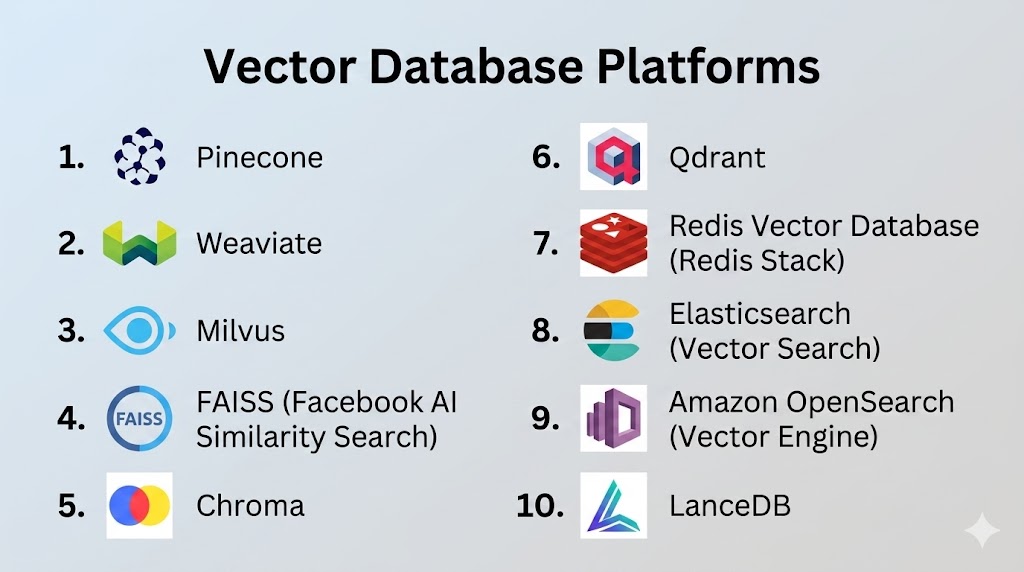
Top 10 Vector Database Platforms
#1 — Pinecone
Short description: A fully managed vector database designed for high-performance similarity search and GenAI applications like RAG systems and semantic search.
Key Features
- Fully managed vector database
- Real-time vector search
- Metadata filtering
- High-dimensional similarity search
- Scalable infrastructure
Pros
- Very easy to use and manage
- Excellent performance for LLM applications
Cons
- Closed ecosystem
- Can become costly at scale
Platforms / Deployment
Cloud
Security & Compliance
Encryption at rest and in transit; Not publicly stated
Integrations & Ecosystem
- LangChain
- OpenAI
- LlamaIndex
- APIs
Support & Community
Strong enterprise support
#2 — Weaviate
Short description: An open-source vector database with built-in ML models and hybrid search capabilities for AI-powered applications.
Key Features
- Vector + keyword hybrid search
- Built-in embedding models
- GraphQL & REST APIs
- Real-time indexing
- Modular architecture
Pros
- Flexible and developer-friendly
- Strong hybrid search support
Cons
- Requires tuning for large scale
- Operational complexity
Platforms / Deployment
Cloud / On-premise
Security & Compliance
RBAC, encryption; Not publicly stated
Integrations & Ecosystem
- OpenAI
- Hugging Face
- LangChain
- APIs
Support & Community
Strong open-source community
#3 — Milvus
Short description: A highly scalable open-source vector database designed for managing billions of embeddings with high-speed search performance.
Key Features
- High-performance ANN search
- Scalable distributed architecture
- Multiple index types (HNSW, IVF)
- GPU acceleration support
- Metadata filtering
Pros
- Excellent for large-scale AI workloads
- Highly scalable
Cons
- Complex setup
- Requires infrastructure expertise
Platforms / Deployment
Cloud / On-premise
Security & Compliance
Encryption support; Not publicly stated
Integrations & Ecosystem
- AI frameworks
- Kubernetes
- APIs
Support & Community
Strong open-source backing
#4 — FAISS (Facebook AI Similarity Search)
Short description: A high-performance library developed by Meta for efficient similarity search and clustering of dense vectors.
Key Features
- Fast nearest neighbor search
- GPU support
- Multiple indexing algorithms
- Large-scale vector handling
- C++ and Python support
Pros
- Extremely fast search performance
- Widely used in research
Cons
- Not a full database
- Requires manual integration
Platforms / Deployment
Local / Cloud
Security & Compliance
Depends on implementation; Not publicly stated
Integrations & Ecosystem
- AI frameworks
- Python ML stacks
- Custom applications
Support & Community
Strong research community
#5 — Chroma
Short description: A lightweight open-source vector database designed specifically for AI applications and LLM-based workflows.
Key Features
- Simple vector storage
- Embedding management
- LLM integration support
- Metadata filtering
- Fast prototyping
Pros
- Easy for developers and prototypes
- LLM-friendly design
Cons
- Not enterprise-ready
- Limited scalability
Platforms / Deployment
Cloud / Local
Security & Compliance
Basic security; Not publicly stated
Integrations & Ecosystem
- LangChain
- OpenAI
- LLM frameworks
Support & Community
Growing open-source community
#6 — Qdrant
Short description: A high-performance vector database written in Rust, optimized for similarity search and filtering.
Key Features
- ANN search engine
- Payload filtering
- REST & gRPC APIs
- Scalable architecture
- Hybrid search support
Pros
- Fast and efficient Rust-based engine
- Strong filtering capabilities
Cons
- Smaller ecosystem
- Requires configuration
Platforms / Deployment
Cloud / On-premise
Security & Compliance
Encryption support; Not publicly stated
Integrations & Ecosystem
- AI frameworks
- LangChain
- APIs
Support & Community
Active open-source community
#7 — Redis Vector Search
Short description: An extension of Redis that adds vector similarity search capabilities to its in-memory database.
Key Features
- In-memory vector search
- Real-time query processing
- Hybrid search support
- Low-latency performance
- Indexing support
Pros
- Extremely fast due to in-memory design
- Easy integration with Redis
Cons
- Memory intensive
- Not suited for massive datasets
Platforms / Deployment
Cloud / On-premise
Security & Compliance
Redis security features; Not publicly stated
Integrations & Ecosystem
- Redis ecosystem
- AI tools
- APIs
Support & Community
Strong Redis community
#8 — Elasticsearch (Vector Search)
Short description: A distributed search engine that now supports vector search for AI-powered semantic search applications.
Key Features
- Full-text + vector search
- Hybrid search capabilities
- Distributed architecture
- Real-time indexing
- Advanced filtering
Pros
- Strong search + vector hybrid system
- Mature ecosystem
Cons
- Complex tuning
- Resource-heavy
Platforms / Deployment
Cloud / On-premise
Security & Compliance
Encryption, RBAC; Not publicly stated
Integrations & Ecosystem
- Kibana
- Log systems
- APIs
Support & Community
Strong Elastic ecosystem
#9 — Amazon OpenSearch Vector Engine
Short description: A managed search service from AWS that supports vector search for semantic and AI-driven applications.
Key Features
- Vector similarity search
- Hybrid search support
- Fully managed AWS service
- Real-time indexing
- Scalable architecture
Pros
- Deep AWS integration
- Fully managed service
Cons
- AWS dependency
- Cost at scale
Platforms / Deployment
Cloud
Security & Compliance
AWS-grade encryption; Not publicly stated
Integrations & Ecosystem
- AWS services
- OpenSearch ecosystem
- APIs
Support & Community
Strong AWS support
#10 — LanceDB
Short description: A modern open-source vector database designed for AI workloads with fast storage and querying capabilities.
Key Features
- Embedded vector database
- High-speed ANN search
- LLM integration
- Metadata filtering
- Local + cloud support
Pros
- Simple and fast for AI apps
- Great for developers
Cons
- Early-stage ecosystem
- Limited enterprise features
Platforms / Deployment
Cloud / Local
Security & Compliance
Basic encryption; Not publicly stated
Integrations & Ecosystem
- LangChain
- OpenAI
- AI frameworks
Support & Community
Growing community
Comparison Table (Top 10)
| Tool Name | Best For | Platform(s) Supported | Deployment | Standout Feature | Public Rating |
|---|---|---|---|---|---|
| Pinecone | Managed vector search | Cloud | Cloud | Fully managed service | N/A |
| Weaviate | Hybrid AI search | Multi | Cloud/On-prem | GraphQL + hybrid search | N/A |
| Milvus | Large-scale AI apps | Multi | Cloud/On-prem | Massive scalability | N/A |
| FAISS | Research & ML | Multi | Local | Ultra-fast search | N/A |
| Chroma | LLM prototypes | Multi | Cloud/Local | Simple LLM integration | N/A |
| Qdrant | High-performance AI | Multi | Cloud/On-prem | Rust-based engine | N/A |
| Redis Vector | Real-time apps | Multi | Cloud/On-prem | In-memory speed | N/A |
| Elasticsearch | Search + AI | Multi | Cloud/On-prem | Hybrid search | N/A |
| OpenSearch | AWS AI search | Multi | Cloud | AWS integration | N/A |
| LanceDB | AI developers | Multi | Cloud/Local | Lightweight vector DB | N/A |
Evaluation & Scoring of Vector Database Platforms
| Tool Name | Core (25%) | Ease (15%) | Integrations (15%) | Security (10%) | Performance (10%) | Support (10%) | Value (15%) | Weighted Total (0–10) |
|---|---|---|---|---|---|---|---|---|
| Pinecone | 9 | 9 | 10 | 9 | 10 | 9 | 7 | 8.8 |
| Weaviate | 9 | 8 | 9 | 8 | 9 | 8 | 9 | 8.5 |
| Milvus | 10 | 7 | 9 | 9 | 10 | 9 | 9 | 8.9 |
| FAISS | 9 | 6 | 8 | 8 | 10 | 8 | 10 | 8.3 |
| Chroma | 8 | 9 | 9 | 8 | 8 | 8 | 10 | 8.4 |
| Qdrant | 9 | 8 | 9 | 9 | 9 | 8 | 9 | 8.6 |
| Redis Vector | 9 | 9 | 9 | 8 | 10 | 9 | 8 | 8.7 |
| Elasticsearch | 9 | 7 | 9 | 9 | 9 | 9 | 8 | 8.5 |
| OpenSearch | 9 | 8 | 9 | 9 | 9 | 9 | 8 | 8.6 |
| LanceDB | 8 | 9 | 8 | 8 | 8 | 8 | 9 | 8.2 |
Which Vector Database Is Right for You?
Solo / Developer
Chroma or FAISS for quick prototyping
SMB
Weaviate or Qdrant for scalable AI apps
Mid-Market
Pinecone or Redis Vector for production workloads
Enterprise
Milvus, OpenSearch, Elasticsearch for large-scale AI systems
AI/LLM Workloads
Pinecone, Weaviate, Milvus
Real-Time Applications
Redis Vector or Qdrant
Frequently Asked Questions (FAQs)
1. What is a vector database?
A database designed to store and search high-dimensional embeddings for AI applications.
2. Why are vector databases important?
They power semantic search and AI-based applications like LLMs and recommendation systems.
3. What is vector search?
It finds similar data points based on mathematical similarity of embeddings.
4. Are vector databases SQL-based?
No, they are optimized for similarity search rather than relational queries.
5. What is ANN search?
Approximate Nearest Neighbor search used for fast similarity matching.
6. Can vector databases work with LLMs?
Yes, they are widely used in RAG systems.
7. Are vector databases scalable?
Yes, most are designed for distributed scaling.
8. Do they support real-time updates?
Yes, many support real-time ingestion and indexing.
9. What data types can they handle?
Text, images, audio, video embeddings.
10. Are they cloud-native?
Most modern vector databases are cloud-ready or fully managed.
Conclusion
Vector Database Platforms are the backbone of modern AI and generative applications, enabling machines to understand and retrieve information based on meaning rather than exact matches. As AI adoption grows, vector databases are becoming essential for semantic search, recommendation systems, chatbots, and RAG-based architectures. Each platform offers unique strengths—Pinecone for managed simplicity, Milvus for massive scalability, Weaviate for hybrid search, and Redis for real-time speed. The right choice depends on your workload, scale, and AI architecture. Ultimately, vector databases are redefining how applications interact with data in the age of AI, making search more intelligent, contextual, and powerful.
