Introduction
Log Management Tools are platforms that collect, store, analyze, and monitor log data generated by applications, servers, networks, and cloud infrastructure. Logs are critical for understanding system behavior, troubleshooting issues, detecting security threats, and maintaining operational visibility across environments.
In modern IT ecosystems, where applications are distributed across cloud, containers, and microservices, log data has become massive and complex. Without proper log management, teams struggle to identify issues quickly, leading to downtime, security risks, and poor user experience. These tools centralize logs, provide search and analytics capabilities, and enable real-time alerting to ensure systems remain reliable and secure.
Common use cases include:
- Troubleshooting application and infrastructure issues
- Security monitoring and threat detection
- Compliance and audit logging
- Performance optimization
- DevOps and SRE observability workflows
Key evaluation criteria:
- Log ingestion and scalability
- Search and query performance
- Real-time alerting and analytics
- Integration with DevOps and security tools
- Data retention and storage flexibility
- Visualization and dashboards
- Security and access control
- Cost efficiency
Best for: DevOps teams, SREs, security analysts, IT operations, and enterprises managing complex systems.
Not ideal for: Small applications with minimal logging needs or teams without log analysis requirements.
Key Trends in Log Management Tools
- Shift toward unified observability platforms combining logs, metrics, and traces
- AI-driven anomaly detection and log analysis
- Real-time streaming and processing of log data
- Increased adoption of cloud-native logging solutions
- Integration with SIEM and security platforms
- API-first architectures for flexibility
- Cost optimization through log sampling and tiered storage
- Kubernetes and container log monitoring
- OpenTelemetry adoption for standardized logging
- Enhanced security features like RBAC and audit trails
How We Selected These Tools (Methodology)
- Strong market adoption and credibility
- Feature completeness across log collection, analysis, and alerting
- Performance and scalability
- Security capabilities and enterprise readiness
- Integration ecosystem with DevOps and security tools
- Ease of use and onboarding experience
- Support and documentation quality
- Flexibility across cloud and on-prem environments
- Balance between open-source and enterprise tools
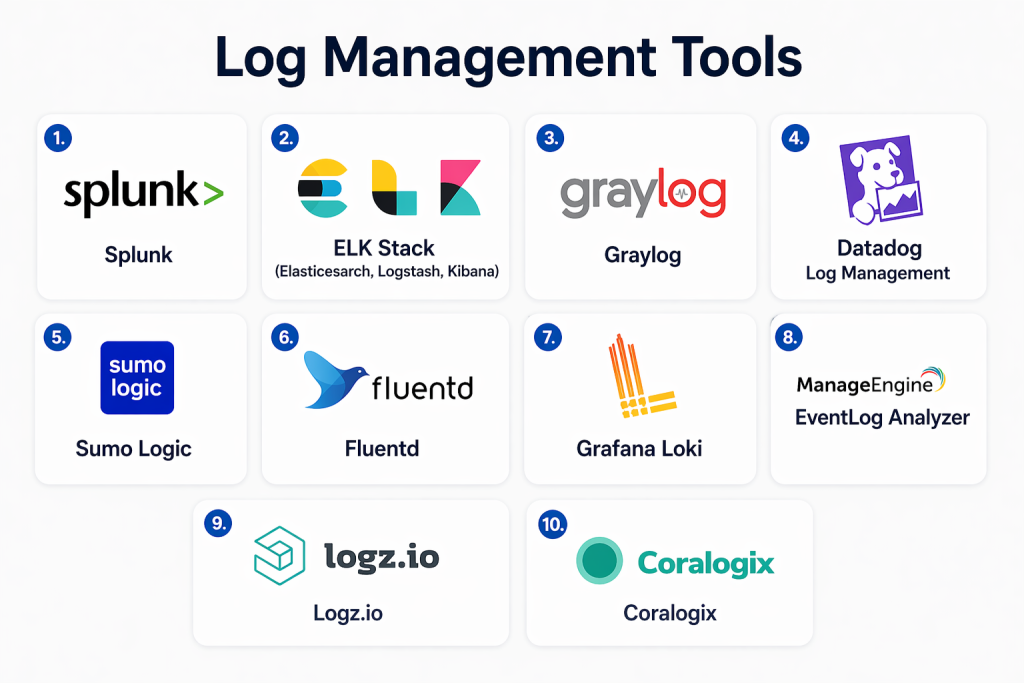
Top 10 Log Management Tools Tools
#1 — Splunk
Short description: Splunk is a leading log management and analytics platform used for monitoring, security, and operational intelligence in large-scale environments.
Key Features
- Real-time log analysis
- Advanced search and query language
- Machine learning insights
- Alerting and dashboards
- Security and compliance monitoring
- Scalable architecture
Pros
- Powerful analytics capabilities
- Enterprise-grade scalability
Cons
- High cost
- Complex setup
Platforms / Deployment
- Cloud / Hybrid
Security & Compliance
- RBAC, encryption, audit logs
- Not publicly stated
Integrations & Ecosystem
Splunk integrates with a wide range of enterprise and DevOps tools.
- Cloud platforms
- SIEM tools
- APIs
- DevOps tools
Support & Community
Strong enterprise support and large community.
#2 — ELK Stack (Elasticsearch, Logstash, Kibana)
Short description: ELK Stack is a popular open-source log management solution for collecting, storing, and visualizing log data.
Key Features
- Log ingestion and processing
- Full-text search
- Visualization dashboards
- Real-time analytics
- Open-source flexibility
Pros
- Highly customizable
- Strong community support
Cons
- Requires setup and maintenance
- Resource-intensive
Platforms / Deployment
- Cloud / Self-hosted
Security & Compliance
- Varies / N/A
Integrations & Ecosystem
- Beats agents
- APIs
- Cloud integrations
Support & Community
Large open-source ecosystem.
#3 — Graylog
Short description: Graylog provides centralized log management with strong search and alerting capabilities.
Key Features
- Log aggregation
- Real-time alerts
- Search and analysis
- Dashboard visualization
- Scalability
Pros
- Easy to use compared to ELK
- Open-source option
Cons
- Limited advanced analytics
- Enterprise features require upgrade
Platforms / Deployment
- Cloud / Self-hosted
Security & Compliance
- Not publicly stated
Integrations & Ecosystem
- APIs
- Log collectors
- DevOps tools
Support & Community
Active community and documentation.
#4 — Datadog Log Management
Short description: Datadog provides log management integrated with monitoring and observability capabilities.
Key Features
- Log ingestion and indexing
- Real-time analytics
- Correlation with metrics
- Alerts and dashboards
- Cloud-native monitoring
Pros
- Unified observability platform
- Easy integration
Cons
- Pricing can increase with scale
- Data ingestion costs
Platforms / Deployment
- Cloud
Security & Compliance
- Not publicly stated
Integrations & Ecosystem
- AWS
- Azure
- Kubernetes
- APIs
Support & Community
Strong documentation and support.
#5 — Sumo Logic
Short description: Sumo Logic is a cloud-native log analytics platform focused on security and operational insights.
Key Features
- Real-time log analytics
- Security monitoring
- Machine learning insights
- Dashboards and alerts
- Cloud scalability
Pros
- Fully cloud-native
- Strong analytics
Cons
- Pricing complexity
- Learning curve
Platforms / Deployment
- Cloud
Security & Compliance
- Not publicly stated
Integrations & Ecosystem
- Cloud platforms
- APIs
- DevOps tools
Support & Community
Enterprise support available.
#6 — Fluentd
Short description: Fluentd is an open-source data collector for unified logging and log routing.
Key Features
- Log aggregation
- Data routing
- Plugin ecosystem
- Lightweight architecture
- Cloud integration
Pros
- Flexible and extensible
- Open-source
Cons
- Requires configuration
- No built-in analytics
Platforms / Deployment
- Self-hosted
Security & Compliance
- Varies / N/A
Integrations & Ecosystem
- Kubernetes
- APIs
- Logging tools
Support & Community
Strong open-source community.
#7 — Grafana Loki
Short description: Grafana Loki is a log aggregation system designed for efficiency and integration with Grafana dashboards.
Key Features
- Log aggregation
- Label-based indexing
- Integration with Grafana
- Cost-efficient storage
- Scalable architecture
Pros
- Lightweight and cost-effective
- Easy integration with Grafana
Cons
- Limited advanced analytics
- Requires setup
Platforms / Deployment
- Cloud / Self-hosted
Security & Compliance
- Not publicly stated
Integrations & Ecosystem
- Grafana
- Kubernetes
- APIs
Support & Community
Growing community support.
#8 — ManageEngine EventLog Analyzer
Short description: ManageEngine provides log management with a focus on security, compliance, and auditing.
Key Features
- Log collection and analysis
- Security monitoring
- Compliance reporting
- Real-time alerts
- Dashboard visualization
Pros
- Strong compliance features
- User-friendly interface
Cons
- Limited scalability for large environments
- UI limitations
Platforms / Deployment
- Cloud / On-prem
Security & Compliance
- Not publicly stated
Integrations & Ecosystem
- SIEM tools
- APIs
- IT tools
Support & Community
Good enterprise support.
#9 — Logz.io
Short description: Logz.io offers managed log analytics built on open-source technologies.
Key Features
- Managed ELK platform
- Real-time analytics
- AI-driven insights
- Dashboards
- Cloud-native
Pros
- Easy deployment
- Managed service
Cons
- Cost may increase
- Less control than self-hosted
Platforms / Deployment
- Cloud
Security & Compliance
- Not publicly stated
Integrations & Ecosystem
- AWS
- Azure
- APIs
Support & Community
Strong support and documentation.
#10 — Coralogix
Short description: Coralogix provides log analytics with machine learning capabilities and cost optimization.
Key Features
- Log analytics
- Machine learning insights
- Real-time monitoring
- Alerts and dashboards
- Cost optimization
Pros
- Strong analytics
- Cost-efficient storage
Cons
- Smaller ecosystem
- Learning curve
Platforms / Deployment
- Cloud
Security & Compliance
- Not publicly stated
Integrations & Ecosystem
- Cloud platforms
- APIs
Support & Community
Growing support ecosystem.
Comparison Table (Top 10)
| Tool Name | Best For | Platform(s) Supported | Deployment | Standout Feature | Public Rating |
|---|---|---|---|---|---|
| Splunk | Enterprise analytics | Web | Hybrid | Advanced search | N/A |
| ELK Stack | Open-source users | Web | Hybrid | Customization | N/A |
| Graylog | SMB logging | Web | Hybrid | Simplicity | N/A |
| Datadog | Observability | Web | Cloud | Unified monitoring | N/A |
| Sumo Logic | Cloud analytics | Web | Cloud | ML insights | N/A |
| Fluentd | Log routing | CLI | Self-hosted | Flexibility | N/A |
| Grafana Loki | Cost-efficient logs | Web | Hybrid | Lightweight | N/A |
| ManageEngine | Compliance | Web | Hybrid | Audit reporting | N/A |
| Logz.io | Managed ELK | Web | Cloud | Managed service | N/A |
| Coralogix | Analytics | Web | Cloud | Cost optimization | N/A |
Evaluation & Scoring of Log Management Tools
| Tool Name | Core | Ease | Integrations | Security | Performance | Support | Value | Weighted Total |
|---|---|---|---|---|---|---|---|---|
| Splunk | 10 | 7 | 10 | 9 | 10 | 9 | 6 | 8.9 |
| ELK | 9 | 6 | 9 | 7 | 9 | 9 | 9 | 8.4 |
| Graylog | 8 | 7 | 8 | 7 | 8 | 8 | 8 | 7.9 |
| Datadog | 9 | 8 | 9 | 8 | 9 | 9 | 7 | 8.5 |
| Sumo Logic | 9 | 7 | 8 | 8 | 9 | 8 | 7 | 8.2 |
| Fluentd | 7 | 6 | 9 | 6 | 8 | 7 | 10 | 7.8 |
| Loki | 7 | 7 | 8 | 6 | 8 | 7 | 9 | 7.7 |
| ManageEngine | 8 | 8 | 7 | 8 | 7 | 8 | 8 | 7.9 |
| Logz.io | 8 | 8 | 8 | 7 | 8 | 8 | 7 | 7.9 |
| Coralogix | 8 | 7 | 7 | 7 | 8 | 7 | 8 | 7.6 |
Interpretation:
These scores compare tools across capabilities, usability, and ecosystem. Higher scores indicate strong overall platforms, while lower scores represent niche or specialized tools.
Which Log Management Tools Tool Is Right for You?
Solo / Freelancer
Fluentd or lightweight open-source tools are sufficient.
SMB
Graylog or ManageEngine offer ease of use and affordability.
Mid-Market
Datadog or Sumo Logic provide balance and scalability.
Enterprise
Splunk and ELK Stack offer advanced analytics and flexibility.
Budget vs Premium
Open-source tools reduce cost; enterprise tools offer advanced features.
Feature Depth vs Ease of Use
Advanced tools provide deep insights but require setup.
Integrations & Scalability
Choose tools compatible with your DevOps ecosystem.
Security & Compliance Needs
Enterprises should prioritize compliance and auditing capabilities.
Frequently Asked Questions (FAQs)
1. What is log management?
Log management involves collecting, storing, and analyzing log data from systems and applications.
2. Why are log management tools important?
They help detect issues, improve performance, and enhance security monitoring.
3. Can logs help in security?
Yes, logs are essential for detecting threats and investigating incidents.
4. Are open-source tools effective?
Yes, but they require setup and maintenance.
5. What integrations matter?
Cloud platforms, DevOps tools, and SIEM systems are important.
6. How scalable are these tools?
Enterprise tools are highly scalable; open-source depends on configuration.
7. Do these tools support real-time monitoring?
Yes, most modern tools provide real-time capabilities.
8. Are they expensive?
Costs vary widely depending on scale and features.
9. Can logs improve performance?
Yes, logs help identify bottlenecks and optimize systems.
10. Is migration easy?
It depends on data formats and integration complexity.
Conclusion
Log Management Tools play a critical role in maintaining visibility, security, and reliability across modern IT environments. As systems become more distributed and complex, the ability to collect and analyze log data efficiently becomes essential for both operational success and security posture. These tools enable teams to detect issues early, troubleshoot faster, and gain insights into system behavior. While enterprise platforms offer powerful analytics and scalability, open-source solutions provide flexibility and cost advantages. The right choice depends on your infrastructure, team expertise, and monitoring requirements. It is important to evaluate integration capabilities, scalability, and ease of use before making a decision. Start by identifying your logging needs, shortlist a few tools, and test them in your environment. A well-implemented log management solution can significantly improve performance, security, and operational efficiency.
