Introduction
Data Warehouse Platforms are centralized systems designed to collect, store, and analyze large volumes of structured and semi-structured data from multiple sources. They are optimized for analytics, reporting, and business intelligence (BI) rather than day-to-day transactions.
Modern organizations rely on data warehouses to combine data from CRM, ERP, applications, logs, and external systems into a single source of truth for decision-making.
Unlike traditional databases, data warehouses are built for high-performance querying, historical data analysis, and large-scale aggregation workloads.
Common use cases include:
- Business intelligence dashboards
- Financial reporting and forecasting
- Customer behavior analytics
- Marketing performance analysis
- Enterprise data consolidation
- AI/ML data preparation
Key evaluation criteria:
- Query performance and scalability
- Cloud-native architecture
- Data ingestion and ETL/ELT support
- BI and analytics tool integration
- Storage efficiency and compression
- Security and compliance features
- Real-time or near real-time analytics
- Ease of use and ecosystem maturity
Best for: Data engineers, analysts, BI teams, and enterprises managing large-scale analytics workloads.
Not ideal for: High-frequency transactional systems or OLTP applications.
Key Trends in Data Warehouse Platforms
- Shift to cloud-native and serverless architectures
- Separation of storage and compute for scalability
- Rise of lakehouse architectures (data lake + warehouse fusion)
- Real-time and near real-time analytics support
- AI-driven query optimization and workload management
- Pay-as-you-go pricing models replacing fixed infrastructure
- Strong integration with BI and ML platforms
- Increased support for semi-structured data (JSON, Parquet)
- Automated scaling and workload isolation
- Built-in data governance and security controls
How We Selected These Tools (Methodology)
- Strong adoption in enterprise and cloud ecosystems
- Performance in large-scale analytical workloads
- Scalability and distributed processing capabilities
- Cloud-native and hybrid deployment support
- Integration with BI, ETL, and analytics tools
- Security, governance, and compliance readiness
- Query optimization and performance benchmarks
- Ecosystem maturity and developer adoption
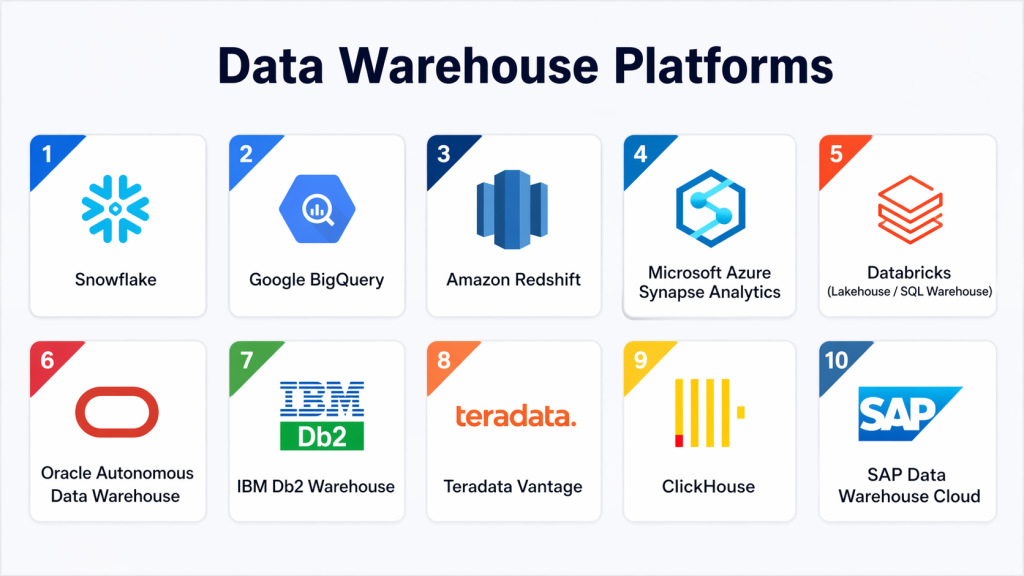
Top 10 Data Warehouse Platforms
#1 — Snowflake
A leading cloud-native data warehouse known for its separation of compute and storage, enabling elastic scalability and high-performance analytics.
Key Features
- Separate compute and storage architecture
- Multi-cloud support
- Data sharing across organizations
- High concurrency processing
- Support for structured and semi-structured data
Pros
- Highly scalable and flexible architecture
- Strong performance for analytics workloads
Cons
- Can become expensive at scale
- Requires optimization for cost control
Platforms / Deployment
Cloud
Security & Compliance
Encryption, RBAC; Not publicly stated
Integrations & Ecosystem
- BI tools
- ETL platforms
- Cloud services
Support & Community
Strong enterprise support
#2 — Google BigQuery
A fully managed serverless data warehouse designed for fast SQL-based analytics over massive datasets.
Key Features
- Serverless architecture
- Real-time analytics support
- BigQuery ML integration
- Automatic scaling
- High-speed query engine
Pros
- No infrastructure management needed
- Extremely fast query performance
Cons
- Cost increases with heavy usage
- Google Cloud dependency
Platforms / Deployment
Cloud
Security & Compliance
Google Cloud security; Not publicly stated
Integrations & Ecosystem
- Google Cloud services
- BI tools
- APIs
Support & Community
Strong Google ecosystem support
#3 — Amazon Redshift
A cloud-based data warehouse service from AWS optimized for large-scale analytics.
Key Features
- Columnar storage architecture
- Massively parallel processing (MPP)
- Data lake integration
- AWS ecosystem integration
- Automated backups
Pros
- Strong AWS integration
- High performance for analytics
Cons
- AWS lock-in
- Requires tuning for best performance
Platforms / Deployment
Cloud
Security & Compliance
AWS encryption and IAM; Not publicly stated
Integrations & Ecosystem
- AWS services
- BI tools
- ETL pipelines
Support & Community
Strong AWS support
#4 — Microsoft Azure Synapse Analytics
A unified analytics platform combining data warehousing, big data, and AI capabilities.
Key Features
- SQL + Spark integration
- Data lake integration
- Real-time analytics
- Unified analytics workspace
- Built-in security
Pros
- Unified analytics platform
- Strong Microsoft ecosystem
Cons
- Complex architecture
- Azure dependency
Platforms / Deployment
Cloud
Security & Compliance
Enterprise encryption; Not publicly stated
Integrations & Ecosystem
- Power BI
- Azure services
- Data pipelines
Support & Community
Strong Microsoft support
#5 — Databricks SQL (Lakehouse Platform)
A modern data platform combining data warehouse and data lake capabilities.
Key Features
- Lakehouse architecture
- Delta Lake storage
- SQL analytics engine
- AI/ML integration
- Real-time data processing
Pros
- Combines warehouse + data lake
- Strong AI/ML support
Cons
- Complex learning curve
- Requires architectural understanding
Platforms / Deployment
Cloud
Security & Compliance
Encryption and governance; Not publicly stated
Integrations & Ecosystem
- Apache Spark
- BI tools
- ML frameworks
Support & Community
Strong developer ecosystem
#6 — Oracle Autonomous Data Warehous
A self-managing cloud data warehouse that automates tuning, scaling, and provisioning.
Key Features
- Autonomous performance tuning
- Auto scaling
- Built-in machine learning
- High-performance SQL engine
- Security automation
Pros
- Minimal manual management required
- Strong enterprise features
Cons
- Oracle ecosystem dependency
- High cost
Platforms / Deployment
Cloud
Security & Compliance
Advanced encryption; Not publicly stated
Integrations & Ecosystem
- Oracle applications
- BI tools
- APIs
Support & Community
Strong enterprise support
#7 — IBM Db2 Warehouse
A high-performance enterprise data warehouse optimized for hybrid and cloud environments.
Key Features
- In-memory processing
- AI-powered optimization
- Data compression
- Hybrid cloud support
- Advanced SQL engine
Pros
- Strong enterprise analytics capabilities
- Good hybrid flexibility
Cons
- Complex setup
- Smaller cloud adoption
Platforms / Deployment
Cloud / On-premise
Security & Compliance
Enterprise-grade security; Not publicly stated
Integrations & Ecosystem
- IBM Cloud
- Analytics tools
- APIs
Support & Community
Strong IBM support
#8 — Teradata Vantage
A scalable enterprise-grade data warehouse designed for complex analytical workloads.
Key Features
- Massively parallel processing
- Multi-cloud support
- Advanced analytics engine
- Workload management
- High scalability
Pros
- Excellent for enterprise analytics
- Strong performance at scale
Cons
- Expensive
- Complex architecture
Platforms / Deployment
Cloud / On-premise
Security & Compliance
Enterprise encryption; Not publicly stated
Integrations & Ecosystem
- BI tools
- Cloud platforms
- APIs
Support & Community
Strong enterprise support
#9 — ClickHouse
A high-performance open-source columnar database optimized for real-time analytics.
Key Features
- Columnar storage engine
- High-speed query execution
- Real-time analytics
- Horizontal scaling
- Data compression
Pros
- Extremely fast analytics performance
- Open-source flexibility
Cons
- Requires tuning
- Limited governance features
Platforms / Deployment
Cloud / On-premise
Security & Compliance
Basic encryption; Not publicly stated
Integrations & Ecosystem
- BI tools
- Data pipelines
- APIs
Support & Community
Strong open-source community
#10 — SAP Data Warehouse Cloud
A cloud-based data warehouse platform designed for enterprise data integration and analytics.
Key Features
- Cloud-native data warehousing
- Data modeling tools
- SAP ecosystem integration
- Real-time analytics support
- Governance and security tools
Pros
- Strong SAP integration
- Enterprise-ready analytics
Cons
- SAP ecosystem dependency
- Complex for beginners
Platforms / Deployment
Cloud
Security & Compliance
Enterprise-grade security; Not publicly stated
Integrations & Ecosystem
- SAP applications
- BI tools
- APIs
Support & Community
Strong SAP support
Comparison Table (Top 10)
| Tool Name | Best For | Platform(s) Supported | Deployment | Standout Feature | Public Rating |
|---|---|---|---|---|---|
| Snowflake | Cloud analytics | Multi | Cloud | Elastic scaling | N/A |
| BigQuery | Serverless analytics | Multi | Cloud | No infrastructure management | N/A |
| Redshift | AWS analytics | Multi | Cloud | MPP engine | N/A |
| Azure Synapse | Microsoft ecosystem | Multi | Cloud | Unified analytics | N/A |
| Databricks | Lakehouse platform | Multi | Cloud | AI + data lake | N/A |
| Oracle ADW | Enterprise analytics | Multi | Cloud | Autonomous tuning | N/A |
| IBM Db2 | Hybrid analytics | Multi | Cloud/On-prem | AI optimization | N/A |
| Teradata | Large enterprises | Multi | Cloud/On-prem | Parallel processing | N/A |
| ClickHouse | Real-time analytics | Multi | Cloud/On-prem | Fast columnar engine | N/A |
| SAP DWC | SAP enterprises | Multi | Cloud | SAP integration | N/A |
Evaluation & Scoring of Data Warehouse Platforms
| Tool Name | Core | Ease | Integrations | Security | Performance | Support | Value | Total |
|---|---|---|---|---|---|---|---|---|
| Snowflake | 10 | 9 | 10 | 9 | 10 | 9 | 8 | 9.3 |
| BigQuery | 10 | 10 | 10 | 9 | 10 | 9 | 8 | 9.4 |
| Redshift | 9 | 9 | 9 | 9 | 9 | 9 | 8 | 8.9 |
| Azure Synapse | 9 | 8 | 10 | 9 | 9 | 9 | 8 | 8.8 |
| Databricks | 10 | 8 | 10 | 9 | 10 | 9 | 8 | 9.1 |
| Oracle ADW | 9 | 8 | 9 | 10 | 9 | 9 | 7 | 8.6 |
| IBM Db2 | 9 | 7 | 8 | 9 | 9 | 9 | 8 | 8.5 |
| Teradata | 10 | 7 | 9 | 9 | 10 | 9 | 7 | 8.7 |
| ClickHouse | 9 | 8 | 8 | 8 | 10 | 8 | 9 | 8.6 |
| SAP DWC | 9 | 7 | 9 | 9 | 9 | 9 | 7 | 8.4 |
Which Data Warehouse Platform Should You Choose?
Solo / Developer
ClickHouse or BigQuery
SMB
Snowflake or Redshift
Mid-Market
Azure Synapse or Databricks
Enterprise
Teradata, Oracle ADW, IBM Db2, SAP DWC
Cloud-Native Teams
Snowflake or BigQuery
Frequently Asked Questions (FAQs)
1. What is a data warehouse?
A data warehouse is a system used to store and analyze large volumes of structured data from multiple sources. It is optimized for reporting and analytics.
2. How is it different from a database?
A database handles transactional data, while a data warehouse is designed for analytical processing and reporting.
3. What is ETL in data warehousing?
ETL stands for Extract, Transform, Load, the process of moving and preparing data for analysis.
4. What is a cloud data warehouse?
A cloud data warehouse is a fully managed, scalable analytics platform hosted in the cloud.
5. What is a lakehouse architecture?
A lakehouse combines features of data lakes and data warehouses in a single platform.
6. Which data warehouse is most popular?
Snowflake, BigQuery, and Redshift are among the most widely used platforms.
7. Is real-time analytics possible in data warehouses?
Yes, modern platforms support near real-time and streaming data ingestion.
8. Are data warehouses expensive?
Costs vary based on usage, but cloud models use pay-as-you-go pricing.
9. Who uses data warehouses?
Data engineers, analysts, BI teams, and enterprise IT organizations.
10. Can data warehouses handle big data?
Yes, modern systems are designed for large-scale and high-volume data processing.
Conclusion
Data Warehouse Platforms are the foundation of modern analytics and business intelligence systems. They allow organizations to unify data from multiple sources and transform it into meaningful insights for decision-making.
With the shift to cloud computing, data warehouses have evolved into scalable, serverless, and highly automated platforms that support real-time analytics and AI workloads.
Each platform offers unique strengths—Snowflake for flexibility, BigQuery for speed, Databricks for lakehouse architecture, and Teradata for enterprise-scale workloads.
The right choice depends on your data volume, ecosystem, and analytical requirements.
Ultimately, data warehouses empower organizations to turn raw data into actionable intelligence at scale, making them essential for data-driven success.
