Introduction
Public Key Infrastructure (PKI) Tools are systems that manage digital certificates, public/private keys, and cryptographic trust chains used to secure digital communications. PKI forms the backbone of SSL/TLS, secure email, VPN authentication, API security, and digital signatures.
In simple terms, PKI ensures that “who you are talking to is really who they claim to be” and that data is encrypted during communication. Without PKI, modern secure internet systems would not function safely.
Today, organizations rely on PKI tools to handle certificate issuance, renewal, revocation, key lifecycle management, and compliance enforcement at scale.
Common use cases include:
- SSL/TLS certificate management
- Secure API and microservices authentication
- VPN and network security
- Email encryption and digital signatures
- Zero-trust security architecture
Key evaluation criteria:
- Certificate lifecycle automation
- Key management and encryption support
- HSM integration (Hardware Security Modules)
- Scalability for enterprise environments
- Multi-cloud and hybrid support
- Compliance (FIPS, ISO, GDPR, etc.)
- Audit logging and visibility
- Ease of deployment and integration
Best for: Enterprises, government organizations, financial institutions, cloud providers, and security teams managing large-scale digital trust systems.
Not ideal for: Small static websites or non-secure internal applications without encryption needs.
Key Trends in PKI Tools
- Cloud-managed PKI replacing traditional on-prem CAs
- Automation of certificate lifecycle (issue, renew, revoke)
- Zero Trust security models integrating PKI deeply
- HSM-backed key protection becoming standard
- API-first PKI platforms for DevOps environments
- Shorter certificate lifespans requiring automation
- Multi-cloud PKI orchestration across AWS, Azure, GCP
- Post-quantum cryptography readiness in PKI systems
- Self-service certificate issuance for developers
- Continuous compliance and audit automation
How We Selected These Tools (Methodology)
- Strong enterprise adoption and market presence
- Full support for PKI lifecycle management
- Integration with cloud, DevOps, and security ecosystems
- Support for HSM and strong cryptographic standards
- Scalability for large infrastructure environments
- Automation capabilities for certificates and keys
- Compliance readiness (FIPS, SOC2, ISO)
- Fit across SMB, mid-market, and enterprise
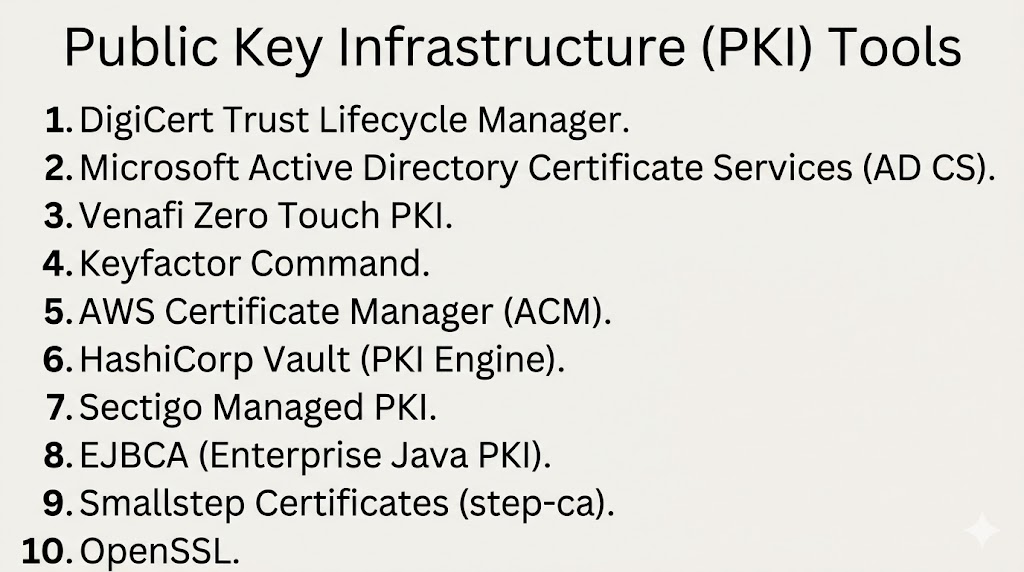
Top 10 Public Key Infrastructure (PKI) Tools
#1 — Venafi Zero Touch PKI
Short description: A cloud-based PKI platform designed to fully automate certificate lifecycle management and eliminate manual PKI operations.
Key Features
- Automated certificate lifecycle management
- Cloud-based PKI orchestration
- Zero-touch certificate issuance
- Policy enforcement
- Integration with enterprise systems
Pros
- Fully automated PKI operations
- Strong enterprise scalability
Cons
- High cost
- Enterprise-focused complexity
Platforms / Deployment
Cloud
Security & Compliance
Strong encryption, audit logging; Not publicly stated
Integrations & Ecosystem
- Cloud platforms
- DevOps tools
- APIs
Support & Community
Enterprise-grade support
#2 — Keyfactor
Short description: A modern PKI and certificate lifecycle management platform enabling organizations to secure devices, applications, and workloads.
Key Features
- Certificate lifecycle automation
- Key management
- IoT and device identity security
- PKI orchestration
- Policy-based control
Pros
- Strong automation at scale
- Excellent for IoT security
Cons
- Requires setup expertise
- Enterprise pricing
Platforms / Deployment
Cloud / On-premise
Security & Compliance
FIPS-ready encryption; Not publicly stated
Integrations & Ecosystem
- DevOps tools
- Cloud platforms
- APIs
Support & Community
Strong enterprise support
#3 — Sectigo Managed PKI
Short description: A managed PKI platform offering certificate issuance, lifecycle management, and enterprise identity trust services.
Key Features
- Managed certificate authority
- Lifecycle automation
- SSL/TLS management
- Private PKI support
- Compliance tools
Pros
- Easy managed PKI service
- Reduces operational overhead
Cons
- Less customization flexibility
- Subscription dependency
Platforms / Deployment
Cloud
Security & Compliance
Industry-grade encryption; Not publicly stated
Integrations & Ecosystem
- Web servers
- Cloud platforms
- APIs
Support & Community
Good enterprise support
#4 — AWS Certificate Manager (ACM)
Short description: A fully managed AWS service that simplifies provisioning and managing SSL/TLS certificates for AWS workloads.
Key Features
- Automated certificate provisioning
- SSL/TLS lifecycle management
- AWS service integration
- Automatic renewals
- Private and public certificates
Pros
- Seamless AWS integration
- Fully managed service
Cons
- AWS ecosystem lock-in
- Limited external use
Platforms / Deployment
Cloud
Security & Compliance
AWS-grade encryption; Not publicly stated
Integrations & Ecosystem
- AWS services
- APIs
- Cloud workloads
Support & Community
Strong AWS support
#5 — Microsoft Active Directory Certificate Services (AD CS)
Short description: A Windows-based PKI solution used for issuing and managing digital certificates within enterprise environments.
Key Features
- Certificate authority services
- Smart card authentication
- SSL/TLS support
- Group policy integration
- Certificate templates
Pros
- Deep Windows integration
- Cost-effective for Microsoft environments
Cons
- Windows-only dependency
- Complex setup
Platforms / Deployment
On-premise / Hybrid
Security & Compliance
Enterprise-grade encryption; Not publicly stated
Integrations & Ecosystem
- Active Directory
- Microsoft ecosystem
- Enterprise systems
Support & Community
Strong Microsoft support
#6 — EJBCA (Keyfactor Community/Enterprise)
Short description: An open-source and enterprise PKI platform used for issuing and managing certificates at scale.
Key Features
- Certificate authority services
- Full PKI lifecycle management
- Multi-protocol support (SCEP, CMP)
- HSM integration
- REST APIs
Pros
- Highly flexible and open-source option
- Strong scalability
Cons
- Requires technical expertise
- Complex deployment
Platforms / Deployment
Cloud / On-premise
Security & Compliance
Strong cryptography support; Not publicly stated
Integrations & Ecosystem
- DevOps tools
- Cloud systems
- APIs
Support & Community
Strong open-source community
#7 — HashiCorp Vault (PKI Engine)
Short description: A secrets management platform with a built-in PKI engine for issuing and managing certificates dynamically.
Key Features
- Dynamic certificate generation
- Key management
- Secret encryption services
- API-driven PKI
- Lease-based certificate lifecycle
Pros
- DevOps-friendly PKI automation
- Highly flexible API system
Cons
- Complex configuration
- Requires DevOps expertise
Platforms / Deployment
Cloud / On-premise
Security & Compliance
Strong encryption; Not publicly stated
Integrations & Ecosystem
- Kubernetes
- Cloud platforms
- DevOps pipelines
Support & Community
Strong developer community
#8 — DigiCert PKI Platform
Short description: A leading enterprise PKI solution offering certificate lifecycle management and trust services.
Key Features
- Certificate lifecycle management
- SSL/TLS automation
- Private PKI services
- Policy enforcement
- Global trust services
Pros
- Trusted enterprise CA provider
- Strong compliance support
Cons
- Expensive
- Enterprise-focused
Platforms / Deployment
Cloud
Security & Compliance
FIPS-compliant encryption; Not publicly stated
Integrations & Ecosystem
- Enterprise systems
- APIs
- Cloud platforms
Support & Community
Strong enterprise support
#9 — Smallstep Certificates (Step-CA)
Short description: A modern open-source PKI system designed for developers and cloud-native environments.
Key Features
- Automated certificate issuance
- ACME protocol support
- SSH certificate support
- Kubernetes integration
- Lightweight PKI setup
Pros
- Developer-friendly PKI automation
- Easy cloud-native integration
Cons
- Limited enterprise governance features
- Requires technical knowledge
Platforms / Deployment
Cloud / On-premise
Security & Compliance
Strong encryption; Not publicly stated
Integrations & Ecosystem
- Kubernetes
- DevOps tools
- APIs
Support & Community
Strong open-source community
#10 — OpenSSL (PKI Toolkit)
Short description: A widely used open-source cryptographic toolkit for implementing PKI functions like certificate generation and encryption.
Key Features
- Certificate creation and management
- Encryption and decryption tools
- SSL/TLS implementation
- Cryptographic libraries
- Command-line utilities
Pros
- Free and widely supported
- Extremely flexible
Cons
- Complex CLI usage
- No enterprise UI
Platforms / Deployment
Multi-platform (Windows / Linux / macOS)
Security & Compliance
Industry-standard cryptography; Not publicly stated
Integrations & Ecosystem
- Development environments
- Web servers
- APIs
Support & Community
Large open-source community
Comparison Table (Top 10)
| Tool Name | Best For | Platform(s) Supported | Deployment | Standout Feature | Public Rating |
|---|---|---|---|---|---|
| Venafi | Enterprise PKI automation | Web | Cloud | Zero-touch PKI | N/A |
| Keyfactor | IoT & enterprise PKI | Web | Cloud/On-prem | Lifecycle automation | N/A |
| Sectigo | Managed PKI | Web | Cloud | Managed CA service | N/A |
| AWS ACM | AWS workloads | Web | Cloud | AWS integration | N/A |
| AD CS | Microsoft environments | Windows | On-prem | AD integration | N/A |
| EJBCA | Open-source PKI | Multi | Cloud/On-prem | Full PKI control | N/A |
| HashiCorp Vault | DevOps PKI | Multi | Cloud/On-prem | API-driven PKI | N/A |
| DigiCert | Enterprise trust | Web | Cloud | Global CA services | N/A |
| Smallstep | Cloud-native PKI | Multi | Cloud/On-prem | Developer-first PKI | N/A |
| OpenSSL | Developers | Multi | Local | Cryptography toolkit | N/A |
Evaluation & Scoring of PKI Tools
| Tool Name | Core (25%) | Ease (15%) | Integrations (15%) | Security (10%) | Performance (10%) | Support (10%) | Value (15%) | Weighted Total (0–10) |
|---|---|---|---|---|---|---|---|---|
| Venafi | 9 | 7 | 9 | 10 | 9 | 9 | 7 | 8.6 |
| Keyfactor | 9 | 7 | 9 | 10 | 9 | 9 | 7 | 8.6 |
| Sectigo | 8 | 8 | 8 | 9 | 8 | 8 | 8 | 8.1 |
| AWS ACM | 8 | 9 | 9 | 9 | 9 | 9 | 8 | 8.6 |
| AD CS | 8 | 8 | 8 | 8 | 8 | 8 | 9 | 8.1 |
| EJBCA | 9 | 6 | 8 | 10 | 9 | 8 | 8 | 8.3 |
| HashiCorp Vault | 9 | 7 | 9 | 10 | 9 | 8 | 8 | 8.5 |
| DigiCert | 9 | 7 | 8 | 10 | 9 | 9 | 6 | 8.4 |
| Smallstep | 8 | 8 | 8 | 9 | 8 | 8 | 9 | 8.3 |
| OpenSSL | 8 | 5 | 7 | 10 | 9 | 7 | 10 | 8.0 |
Which PKI Tool Is Right for You?
Solo / Freelancer
Use OpenSSL or Smallstep for learning and small-scale use
SMB
Sectigo or AWS ACM for simple certificate management
Mid-Market
HashiCorp Vault or Keyfactor for automation and flexibility
Enterprise
Venafi, DigiCert, and EJBCA for full PKI governance
Budget vs Premium
- Budget → Open-source tools
- Premium → Enterprise PKI platforms
Feature Depth vs Ease of Use
- Advanced tools → High control but complex
- Managed PKI → Easier but less flexible
Integrations & Scalability
Choose tools based on cloud + DevOps + enterprise integration needs
Security & Compliance Needs
Highly regulated industries require HSM-backed and audited PKI systems
Frequently Asked Questions (FAQs)
1. What is PKI used for?
PKI is used to secure digital communication through encryption, authentication, and digital certificates.
2. Why is PKI important?
It ensures trust between systems, users, and applications over insecure networks.
3. What is a Certificate Authority (CA)?
A CA issues and verifies digital certificates in a PKI system.
4. What is key lifecycle management?
It includes generating, storing, rotating, and revoking cryptographic keys.
5. Are cloud PKI tools secure?
Yes, they use strong encryption and compliance-grade security standards.
6. What is the difference between PKI and KMS?
PKI manages certificates; KMS manages encryption keys.
7. Can PKI be automated?
Yes, modern tools automate certificate issuance and renewal.
8. What industries use PKI?
Finance, healthcare, government, telecom, and cloud providers.
9. What is HSM in PKI?
A Hardware Security Module that protects cryptographic keys.
10. Is open-source PKI safe?
Yes, if properly configured and maintained with security best practices.
Conclusion
Public Key Infrastructure (PKI) is a critical foundation of modern digital security, enabling trusted communication, encrypted data exchange, and identity verification across systems. As organizations scale across cloud and hybrid environments, PKI tools have evolved from manual certificate management systems into fully automated, cloud-native security platforms. Modern PKI solutions provide automation, scalability, compliance support, and integration with DevOps and cloud ecosystems, making them essential for enterprises managing digital trust at scale. However, selecting the right tool depends on your architecture, security requirements, and operational complexity. Enterprise-grade platforms like Venafi and Keyfactor deliver deep governance and automation, while cloud-native tools like AWS ACM and Azure AD CS simplify certificate management for cloud environments. Open-source tools like EJBCA and OpenSSL provide flexibility for technical teams. The key is to balance security, automation, and operational simplicity while ensuring compliance and scalability.
