Introduction
Network Detection & Response (NDR) is a cybersecurity solution that monitors network traffic, detects anomalies, and responds to threats in real time. Unlike traditional network security tools, NDR leverages AI, behavioral analytics, and advanced machine learning to identify sophisticated attacks, lateral movement, and insider threats across physical, virtual, and cloud networks.
Organizations rely on NDR to maintain visibility, investigate threats, and automate response actions before incidents escalate.
Real-world use cases include:
- Detecting lateral movement of malware within internal networks
- Monitoring unusual traffic patterns indicative of exfiltration
- Identifying compromised devices or unauthorized access
- Supporting incident response and threat hunting workflows
- Enhancing visibility for hybrid cloud and remote environments
Key evaluation criteria for buyers:
- Threat detection capabilities (AI-driven, behavioral, anomaly-based)
- Response automation and orchestration
- Network coverage and sensor deployment flexibility
- Integration with SIEM, SOAR, and endpoint solutions
- Cloud, on-premises, or hybrid deployment options
- Scalability and high-speed traffic monitoring
- Security and compliance certifications
- Ease of use and dashboard insights
- Vendor support and community strength
- Cost and licensing models
Best for: SOC teams, security analysts, enterprises with complex networks, and organizations needing advanced threat hunting
Not ideal for: Small organizations with minimal network complexity; basic firewall or IDS solutions may suffice
Key Trends in Network Detection & Response (NDR)
- AI and machine learning for anomaly and threat detection
- Integration with Extended Detection & Response (XDR) and SIEM platforms
- Automated response orchestration to reduce SOC workloads
- Cloud-native sensors for hybrid and multi-cloud visibility
- Behavioral analytics to identify insider threats and zero-day attacks
- Support for encrypted traffic inspection without performance degradation
- Emphasis on compliance with SOC 2, ISO 27001, HIPAA, and GDPR
- Subscription-based and usage-based pricing models
- Real-time alerting and contextualized threat intelligence
- Lightweight agents and network taps for minimal disruption
How We Selected These Tools (Methodology)
- Evaluated market adoption and presence across industries
- Assessed core NDR features including detection, response, and analytics
- Reviewed performance reliability signals from independent reports and user feedback
- Considered security posture, certifications, and compliance readiness
- Examined integrations with SIEM, SOAR, endpoint, and cloud security tools
- Analyzed customer fit across SMBs, mid-market, and enterprise environments
- Accounted for ease of deployment, sensor footprint, and management dashboards
- Factored in vendor support, documentation, and community engagement
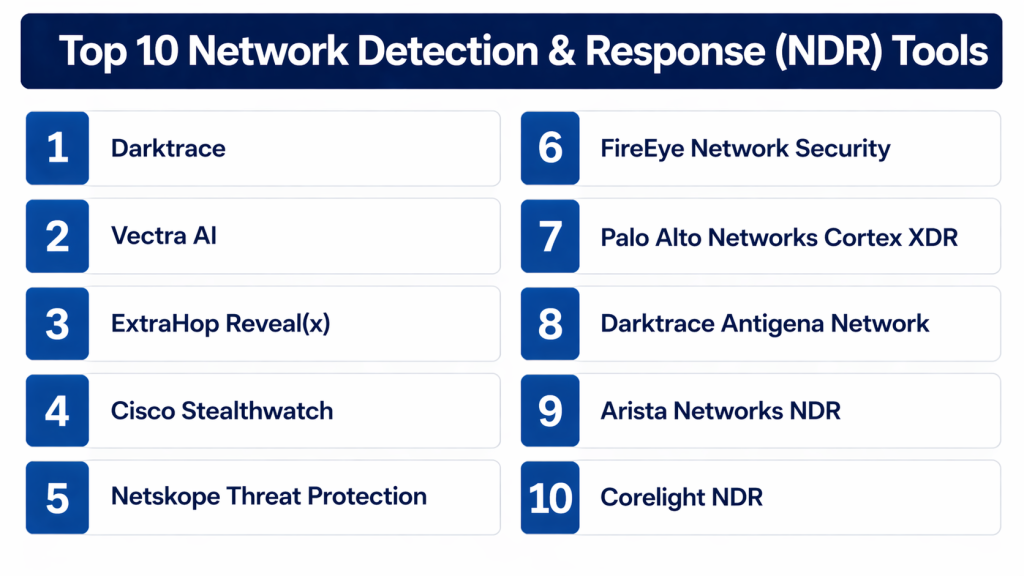
Top 10 Network Detection & Response (NDR) Tools
#1 — Darktrace
Short description: AI-driven NDR platform for detecting advanced network threats in real time
Key Features
- Self-learning AI models for anomaly detection
- Autonomous threat response
- Network and cloud traffic monitoring
- Behavioral analytics for insider threats
- Automated incident prioritization
Pros
- Strong AI-driven detection
- Minimal manual tuning required
Cons
- Premium pricing
- Initial setup complexity
Platforms / Deployment
- Windows / Linux / Cloud / Hybrid
Security & Compliance
- SOC 2, ISO 27001
- MFA, encryption
Integrations & Ecosystem
- SIEM, SOAR, and endpoint tools
- Splunk, ServiceNow
- REST APIs for automation
Support & Community
Enterprise support available; documentation comprehensive
#2 — Vectra AI
Short description: NDR solution leveraging AI to detect threats across cloud, data center, and enterprise networks
Key Features
- AI-based threat detection and scoring
- Real-time threat hunting
- Cloud, data center, and enterprise coverage
- Automated response workflows
- Visualization of attack paths
Pros
- Comprehensive network visibility
- Strong cloud integration
Cons
- Licensing can be complex
- May require training for advanced analytics
Platforms / Deployment
- Windows / Linux / Cloud / Hybrid
Security & Compliance
- SOC 2, ISO 27001
- MFA, encryption
Integrations & Ecosystem
- SIEM and SOAR integrations
- API extensibility
- Splunk, ServiceNow, Jira
Support & Community
Documentation and enterprise support robust; moderate community presence
#3 — ExtraHop Reveal(x)
Short description: Real-time NDR platform offering threat detection and automated network response
Key Features
- Continuous network traffic analysis
- Behavioral threat detection
- Automated remediation workflows
- Cloud and on-prem monitoring
- Risk scoring and threat intelligence integration
Pros
- Detailed network visibility
- Automated prioritization of threats
Cons
- Resource-heavy for large networks
- Learning curve for analytics dashboard
Platforms / Deployment
- Windows / Linux / Cloud / Hybrid
Security & Compliance
- SOC 2, ISO 27001
- MFA, encryption
Integrations & Ecosystem
- SIEM and endpoint integration
- APIs for automation
- Threat intelligence feeds
Support & Community
Comprehensive documentation; enterprise support available
#4 — Cisco Stealthwatch
Short description: NDR solution focused on network traffic analysis and threat detection
Key Features
- Behavioral analytics and anomaly detection
- Cloud and on-premises network coverage
- Integration with Cisco security ecosystem
- Automated alerts and responses
- Encrypted traffic monitoring
Pros
- Strong integration with Cisco products
- Scalable for large networks
Cons
- Complexity in configuration
- Premium pricing
Platforms / Deployment
- Windows / Linux / Cloud / Hybrid
Security & Compliance
- SOC 2, ISO 27001
- MFA, encryption
Integrations & Ecosystem
- SIEM, SOAR, and Cisco security tools
- REST API for custom workflows
Support & Community
Enterprise support and community forums available
#5 — Netskope Threat Protection
Short description: Cloud-native NDR platform emphasizing network and cloud traffic threat detection
Key Features
- Cloud and network traffic analysis
- Threat intelligence and anomaly detection
- Automated remediation and alerting
- User and entity behavior analytics
- Risk scoring and policy enforcement
Pros
- Strong cloud visibility
- AI-driven detection
Cons
- Focused mainly on cloud networks
- Complex initial setup
Platforms / Deployment
- Cloud / Hybrid
Security & Compliance
- SOC 2, ISO 27001
- MFA, encryption
Integrations & Ecosystem
- SIEM, SOAR integrations
- API access for automation
Support & Community
Enterprise support available; documentation comprehensive
#6 — FireEye Network Security
Short description: NDR platform providing advanced network monitoring and threat detection
Key Features
- Network traffic inspection
- Behavioral and signature-based detection
- Threat intelligence integration
- Automated alerting and prioritization
- Scalable architecture for enterprise networks
Pros
- High detection accuracy
- Strong integration with threat intelligence
Cons
- Resource-intensive deployment
- Premium licensing
Platforms / Deployment
- Windows / Linux / Cloud / Hybrid
Security & Compliance
- SOC 2, ISO 27001
- MFA, encryption
Integrations & Ecosystem
- SIEM and SOAR integration
- APIs for automation
Support & Community
Enterprise support; detailed documentation
#7 — Palo Alto Networks Cortex XDR
Short description: NDR solution integrated with endpoint and network analytics for threat detection
Key Features
- AI-based threat detection
- Network and endpoint correlation
- Automated investigation and response
- Cloud and on-prem coverage
- Behavior analytics and risk scoring
Pros
- Unified view of network and endpoints
- Strong AI analytics
Cons
- Complexity in deployment
- Licensing may be costly
Platforms / Deployment
- Windows / Linux / Cloud / Hybrid
Security & Compliance
- SOC 2, ISO 27001
- MFA, encryption
Integrations & Ecosystem
- SIEM, SOAR, and Palo Alto ecosystem
- APIs for custom integrations
Support & Community
Enterprise-grade support; active community forums
#8 — Darktrace Antigena Network
Short description: Autonomous NDR platform using AI for real-time network threat response
Key Features
- Autonomous threat mitigation
- AI-driven behavioral analytics
- Cloud and on-prem monitoring
- Network and email threat correlation
- Anomaly detection across all traffic
Pros
- Autonomous response reduces SOC workload
- High-speed detection
Cons
- Premium pricing
- May require tuning for complex networks
Platforms / Deployment
- Windows / Linux / Cloud / Hybrid
Security & Compliance
- SOC 2, ISO 27001
- MFA, encryption
Integrations & Ecosystem
- SIEM, SOAR, API integrations
- Threat intelligence feed support
Support & Community
Documentation and enterprise support available
#9 — Arista Networks NDR
Short description: Network traffic analysis and detection platform for enterprise-scale networks
Key Features
- Real-time network monitoring
- Behavioral and anomaly detection
- Integration with Arista switches and cloud
- Automated alerting and response
- Threat scoring and reporting
Pros
- High-speed network visibility
- Strong integration with Arista ecosystem
Cons
- Best suited for Arista-heavy environments
- Complexity for mixed environments
Platforms / Deployment
- Windows / Linux / Cloud / Hybrid
Security & Compliance
- SOC 2, ISO 27001
- MFA, encryption
Integrations & Ecosystem
- SIEM, SOAR, Arista APIs
- Threat intelligence feeds
Support & Community
Enterprise support; documentation available
#10 — Corelight NDR
Short description: NDR platform using Zeek-based network visibility and threat detection
Key Features
- Zeek-based network traffic analysis
- Real-time threat detection
- Behavioral analytics
- Cloud and on-prem deployment
- API and SIEM integration
Pros
- Open-source Zeek foundation provides flexibility
- Scalable monitoring
Cons
- Requires skilled network analysts
- Limited automated remediation
Platforms / Deployment
- Windows / Linux / Cloud / Hybrid
Security & Compliance
- SOC 2, ISO 27001
- MFA, encryption
Integrations & Ecosystem
- SIEM, SOAR integration
- APIs for automation
Support & Community
Enterprise support and community forums
Comparison Table (Top 10)
| Tool Name | Best For | Platform(s) Supported | Deployment | Standout Feature | Public Rating |
|---|---|---|---|---|---|
| Darktrace | Enterprise / SOC teams | Windows, Linux, Cloud / Hybrid | Cloud / Hybrid | AI-driven threat detection | N/A |
| Vectra AI | Enterprise / Cloud networks | Windows, Linux, Cloud / Hybrid | Cloud / Hybrid | AI-based threat scoring | N/A |
| ExtraHop Reveal(x) | Enterprise / Mid-market | Windows, Linux, Cloud / Hybrid | Cloud / Hybrid | Automated threat response | N/A |
| Cisco Stealthwatch | Large enterprise | Windows, Linux, Cloud / Hybrid | Cloud / Hybrid | Behavioral analytics | N/A |
| Netskope Threat Protection | Cloud-focused enterprises | Cloud / Hybrid | Cloud / Hybrid | Cloud traffic threat detection | N/A |
| FireEye Network Security | Enterprise / Mid-market | Windows, Linux, Cloud / Hybrid | Cloud / Hybrid | Signature + behavioral detection | N/A |
| Palo Alto Cortex XDR | Enterprise / SOC teams | Windows, Linux, Cloud / Hybrid | Cloud / Hybrid | Network + endpoint analytics | N/A |
| Darktrace Antigena Network | Autonomous response-focused | Windows, Linux, Cloud / Hybrid | Cloud / Hybrid | AI-driven autonomous mitigation | N/A |
| Arista Networks NDR | Arista-heavy enterprises | Windows, Linux, Cloud / Hybrid | Cloud / Hybrid | High-speed visibility | N/A |
| Corelight | Open-source Zeek foundation | Windows, Linux, Cloud / Hybrid | Cloud / Hybrid | Zeek-based network analytics | N/A |
Frequently Asked Questions (FAQs)
What pricing models do NDR tools use?
Most NDR platforms offer subscription-based pricing, often per sensor or per monitored network segment. Some include tiered features or cloud consumption-based models.
How long does deployment take?
Deployment depends on network size and complexity. Cloud-native solutions may deploy in hours, while hybrid deployments can take several days.
Can NDR replace firewalls or IDS?
No, NDR complements existing network security infrastructure. It adds behavioral analytics and automated response capabilities.
Are NDR tools suitable for cloud environments?
Yes, modern NDR platforms provide cloud network monitoring, SaaS integration, and hybrid deployment support.
Do NDR tools require skilled analysts?
While AI and automation reduce manual effort, skilled analysts are recommended for incident investigation and tuning alerts.
How do NDR tools integrate with SIEM and SOAR?
Most NDR platforms offer native connectors or APIs to feed alerts and telemetry into SIEM or SOAR solutions for centralized monitoring and response.
Can NDR detect insider threats?
Yes, behavioral analytics and anomaly detection help identify insider threats, compromised accounts, and lateral movement.
How do NDR tools handle encrypted traffic?
Many platforms use SSL/TLS decryption, metadata analysis, or AI-based inference to detect threats without inspecting raw payloads fully.
Are NDR solutions scalable?
Yes, leading platforms scale from SMBs to large enterprises with distributed sensors, cloud monitoring, and multi-tenant management.
What are common mistakes when implementing NDR?
- Underestimating deployment complexity
- Not tuning alerts properly
- Ignoring integration with SIEM or endpoint solutions
- Failing to train SOC teams on analytics dashboards
Conclusion
Network Detection & Response (NDR) enhances visibility, threat detection, and response across enterprise networks. By leveraging AI, behavioral analytics, and cloud-ready sensors, organizations can detect attacks early, automate responses, and prioritize critical incidents. Choosing the right NDR solution depends on network complexity, SOC team capabilities, hybrid cloud adoption, and compliance requirements. Enterprises may favor platforms with deep analytics and automated mitigation, while mid-market or cloud-focused businesses may prefer ease of deployment and cost-effectiveness. Pilot testing two to three platforms can validate detection accuracy, integrations, and operational impact. Aligning NDR capabilities with business goals ensures robust network security, optimized threat response, and operational efficiency.
