Introduction
Fraud Detection Platforms are software systems designed to identify, prevent, and respond to fraudulent activities in real time across digital transactions, user accounts, and financial systems. These platforms use AI, machine learning, behavioral analytics, and rule-based engines to detect suspicious patterns and anomalies in large datasets.
With the rise of digital payments, eCommerce, and online banking, fraud has become more sophisticated and harder to detect using traditional methods. Modern platforms enable organizations to detect fraud in milliseconds, reduce false positives, and automate investigations, making them essential for fintech, banking, and SaaS businesses.
Common use cases include:
- Payment fraud detection and prevention
- Identity verification and account takeover protection
- Transaction monitoring and AML compliance
- eCommerce fraud and chargeback prevention
- Digital onboarding and KYC fraud detection
Key evaluation criteria:
- Real-time fraud detection capabilities
- AI/ML accuracy and adaptability
- Behavioral analytics and risk scoring
- Integration with payment and identity systems
- Scalability for high transaction volumes
- False positive reduction mechanisms
- Compliance and audit readiness
- Ease of deployment and customization
Best for: Banks, fintech companies, payment providers, eCommerce platforms, and enterprises handling high-value transactions.
Not ideal for: Small businesses with low transaction volume or minimal fraud exposure.
Key Trends in Fraud Detection Platforms
- AI and machine learning dominating fraud detection models
- Real-time transaction monitoring and decisioning
- Behavioral biometrics and device intelligence
- Graph-based fraud detection for complex fraud networks
- Automation of fraud investigation workflows
- Integration with identity verification and KYC tools
- Cloud-native fraud platforms for scalability
- Explainable AI for compliance transparency
- Multi-layered fraud prevention strategies
- Industry-specific fraud models (fintech, eCommerce, insurance)
How We Selected These Tools (Methodology)
- Strong adoption across fintech, banking, and eCommerce
- Proven real-time fraud detection capabilities
- AI/ML-driven risk scoring and analytics
- Integration with payment, identity, and security systems
- Scalability for large transaction volumes
- Security and compliance readiness
- Usability for fraud and risk teams
- Fit across SMB, mid-market, and enterprise
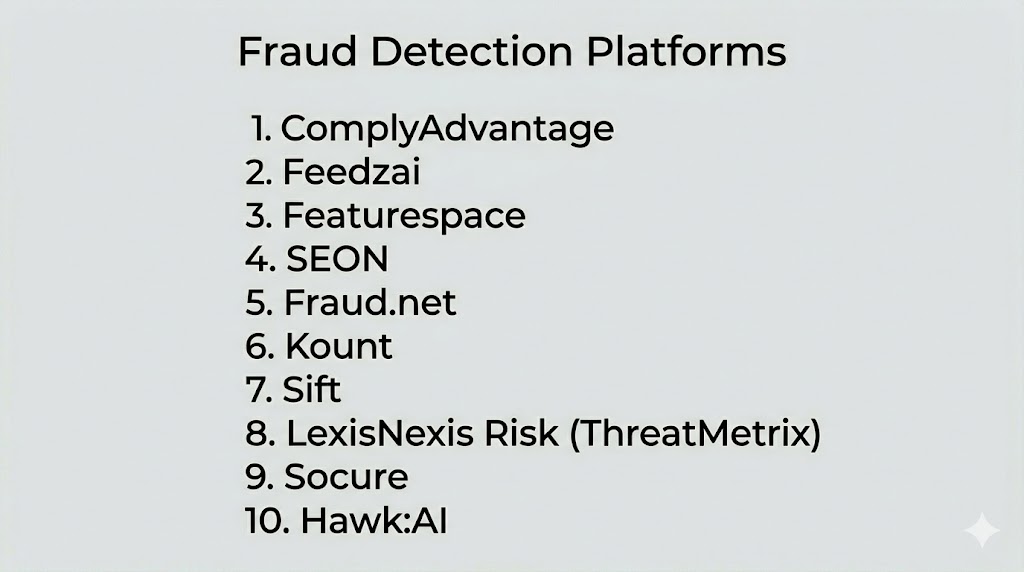
Top 10 Fraud Detection Platforms
#1 — ComplyAdvantage
Short description: An AI-driven fraud and financial crime detection platform focused on transaction monitoring and risk intelligence for financial institutions.
Key Features
- AI-based transaction monitoring
- Risk intelligence data
- Fraud detection models
- Compliance automation
- Real-time alerts
Pros
- Strong AI-driven insights
- Comprehensive compliance support
Cons
- Enterprise-focused pricing
- Requires integration effort
Platforms / Deployment
Cloud
Security & Compliance
Encryption, audit logs; Not publicly stated
Integrations & Ecosystem
- APIs
- Banking systems
- Compliance tools
Support & Community
Enterprise-grade support
#2 — Feedzai
Short description: A leading AI-powered fraud detection platform that analyzes transactions in real time to detect payment fraud and financial crime.
Key Features
- Real-time transaction monitoring
- AI risk scoring
- Behavioral analytics
- Fraud detection models
- Case management
Pros
- Highly accurate detection models
- Scalable for large financial systems
Cons
- Complex implementation
- Premium pricing
Platforms / Deployment
Cloud / Hybrid
Security & Compliance
Encryption; Not publicly stated
Integrations & Ecosystem
- Payment systems
- APIs
- Banking platforms
Support & Community
Strong enterprise support
#3 — Featurespace
Short description: A machine learning-based fraud detection platform known for adaptive behavioral analytics and anomaly detection.
Key Features
- Adaptive behavioral analytics
- Real-time fraud detection
- Anomaly detection
- Risk scoring
- Reporting dashboards
Pros
- Low false positives
- Advanced analytics
Cons
- Requires data expertise
- Enterprise-focused
Platforms / Deployment
Cloud
Security & Compliance
Encryption; Not publicly stated
Integrations & Ecosystem
- APIs
- Financial systems
- Data platforms
Support & Community
Enterprise support
#4 — SEON
Short description: A flexible fraud prevention platform using digital footprint analysis, device intelligence, and customizable rules.
Key Features
- Device fingerprinting
- Email and IP analysis
- Risk scoring engine
- Real-time monitoring
- Custom rules
Pros
- Highly customizable
- Strong fraud prevention for eCommerce
Cons
- Requires configuration
- Limited enterprise depth
Platforms / Deployment
Cloud
Security & Compliance
Encryption; Not publicly stated
Integrations & Ecosystem
- APIs
- Payment gateways
- SaaS tools
Support & Community
Good support
#5 — Fraud.net
Short description: A global fraud detection platform offering real-time monitoring, AI analytics, and fraud intelligence sharing.
Key Features
- Real-time fraud detection
- AI analytics
- Fraud intelligence network
- Risk scoring
- Reporting tools
Pros
- Global fraud intelligence
- Scalable platform
Cons
- Complex setup
- Requires expertise
Platforms / Deployment
Cloud
Security & Compliance
Encryption; Not publicly stated
Integrations & Ecosystem
- APIs
- Financial systems
- Security tools
Support & Community
Enterprise support
#6 — Kount
Short description: A digital fraud prevention platform focused on identity trust, payment fraud detection, and risk decisioning.
Key Features
- Identity verification
- Fraud risk scoring
- Payment fraud detection
- Behavioral analytics
- Reporting
Pros
- Strong identity-based detection
- Real-time decisioning
Cons
- Integration complexity
- Enterprise pricing
Platforms / Deployment
Cloud
Security & Compliance
Encryption; Not publicly stated
Integrations & Ecosystem
- APIs
- Payment platforms
- Data systems
Support & Community
Good enterprise support
#7 — Sift
Short description: A digital trust and safety platform focused on preventing fraud across payments, accounts, and content.
Key Features
- Real-time fraud detection
- Machine learning models
- Behavioral analytics
- Chargeback prevention
- Reporting
Pros
- Strong eCommerce focus
- Scalable
Cons
- Pricing may vary
- Limited SMB focus
Platforms / Deployment
Cloud
Security & Compliance
Encryption; Not publicly stated
Integrations & Ecosystem
- APIs
- eCommerce platforms
- Payment systems
Support & Community
Strong support
#8 — LexisNexis Risk (ThreatMetrix)
Short description: A comprehensive fraud detection platform combining identity intelligence, device recognition, and behavioral biometrics.
Key Features
- Digital identity intelligence
- Device recognition
- Behavioral biometrics
- Risk scoring
- Transaction monitoring
Pros
- Extensive data intelligence
- Strong global coverage
Cons
- Complex integration
- Enterprise-focused
Platforms / Deployment
Cloud
Security & Compliance
Encryption; Not publicly stated
Integrations & Ecosystem
- APIs
- Banking systems
- Identity platforms
Support & Community
Enterprise support
#9 — Socure
Short description: A digital identity verification and fraud detection platform focused on onboarding and identity fraud prevention.
Key Features
- Identity verification
- Fraud risk scoring
- Document verification
- AI models
- Compliance tools
Pros
- Strong onboarding fraud detection
- AI-driven identity checks
Cons
- Limited transaction monitoring
- Enterprise-focused
Platforms / Deployment
Cloud
Security & Compliance
Encryption; Not publicly stated
Integrations & Ecosystem
- APIs
- Identity systems
- Fintech platforms
Support & Community
Good enterprise support
#10 — Hawk:AI
Short description: A modern AI-powered fraud detection platform specializing in AML compliance and transaction monitoring.
Key Features
- AML compliance
- Transaction monitoring
- AI-based risk scoring
- Fraud detection models
- Reporting tools
Pros
- Strong AML capabilities
- Modern architecture
Cons
- Limited ecosystem
- Requires configuration
Platforms / Deployment
Cloud
Security & Compliance
Encryption; Not publicly stated
Integrations & Ecosystem
- APIs
- Banking systems
- Compliance tools
Support & Community
Growing support
Comparison Table (Top 10)
| Tool Name | Best For | Platform(s) Supported | Deployment | Standout Feature | Public Rating |
|---|---|---|---|---|---|
| ComplyAdvantage | Compliance + fraud | Web | Cloud | Risk intelligence | N/A |
| Feedzai | Payments fraud | Web | Cloud/Hybrid | Real-time AI detection | N/A |
| Featurespace | Behavioral analytics | Web | Cloud | Adaptive ML | N/A |
| SEON | eCommerce | Web | Cloud | Device intelligence | N/A |
| Fraud.net | Global fraud intel | Web | Cloud | Shared intelligence | N/A |
| Kount | Identity fraud | Web | Cloud | Identity trust | N/A |
| Sift | eCommerce fraud | Web | Cloud | Digital trust platform | N/A |
| LexisNexis | Identity + risk | Web | Cloud | Data intelligence | N/A |
| Socure | Identity verification | Web | Cloud | Onboarding fraud | N/A |
| Hawk:AI | AML fraud | Web | Cloud | AML-focused AI | N/A |
Evaluation & Scoring of Fraud Detection Platforms
| Tool Name | Core (25%) | Ease (15%) | Integrations (15%) | Security (10%) | Performance (10%) | Support (10%) | Value (15%) | Weighted Total (0–10) |
|---|---|---|---|---|---|---|---|---|
| ComplyAdvantage | 9 | 7 | 8 | 9 | 9 | 8 | 7 | 8.2 |
| Feedzai | 9 | 7 | 9 | 9 | 9 | 9 | 7 | 8.5 |
| Featurespace | 9 | 6 | 8 | 9 | 9 | 8 | 7 | 8.2 |
| SEON | 8 | 8 | 7 | 8 | 8 | 7 | 8 | 7.9 |
| Fraud.net | 8 | 7 | 8 | 8 | 8 | 8 | 7 | 7.9 |
| Kount | 8 | 7 | 8 | 8 | 8 | 8 | 7 | 7.9 |
| Sift | 8 | 8 | 8 | 8 | 8 | 8 | 7 | 8.0 |
| LexisNexis | 9 | 6 | 9 | 9 | 9 | 8 | 6 | 8.3 |
| Socure | 8 | 7 | 7 | 8 | 8 | 7 | 7 | 7.7 |
| Hawk:AI | 8 | 7 | 7 | 8 | 8 | 7 | 7 | 7.6 |
How to interpret scores:
- 8+ → Enterprise-grade fraud platforms
- 7–8 → Balanced mid-market tools
- Below 7.5 → SMB-focused tools
These scores are comparative and should be validated through real-world testing and pilot deployments.
Which Fraud Detection Platform Is Right for You?
Solo / Freelancer
Basic fraud prevention tools or payment gateway protections may be sufficient
SMB
SEON or Sift offer ease of use and quick deployment
Mid-Market
Kount and Fraud.net provide strong risk detection and scalability
Enterprise
Feedzai, Featurespace, and LexisNexis offer advanced analytics and global coverage
Budget vs Premium
- Budget → Simple rule-based systems
- Premium → AI-driven real-time detection
Feature Depth vs Ease of Use
- Deep analytics → More control, more complexity
- Simple tools → Faster onboarding
Integrations & Scalability
Choose tools that integrate with payment systems, identity platforms, and analytics
Security & Compliance Needs
Financial institutions should prioritize AML, compliance, and audit-ready platforms
Frequently Asked Questions (FAQs)
1. What are Fraud Detection Platforms?
They are systems that detect and prevent fraudulent activities using AI, analytics, and real-time monitoring.
2. Why are they important?
They protect businesses from financial losses and improve trust in digital transactions.
3. How do these tools work?
They analyze transaction data, user behavior, and patterns to identify anomalies and suspicious activities.
4. How much do they cost?
Pricing varies based on features, scale, and transaction volume.
5. How long does implementation take?
Cloud platforms can be deployed quickly, while enterprise solutions take longer.
6. What are common mistakes?
Ignoring false positives, underestimating data volume, and poor integration planning.
7. Do these tools use AI?
Yes, most modern platforms rely heavily on AI and machine learning.
8. Can they integrate with payment systems?
Yes, most tools integrate with payment gateways, banks, and SaaS systems.
9. Are they secure?
They typically include encryption, access controls, and audit logging.
10. Can they scale with growth?
Yes, most platforms are designed to handle large transaction volumes.
Conclusion
Fraud Detection Platforms have become critical infrastructure for digital businesses, enabling organizations to detect threats in real time, reduce financial losses, and maintain customer trust. With fraud techniques evolving rapidly, relying on manual or rule-based systems is no longer sufficient.
Modern platforms leverage AI, behavioral analytics, and real-time decisioning to identify complex fraud patterns that traditional systems cannot detect. This shift allows organizations to move from reactive fraud response to proactive fraud prevention.
However, the “best” platform depends on your specific needs—transaction volume, industry, compliance requirements, and integration ecosystem all play a major role. Enterprise organizations often require advanced analytics and global data intelligence, while smaller businesses benefit from simpler, faster-to-deploy solutions.
Instead of focusing only on features, evaluate how well a platform aligns with your workflows, reduces false positives, and integrates with your existing systems. Running a pilot with shortlisted tools is the most effective way to validate performance.
