Introduction
Secrets Management Tools are specialized platforms designed to securely store, manage, and retrieve sensitive information such as API keys, passwords, certificates, tokens, and encryption keys. In modern development and DevOps workflows, secrets are used across environments (development, staging, production), in CI/CD pipelines, and within distributed systems. Mishandled secrets can lead to credential leakage, unauthorized access, and costly security incidents.
By centralizing secrets in a secure store with access control, encryption, audit logs, and rotation policies, teams can enforce least‑privilege access, automate secret lifecycle management, and integrate securely with applications, containers, and cloud services.
Common use cases include:
- Centralized storage for credentials and keys
- Automated secret rotation and lifecycle management
- Securing secrets for applications and microservices
- Integrating secrets into CI/CD pipelines
- Issuing short‑lived credentials for dynamic environments
Buyers should evaluate:
- Encryption and key management capabilities
- Access control and RBAC policies
- Support for dynamic secret rotation
- Integration with cloud providers and CI/CD systems
- Audit logging and compliance reporting
- Federation and identity provider support
- Ease of deployment (cloud, self‑hosted, hybrid)
- Pricing models and scalability
Best for: DevOps engineers, security teams, platform teams, and developers managing secure credentials in modern infrastructure.
Not ideal for: Very small projects with minimal secrets; simple configuration files may suffice for basic use cases.
Key Trends in Secrets Management Tools
- Zero‑trust security integration
- Dynamic and ephemeral secret issuance
- Cloud‑native secret stores with auto‑rotation
- Integration with identity providers (OIDC, IAM)
- Secrets as code and policy‑driven access
- API‑first secret retrieval
- Enhanced audit logging and SIEM integrations
- GitOps integration for secure delivery pipelines
- Container and Kubernetes native secret injection
- AI‑driven anomaly detection in secret access patterns
How We Selected These Tools (Methodology)
- Evaluated encryption and key management standards
- Assessed access control and policy capabilities
- Reviewed cloud and ecosystem integrations
- Considered ease of automation and API support
- Included both open‑source and commercial options
- Analyzed audit and compliance features
- Reviewed scalability and performance
- Considered secrets lifecycle management (rotation)
- Evaluated community and vendor support
- Focused on real‑world usability and security posture
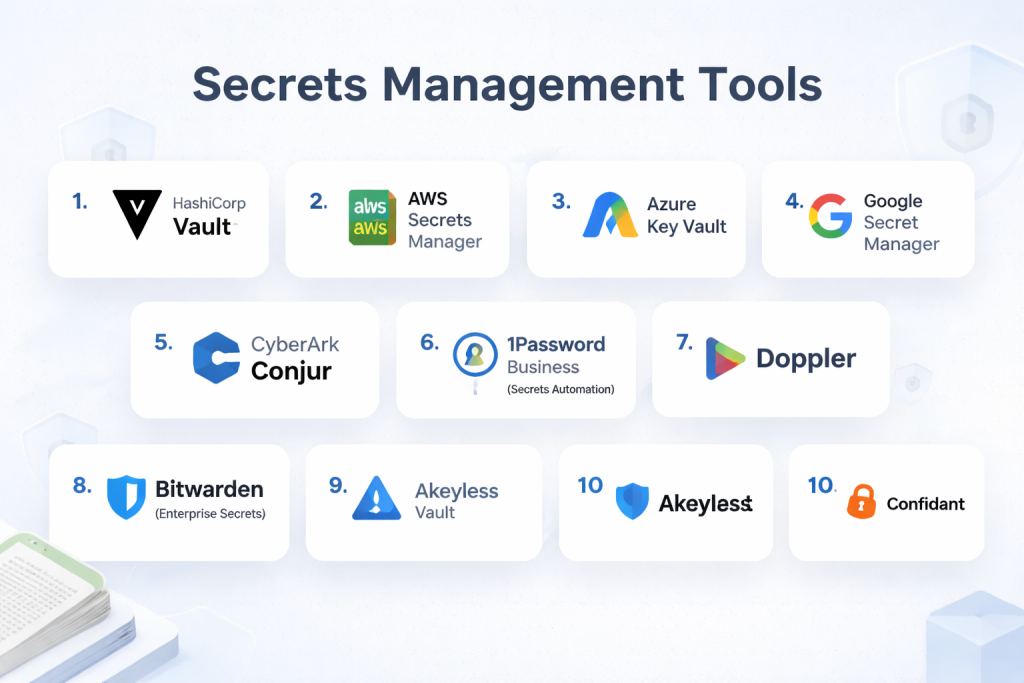
Top 10 Secrets Management Tools
#1 — HashiCorp Vault
Short description: A widely adopted secrets management and encryption platform with dynamic secret issuance and rich policy controls.
Key Features
- Centralized secrets store
- Dynamic and ephemeral secrets
- Encryption as a service
- RBAC and policy enforcement
- Audit logging
- API‑first design
Pros
- Highly flexible and secure
- Strong ecosystem support
Cons
- Steep learning curve
- Operational complexity
Platforms / Deployment
- Cloud / Self‑hosted / Hybrid
Security & Compliance
- Encryption, RBAC, audit logs
Integrations & Ecosystem
- Kubernetes, cloud IAM, CI/CD tools, identity providers
Support & Community
Large community and enterprise support.
#2 — AWS Secrets Manager
Short description: Managed AWS service for storing and rotating secrets with deep integration into AWS services.
Key Features
- Secure secret storage
- Automatic rotation
- IAM integration
- Encryption at rest
- Detailed audit logs
- CloudWatch alarms
Pros
- Native AWS integration
- Automated rotation
Cons
- AWS lock‑in
- Cost at scale
Platforms / Deployment
- Cloud (AWS)
Security & Compliance
- Encryption, AWS IAM, audit logs
Integrations & Ecosystem
- AWS ecosystem, CI/CD pipelines
Support & Community
AWS enterprise support and documentation.
#3 — Azure Key Vault
Short description: Microsoft’s secrets, keys, and certificates management service designed for Azure workloads.
Key Features
- Secrets, keys, certificates
- Azure AD integration
- Automated key rotation
- Logging to Security Center
- RBAC policies
- HSM backed keys
Pros
- Deep Azure integration
- Enterprise compliance features
Cons
- Azure ecosystem dependency
Platforms / Deployment
- Cloud (Azure)
Security & Compliance
- Encryption, RBAC, compliance reporting
Integrations & Ecosystem
- Azure DevOps, cloud apps
Support & Community
Microsoft enterprise support.
#4 — Google Secret Manager
Short description: Google Cloud’s managed secret storage service with strong IAM and audit capabilities.
Key Features
- Secure secret storage
- IAM and access policies
- Versioning
- Audit logging
- Replication across regions
- API access
Pros
- Seamless Google Cloud integration
- Strong audit features
Cons
- Limited outside Google ecosystem
Platforms / Deployment
- Cloud (Google)
Security & Compliance
- IAM, encryption, audit trails
Integrations & Ecosystem
- GCP services, CI/CD
Support & Community
Google Cloud support.
#5 — CyberArk Conjur
Short description: Enterprise secrets management platform focused on securing DevOps and CI/CD pipelines.
Key Features
- Secrets store
- Access control and policies
- CI/CD and container integration
- Audit and compliance
- Dynamic credential issuance
Pros
- Enterprise security and governance
- Strong compliance focus
Cons
- Commercial cost
- Setup complexity
Platforms / Deployment
- Cloud / Self‑hosted
Security & Compliance
- Audit logging, RBAC
Integrations & Ecosystem
- CI/CD, Kubernetes, cloud providers
Support & Community
Commercial support.
#6 — 1Password Business (Secrets Automation)
Short description: Secrets management features within 1Password aimed at developer and team secret automation.
Key Features
- Central secret storage
- Team access controls
- Automated secret rotation
- Audit logs
- Secure sharing
- Integrations
Pros
- Developer‑friendly UI
- Strong security practices
Cons
- Not focused solely on machine‑to‑machine secrets
Platforms / Deployment
- Cloud
Security & Compliance
- Encryption, audit logging
Integrations & Ecosystem
- CI/CD tools, identity providers
Support & Community
Commercial support.
#7 — Doppler
Short description: Centralized secrets manager with environment sync and developer‑centric workflows.
Key Features
- Centralized secrets
- Environment management
- Auto sync with apps
- Audit logs
- API & CLI
- Role‑based access
Pros
- Easy developer onboarding
- Environment support
Cons
- Cloud‑centric
Platforms / Deployment
- Cloud / Hybrid
Security & Compliance
- RBAC, encryption
Integrations & Ecosystem
- CI/CD, cloud providers
Support & Community
Commercial documentation.
#8 — Bitwarden (Enterprise Secrets)
Short description: Vault‑style secrets and credential management within Bitwarden’s enterprise offerings.
Key Features
- Password and secret vault
- Secure sharing
- Access policies
- Audit logs
- API and CLI
Pros
- Familiar interface
- Cost‑effective
Cons
- Not purpose‑built for machine secrets
Platforms / Deployment
- Cloud / Self‑hosted
Security & Compliance
- Encryption, RBAC
Integrations & Ecosystem
- DevOps pipelines
Support & Community
Enterprise support and community.
#9 — Akeyless Vault
Short description: Unified secrets and key management platform with zero‑trust and cloud‑native deployment.
Key Features
- Secrets store
- Dynamic secrets
- Zero‑trust policies
- Multi‑cloud support
- Audit and logs
- API access
Pros
- Multi‑cloud support
- Zero‑trust features
Cons
- Commercial pricing
Platforms / Deployment
- Cloud / Self‑hosted
Security & Compliance
- Encryption, RBAC
Integrations & Ecosystem
- CI/CD, cloud services
Support & Community
Commercial support.
#10 — Confidant
Short description: Open‑source secret storage and retrieval service originally from Lyft with strong access controls.
Key Features
- Central secrets store
- IAM integration
- Audit logging
- Encryption at rest
- API access
Pros
- Open‑source and flexible
Cons
- Community support only
- Setup complexity
Platforms / Deployment
- Cloud / Self‑hosted
Security & Compliance
- Encryption, audit logs
Integrations & Ecosystem
- CI/CD tools, identity providers
Support & Community
Community support.
Comparison Table (Top 10)
| Tool Name | Best For | Platform(s) Supported | Deployment | Standout Feature | Public Rating |
|---|---|---|---|---|---|
| HashiCorp Vault | Enterprise secrets | Cross‑platform | Cloud/Self‑hosted/Hybrid | Dynamic secrets | N/A |
| AWS Secrets Manager | AWS ecosystems | Cloud | Cloud | Auto secret rotation | N/A |
| Azure Key Vault | Azure workloads | Cloud | Cloud | Keys & cert support | N/A |
| Google Secret Manager | GCP users | Cloud | Cloud | IAM & audit logs | N/A |
| CyberArk Conjur | DevOps & CI/CD | Cloud/Self‑hosted | Hybrid | Enterprise governance | N/A |
| 1Password Business | Team access | Cloud | Cloud | Developer‑friendly UI | N/A |
| Doppler | Dev/deployment | Cloud/Hybrid | Hybrid | Environment sync | N/A |
| Bitwarden | Enterprise credentials | Cloud/Self‑hosted | Hybrid | Vault simplicity | N/A |
| Akeyless Vault | Zero‑trust & cloud | Cloud/Self‑hosted | Hybrid | Zero‑trust secrets | N/A |
| Confidant | Open‑source | Cloud/Self‑hosted | Hybrid | Lightweight open‑source | N/A |
Evaluation & Scoring of Secrets Management Tools
| Tool Name | Core (25%) | Ease (15%) | Integrations (15%) | Security (10%) | Performance (10%) | Support (10%) | Value (15%) | Weighted Total |
|---|---|---|---|---|---|---|---|---|
| HashiCorp Vault | 10 | 7 | 9 | 9 | 8 | 8 | 8 | 8.7 |
| AWS Secrets Manager | 9 | 8 | 9 | 9 | 8 | 8 | 7 | 8.3 |
| Azure Key Vault | 9 | 8 | 8 | 9 | 8 | 8 | 7 | 8.2 |
| Google Secret Manager | 8 | 8 | 8 | 9 | 8 | 8 | 7 | 8.0 |
| CyberArk Conjur | 9 | 7 | 8 | 9 | 8 | 8 | 7 | 8.0 |
| 1Password Business | 7 | 9 | 7 | 8 | 7 | 8 | 8 | 7.9 |
| Doppler | 8 | 9 | 8 | 8 | 7 | 8 | 8 | 8.1 |
| Bitwarden | 7 | 8 | 7 | 8 | 7 | 8 | 9 | 7.8 |
| Akeyless Vault | 8 | 7 | 8 | 8 | 8 | 7 | 7 | 7.8 |
| Confidant | 7 | 7 | 7 | 8 | 7 | 7 | 9 | 7.4 |
Which Secrets Management Tool Is Right for You?
Solo / Freelancer
Bitwarden or Confidant for lightweight and cost‑effective secret storage.
SMB
Doppler or 1Password Business for developer‑friendly onboarding and team workflows.
Mid‑Market
HashiCorp Vault or Akeyless Vault for scalable and policy‑driven secrets.
Enterprise
HashiCorp Vault, AWS Secrets Manager, or CyberArk Conjur for strong governance and integration.
Budget vs Premium
- Budget: Confidant, Bitwarden
- Premium: CyberArk Conjur, AWS Secrets Manager
Feature Depth vs Ease of Use
- Easy: Doppler, 1Password Business
- Advanced: Vault family, CyberArk Conjur
Integrations & Scalability
- Enterprise‑grade: HashiCorp Vault, AWS Secrets Manager
Security & Compliance Needs
- Choose tools with strong encryption, audit logs, and IAM integration.
Frequently Asked Questions (FAQs)
1. What is a secrets management tool?
It securely stores and manages sensitive credentials, API keys, and secrets.
2. Why use a dedicated tool?
To reduce leakage risk, enforce policies, and support automation.
3. Can these tools integrate with CI/CD?
Yes, most integrate via APIs or plugins.
4. Do they support secret rotation?
Many provide automated or scheduled rotation.
5. Which tool is best for cloud environments?
Native services like AWS, Azure, and Google Secret Manager excel there.
6. Are open‑source options secure?
Yes, when configured properly with encryption and policies.
7. Do these tools support audit logging?
Most enterprise tools provide audit trails.
8. Can they issue ephemeral secrets?
Yes — tools like Vault and Akeyless support dynamic secrets.
9. How do I choose?
Evaluate your ecosystem, compliance needs, and desired integrations.
10. Do they handle certificates too?
Some tools manage keys, certificates, and secrets together.
Conclusion
Secrets Management Tools are foundational to secure application development, cloud infrastructure, and automated workflows. From enterprise‑grade platforms like HashiCorp Vault and CyberArk Conjur to cloud‑native managed services from AWS, Azure, and Google, selecting the right tool depends on your team’s scale, compliance needs, and deployment environment. A practical approach is to pilot a few options, integrate them into your CI/CD workflows, and enforce policies that minimize risk while improving developer productivity.
