Introduction
Certificate management tools are security solutions that help organizations manage the lifecycle of digital certificates—including issuance, renewal, revocation, monitoring, and compliance—for SSL/TLS, PKI, code signing, SSH keys, and other cryptographic assets. These tools are designed to ensure that digital certificates are kept valid, secure, and up to date, reducing the risk of outages, security breaches, and compliance violations caused by expired or mismanaged certificates.
In 2026 and beyond, certificate management has become more important due to the growth of encrypted traffic, cloud-native workloads, microservices, IoT devices, DevOps pipelines, and zero-trust security frameworks. Without proper tooling, enterprises face challenges like certificate sprawl, manual processes, and lack of centralized visibility.
Real-world use cases include:
- Preventing service outages caused by expired SSL/TLS certificates
- Automating certificate issuance and renewal across environments
- Managing internal PKI and public CA certificates
- Ensuring compliance reporting for auditors
- Securing code signing, device authentication, and API encryption
What buyers should evaluate:
- Support for multiple certificate types (SSL, code signing, S/MIME, SSH, IoT)
- Automation of issuance and renewal workflows
- Integration with cloud platforms and DevOps tools
- Centralized inventory and discovery
- Alerting and expiration tracking
- Role-based access control (RBAC)
- Reporting and audit capabilities
- Scalability across hybrid environments
- APIs and extensibility
- Cost versus value
Best for: IT security teams, DevOps engineers, cloud architects, enterprises with large PKI deployments, and organizations focused on automation and compliance.
Not ideal for: Small shops with very few certificates and limited infrastructure where manual tracking is feasible.
Key Trends in Certificate Management Tools
- Automation-first certificate lifecycle management to reduce outages
- Cloud-native and API-first designs for DevOps and microservices
- Discovery and inventory across hybrid environments
- Integration with CI/CD and DevSecOps workflows
- Certificate-based zero-trust and device authentication
- Extended support for SSH keys and code signing
- AI-assisted expiration prediction and anomaly detection
- Audit-ready compliance reporting
- Role-based access and identity integration
- Consolidation of certificate data for telemetry and analytics
How We Selected These Tools (Methodology)
- Evaluated market adoption and vendor reputation
- Assessed lifecycle automation and discovery capabilities
- Reviewed security and compliance features
- Considered integration with cloud and DevOps ecosystems
- Compared ease of use and deployment flexibility
- Included tools suitable for enterprise and mid-market use cases
- Analyzed scalability across hybrid architectures
- Evaluated alerting, reporting, and audit workflows
- Focused on real-world usability and reliability
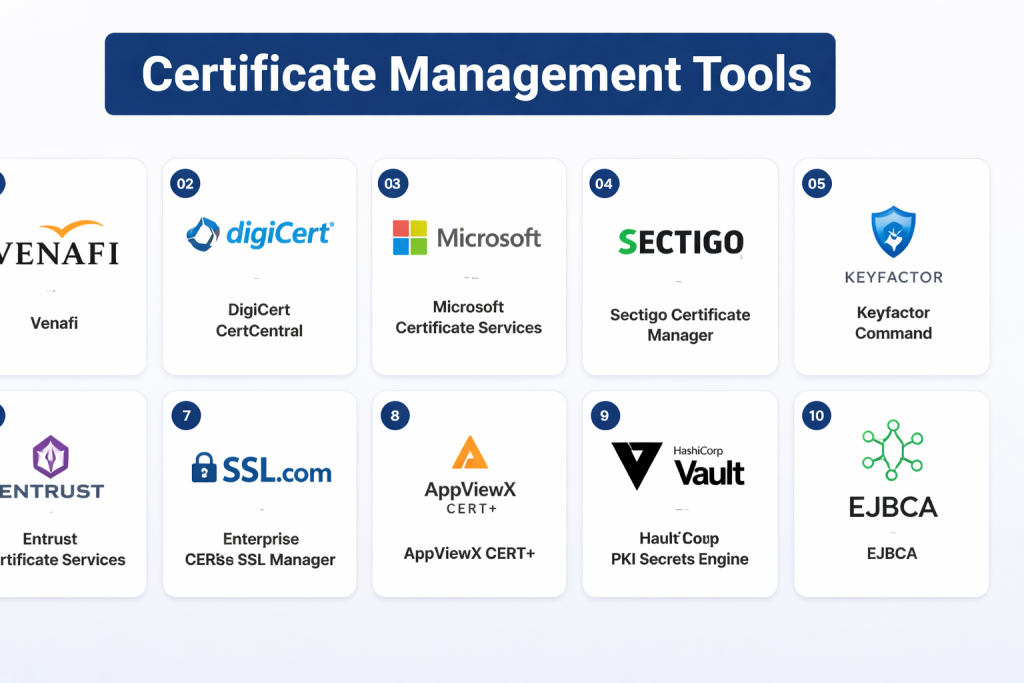
Top 10 Certificate Management Tools
#1 — Venafi
Short description: An enterprise-grade certificate management platform focused on large-scale automation, visibility, and risk mitigation.
Key Features
- Centralized certificate discovery and inventory
- Automated issuance and renewal
- Policy enforcement and compliance reporting
- Multi-vendor CA support
- Risk analytics and dashboards
- API integrations
Pros
- Strong enterprise automation capabilities
- Broad support for certificate types
Cons
- Higher cost
- Requires onboarding and training
Platforms / Deployment
Web / Cloud / On-premises
Hybrid
Security & Compliance
RBAC, encryption, audit logs (details not publicly stated)
Integrations & Ecosystem
Venafi integrates with PKI, DevOps, cloud, and security tools.
- Public & private CAs
- DevOps pipelines
- Cloud platforms
- SIEM tools
Support & Community
Enterprise-level support and professional services.
#2 — DigiCert CertCentral
Short description: A certificate management platform from a major public CA, offering automation and lifecycle controls.
Key Features
- Automated issuance and renewal
- Certificate inventory and alerts
- Developer-friendly APIs
- Multi-tenant support
- Policy management
Pros
- Strong TLS/SSL support
- Good automation and reporting
Cons
- Best for DigiCert-issued certificates
- Enterprise PKI orchestration less mature
Platforms / Deployment
Web / Cloud
SaaS
Security & Compliance
Not publicly stated
Integrations & Ecosystem
Works well with cloud platforms and DevOps tools.
- API-first workflows
- CI/CD integration
- Cloud and hybrid support
Support & Community
Strong documentation and support.
#3 — Microsoft Certificate Services
Short description: A widely used on-premises certificate authority and management tool integrated into Windows Server environments.
Key Features
- Certificate issuance via Active Directory
- Group Policy integration
- Internal PKI management
- Role-based administration
- Revocation services
Pros
- Native Windows integration
- Good for internal PKI
Cons
- Limited cloud-native features
- Manual workflow elements
Platforms / Deployment
Windows Server / On-premises
Security & Compliance
Not publicly stated
Integrations & Ecosystem
Integrates with Active Directory and enterprise identity systems.
Support & Community
Large community and extensive documentation.
#4 — Sectigo Certificate Manager
Short description: A certificate lifecycle automation platform with broad CA support.
Key Features
- Certificate discovery
- Automated issuance and renewal
- Multi-vendor CA support
- Reporting and alerts
- Policy enforcement
Pros
- Flexible CA support
- Strong discovery features
Cons
- UI can be complex
- Less focused on DevOps automation
Platforms / Deployment
Web / Cloud
SaaS
Security & Compliance
Not publicly stated
Integrations & Ecosystem
Works with network and security tools.
- APIs
- Cloud services
Support & Community
Good support and resources.
#5 — Keyfactor Command
Short description: A certificate and key lifecycle automation platform with strong PKI and DevOps integration.
Key Features
- Centralized certificate inventory
- Automated issuance and renewal
- Support for SSL/TLS, SSH, code signing
- API-first automation
- Policy-driven governance
Pros
- Excellent DevOps support
- Broad key/certificate type coverage
Cons
- Enterprise pricing
- Learning curve
Platforms / Deployment
Web / Cloud / On-premises
Hybrid
Security & Compliance
Not publicly stated
Integrations & Ecosystem
Tight integration with CI/CD, cloud, and security tools.
- DevOps pipelines
- Public & private CAs
- Cloud providers
Support & Community
Strong enterprise support.
#6 — Entrust Certificate Services
Short description: A certificate lifecycle platform from a major CA with enterprise and cloud support.
Key Features
- Automated certificate lifecycle
- Centralized inventory
- Multi-vendor support
- Alerts and policy enforcement
- Developer APIs
Pros
- Enterprise credential support
- Good CA ecosystem integration
Cons
- Enterprise pricing
- Scope can be broad
Platforms / Deployment
Web / Cloud
SaaS
Security & Compliance
Not publicly stated
Integrations & Ecosystem
Integrates with platforms and DevOps workflows.
- Public CA issuance
- APIs
- Cloud toolchains
Support & Community
Enterprise support and documentation.
#7 — SSL.com Enterprise SSL Manager
Short description: A TLS/SSL-focused certificate management platform with multi-CA support and automation.
Key Features
- SSL/TLS certificate lifecycle automation
- Discovery and monitoring
- Multi-CA orchestration
- Alerts and reporting
- API integrations
Pros
- Focused SSL/TLS feature set
- Flexible CA options
Cons
- Less broad than full PKI tooling
- Smaller ecosystem than enterprise leaders
Platforms / Deployment
Web / Cloud
SaaS
Security & Compliance
Not publicly stated
Integrations & Ecosystem
Supports integration with cloud and security tools.
- APIs
- Developer toolchains
Support & Community
Good support and documentation.
#8 — AppViewX CERT+
Short description: A comprehensive certificate and key automation platform with strong policy governance.
Key Features
- Certificate discovery
- Automated issuance and renewal
- Policy enforcement
- Certificate life cycle analytics
- APIs and orchestration
Pros
- Strong policy and governance
- Good automation
Cons
- Complex deployment
- Enterprise-focused
Platforms / Deployment
Web / Cloud / On-premises
Hybrid
Security & Compliance
Not publicly stated
Integrations & Ecosystem
Integrates with DevOps and enterprise CI/CD tools.
- APIs
- Cloud and hybrid environments
Support & Community
Strong enterprise documentation and services.
#9 — HashiCorp Vault PKI Secrets Engine
Short description: A flexible secrets and PKI engine for certificate issuance and lifecycle management in DevOps environments.
Key Features
- Dynamic certificate issuance
- PKI secrets engine
- Lease and renewal automation
- Strong API-first design
- Developer-friendly workflows
Pros
- Strong DevOps alignment
- Self-hosted flexibility
Cons
- Not turnkey certificate management
- Requires Vault expertise
Platforms / Deployment
Web / Linux / Cloud
Self-hosted / Hybrid
Security & Compliance
Not publicly stated
Integrations & Ecosystem
Strong DevOps and API ecosystem.
- CI/CD tools
- Cloud providers
Support & Community
Active open-source community and enterprise support.
#10 — EJBCA (Enterprise JavaBeans Certificate Authority)
Short description: An open-source CA and certificate management platform with flexible deployment.
Key Features
- Certificate authority functions
- Automated issuance
- Multi-protocol support
- Audit and compliance logging
- Flexible deployment
Pros
- Open-source with strong community
- Flexible PKI features
Cons
- Requires expertise to operate
- Not turnkey for large enterprises
Platforms / Deployment
Web / Self-hosted
Hybrid
Security & Compliance
Not publicly stated
Integrations & Ecosystem
Supports standard PKI integrations.
- APIs
- Enterprise LDAP
Support & Community
Active open-source support and documentation.
Comparison Table (Top 10)
| Tool Name | Best For | Platform(s) Supported | Deployment | Standout Feature | Public Rating |
|---|---|---|---|---|---|
| Venafi | Enterprise | Multi-platform | Cloud/Hybrid | Enterprise automation | N/A |
| DigiCert CertCentral | SSL/TLS-focused | Web/Cloud | SaaS | CA-integrated lifecycle | N/A |
| Microsoft Certificate Services | Windows PKI | On-premises | On-prem | Native AD integration | N/A |
| Sectigo Certificate Manager | Flexible CA support | Web/Cloud | SaaS | Discovery and automation | N/A |
| Keyfactor Command | DevOps-ready | Multi-platform | Hybrid | API-first automation | N/A |
| Entrust Certificate Services | Enterprise CA support | Web/Cloud | SaaS | Enterprise CA ecosystem | N/A |
| SSL.com Enterprise Manager | SSL/TLS | Web/Cloud | SaaS | Focused SSL management | N/A |
| AppViewX CERT+ | Governance-centered | Multi-platform | Hybrid | Policy enforcement | N/A |
| HashiCorp Vault PKI | DevOps/Infrastructure | Web/Cloud | Self-hosted/Hybrid | Dynamic PKI automation | N/A |
| EJBCA | Open-source PKI | Web/Self-hosted | Hybrid | Open-source PKI | N/A |
Evaluation & Scoring of Certificate Management Tools
| Tool Name | Core (25%) | Ease (15%) | Integrations (15%) | Security (10%) | Performance (10%) | Support (10%) | Value (15%) | Weighted Total (0–10) |
|---|---|---|---|---|---|---|---|---|
| Venafi | 9 | 7 | 9 | 9 | 8 | 8 | 6 | 8.3 |
| DigiCert | 8 | 8 | 8 | 8 | 8 | 8 | 8 | 8.0 |
| Microsoft Cert Services | 7 | 6 | 7 | 8 | 7 | 8 | 8 | 7.4 |
| Sectigo | 7 | 7 | 7 | 8 | 7 | 7 | 8 | 7.5 |
| Keyfactor | 8 | 7 | 9 | 8 | 8 | 8 | 7 | 8.0 |
| Entrust | 7 | 7 | 8 | 8 | 7 | 8 | 7 | 7.6 |
| SSL.com | 7 | 7 | 7 | 8 | 7 | 7 | 8 | 7.4 |
| AppViewX | 8 | 6 | 8 | 9 | 8 | 8 | 7 | 7.9 |
| HashiCorp Vault PKI | 8 | 6 | 8 | 8 | 8 | 7 | 9 | 8.0 |
| EJBCA | 7 | 6 | 6 | 8 | 7 | 7 | 9 | 7.4 |
How to interpret these scores:
These scores are comparative based on typical enterprise use cases. Higher total indicates stronger overall capabilities across lifecycle automation, ecosystem integrations, and security posture. Tools that emphasize automation and integration with modern architectures tend to score higher for adaptability and future readiness.
Which Certificate Management Tool Is Right for You?
Solo / Small Teams
Open-source or free tools like EJBCA or HashiCorp Vault PKI offer flexible, low‑cost options, especially if your certificate footprint is limited.
SMB / Mid‑Market
CertCentral, Sectigo Certificate Manager, and Entrust Certificate Services provide solid lifecycle automation without enterprise overhead.
Enterprise
Venafi, Keyfactor, and AppViewX CERT+ excel with broad automation, governance, and cross‑environment integration needs.
DevOps / Developer Workloads
HashiCorp Vault PKI stands out for dynamic certificate issuance and heavy API automation in cloud‑native environments.
Windows / Active Directory Environments
Microsoft Certificate Services remains a pragmatic choice for organizations standardized on Windows Server and Active Directory PKI.
Integration & Scalability Focus
Keyfactor and Venafi offer rich APIs and flexible pipelines for cloud, hybrid environments, and DevSecOps practices.
Frequently Asked Questions (FAQs)
1. What is certificate management?
Certificate management is the lifecycle process of issuing, renewing, monitoring, and revoking digital certificates.
2. Why is certificate automation important?
Automation reduces outages and manual errors caused by expired certificates.
3. Do these tools support multi‑vendor CAs?
Many support multiple public and private CAs to avoid vendor lock‑in.
4. What certificates should be managed?
SSL/TLS, PKI, code signing, S/MIME, IoT, API authentication certificates, and SSH keys.
5. Are these tools suitable for cloud?
Most modern platforms are cloud‑native or hybrid and support cloud and on‑prem environments.
6. Can they integrate with DevOps pipelines?
Yes. API‑first tools like Keyfactor and Vault are designed for CI/CD integration.
7. What is certificate discovery?
It’s the process of finding all certificates across environments to avoid blind spots.
8. How do these tools help with compliance?
They offer reporting, alerting, and policy enforcement for audit readiness.
9. Can these tools revoke certificates?
Yes, revocation and key rotation are core lifecycle functions.
10. How do I choose the right tool?
Evaluate certificate volume, automation needs, environment complexity, and integration requirements.
Conclusion
Certificate management tools are essential for organizations that rely on digital certificates for encryption, authentication, and secure communication. Manual tracking and isolated processes are no longer sufficient in dynamic environments where certificates power APIs, cloud workloads, IoT, and internal PKI. Automation, discovery, centralized visibility, policy enforcement, and integration with DevOps and security ecosystems are key differentiators in choosing the right solution. Start by evaluating your certificate landscape, estimate scale and complexity, and shortlist tools that align with your automation goals, compliance needs, and infrastructure stack.
