Introduction
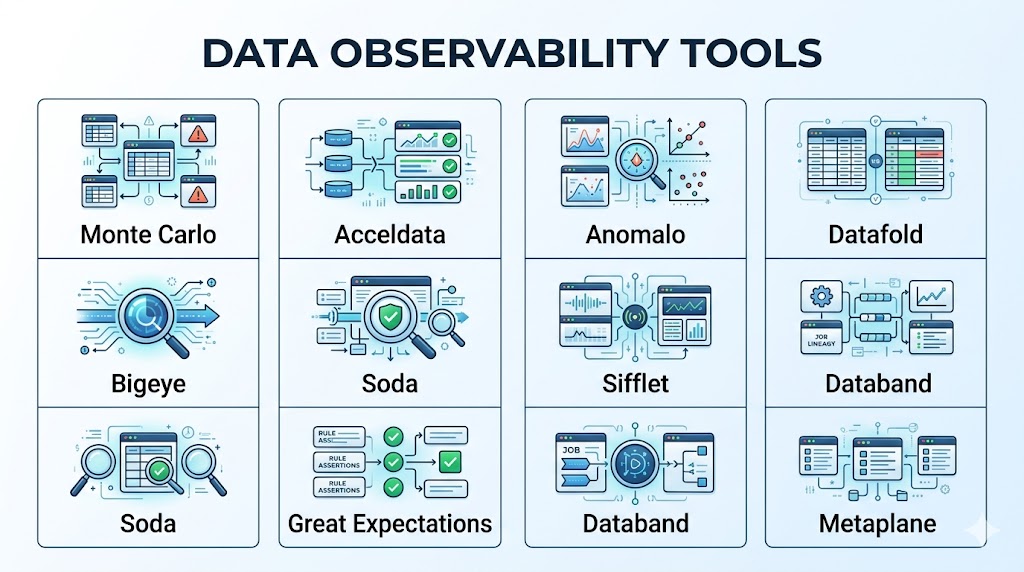
Data Observability Tools are platforms that help organizations monitor, analyze, and ensure the health, reliability, and performance of data pipelines and datasets. They provide visibility into key metrics like data freshness, volume, schema changes, and anomalies, enabling teams to detect and resolve issues before they impact business decisions.
In modern data environments, where organizations rely on complex pipelines, cloud warehouses, and real-time analytics, data failures can go unnoticed and cause significant downstream problems. Data observability tools address this by offering automated monitoring, anomaly detection, lineage tracking, and root cause analysis.
Real-world use cases:
- Detecting broken data pipelines
- Monitoring data quality and freshness
- Debugging dashboards and reports
- Ensuring reliability of AI and analytics systems
- Reducing data downtime
What buyers should evaluate:
- Automated monitoring capabilities
- Anomaly detection using AI or rules
- Data lineage and root cause analysis
- Integration with data warehouses and pipelines
- Real-time vs batch monitoring
- Ease of setup and usability
- Scalability across large datasets
- Alerting and incident management
- API and extensibility
- Pricing model
Best for: Data engineers, analytics teams, data platform teams, and enterprises with complex data pipelines
Not ideal for: Small teams with simple data workflows
Key Trends in Data Observability Tools
- AI-driven anomaly detection and automated insights
- Real-time monitoring of data pipelines
- Integration with modern data stacks
- Convergence of data quality and observability
- Data reliability engineering practices
- Active metadata for faster issue resolution
- No-code and low-code monitoring interfaces
- Integration with governance and lineage tools
- Increased focus on data downtime reduction
- Open-source observability frameworks gaining traction
How We Selected These Tools Methodology
- Market adoption and industry recognition
- Depth of observability features
- Integration with modern data ecosystems
- Automation and AI capabilities
- Scalability across enterprise environments
- Ease of use and deployment
- Vendor innovation and roadmap
- Support and documentation quality
- Fit across SMB and enterprise use cases
- Coverage of monitoring, lineage, and analytics
Top 10 Data Observability Tools
#1 — Monte Carlo
Short description:
Monte Carlo is a leading data observability platform focused on data reliability. It monitors data freshness, volume, and schema changes. It uses machine learning for anomaly detection. It provides lineage tracking. It is scalable for enterprises. It is widely adopted.
Key Features
- Automated monitoring
- ML-based anomaly detection
- Data lineage
- Root cause analysis
- Alerting
Pros
- Strong automation
- Enterprise-ready
- Scalable
Cons
- Premium pricing
- Limited customization
Platforms / Deployment
- Cloud
Security & Compliance
- RBAC
- Compliance Not publicly stated
Integrations & Ecosystem
Integrates with modern data stacks and warehouses.
- Snowflake
- BigQuery
- APIs
Support & Community
Strong enterprise support and adoption.
#2 — Acceldata
Short description:
Acceldata provides full-stack data observability across performance, quality, and cost. It uses AI to detect issues. It supports hybrid environments. It integrates with big data systems. It is scalable. It is enterprise-focused.
Key Features
- Data monitoring
- Performance tracking
- AI anomaly detection
- Cost optimization
- Integration
Pros
- Comprehensive observability
- Scalable
- Strong automation
Cons
- Complex setup
- Enterprise-focused
Platforms / Deployment
- Cloud / Hybrid
Security & Compliance
- RBAC
- Compliance Not publicly stated
Integrations & Ecosystem
Supports integration with big data and cloud systems.
- Hadoop
- Spark
- APIs
Support & Community
Enterprise-level support.
#3 — Bigeye
Short description:
Bigeye provides automated data monitoring using machine learning. It tracks key metrics like freshness and volume. It integrates with data warehouses. It is easy to deploy. It is scalable. It is popular among modern data teams.
Key Features
- Automated monitoring
- ML-based insights
- Data metrics tracking
- Integration
- Alerts
Pros
- Easy setup
- Scalable
- Automated insights
Cons
- Limited advanced features
- Cost
Platforms / Deployment
- Cloud
Security & Compliance
- RBAC
- Compliance Not publicly stated
Integrations & Ecosystem
Integrates with cloud data platforms.
- Snowflake
- BigQuery
- APIs
Support & Community
Growing adoption and support.
#4 — Soda
Short description:
Soda is a data observability and quality tool that enables rule-based validation. It supports SQL-based checks. It integrates with pipelines. It offers open-source and cloud options. It is flexible. It is widely used.
Key Features
- Data testing
- Monitoring
- SQL-based checks
- Integration
- Alerts
Pros
- Open-source option
- Developer-friendly
- Flexible
Cons
- Requires setup
- Limited automation
Platforms / Deployment
- Cloud / Self-hosted
Security & Compliance
- Not publicly stated
Integrations & Ecosystem
Integrates with databases and pipelines.
- Data warehouses
- APIs
Support & Community
Strong open-source community.
#5 — Great Expectations
Short description:
Great Expectations is an open-source data validation framework. It allows users to define data rules. It integrates with pipelines. It is flexible. It is widely used. It is suitable for developers.
Key Features
- Data validation
- Testing framework
- Integration
- Automation
- Reporting
Pros
- Open-source
- Flexible
- Developer-friendly
Cons
- Requires expertise
- Limited UI
Platforms / Deployment
- Cloud / Self-hosted
Security & Compliance
- Not publicly stated
Integrations & Ecosystem
Integrates with data pipelines and tools.
- Data platforms
- APIs
Support & Community
Strong community support.
#6 — Anomalo
Short description:
Anomalo provides automated data monitoring with anomaly detection. It integrates with warehouses. It requires minimal setup. It is scalable. It provides strong performance.
Key Features
- Automated anomaly detection
- Monitoring
- Integration
- Alerts
- Analytics
Pros
- Easy setup
- Scalable
- Reliable
Cons
- Limited customization
- Cost
Platforms / Deployment
- Cloud
Security & Compliance
- RBAC
- Compliance Not publicly stated
Integrations & Ecosystem
Integrates with cloud data platforms.
- Data warehouses
- APIs
Support & Community
Enterprise support.
#7 — Datafold
Short description:
Datafold focuses on data testing and observability. It provides data diff and monitoring capabilities. It integrates with pipelines. It is developer-friendly. It is scalable.
Key Features
- Data diff
- Monitoring
- Integration
- Automation
- Alerts
Pros
- Developer-focused
- Flexible
- Scalable
Cons
- Requires setup
- Limited UI
Platforms / Deployment
- Cloud
Security & Compliance
- Not publicly stated
Integrations & Ecosystem
Integrates with modern data stacks.
- Data platforms
- APIs
Support & Community
Growing ecosystem.
#8 — Sifflet
Short description:
Sifflet is a modern data observability platform focused on reliability and monitoring. It provides anomaly detection and lineage. It integrates with data systems. It is scalable. It offers strong performance.
Key Features
- Data monitoring
- Anomaly detection
- Lineage
- Integration
- Alerts
Pros
- Strong monitoring
- Scalable
- Easy to use
Cons
- Smaller ecosystem
- Cost
Platforms / Deployment
- Cloud
Security & Compliance
- RBAC
- Compliance Not publicly stated
Integrations & Ecosystem
Integrates with modern data platforms.
- Data warehouses
- APIs
Support & Community
Growing support.
#9 — Databand
Short description:
Databand provides observability for data pipelines and workflows. It tracks performance and failures. It integrates with orchestration tools. It is scalable. It supports enterprise environments.
Key Features
- Pipeline monitoring
- Alerts
- Integration
- Performance tracking
- Analytics
Pros
- Strong pipeline monitoring
- Scalable
- Reliable
Cons
- Complex setup
- Cost
Platforms / Deployment
- Cloud
Security & Compliance
- RBAC
- Compliance Not publicly stated
Integrations & Ecosystem
Integrates with orchestration and data tools.
- Airflow
- APIs
Support & Community
Enterprise support.
#10 — Metaplane
Short description:
Metaplane provides data observability with a focus on anomaly detection. It integrates with data warehouses. It is easy to deploy. It is scalable. It is suitable for modern data teams.
Key Features
- Anomaly detection
- Monitoring
- Integration
- Alerts
- Reporting
Pros
- Easy setup
- Scalable
- Flexible
Cons
- Limited advanced features
- Smaller ecosystem
Platforms / Deployment
- Cloud
Security & Compliance
- RBAC
- Compliance Not publicly stated
Integrations & Ecosystem
Integrates with data platforms and APIs.
- Data warehouses
- APIs
Support & Community
Growing adoption.
Comparison Table
| Tool | Best For | Platform | Deployment | Standout Feature | Rating |
|---|---|---|---|---|---|
| Monte Carlo | Enterprise | Cloud | Cloud | ML anomaly detection | N/A |
| Acceldata | Enterprise | Multi | Hybrid | Full-stack observability | N/A |
| Bigeye | SMB | Cloud | Cloud | Automated monitoring | N/A |
| Soda | Developers | Multi | Hybrid | SQL-based testing | N/A |
| Great Expectations | Developers | Multi | Hybrid | Open-source validation | N/A |
| Anomalo | SMB | Cloud | Cloud | Automated detection | N/A |
| Datafold | Devs | Cloud | Cloud | Data diff | N/A |
| Sifflet | Mid-market | Cloud | Cloud | Monitoring | N/A |
| Databand | Enterprise | Cloud | Cloud | Pipeline tracking | N/A |
| Metaplane | SMB | Cloud | Cloud | Anomaly detection | N/A |
Evaluation & Scoring of Data Observability Tools
| Tool | Core | Ease | Integration | Security | Performance | Support | Value | Weighted Total |
|---|---|---|---|---|---|---|---|---|
| Monte Carlo | 10 | 8 | 9 | 9 | 9 | 9 | 7 | 9.0 |
| Acceldata | 9 | 7 | 9 | 9 | 9 | 8 | 7 | 8.6 |
| Bigeye | 8 | 9 | 8 | 8 | 8 | 8 | 8 | 8.3 |
| Soda | 8 | 8 | 8 | 8 | 8 | 7 | 9 | 8.2 |
| Great Expectations | 8 | 7 | 9 | 8 | 8 | 7 | 9 | 8.2 |
| Anomalo | 8 | 9 | 8 | 8 | 8 | 8 | 8 | 8.3 |
| Datafold | 8 | 7 | 8 | 8 | 8 | 7 | 9 | 8.0 |
| Sifflet | 8 | 8 | 8 | 8 | 8 | 7 | 8 | 8.0 |
| Databand | 9 | 7 | 8 | 9 | 9 | 8 | 7 | 8.4 |
| Metaplane | 8 | 9 | 8 | 8 | 8 | 7 | 8 | 8.1 |
Scoring is comparative and based on capabilities, usability, integrations, and value. Higher scores indicate stronger performance, but the best tool depends on your use case.
Which Data Observability Tool Is Right for You
Solo / Freelancer
- Great Expectations
SMB
- Soda, Bigeye
Mid-Market
- Sifflet, Anomalo
Enterprise
- Monte Carlo, Acceldata, Databand
Budget vs Premium
- Budget option is Soda
- Premium option is Monte Carlo
Feature Depth vs Ease of Use
- Easy option is Bigeye
- Advanced option is Acceldata
Integrations & Scalability
- Strong integration offered by Databand
Security & Compliance Needs
- Enterprise-grade option is Monte Carlo
Frequently Asked Questions
1. What are Data Observability Tools
They monitor data health and reliability. They track metrics like freshness and volume. They detect anomalies. They ensure data quality.
2. Why are Data Observability Tools important
They prevent data issues from impacting business decisions. They improve reliability. They reduce downtime. They support analytics and AI.
3. How do Data Observability Tools work
They collect metadata and metrics. They monitor pipelines. They detect anomalies using rules or AI. They provide alerts and insights.
4. Who should use Data Observability Tools
Data engineers and analytics teams benefit the most. Enterprises use them widely. They help manage complex pipelines.
5. Are Data Observability Tools scalable
Yes, they are designed for large datasets and cloud environments. They scale with business needs. They ensure reliability.
6. Do Data Observability Tools integrate with other tools
Yes, they integrate with warehouses, pipelines, and BI tools. This creates a unified ecosystem. Integration improves workflows.
7. Are Data Observability Tools secure
They include access controls and monitoring. They help protect data. Proper setup ensures security. They reduce risks.
8. Are Data Observability Tools difficult to implement
Some tools are easy to deploy, while others require expertise. Enterprise tools can be complex. Planning is important.
9. What are alternatives to Data Observability Tools
Alternatives include data testing and monitoring tools. However, they lack full visibility. Observability tools provide deeper insights.
10. Are Data Observability Tools expensive
Pricing varies based on features and scale. Open-source options exist. Enterprise tools can be costly.
Conclusion
Data Observability Tools have become essential for ensuring reliable, high-quality data in modern data ecosystems. By providing visibility into data pipelines, detecting anomalies, and enabling faster issue resolution, these tools help organizations maintain trust in their data and prevent costly errors in analytics and decision-making. Choosing the right tool depends on your organization’s scale, technical expertise, and integration needs. Enterprise platforms like Monte Carlo and Acceldata offer comprehensive capabilities, while tools like Soda and Great Expectations provide flexibility and cost efficiency. The best approach is to shortlist a few tools, test them in your environment, and ensure they align with your data strategy before making a final decision.
