Introduction
Real-time analytics platforms are systems designed to process, analyze, and deliver insights from data as it is generated. Unlike traditional analytics, which relies on batch processing, real-time platforms enable instant decision-making by continuously ingesting and analyzing streaming data.
This capability has become critical as businesses increasingly rely on live data for operations, customer experience, and automation. From fraud detection to personalized recommendations, real-time analytics powers modern digital systems where speed and accuracy are essential.
Real-world use cases include:
- Monitoring application performance and system health in real time
- Detecting fraud or anomalies in financial transactions
- Delivering personalized recommendations instantly
- Tracking user behavior in apps and websites
- Managing IoT and sensor-based data streams
What buyers should evaluate:
- Latency and processing speed
- Scalability and throughput
- Streaming data support (Kafka, APIs, etc.)
- Integration with data warehouses and BI tools
- AI and predictive analytics capabilities
- Ease of deployment and management
- Cost and infrastructure requirements
- Security and compliance readiness
- Developer flexibility and APIs
- Real-time visualization and dashboards
Best for: Data engineers, product teams, DevOps teams, fintech companies, SaaS platforms, and enterprises requiring instant insights from streaming data.
Not ideal for: Small teams with limited data needs or businesses that can operate effectively with batch analytics.
Key Trends in Real-Time Analytics Platforms
- Streaming-first architectures: Shift from batch to continuous data processing
- AI-powered real-time insights: Predictive analytics and anomaly detection
- Unified data platforms: Combining streaming, batch, and AI workloads
- Low-latency query engines: Sub-second analytics for user-facing applications
- Event-driven systems: Increasing adoption of event-based architectures
- Cloud-native scalability: Managed services handling massive data volumes
- Data mesh and decentralization: Distributed ownership of real-time data pipelines
- Integration with observability tools: Real-time monitoring across infrastructure
- Edge analytics growth: Processing data closer to the source (IoT, devices)
- Cost optimization models: Tiered storage and compute separation
How We Selected These Tools (Methodology)
The platforms were selected based on:
- Industry adoption and real-world usage
- Performance in low-latency and high-throughput environments
- Feature completeness across streaming, processing, and analytics
- Integration capabilities with modern data stacks
- Support for AI and advanced analytics
- Scalability across different workloads
- Developer and enterprise usability
- Open-source vs managed flexibility
- Community and ecosystem strength
- Overall value and reliability
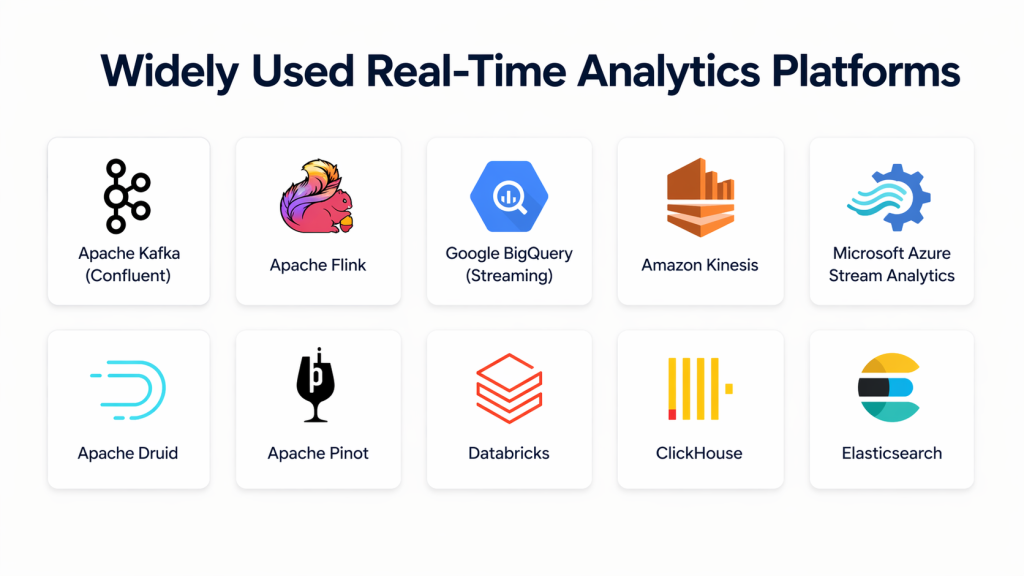
Top 10 Real-Time Analytics Platforms Tools
#1 — Apache Kafka (Confluent)
Short description: A distributed event streaming platform used for building real-time data pipelines and streaming applications.
Key Features
- High-throughput event streaming
- Distributed architecture
- Fault-tolerant data pipelines
- Stream processing with ksqlDB
- Scalable messaging system
- Real-time data integration
Pros
- Industry standard for streaming
- Highly scalable and reliable
- Strong ecosystem
Cons
- Complex setup
- Requires engineering expertise
Platforms / Deployment
Cloud / Self-hosted / Hybrid
Security & Compliance
RBAC, encryption; others Not publicly stated
Integrations & Ecosystem
Extensive integrations with data systems.
- Databases
- Stream processing tools
- Cloud services
Support & Community
Very strong open-source and enterprise support ecosystem.
#2 — Apache Flink
Short description: A powerful stream processing engine for real-time data analytics and event-driven applications.
Key Features
- Low-latency stream processing
- Stateful computations
- Event-time processing
- Fault tolerance
- Distributed execution
- Complex event processing
Pros
- High performance
- Advanced streaming capabilities
Cons
- Steep learning curve
- Requires infrastructure setup
Platforms / Deployment
Cloud / Self-hosted
Security & Compliance
Not publicly stated
Integrations & Ecosystem
- Kafka
- Data lakes
- APIs
Support & Community
Strong developer community.
#3 — Google BigQuery (Streaming)
Short description: A cloud-native data warehouse supporting real-time analytics through streaming data ingestion.
Key Features
- Streaming data ingestion
- SQL-based analytics
- Serverless architecture
- Real-time dashboards
- Integration with cloud services
Pros
- Easy to use
- Fully managed
- Scales automatically
Cons
- Cost can grow with usage
- Limited control over infrastructure
Platforms / Deployment
Cloud
Security & Compliance
Encryption, access controls; others Not publicly stated
Integrations & Ecosystem
- Cloud services
- BI tools
- APIs
Support & Community
Extensive documentation and enterprise support.
#4 — Amazon Kinesis
Short description: A real-time data streaming platform for collecting and processing large streams of data.
Key Features
- Real-time data ingestion
- Stream processing
- Integration with AWS ecosystem
- Scalable infrastructure
- Data analytics pipelines
Pros
- Fully managed service
- High scalability
Cons
- AWS lock-in
- Pricing complexity
Platforms / Deployment
Cloud
Security & Compliance
Encryption, IAM; others Not publicly stated
Integrations & Ecosystem
- AWS services
- APIs
- Data pipelines
Support & Community
Strong enterprise support.
#5 — Azure Stream Analytics
Short description: A real-time analytics service designed for event processing within the Azure ecosystem.
Key Features
- Event stream processing
- SQL-based queries
- Integration with Azure services
- Real-time dashboards
- IoT support
Pros
- Easy integration with Azure
- Simple query model
Cons
- Limited outside Azure
- Customization constraints
Platforms / Deployment
Cloud
Security & Compliance
Not publicly stated
Integrations & Ecosystem
- Azure services
- IoT platforms
- APIs
Support & Community
Enterprise support and documentation.
#6 — Apache Druid
Short description: A real-time analytics database optimized for time-series and event-driven data.
Key Features
- Real-time ingestion
- Columnar storage
- Fast aggregations
- Time-series analytics
- Scalable architecture
Pros
- Excellent for dashboards
- High query performance
Cons
- Limited for complex joins
- Setup complexity
Platforms / Deployment
Cloud / Self-hosted
Security & Compliance
Not publicly stated
Integrations & Ecosystem
- Kafka
- Data sources
- APIs
Support & Community
Strong open-source ecosystem.
#7 — Apache Pinot
Short description: A real-time OLAP database designed for low-latency analytics on large datasets.
Key Features
- Sub-second query performance
- Real-time ingestion
- High concurrency
- Scalable architecture
- Distributed system
Pros
- Extremely fast queries
- Ideal for user-facing analytics
Cons
- Complex setup
- Limited visualization features
Platforms / Deployment
Cloud / Self-hosted
Security & Compliance
Not publicly stated
Integrations & Ecosystem
- Kafka
- APIs
- Data pipelines
Support & Community
Strong open-source support.
#8 — Databricks
Short description: A unified data platform combining real-time analytics, AI, and data engineering.
Key Features
- Streaming and batch processing
- Lakehouse architecture
- AI and ML integration
- Scalable data pipelines
- Real-time analytics
Pros
- Unified platform
- Strong AI capabilities
Cons
- Expensive
- Requires expertise
Platforms / Deployment
Cloud
Security & Compliance
Not publicly stated
Integrations & Ecosystem
- Data lakes
- ML tools
- APIs
Support & Community
Enterprise-level support.
#9 — ClickHouse
Short description: A high-performance columnar database optimized for real-time analytical queries.
Key Features
- Fast query processing
- Columnar storage
- High scalability
- Real-time analytics
- Cost-efficient performance
Pros
- Extremely fast
- Efficient for large datasets
Cons
- Limited transactional support
- Requires tuning
Platforms / Deployment
Cloud / Self-hosted
Security & Compliance
Not publicly stated
Integrations & Ecosystem
- APIs
- Data pipelines
- Cloud platforms
Support & Community
Growing community and enterprise adoption.
#10 — Elasticsearch
Short description: A distributed search and analytics engine used for real-time log and event data analysis.
Key Features
- Full-text search
- Real-time analytics
- Distributed architecture
- Log analytics
- Visualization support
Pros
- Flexible and powerful
- Strong ecosystem
Cons
- Resource intensive
- Complex scaling
Platforms / Deployment
Cloud / Self-hosted
Security & Compliance
Not publicly stated
Integrations & Ecosystem
- Log management tools
- APIs
- Monitoring systems
Support & Community
Large open-source community.
Comparison Table (Top 10)
| Tool Name | Best For | Platform(s) Supported | Deployment | Standout Feature | Public Rating |
|---|---|---|---|---|---|
| Apache Kafka | Streaming pipelines | Multi-platform | Cloud/Hybrid | Event streaming | N/A |
| Apache Flink | Stream processing | Multi-platform | Cloud/Self-hosted | Stateful processing | N/A |
| BigQuery | Cloud analytics | Web | Cloud | Serverless analytics | N/A |
| Amazon Kinesis | AWS users | Web | Cloud | Managed streaming | N/A |
| Azure Stream Analytics | Azure users | Web | Cloud | SQL streaming | N/A |
| Apache Druid | Time-series analytics | Web | Cloud/Self-hosted | Fast aggregations | N/A |
| Apache Pinot | Low-latency analytics | Web | Cloud/Self-hosted | Sub-second queries | N/A |
| Databricks | AI + analytics | Web | Cloud | Lakehouse model | N/A |
| ClickHouse | Fast analytics | Web | Cloud/Self-hosted | Columnar speed | N/A |
| Elasticsearch | Log analytics | Web | Cloud/Self-hosted | Search + analytics | N/A |
Evaluation & Scoring of Real-Time Analytics Platforms
| Tool Name | Core (25%) | Ease (15%) | Integrations (15%) | Security (10%) | Performance (10%) | Support (10%) | Value (15%) | Weighted Total |
|---|---|---|---|---|---|---|---|---|
| Kafka | 10 | 5 | 10 | 7 | 9 | 9 | 8 | 8.6 |
| Flink | 9 | 5 | 9 | 7 | 9 | 8 | 8 | 8.2 |
| BigQuery | 8 | 9 | 9 | 8 | 8 | 8 | 7 | 8.2 |
| Kinesis | 8 | 7 | 8 | 8 | 8 | 8 | 7 | 7.9 |
| Azure Stream | 7 | 8 | 8 | 8 | 7 | 8 | 7 | 7.7 |
| Druid | 8 | 6 | 8 | 6 | 9 | 7 | 7 | 7.7 |
| Pinot | 9 | 5 | 8 | 6 | 10 | 7 | 7 | 7.9 |
| Databricks | 9 | 6 | 9 | 8 | 9 | 8 | 6 | 8.2 |
| ClickHouse | 9 | 6 | 8 | 6 | 10 | 7 | 8 | 8.1 |
| Elasticsearch | 8 | 6 | 9 | 6 | 8 | 8 | 7 | 7.8 |
How to interpret scores:
- Scores are comparative within this category
- Higher scores indicate stronger overall capabilities
- Developer-focused tools score high in performance but lower in ease of use
- Managed cloud tools score higher in usability
- Choose based on your team’s technical expertise and use case
Which Real-Time Analytics Platform Is Right for You?
Solo / Freelancer
- Best: BigQuery
- Focus on ease of use and minimal setup
SMB
- Best: BigQuery, Azure Stream Analytics
- Need managed services and cost control
Mid-Market
- Best: Kinesis, Apache Pinot
- Balance performance and scalability
Enterprise
- Best: Kafka, Flink, Databricks
- Require high throughput and customization
Budget vs Premium
- Budget: Open-source tools (Kafka, Flink)
- Premium: Databricks, managed cloud platforms
Feature Depth vs Ease of Use
- Depth: Kafka, Flink
- Ease: BigQuery, Azure
Integrations & Scalability
- Strong: Kafka, Databricks
- Moderate: Azure, Kinesis
Security & Compliance Needs
- Cloud platforms offer built-in security
- Open-source tools require custom implementation
Frequently Asked Questions (FAQs)
What is real-time analytics?
It is the process of analyzing data immediately as it is generated.
How is it different from batch analytics?
Batch analytics processes data later, while real-time analytics processes it instantly.
What industries use real-time analytics?
Finance, eCommerce, healthcare, IoT, and SaaS industries.
Is real-time analytics expensive?
It can be, depending on infrastructure and scale.
Do I need developers to use these tools?
Most platforms require technical expertise.
What is streaming data?
Data that is continuously generated and processed.
Can real-time analytics handle big data?
Yes, modern platforms are designed for large-scale data.
Are these platforms cloud-based?
Many are cloud-based, but some support hybrid or self-hosted setups.
What is the biggest challenge?
Managing latency, cost, and system complexity.
Can AI be integrated?
Yes, many platforms support AI-driven analytics.
Conclusion
Real-time analytics platforms are essential for businesses that need instant insights and fast decision-making. From streaming engines to unified analytics platforms, each tool offers unique strengths depending on your requirements. The best approach is to shortlist a few platforms, test them with real workloads, and evaluate performance, scalability, and integration capabilities before making a final decision.
