Introduction
Data Governance Platforms are solutions that help organizations manage, control, and protect their data assets through policies, processes, and technology. These platforms ensure that data is accurate, secure, compliant, and accessible to the right users across the organization.
As businesses rely heavily on data for analytics, AI, and decision-making, governance has become critical. Poor governance leads to data silos, compliance risks, inconsistent reporting, and security vulnerabilities. Modern platforms provide metadata management, data lineage, policy enforcement, data quality monitoring, and AI-driven automation, enabling organizations to maintain trust in their data.
Real-world use cases:
- Ensuring regulatory compliance such as GDPR and data privacy standards
- Managing data access and security policies
- Improving data quality and consistency
- Enabling self-service analytics with trusted data
- Supporting enterprise data strategy and governance initiatives
What buyers should evaluate:
- Metadata management capabilities
- Data lineage and visibility
- Policy enforcement and workflow automation
- Integration with data platforms and tools
- Data quality monitoring features
- Scalability across enterprise environments
- Ease of use and collaboration features
- Security and compliance capabilities
- API and extensibility
- Pricing and deployment model
Best for: Enterprises, data governance teams, compliance teams, and organizations managing large-scale data ecosystems
Not ideal for: Small teams with limited data complexity
Key Trends in Data Governance Platforms
- AI-driven data classification and governance automation
- Integration with data catalogs and lineage tools
- Real-time data monitoring and observability
- Increased focus on privacy and regulatory compliance
- Cloud-native governance platforms
- Active metadata for automated workflows
- Low-code and no-code governance interfaces
- Integration with modern data stacks
- API-first architecture for extensibility
- Convergence of governance, quality, and catalog platforms
How We Selected These Tools Methodology
- Market adoption and industry recognition
- Depth of governance and policy management features
- Integration with data ecosystems
- Automation and AI capabilities
- Scalability across environments
- Ease of deployment and usability
- Vendor innovation and maturity
- Support and documentation quality
- Fit across SMB and enterprise use cases
- Coverage of modern governance needs
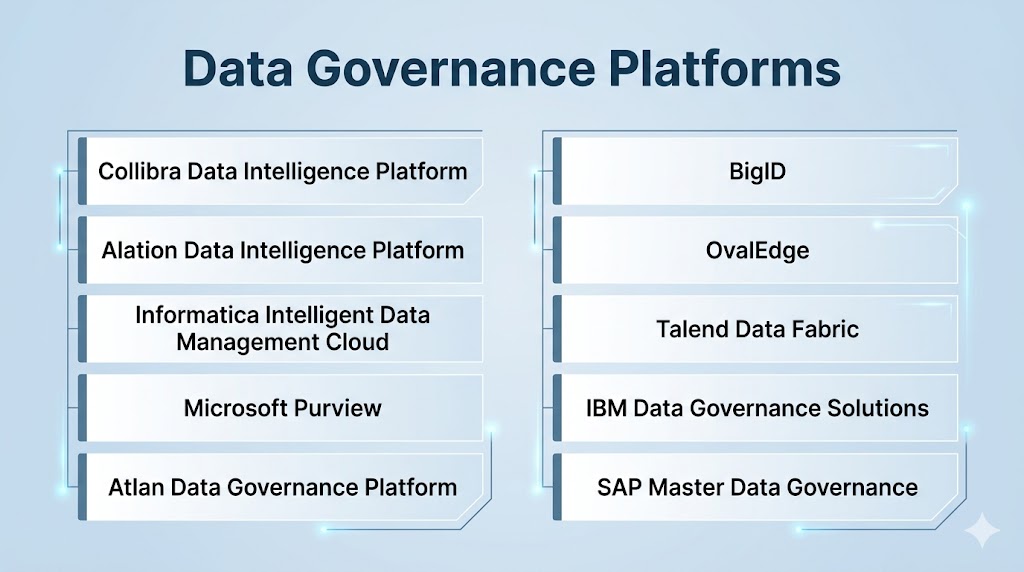
Top 10 Data Governance Platforms
#1 — Collibra Data Intelligence Platform
Short description:
Collibra is a leading data governance platform designed for enterprises. It provides metadata management, data lineage, and policy enforcement. It supports collaboration and workflows. It integrates with enterprise systems. It is highly scalable. It is widely used.
Key Features
- Data governance
- Metadata management
- Data lineage
- Workflow automation
- Collaboration tools
Pros
- Strong governance capabilities
- Enterprise-ready
- Scalable
Cons
- Complex implementation
- Expensive
Platforms / Deployment
- Cloud
Security & Compliance
- RBAC
- Compliance Not publicly stated
Integrations & Ecosystem
Integrates with enterprise data platforms and governance tools.
- Data warehouses
- BI tools
- APIs
Support & Community
Strong enterprise support and ecosystem.
#2 — Alation Data Intelligence Platform
Short description:
Alation combines data catalog and governance capabilities. It offers AI-driven data discovery. It supports collaboration and workflows. It integrates with data systems. It is scalable. It is widely adopted.
Key Features
- Data catalog
- Governance workflows
- AI-powered discovery
- Integration
- Collaboration
Pros
- User-friendly interface
- Strong ecosystem
- Scalable
Cons
- Limited standalone governance depth
- Cost
Platforms / Deployment
- Cloud
Security & Compliance
- RBAC
- Compliance Not publicly stated
Integrations & Ecosystem
Integrates with BI tools and data platforms.
- Data warehouses
- Analytics tools
- APIs
Support & Community
Strong enterprise support.
#3 — Informatica Intelligent Data Management Cloud
Short description:
Informatica provides a comprehensive governance platform with data quality and integration capabilities. It supports automation and AI-driven insights. It integrates with enterprise systems. It is scalable. It is widely used.
Key Features
- Data governance
- Data quality
- Metadata management
- Automation
- Integration
Pros
- Comprehensive platform
- Scalable
- Strong ecosystem
Cons
- Complex setup
- Expensive
Platforms / Deployment
- Cloud / Hybrid
Security & Compliance
- RBAC
- Compliance Not publicly stated
Integrations & Ecosystem
Integrates with enterprise data platforms.
- Data systems
- APIs
Support & Community
Enterprise support available.
#4 — Microsoft Purview
Short description:
Microsoft Purview provides governance and compliance across cloud environments. It tracks data movement and policies. It integrates with Microsoft ecosystem. It is scalable. It offers strong compliance features.
Key Features
- Data governance
- Data lineage
- Policy enforcement
- Integration
- Monitoring
Pros
- Strong integration
- Scalable
- Easy deployment
Cons
- Microsoft dependency
- Limited outside ecosystem
Platforms / Deployment
- Cloud
Security & Compliance
- RBAC
- Compliance Not publicly stated
Integrations & Ecosystem
Integrates with Microsoft tools and cloud platforms.
- Azure
- APIs
Support & Community
Strong enterprise support.
#5 — Atlan Data Governance Platform
Short description:
Atlan is a modern data governance platform focused on collaboration. It provides metadata management and workflows. It integrates with modern data stacks. It is scalable. It offers strong usability.
Key Features
- Metadata management
- Governance workflows
- Collaboration
- Integration
- Automation
Pros
- Easy to use
- Strong collaboration
- Scalable
Cons
- Limited advanced governance
- Cost
Platforms / Deployment
- Cloud
Security & Compliance
- RBAC
- Compliance Not publicly stated
Integrations & Ecosystem
Integrates with modern data platforms.
- Data warehouses
- APIs
Support & Community
Growing ecosystem and support.
#6 — BigID
Short description:
BigID focuses on data privacy and governance. It provides data discovery and classification. It supports compliance workflows. It integrates with enterprise systems. It is scalable. It is widely used.
Key Features
- Data discovery
- Classification
- Governance
- Compliance
- Integration
Pros
- Strong privacy features
- Scalable
- Reliable
Cons
- Complex
- Cost
Platforms / Deployment
- Cloud
Security & Compliance
- RBAC
- Compliance Not publicly stated
Integrations & Ecosystem
Integrates with enterprise data systems.
- Data platforms
- APIs
Support & Community
Enterprise support.
#7 — OvalEdge
Short description:
OvalEdge provides governance and data catalog capabilities. It supports workflows and automation. It integrates with data platforms. It is scalable. It offers strong performance.
Key Features
- Data governance
- Catalog
- Automation
- Integration
- Reporting
Pros
- Flexible
- Scalable
- Reliable
Cons
- Complex
- Cost
Platforms / Deployment
- Cloud
Security & Compliance
- RBAC
- Compliance Not publicly stated
Integrations & Ecosystem
Integrates with enterprise tools and systems.
- Data platforms
- APIs
Support & Community
Enterprise support.
#8 — Talend Data Fabric
Short description:
Talend Data Fabric combines data integration and governance. It supports data quality and lineage. It integrates with modern data stacks. It is scalable. It offers flexibility.
Key Features
- Data governance
- Data integration
- Data quality
- Lineage
- Automation
Pros
- Flexible
- Scalable
- Open-source option
Cons
- Learning curve
- Complex interface
Platforms / Deployment
- Cloud / Hybrid
Security & Compliance
- RBAC
- Compliance Not publicly stated
Integrations & Ecosystem
Integrates with data pipelines and tools.
- Data warehouses
- APIs
Support & Community
Active community and support.
#9 — IBM Data Governance Solutions
Short description:
IBM provides governance solutions with strong data management and compliance features. It supports metadata management and workflows. It integrates with IBM ecosystem. It is scalable. It is suitable for enterprises.
Key Features
- Data governance
- Metadata management
- Compliance
- Integration
- Monitoring
Pros
- Strong enterprise features
- Scalable
- Reliable
Cons
- Complex
- Cost
Platforms / Deployment
- Cloud / On-prem
Security & Compliance
- RBAC
- Compliance Not publicly stated
Integrations & Ecosystem
Integrates with IBM data platforms.
- Data systems
- APIs
Support & Community
Enterprise support available.
#10 — SAP Master Data Governance
Short description:
SAP Master Data Governance provides governance capabilities for master data. It supports workflows and compliance. It integrates with SAP systems. It is scalable. It is widely used in enterprise environments.
Key Features
- Data governance
- Workflow automation
- Integration
- Compliance
- Reporting
Pros
- Strong SAP integration
- Scalable
- Reliable
Cons
- Limited outside SAP
- Complex setup
Platforms / Deployment
- Cloud / On-prem
Security & Compliance
- RBAC
- Compliance Not publicly stated
Integrations & Ecosystem
Integrates with SAP and enterprise systems.
- SAP ecosystem
- APIs
Support & Community
Enterprise support.
Comparison Table
| Tool | Best For | Platform | Deployment | Standout Feature | Rating |
|---|---|---|---|---|---|
| Collibra | Enterprise | Cloud | Cloud | Governance | N/A |
| Alation | Enterprise | Cloud | Cloud | Discovery | N/A |
| Informatica | Enterprise | Multi | Hybrid | Full suite | N/A |
| Microsoft | Enterprise | Cloud | Cloud | Integration | N/A |
| Atlan | Modern teams | Cloud | Cloud | Collaboration | N/A |
| BigID | Compliance | Cloud | Cloud | Privacy | N/A |
| OvalEdge | Enterprise | Cloud | Cloud | Flexibility | N/A |
| Talend | SMB | Multi | Hybrid | Integration | N/A |
| IBM | Enterprise | Multi | Hybrid | Reliability | N/A |
| SAP | Enterprise | Multi | Hybrid | SAP integration | N/A |
Evaluation & Scoring of Data Governance Platforms
| Tool | Core | Ease | Integration | Security | Performance | Support | Value | Weighted Total |
|---|---|---|---|---|---|---|---|---|
| Collibra | 10 | 7 | 9 | 10 | 9 | 9 | 7 | 9.0 |
| Alation | 9 | 9 | 9 | 9 | 8 | 8 | 8 | 8.7 |
| Informatica | 10 | 7 | 9 | 10 | 9 | 9 | 7 | 9.0 |
| Microsoft | 9 | 9 | 9 | 9 | 8 | 8 | 8 | 8.7 |
| Atlan | 9 | 9 | 9 | 8 | 8 | 8 | 8 | 8.6 |
| BigID | 9 | 7 | 8 | 9 | 8 | 8 | 7 | 8.3 |
| OvalEdge | 9 | 7 | 8 | 9 | 8 | 8 | 7 | 8.2 |
| Talend | 8 | 8 | 9 | 8 | 8 | 8 | 8 | 8.3 |
| IBM | 9 | 7 | 8 | 9 | 9 | 8 | 7 | 8.3 |
| SAP | 9 | 7 | 8 | 9 | 9 | 8 | 7 | 8.3 |
Scoring is comparative and based on capabilities, usability, integrations, and value. Higher scores indicate stronger overall performance, but the best platform depends on your organization’s needs.
Which Data Governance Platform Is Right for You
Solo / Freelancer
- Not typically required
SMB
- Talend, Atlan
Mid-Market
- Alation, Microsoft Purview
Enterprise
- Collibra, Informatica, SAP
Budget vs Premium
- Budget option is Talend
- Premium option is Collibra
Feature Depth vs Ease of Use
- Easy option is Atlan
- Advanced option is Informatica
Integrations & Scalability
- Strong integration offered by Microsoft Purview
Security & Compliance Needs
- Enterprise-grade option is BigID
Frequently Asked Questions
1. What are Data Governance Platforms
They help manage data policies and ensure data quality. They provide control over data usage. They improve compliance. They support data strategy.
2. Why are Data Governance Platforms important
They ensure data accuracy and compliance. They reduce risks. They improve decision-making. They enable trusted data usage.
3. How do Data Governance Platforms work
They collect metadata and enforce policies. They monitor data usage. They provide workflows. They ensure compliance.
4. Who should use Data Governance Platforms
Enterprises and data-driven organizations benefit the most. Governance teams use them. They help manage complex data systems.
5. Are Data Governance Platforms scalable
Yes, they support large datasets and cloud environments. They scale with business growth. They ensure consistent governance.
6. Do Data Governance Platforms integrate with other tools
Yes, they integrate with data warehouses, BI tools, and pipelines. This creates a unified ecosystem. Integration improves workflows.
7. Are Data Governance Platforms secure
They include access controls and compliance features. They protect sensitive data. Proper setup ensures security. They reduce risks.
8. Are Data Governance Platforms difficult to implement
Some tools are complex and require expertise. Enterprise deployments take time. Proper planning is essential.
9. What are alternatives to Data Governance Platforms
Alternatives include manual processes and basic data tools. They lack automation. Governance platforms provide better control.
10. Are Data Governance Platforms expensive
Pricing varies based on features and scale. Enterprise tools can be costly. Some flexible pricing options exist.
Conclusion
Data Governance Platforms are essential for organizations aiming to maintain control, compliance, and trust in their data. As data ecosystems become more complex, these platforms provide the structure needed to manage policies, ensure quality, and enable secure data access across teams.Choosing the right platform depends on your organization’s size, data maturity, and integration requirements. Enterprise solutions like Collibra and Informatica offer comprehensive capabilities, while modern platforms like Atlan and Talend provide flexibility and ease of use. The best approach is to evaluate your needs, test multiple solutions, and ensure alignment with your long-term data strategy before making a decision.
