Introduction
Stream processing frameworks are systems designed to process continuous streams of data in real time. Unlike traditional batch processing, where data is collected and analyzed later, these frameworks allow organizations to process and react to data instantly as it flows through systems. This capability is essential for modern applications that depend on speed, accuracy, and responsiveness.
With the rapid growth of real-time applications, stream processing has become a core part of modern data architecture. From financial systems to IoT devices, businesses rely on these frameworks to power instant decision-making and automation.
Real-world use cases include:
- Real-time fraud detection in banking systems
- Monitoring logs, metrics, and infrastructure performance
- Processing IoT and sensor-based data streams
- Delivering personalized recommendations instantly
- Building real-time ETL pipelines
What buyers should evaluate:
- Processing latency and speed
- Scalability and fault tolerance
- Stateful processing capabilities
- Integration with streaming platforms like Kafka
- Ease of development and APIs
- Deployment flexibility (cloud, on-prem, hybrid)
- Exactly-once processing guarantees
- Monitoring and debugging tools
- Cost and infrastructure requirements
- Community and ecosystem support
Best for: Data engineers, backend developers, DevOps teams, and organizations building real-time or event-driven systems.
Not ideal for: Small-scale applications or teams that rely primarily on batch processing and do not require real-time insights.
Key Trends in Stream Processing Frameworks
- Unified batch and streaming architectures
- Increasing adoption of exactly-once processing guarantees
- Growth of cloud-native and managed streaming services
- Integration with AI and machine learning pipelines
- Serverless stream processing models
- Improved observability and monitoring tools
- Event-driven microservices becoming standard
- Real-time data integration with data lakes
- Edge processing for IoT workloads
- Focus on developer-friendly APIs and tooling
How We Selected These Tools (Methodology)
The frameworks were selected based on:
- Industry adoption and popularity
- Performance in real-time environments
- Feature completeness and reliability
- Integration with modern data stacks
- Scalability across workloads
- Developer experience and usability
- Flexibility in deployment options
- Community and ecosystem strength
- Innovation in stream processing
- Overall value for investment
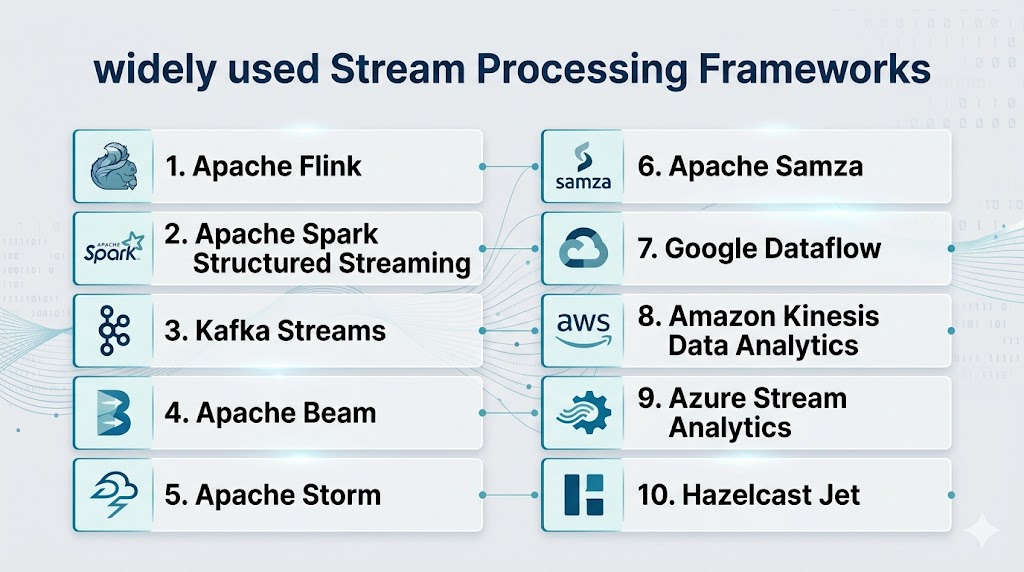
Top 10 Stream Processing Frameworks Tools
#1 — Apache Flink
Short description: A highly advanced stream processing framework known for low-latency and stateful computations in large-scale systems.
Key Features
- Stateful stream processing
- Event-time processing
- Exactly-once guarantees
- Distributed architecture
- High throughput
- Fault tolerance
Pros
- Excellent performance and accuracy
- Ideal for complex real-time use cases
Cons
- Steep learning curve
- Requires infrastructure expertise
Platforms / Deployment
Cloud / Self-hosted
Security & Compliance
Not publicly stated
Integrations & Ecosystem
- Kafka
- Data lakes
- APIs
Support & Community
Strong open-source community with extensive documentation.
#2 — Apache Spark Structured Streaming
Short description: A scalable stream processing engine that extends Apache Spark’s capabilities to real-time data processing.
Key Features
- Unified batch and streaming
- High scalability
- SQL-based processing
- Fault tolerance
- Integration with Spark ecosystem
Pros
- Easy transition from batch workloads
- Strong ecosystem and tooling
Cons
- Higher latency compared to Flink
- Resource intensive
Platforms / Deployment
Cloud / Self-hosted
Security & Compliance
Not publicly stated
Integrations & Ecosystem
- Data lakes
- Databases
- APIs
Support & Community
Large global community and extensive resources.
#3 — Kafka Streams
Short description: A lightweight stream processing library built on top of Kafka for building real-time applications.
Key Features
- Native Kafka integration
- Stateful and stateless processing
- Exactly-once processing
- Lightweight architecture
- High scalability
Pros
- Easy to integrate with Kafka
- No separate cluster required
Cons
- Limited outside Kafka ecosystem
- Requires Kafka knowledge
Platforms / Deployment
Cloud / Self-hosted
Security & Compliance
Not publicly stated
Integrations & Ecosystem
- Kafka ecosystem
- APIs
- Data pipelines
Support & Community
Strong support within Kafka community.
#4 — Apache Beam
Short description: A unified programming model for defining both batch and stream processing pipelines.
Key Features
- Unified processing model
- Multi-language SDKs
- Windowing and event-time support
- Portability across engines
- Flexible pipelines
Pros
- Highly flexible
- Works with multiple runners
Cons
- Requires external execution engines
- Complexity in setup
Platforms / Deployment
Cloud / Self-hosted
Security & Compliance
Not publicly stated
Integrations & Ecosystem
- Dataflow
- Spark
- Flink
Support & Community
Active developer community.
#5 — Apache Storm
Short description: A distributed real-time computation system for processing large volumes of streaming data.
Key Features
- Low-latency processing
- Distributed architecture
- Fault tolerance
- Scalable system
- Real-time computation
Pros
- Mature and stable
- Reliable performance
Cons
- Less modern compared to newer frameworks
- Limited advanced capabilities
Platforms / Deployment
Cloud / Self-hosted
Security & Compliance
Not publicly stated
Integrations & Ecosystem
- Messaging systems
- APIs
Support & Community
Established community support.
#6 — Apache Samza
Short description: A stream processing framework designed for large-scale processing with strong Kafka integration.
Key Features
- Stateful processing
- Kafka integration
- Fault tolerance
- Distributed execution
- Scalable architecture
Pros
- Reliable for Kafka-based systems
- Good fault tolerance
Cons
- Smaller ecosystem
- Limited flexibility
Platforms / Deployment
Cloud / Self-hosted
Security & Compliance
Not publicly stated
Integrations & Ecosystem
- Kafka
- Data systems
Support & Community
Moderate community support.
#7 — Google Dataflow
Short description: A fully managed service for executing stream and batch data pipelines.
Key Features
- Auto-scaling
- Managed infrastructure
- Real-time processing
- Unified pipelines
- High reliability
Pros
- Easy to use
- No infrastructure management
Cons
- Cloud dependency
- Pricing complexity
Platforms / Deployment
Cloud
Security & Compliance
Not publicly stated
Integrations & Ecosystem
- Cloud services
- APIs
- Data tools
Support & Community
Strong enterprise support.
#8 — Amazon Kinesis Data Analytics
Short description: A real-time streaming analytics service for processing data within the AWS ecosystem.
Key Features
- Real-time data processing
- SQL-based queries
- Integration with AWS services
- Scalable infrastructure
- Streaming analytics
Pros
- Managed service
- Easy AWS integration
Cons
- Vendor lock-in
- Pricing can scale quickly
Platforms / Deployment
Cloud
Security & Compliance
Not publicly stated
Integrations & Ecosystem
- AWS services
- APIs
Support & Community
Strong support ecosystem.
#9 — Azure Stream Analytics
Short description: A real-time analytics service for processing streaming data within the Azure ecosystem.
Key Features
- SQL-based processing
- Event ingestion
- Real-time dashboards
- IoT integration
- Scalable system
Pros
- Easy to use
- Strong Azure integration
Cons
- Limited flexibility outside Azure
- Customization constraints
Platforms / Deployment
Cloud
Security & Compliance
Not publicly stated
Integrations & Ecosystem
- Azure services
- IoT tools
Support & Community
Enterprise-level support.
#10 — Hazelcast Jet
Short description: A distributed stream processing engine focused on in-memory computation and low latency.
Key Features
- In-memory processing
- Distributed architecture
- Real-time analytics
- Fault tolerance
- Scalable performance
Pros
- Low latency
- High performance
Cons
- Smaller ecosystem
- Limited adoption
Platforms / Deployment
Cloud / Self-hosted
Security & Compliance
Not publicly stated
Integrations & Ecosystem
- APIs
- Data systems
Support & Community
Moderate community support.
Comparison Table (Top 10)
| Tool Name | Best For | Platform(s) Supported | Deployment | Standout Feature | Public Rating |
|---|---|---|---|---|---|
| Apache Flink | Advanced streaming | Multi-platform | Cloud/Self-hosted | Stateful processing | N/A |
| Spark Streaming | Unified workloads | Multi-platform | Cloud/Self-hosted | Batch + streaming | N/A |
| Kafka Streams | Kafka users | Multi-platform | Cloud/Self-hosted | Lightweight processing | N/A |
| Apache Beam | Portability | Multi-platform | Hybrid | Multi-engine support | N/A |
| Apache Storm | Real-time systems | Multi-platform | Cloud/Self-hosted | Low latency | N/A |
| Apache Samza | Kafka ecosystems | Multi-platform | Cloud/Self-hosted | Kafka integration | N/A |
| Dataflow | Managed pipelines | Web | Cloud | Auto-scaling | N/A |
| Kinesis Analytics | AWS users | Web | Cloud | Managed streaming | N/A |
| Azure Stream | Azure users | Web | Cloud | SQL-based processing | N/A |
| Hazelcast Jet | In-memory processing | Multi-platform | Cloud/Self-hosted | Low latency | N/A |
Evaluation & Scoring of Stream Processing Frameworks
| Tool Name | Core (25%) | Ease (15%) | Integrations (15%) | Security (10%) | Performance (10%) | Support (10%) | Value (15%) | Weighted Total |
|---|---|---|---|---|---|---|---|---|
| Flink | 10 | 5 | 9 | 7 | 10 | 9 | 8 | 8.7 |
| Spark | 9 | 7 | 10 | 7 | 9 | 9 | 8 | 8.6 |
| Kafka Streams | 8 | 7 | 9 | 6 | 9 | 8 | 8 | 8.0 |
| Beam | 8 | 6 | 9 | 6 | 8 | 7 | 8 | 7.8 |
| Storm | 7 | 6 | 7 | 6 | 8 | 7 | 8 | 7.2 |
| Samza | 8 | 6 | 8 | 6 | 8 | 7 | 7 | 7.5 |
| Dataflow | 8 | 9 | 8 | 7 | 8 | 8 | 7 | 8.0 |
| Kinesis | 7 | 8 | 8 | 7 | 7 | 8 | 7 | 7.6 |
| Azure Stream | 7 | 9 | 8 | 7 | 7 | 8 | 7 | 7.8 |
| Hazelcast Jet | 7 | 6 | 6 | 5 | 9 | 6 | 8 | 7.2 |
How to interpret scores:
- Scores are comparative within this category
- Higher scores indicate stronger overall capabilities
- Developer-focused frameworks excel in performance
- Managed tools score higher in ease of use
- Choose based on your technical requirements and scale
Which Stream Processing Framework Is Right for You?
Solo / Freelancer
- Best: Dataflow, Azure Stream Analytics
- Focus on ease of use and minimal setup
SMB
- Best: Spark, Kafka Streams
- Balanced performance and usability
Mid-Market
- Best: Flink, Kinesis Analytics
- Require scalability and flexibility
Enterprise
- Best: Flink, Spark, Beam
- Need high performance and complex processing
Budget vs Premium
- Budget: Open-source tools like Flink and Spark
- Premium: Managed cloud services
Feature Depth vs Ease of Use
- Depth: Flink, Beam
- Ease: Dataflow, Azure
Integrations & Scalability
- Strong: Spark, Flink
- Moderate: Azure, Kinesis
Security & Compliance Needs
- Cloud tools provide built-in controls
- Open-source tools require configuration
Frequently Asked Questions (FAQs)
What is a stream processing framework?
A stream processing framework is a system that processes continuous data in real time instead of waiting for batch collection. It allows businesses to react instantly to incoming data and events. These frameworks are widely used in modern applications where speed and responsiveness are critical.
How is stream processing different from batch processing?
Stream processing analyzes data as it arrives, while batch processing works on stored data at scheduled intervals. This makes stream processing ideal for real-time use cases like monitoring and alerts. Batch processing, on the other hand, is better suited for large historical data analysis.
Which stream processing framework is best?
There is no single best framework, as the choice depends on your use case and technical expertise. Tools like Flink and Spark are powerful for large-scale systems, while managed services are easier to use. Evaluating performance, scalability, and integration needs is key.
Do I need coding skills to use these frameworks?
Yes, most stream processing frameworks require programming knowledge, typically in languages like Java, Python, or Scala. Some managed services simplify development but still need basic technical understanding. Teams often rely on data engineers or developers for implementation.
Can stream processing frameworks scale with large data volumes?
Yes, these frameworks are designed to handle massive data streams efficiently. They use distributed architectures to scale horizontally across multiple nodes. This makes them suitable for enterprise-level workloads and high-throughput systems.
Are these frameworks cloud-based or self-hosted?
Many frameworks support both cloud and self-hosted deployments, offering flexibility based on your needs. Managed cloud services reduce operational complexity, while self-hosted options provide more control. Hybrid models are also commonly used.
What industries use stream processing frameworks?
Industries such as finance, eCommerce, healthcare, IoT, and SaaS rely heavily on stream processing. These frameworks enable real-time insights, automation, and better user experiences. They are especially important in systems that require instant decision-making.
Are stream processing frameworks expensive?
Costs vary depending on the deployment model and scale of usage. Open-source frameworks are free but require infrastructure and maintenance. Managed services can be more expensive but reduce operational overhead.
Can these frameworks integrate with other tools?
Yes, most frameworks integrate with data pipelines, databases, and streaming platforms like Kafka. Integration is a key factor when choosing a framework. A strong ecosystem ensures better flexibility and scalability.
What is the biggest advantage of stream processing?
The biggest advantage is the ability to process and act on data in real time. This enables faster decision-making, improved customer experiences, and better system responsiveness. It also helps organizations stay competitive in data-driven environments.
Conclusion
Stream processing frameworks have become essential for organizations that need to process and act on data instantly. They enable real-time decision-making and power modern applications that rely on continuous data streams. Choosing the right framework depends on your technical expertise, scalability needs, and integration requirements. Open-source tools provide flexibility and control, while managed services simplify deployment and reduce operational overhead. Performance and latency should always be tested using real workloads rather than assumptions. Integration capabilities are crucial, as these frameworks often connect multiple data systems and pipelines. Cost considerations should include infrastructure, maintenance, and long-term scalability. Security and compliance must align with organizational and industry requirements. Testing a few frameworks through pilot projects is the most effective way to validate performance and usability. A well-chosen framework ensures efficient data processing, scalability, and long-term success in real-time applications.
