Introduction
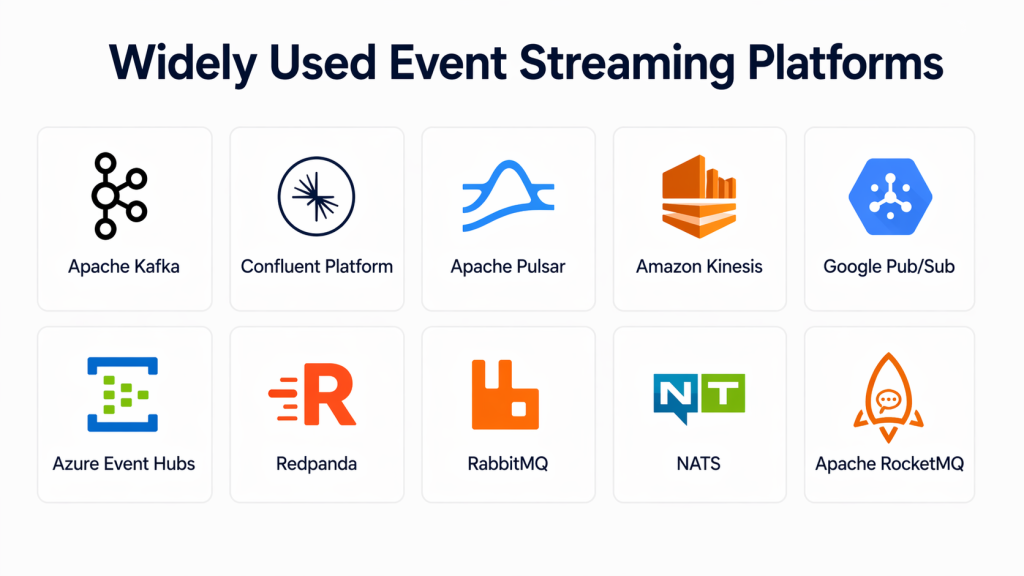
Event streaming platforms are systems designed to capture, process, store, and distribute streams of data (events) in real time. These events can include user actions, transactions, system logs, IoT signals, or any data generated continuously by applications and devices. Unlike traditional batch systems, event streaming enables immediate data flow and processing, making it essential for modern, responsive architectures.
As businesses shift toward real-time systems, event streaming platforms have become foundational for building scalable, event-driven applications. They power everything from microservices communication to real-time analytics and data pipelines.
Real-world use cases include:
- Building real-time data pipelines and integrations
- Enabling event-driven microservices architectures
- Processing logs and monitoring system performance
- Powering real-time analytics and dashboards
- Supporting IoT and sensor-based data streaming
What buyers should evaluate:
- Throughput and latency performance
- Scalability and fault tolerance
- Stream processing capabilities
- Integration with data systems and APIs
- Ease of deployment and management
- Security and access controls
- Cloud vs self-hosted flexibility
- Ecosystem and community support
- Cost and operational complexity
- Compatibility with event-driven architectures
Best for: Data engineers, backend developers, DevOps teams, SaaS companies, and enterprises building real-time or event-driven systems.
Not ideal for: Small projects with minimal data flow or systems that can rely on traditional batch processing.
Key Trends in Event Streaming Platforms
- Event-driven architectures: Growing adoption across microservices and distributed systems
- Cloud-native streaming services: Managed platforms reducing operational overhead
- Exactly-once processing guarantees: Improved data consistency and reliability
- Unified streaming + analytics: Platforms combining ingestion and processing
- Integration with AI/ML pipelines: Real-time model inference and feedback loops
- Serverless streaming models: Reduced infrastructure management
- Schema management and governance: Better control over evolving data structures
- Edge streaming capabilities: Processing events closer to data sources
- Multi-cloud and hybrid deployments: Flexibility across environments
- Observability and monitoring tools: Improved debugging and performance tracking
How We Selected These Tools (Methodology)
The platforms were selected based on:
- Industry adoption and ecosystem maturity
- Performance in high-throughput streaming environments
- Reliability and fault tolerance
- Feature completeness (streaming, processing, storage)
- Integration capabilities with modern data stacks
- Flexibility across cloud and self-hosted deployments
- Developer experience and usability
- Community support and documentation
- Innovation in real-time processing
- Overall value and scalability
Top 10 Event Streaming Platforms Tools
#1 — Apache Kafka
Short description: A distributed event streaming platform widely used for building real-time data pipelines and streaming applications.
Key Features
- High-throughput messaging
- Distributed architecture
- Fault-tolerant storage
- Stream processing support
- Scalability across clusters
- Durable event storage
Pros
- Industry standard
- Highly scalable and reliable
- Large ecosystem
Cons
- Complex setup
- Requires operational expertise
Platforms / Deployment
Cloud / Self-hosted / Hybrid
Security & Compliance
RBAC, encryption; others Not publicly stated
Integrations & Ecosystem
Extensive integrations across data platforms.
- Databases
- Stream processors
- Cloud services
Support & Community
Very strong open-source and enterprise support.
#2 — Confluent Platform
Short description: A managed and enterprise-ready distribution of Kafka with additional tools and services.
Key Features
- Managed Kafka services
- Stream governance tools
- Schema registry
- Stream processing with ksqlDB
- Monitoring and control center
Pros
- Simplified Kafka management
- Enterprise-grade features
Cons
- Premium pricing
- Vendor dependency
Platforms / Deployment
Cloud / Hybrid
Security & Compliance
Encryption, RBAC; others Not publicly stated
Integrations & Ecosystem
- Kafka ecosystem
- Cloud platforms
- APIs
Support & Community
Enterprise support and strong documentation.
#3 — Apache Pulsar
Short description: A cloud-native messaging and streaming platform designed for high scalability and multi-tenancy.
Key Features
- Multi-tenant architecture
- Tiered storage
- Low-latency messaging
- Geo-replication
- Stream processing
Pros
- Flexible architecture
- High scalability
Cons
- Smaller ecosystem than Kafka
- Learning curve
Platforms / Deployment
Cloud / Self-hosted
Security & Compliance
Not publicly stated
Integrations & Ecosystem
- APIs
- Data systems
- Messaging tools
Support & Community
Growing open-source community.
#4 — Amazon Kinesis
Short description: A fully managed streaming platform for real-time data ingestion and processing.
Key Features
- Real-time data streaming
- Scalable infrastructure
- Integration with cloud services
- Data processing pipelines
- Event ingestion
Pros
- Managed service
- Easy scalability
Cons
- Vendor lock-in
- Pricing complexity
Platforms / Deployment
Cloud
Security & Compliance
Encryption, IAM; others Not publicly stated
Integrations & Ecosystem
- Cloud services
- APIs
- Data pipelines
Support & Community
Strong enterprise support.
#5 — Google Pub/Sub
Short description: A messaging service for building event-driven systems and streaming analytics pipelines.
Key Features
- Asynchronous messaging
- Global scalability
- Real-time event delivery
- Integration with cloud services
- Event-driven architecture support
Pros
- Fully managed
- High availability
Cons
- Limited customization
- Cloud dependency
Platforms / Deployment
Cloud
Security & Compliance
Not publicly stated
Integrations & Ecosystem
- Cloud services
- APIs
- Data tools
Support & Community
Strong documentation and support.
#6 — Azure Event Hubs
Short description: A big data streaming platform and event ingestion service within the Azure ecosystem.
Key Features
- High-throughput ingestion
- Event streaming
- Integration with Azure services
- Real-time analytics support
- Partitioned data streams
Pros
- Seamless Azure integration
- Scalable
Cons
- Limited outside Azure
- Customization constraints
Platforms / Deployment
Cloud
Security & Compliance
Not publicly stated
Integrations & Ecosystem
- Azure services
- APIs
- Data tools
Support & Community
Enterprise support available.
#7 — Redpanda
Short description: A Kafka-compatible streaming platform focused on performance and simplicity.
Key Features
- Kafka API compatibility
- Low-latency streaming
- No JVM dependency
- High performance
- Simplified deployment
Pros
- Faster than traditional Kafka setups
- Easier to manage
Cons
- Smaller ecosystem
- Newer platform
Platforms / Deployment
Cloud / Self-hosted
Security & Compliance
Not publicly stated
Integrations & Ecosystem
- Kafka tools
- APIs
- Data pipelines
Support & Community
Growing developer community.
#8 — Apache RocketMQ
Short description: A distributed messaging and streaming platform designed for high-performance data processing.
Key Features
- Distributed messaging
- High throughput
- Low latency
- Event streaming
- Scalable architecture
Pros
- High performance
- Reliable messaging
Cons
- Limited global adoption
- Smaller ecosystem
Platforms / Deployment
Cloud / Self-hosted
Security & Compliance
Not publicly stated
Integrations & Ecosystem
- APIs
- Messaging systems
- Data tools
Support & Community
Moderate community support.
#9 — NATS
Short description: A lightweight messaging system designed for cloud-native and microservices environments.
Key Features
- Lightweight architecture
- High-speed messaging
- Pub/sub model
- Cloud-native design
- Low latency
Pros
- Simple and fast
- Easy to deploy
Cons
- Limited advanced features
- Not ideal for large-scale analytics
Platforms / Deployment
Cloud / Self-hosted
Security & Compliance
Not publicly stated
Integrations & Ecosystem
- APIs
- Microservices frameworks
Support & Community
Active developer community.
#10 — RabbitMQ
Short description: A widely used messaging broker that supports event-driven architectures and asynchronous communication.
Key Features
- Message queuing
- Pub/sub support
- Routing flexibility
- Reliable delivery
- Plugin ecosystem
Pros
- Mature and stable
- Easy to use
Cons
- Not optimized for high-scale streaming
- Performance limitations at scale
Platforms / Deployment
Cloud / Self-hosted
Security & Compliance
Not publicly stated
Integrations & Ecosystem
- APIs
- Messaging systems
- Plugins
Support & Community
Strong community and documentation.
Comparison Table (Top 10)
| Tool Name | Best For | Platform(s) Supported | Deployment | Standout Feature | Public Rating |
|---|---|---|---|---|---|
| Apache Kafka | Large-scale streaming | Multi-platform | Hybrid | High throughput | N/A |
| Confluent | Enterprise Kafka | Web | Cloud/Hybrid | Managed Kafka | N/A |
| Apache Pulsar | Cloud-native streaming | Multi-platform | Cloud/Self-hosted | Multi-tenancy | N/A |
| Amazon Kinesis | AWS users | Web | Cloud | Managed streaming | N/A |
| Google Pub/Sub | Event-driven apps | Web | Cloud | Global messaging | N/A |
| Azure Event Hubs | Azure ecosystem | Web | Cloud | Event ingestion | N/A |
| Redpanda | Kafka alternative | Multi-platform | Cloud/Self-hosted | Performance | N/A |
| RocketMQ | High throughput | Multi-platform | Cloud/Self-hosted | Distributed messaging | N/A |
| NATS | Lightweight messaging | Multi-platform | Cloud/Self-hosted | Simplicity | N/A |
| RabbitMQ | Messaging queues | Multi-platform | Cloud/Self-hosted | Reliability | N/A |
Evaluation & Scoring of Event Streaming Platforms
| Tool Name | Core (25%) | Ease (15%) | Integrations (15%) | Security (10%) | Performance (10%) | Support (10%) | Value (15%) | Weighted Total |
|---|---|---|---|---|---|---|---|---|
| Kafka | 10 | 5 | 10 | 7 | 9 | 9 | 8 | 8.6 |
| Confluent | 9 | 8 | 9 | 8 | 9 | 9 | 6 | 8.3 |
| Pulsar | 9 | 6 | 8 | 7 | 9 | 8 | 8 | 8.1 |
| Kinesis | 8 | 8 | 8 | 8 | 8 | 8 | 7 | 7.9 |
| Pub/Sub | 8 | 8 | 8 | 7 | 8 | 8 | 7 | 7.8 |
| Event Hubs | 8 | 8 | 8 | 7 | 8 | 8 | 7 | 7.8 |
| Redpanda | 8 | 7 | 7 | 6 | 9 | 7 | 8 | 7.7 |
| RocketMQ | 8 | 6 | 7 | 6 | 9 | 7 | 7 | 7.5 |
| NATS | 7 | 9 | 6 | 6 | 8 | 7 | 8 | 7.5 |
| RabbitMQ | 7 | 8 | 7 | 6 | 7 | 8 | 8 | 7.4 |
How to interpret scores:
- Scores are relative comparisons within this category
- Higher scores indicate better overall balance
- Enterprise tools score higher in features and scalability
- Lightweight tools score higher in ease of use
- Choose based on your architecture and scale
Which Event Streaming Platform Is Right for You?
Solo / Freelancer
- Best: NATS, RabbitMQ
- Focus on simplicity and quick setup
SMB
- Best: Redpanda, Pub/Sub
- Balance between performance and ease
Mid-Market
- Best: Pulsar, Kinesis
- Need scalability and flexibility
Enterprise
- Best: Kafka, Confluent
- Require high throughput and reliability
Budget vs Premium
- Budget: Open-source tools (Kafka, Pulsar)
- Premium: Confluent, managed cloud services
Feature Depth vs Ease of Use
- Depth: Kafka, Pulsar
- Ease: NATS, Pub/Sub
Integrations & Scalability
- Strong: Kafka, Confluent
- Moderate: Event Hubs, Pub/Sub
Security & Compliance Needs
- Cloud platforms offer built-in security
- Open-source tools require configuration
Frequently Asked Questions (FAQs)
What is an event streaming platform?
It is a system that processes and distributes data streams in real time.
How is it different from messaging systems?
Event streaming platforms handle continuous data streams, not just messages.
Is Kafka the best option?
It is widely used, but alternatives may suit specific needs better.
Do I need coding skills?
Yes, most platforms require technical expertise.
Can these platforms scale?
Yes, they are designed for high scalability.
Are they cloud-based?
Many support both cloud and self-hosted deployments.
What industries use them?
Finance, tech, IoT, and eCommerce.
Are they expensive?
Costs vary depending on scale and deployment.
Can they integrate with analytics tools?
Yes, most platforms support integrations.
What is the main benefit?
Real-time data processing and faster decision-making.
Conclusion
Event streaming platforms have become a backbone for modern, real-time data architectures, enabling continuous data flow across applications and systems. They play a crucial role in building scalable, event-driven systems that respond instantly to user actions and system events. Choosing the right platform depends on your scale, technical expertise, and integration needs. Open-source platforms offer flexibility and control, while managed cloud solutions simplify deployment and reduce operational overhead. Performance, latency, and fault tolerance should be carefully evaluated based on real workloads. Integration capabilities are equally important, as event streaming often connects multiple systems and services. Cost considerations should include both infrastructure and long-term maintenance. Security and data governance must align with your organizational requirements. Testing a few platforms with real use cases is the best way to validate performance and fit. A well-chosen platform ensures efficient data flow, better system responsiveness, and long-term scalability.
