Introduction
Data Lake Platforms are centralized storage systems designed to store massive volumes of raw, unstructured, semi-structured, and structured data at scale. Unlike traditional databases or data warehouses, data lakes store data in its native format without requiring predefined schemas.
They are widely used in big data analytics, AI/ML pipelines, real-time data processing, IoT systems, and enterprise data storage architectures.
A data lake acts as a single repository for all organizational data, enabling downstream analytics, machine learning, and business intelligence workloads.
Common use cases include:
- Big data storage and analytics
- Machine learning and AI training datasets
- IoT sensor data ingestion
- Log and event data storage
- Data science experimentation
- Enterprise-wide data consolidation
Key evaluation criteria:
- Scalability for massive datasets (petabytes+)
- Cost-effective storage architecture
- Support for structured and unstructured data
- Integration with analytics and AI tools
- Data ingestion and streaming support
- Security, governance, and access control
- Query performance and optimization layers
- Cloud-native and multi-cloud support
Best for: Data engineers, data scientists, AI/ML teams, and enterprises managing large-scale raw data.
Not ideal for: Transactional systems or low-latency relational workloads.
Key Trends in Data Lake Platforms
- Shift to cloud-native object storage-based data lakes
- Rise of data lakehouse architectures (lake + warehouse fusion)
- Strong adoption of open table formats (Delta Lake, Iceberg, Hudi)
- Integration with AI/ML pipelines and GenAI systems
- Real-time streaming ingestion with Kafka and event-driven systems
- Automated data governance and cataloging tools
- Multi-cloud and hybrid data lake deployments
- Serverless data lake architectures
- Increased focus on data quality and lineage tracking
- Cost-efficient cold storage tiers for archival data
How We Selected These Tools (Methodology)
- Market adoption in enterprise and cloud ecosystems
- Scalability for large-scale data storage
- Performance in data ingestion and retrieval
- Integration with analytics, AI, and BI tools
- Cloud-native architecture support
- Security, governance, and compliance readiness
- Ecosystem maturity and open-source adoption
- Support for streaming and batch data processing
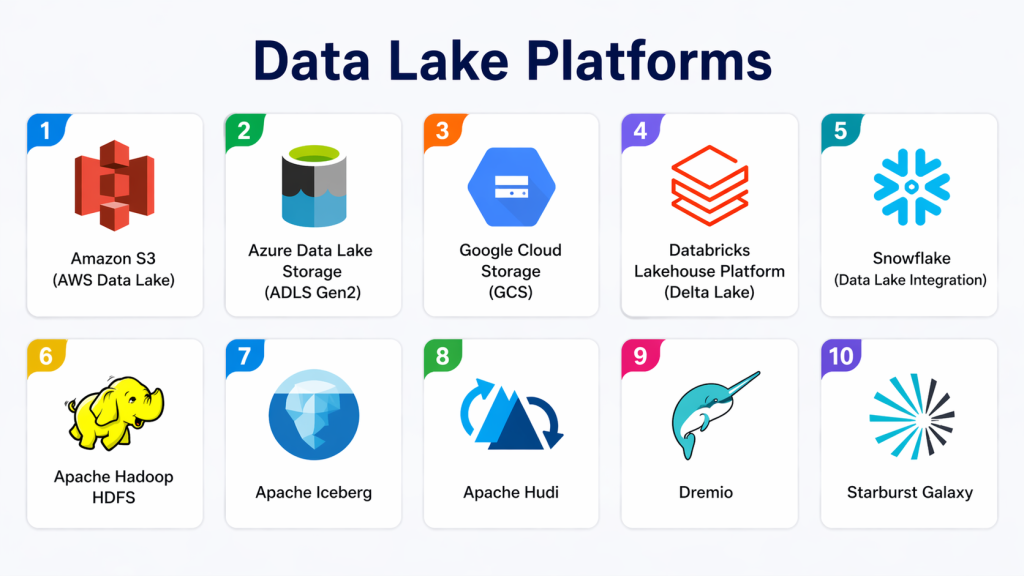
Top 10 Data Lake Platforms
#1 — Amazon S3 (AWS Data Lake Foundation)
A highly scalable object storage platform widely used as the foundation for data lakes in AWS ecosystems.
Key Features
- Unlimited scalable object storage
- High durability and availability
- Integration with AWS analytics tools
- Lifecycle management policies
- Support for structured and unstructured data
Pros
- Industry-standard data lake storage layer
- Highly scalable and cost-efficient
Cons
- Requires additional tools for analytics
- AWS dependency
Platforms / Deployment
Cloud
Security & Compliance
Encryption, IAM, RBAC; Not publicly stated
Integrations & Ecosystem
- AWS Glue
- Athena
- Redshift
- EMR
Support & Community
Strong AWS ecosystem support
#2 — Azure Data Lake Storage (ADLS)
A scalable storage service from Microsoft designed for big data analytics workloads.
Key Features
- Hierarchical namespace
- High throughput storage
- Integration with Azure ecosystem
- Security and access control
- Support for large-scale analytics
Pros
- Strong integration with Microsoft tools
- Enterprise-ready security
Cons
- Azure dependency
- Complex configuration
Platforms / Deployment
Cloud
Security & Compliance
Enterprise-grade encryption; Not publicly stated
Integrations & Ecosystem
- Azure Synapse
- Power BI
- Databricks
Support & Community
Strong Microsoft support
#3 — Google Cloud Storage (GCS)
A highly durable and scalable object storage service used for building data lakes in Google Cloud.
Key Features
- Multi-class storage tiers
- High durability and availability
- Real-time access support
- Integration with BigQuery
- Lifecycle management
Pros
- Simple and highly scalable storage
- Strong AI/ML integration
Cons
- Google Cloud dependency
- Requires external processing tools
Platforms / Deployment
Cloud
Security & Compliance
Google Cloud security; Not publicly stated
Integrations & Ecosystem
- BigQuery
- Vertex AI
- Dataflow
Support & Community
Strong Google ecosystem support
#4 — Databricks Lakehouse Storage (Delta Lake)
A unified data platform combining data lake storage with structured analytics capabilities.
Key Features
- Delta Lake open format
- ACID transactions on data lake
- Streaming + batch processing
- AI/ML integration
- Schema enforcement
Pros
- Bridges lake and warehouse capabilities
- Strong AI/ML ecosystem
Cons
- Requires Spark knowledge
- Complex architecture
Platforms / Deployment
Cloud
Security & Compliance
Governance and encryption; Not publicly stated
Integrations & Ecosystem
- Apache Spark
- BI tools
- ML frameworks
Support & Community
Strong enterprise support
#5 — Snowflake Data Lake Integration
A cloud data platform supporting external data lake integration and analytics on raw data.
Key Features
- External tables support
- Multi-cloud storage compatibility
- High-performance query engine
- Data sharing capabilities
- Structured + semi-structured data support
Pros
- Seamless integration with data lakes
- High-performance analytics
Cons
- Cost increases with scale
- Vendor dependency
Platforms / Deployment
Cloud
Security & Compliance
Strong encryption; Not publicly stated
Integrations & Ecosystem
- AWS S3
- Azure storage
- BI tools
Support & Community
Strong enterprise ecosystem
#6 — Apache Hadoop HDFS
A distributed file system used as one of the earliest and most widely adopted data lake storage systems.
Key Features
- Distributed storage system
- Fault tolerance
- High throughput access
- Batch processing support
- Horizontal scalability
Pros
- Proven big data foundation
- Highly scalable
Cons
- Complex maintenance
- Slower than modern systems
Platforms / Deployment
Cloud / On-premise
Security & Compliance
Basic security layers; Not publicly stated
Integrations & Ecosystem
- Spark
- Hive
- MapReduce
Support & Community
Strong open-source legacy
#7 — Apache Iceberg (Data Lake Table Format)
An open table format designed for large-scale data lakes with efficient metadata handling.
Key Features
- Schema evolution support
- Time travel queries
- High-performance metadata handling
- Engine compatibility
- Partition evolution
Pros
- Open standard for modern data lakes
- Highly flexible
Cons
- Requires external compute engines
- Not a full platform
Platforms / Deployment
Cloud / On-premise
Security & Compliance
Depends on implementation; Not publicly stated
Integrations & Ecosystem
- Spark
- Trino
- Flink
Support & Community
Strong open-source adoption
#8 — Apache Hudi
A data lake framework designed for incremental data processing and real-time ingestion.
Key Features
- Incremental processing
- Upserts and deletes support
- Streaming ingestion
- Time travel queries
- Batch + stream processing
Pros
- Excellent for real-time pipelines
- Efficient data updates
Cons
- Requires Spark ecosystem
- Complex setup
Platforms / Deployment
Cloud / On-premise
Security & Compliance
Depends on stack; Not publicly stated
Integrations & Ecosystem
- Kafka
- Spark
- Hadoop
Support & Community
Strong open-source community
#9 — Azure Data Lake + Synapse Integration
A combined ecosystem for storage and analytics in Microsoft Azure.
Key Features
- Unified analytics engine
- Data lake integration
- Real-time analytics support
- BI integration
- AI/ML support
Pros
- Strong enterprise analytics platform
- Deep Microsoft integration
Cons
- Azure dependency
- Complex architecture
Platforms / Deployment
Cloud
Security & Compliance
Enterprise-grade security; Not publicly stated
Integrations & Ecosystem
- Power BI
- Azure services
- Databricks
Support & Community
Strong Microsoft support
#10 — Dremio Data Lake Platform
A data lake query engine focused on self-service analytics and fast SQL querying over data lakes.
Key Features
- SQL query acceleration
- Data virtualization
- Multi-source connectivity
- Caching layer for performance
- Self-service analytics
Pros
- Easy for BI users
- Fast query performance
Cons
- Limited deep engineering features
- Requires tuning for scale
Platforms / Deployment
Cloud / On-premise
Security & Compliance
Encryption and RBAC; Not publicly stated
Integrations & Ecosystem
- Data lakes
- BI tools
- APIs
Support & Community
Active community
Comparison Table (Top 10)
| Tool Name | Best For | Platform(s) Supported | Deployment | Standout Feature | Public Rating |
|---|---|---|---|---|---|
| Amazon S3 | Cloud storage lakes | Multi | Cloud | Scalability | N/A |
| Azure Data Lake | Microsoft ecosystem | Multi | Cloud | Enterprise security | N/A |
| Google Cloud Storage | AI/ML workloads | Multi | Cloud | AI integration | N/A |
| Databricks | Lakehouse + AI | Multi | Cloud | Delta Lake | N/A |
| Snowflake | Analytics | Multi | Cloud | Data sharing | N/A |
| Hadoop HDFS | Big data systems | Multi | Cloud/On-prem | Distributed storage | N/A |
| Apache Iceberg | Open table format | Multi | Cloud/On-prem | Schema evolution | N/A |
| Apache Hudi | Streaming data | Multi | Cloud/On-prem | Incremental updates | N/A |
| Azure Synapse | Analytics platform | Multi | Cloud | Unified analytics | N/A |
| Dremio | Self-service analytics | Multi | Cloud/On-prem | SQL acceleration | N/A |
Evaluation & Scoring of Data Lake Platforms
| Tool Name | Core | Ease | Integrations | Security | Performance | Support | Value | Total |
|---|---|---|---|---|---|---|---|---|
| Amazon S3 | 10 | 9 | 10 | 9 | 10 | 9 | 9 | 9.4 |
| Azure Data Lake | 10 | 8 | 10 | 10 | 9 | 9 | 8 | 9.0 |
| Google Cloud Storage | 10 | 9 | 10 | 9 | 9 | 9 | 9 | 9.1 |
| Databricks | 10 | 8 | 10 | 9 | 10 | 9 | 8 | 9.1 |
| Snowflake | 9 | 9 | 10 | 9 | 9 | 9 | 8 | 8.9 |
| Hadoop HDFS | 9 | 6 | 8 | 8 | 9 | 8 | 9 | 8.1 |
| Iceberg | 9 | 7 | 9 | 8 | 9 | 8 | 10 | 8.6 |
| Hudi | 9 | 7 | 9 | 8 | 9 | 8 | 9 | 8.4 |
| Azure Synapse | 9 | 8 | 10 | 9 | 9 | 9 | 8 | 8.8 |
| Dremio | 9 | 8 | 9 | 8 | 9 | 8 | 8 | 8.5 |
Which Data Lake Platform Should You Choose?
Solo / Developer
Hadoop HDFS or Iceberg
SMB
Dremio or Google Cloud Storage
Mid-Market
Azure Data Lake or Snowflake integration
Enterprise
Amazon S3, Azure Data Lake, Databricks
AI/ML Workloads
Databricks + GCS + S3
Open Data Ecosystem
Iceberg or Hud
Frequently Asked Questions (FAQs)
1. What is a data lake?
A data lake is a centralized storage system that stores raw data in its original format until it is needed for analysis or processing.
2. How is a data lake different from a data warehouse?
A data lake stores raw and unstructured data, while a data warehouse stores structured and processed data optimized for analytics.
3. What is stored in a data lake?
Structured, semi-structured, and unstructured data like logs, images, videos, and IoT data are stored in data lakes.
4. What is the purpose of a data lake?
It enables large-scale data storage and supports analytics, machine learning, and data science workloads.
5. Is S3 a data lake?
Amazon S3 is commonly used as the storage layer for building data lakes.
6. What is the difference between a data lake and lakehouse?
A lakehouse combines data lake storage with data warehouse analytics capabilities.
7. Are data lakes scalable?
Yes, they are designed to handle petabytes or even exabytes of data.
8. Do data lakes support real-time data?
Yes, many modern data lakes support streaming data ingestion.
9. What tools are used with data lakes?
Tools like Spark, Hadoop, Databricks, and BI tools are commonly used.
10. Are data lakes cloud-based?
Most modern data lakes are cloud-native, but on-premise versions also exist.
Conclusion
Data Lake Platforms are the foundation of modern big data and AI ecosystems. They enable organizations to store massive volumes of raw data at low cost while maintaining flexibility for analytics, machine learning, and real-time processing. With the rise of cloud computing, data lakes have evolved into highly scalable, secure, and AI-ready systems that support advanced analytics pipelines. Platforms like Amazon S3, Azure Data Lake, and Google Cloud Storage dominate the cloud space, while open-source frameworks like Iceberg and Hudi are shaping the future of data architecture.The right choice depends on your cloud ecosystem, scalability needs, and analytics strategy. Ultimately, data lakes empower organizations to store everything, analyze anything, and build intelligence at scale.
