Introduction
Time Series Database (TSDB) Platforms are specialized databases designed to store and analyze data that is indexed by time. This includes data points collected continuously over time such as system metrics, IoT sensor data, financial market prices, application logs, and performance monitoring metrics.
Unlike traditional databases, TSDBs are optimized for high write throughput, time-based queries, compression, and fast aggregation over time ranges.
They are widely used in DevOps monitoring, IoT systems, financial analytics, observability platforms, and real-time analytics systems.
Common use cases include:
- Infrastructure and application monitoring
- IoT sensor data analysis
- Financial trading and stock analysis
- Log analytics and observability
- Real-time dashboards and alerting systems
Key evaluation criteria:
- Write performance for high-frequency data ingestion
- Time-based query speed and aggregation
- Compression efficiency for large datasets
- Scalability for streaming data
- Retention policies and data lifecycle management
- Integration with monitoring and analytics tools
- Cloud and on-premise deployment support
- Real-time alerting and visualization support
Best for: DevOps engineers, IoT developers, data engineers, fintech systems, and observability platforms.
Not ideal for: Traditional transactional systems or relational business applications.
Key Trends in Time Series Database Platforms
- Explosion of observability and monitoring tools
- Cloud-native TSDB adoption (serverless time-series storage)
- Integration with AI/ML for anomaly detection
- Real-time streaming ingestion (Kafka + TSDB pipelines)
- Edge computing for IoT time-series data processing
- Hybrid TSDB + analytics database architectures
- Improved compression algorithms for high-frequency data
- Open-source TSDB dominance in DevOps ecosystems
- Unified observability platforms combining logs + metrics + traces
- Auto-scaling storage for massive telemetry data
How We Selected These Tools (Methodology)
- Strong adoption in monitoring and observability ecosystems
- High ingestion performance for time-series data
- Efficient storage and compression capabilities
- Query performance for time-based analytics
- Cloud and distributed deployment support
- Integration with DevOps and IoT tools
- Real-time dashboard and alerting support
- Scalability for high-volume telemetry data
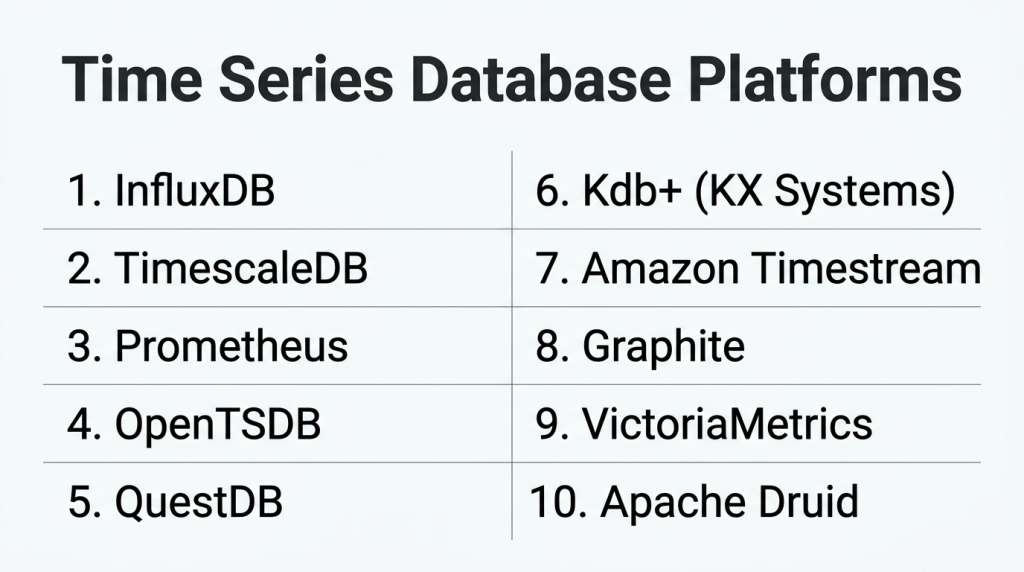
Top 10 Time Series Database Platforms
#1 — InfluxDB
A leading time series database designed for high-speed ingestion and real-time analytics of time-stamped data.
Key Features
- High write throughput
- SQL-like query language (Flux)
- Data retention policies
- Built-in visualization support
- Real-time analytics
Pros
- Strong ecosystem for monitoring
- Easy to use for DevOps
Cons
- Resource-heavy at scale
- Advanced features require paid version
Platforms / Deployment
Cloud / On-premise
Security & Compliance
Encryption and RBAC; Not publicly stated
Integrations & Ecosystem
- Grafana
- IoT platforms
- Monitoring tools
Support & Community
Strong open-source community
#2 — TimescaleDB
A PostgreSQL-based time series database that extends SQL capabilities for time-based data.
Key Features
- Built on PostgreSQL
- SQL support for time-series queries
- Compression and partitioning
- Continuous aggregates
- Scalability
Pros
- Familiar SQL interface
- Strong PostgreSQL ecosystem
Cons
- Requires tuning at scale
- Complex architecture for beginners
Platforms / Deployment
Cloud / On-premise
Security & Compliance
PostgreSQL security model; Not publicly stated
Integrations & Ecosystem
- PostgreSQL tools
- BI platforms
- APIs
Support & Community
Strong open-source support
#3 — Prometheus
A widely used open-source monitoring system and time series database for metrics collection and alerting.
Key Features
- Metrics scraping model
- Powerful query language (PromQL)
- Alerting system
- Service discovery
- Kubernetes integration
Pros
- Industry standard for DevOps
- Strong Kubernetes support
Cons
- Limited long-term storage
- Not ideal for large-scale analytics
Platforms / Deployment
Cloud / On-premise
Security & Compliance
Basic security; Not publicly stated
Integrations & Ecosystem
- Kubernetes
- Grafana
- DevOps tools
Support & Community
Very strong open-source community
#4 — OpenTSDB
A distributed time series database built on top of HBase for large-scale data storage.
Key Features
- Scalable architecture
- HBase backend
- High ingestion rate
- Long-term storage
- REST APIs
Pros
- Handles massive datasets
- Reliable storage system
Cons
- Complex setup
- Requires HBase knowledge
Platforms / Deployment
Cloud / On-premise
Security & Compliance
HBase security model; Not publicly stated
Integrations & Ecosystem
- Hadoop ecosystem
- Big data tools
- APIs
Support & Community
Open-source community
#5 — QuestDB
A high-performance open-source time series database optimized for fast ingestion and SQL querying.
Key Features
- SQL support
- High-speed ingestion
- Columnar storage
- Low-latency queries
- Streaming ingestion
Pros
- Extremely fast performance
- Easy SQL interface
Cons
- Smaller ecosystem
- Less enterprise adoption
Platforms / Deployment
Cloud / On-premise
Security & Compliance
Basic encryption; Not publicly stated
Integrations & Ecosystem
- Kafka
- Analytics tools
- APIs
Support & Community
Growing community
#6 — Kdb+ (KX Systems)
A high-performance in-memory time series database widely used in financial trading systems.
Key Features
- Ultra-low latency processing
- In-memory architecture
- Real-time analytics
- Powerful q language
- High-frequency trading support
Pros
- Industry-leading speed
- Ideal for financial markets
Cons
- High learning curve
- Expensive licensing
Platforms / Deployment
Cloud / On-premise
Security & Compliance
Enterprise-grade; Not publicly stated
Integrations & Ecosystem
- Financial systems
- APIs
- Analytics tools
Support & Community
Enterprise support
#7 — Amazon Timestream
A fully managed serverless time series database from AWS.
Key Features
- Serverless scaling
- Automatic data tiering
- Real-time analytics
- AWS integration
- Built-in retention policies
Pros
- Fully managed service
- Easy scaling
Cons
- AWS lock-in
- Limited customization
Platforms / Deployment
Cloud
Security & Compliance
AWS-grade encryption; Not publicly stated
Integrations & Ecosystem
- AWS services
- IoT Core
- Analytics tools
Support & Community
Strong AWS support
#8 — Graphite
A classic open-source time series database used for monitoring and graphing metrics.
Key Features
- Metrics storage
- Graphing system
- Whisper storage engine
- Time-based data retention
- Simple architecture
Pros
- Simple and reliable
- Good for monitoring
Cons
- Limited scalability
- Outdated architecture
Platforms / Deployment
Cloud / On-premise
Security & Compliance
Basic security; Not publicly stated
Integrations & Ecosystem
- Grafana
- Monitoring tools
- APIs
Support & Community
Active open-source usage
#9 — VictoriaMetrics
A fast, cost-efficient time series database designed for high-performance monitoring systems.
Key Features
- High compression efficiency
- PromQL compatibility
- Scalable architecture
- Low resource usage
- Long-term storage
Pros
- Very efficient storage
- High performance
Cons
- Smaller ecosystem
- Requires configuration
Platforms / Deployment
Cloud / On-premise
Security & Compliance
Encryption support; Not publicly stated
Integrations & Ecosystem
- Prometheus
- Grafana
- Monitoring stacks
Support & Community
Strong growing community
#10 — Apache Druid
A real-time analytics database optimized for time series and event-driven data.
Key Features
- Real-time ingestion
- Fast OLAP queries
- Columnar storage
- Distributed architecture
- Streaming data support
Pros
- Excellent analytics performance
- Real-time processing
Cons
- Complex architecture
- Requires tuning
Platforms / Deployment
Cloud / On-premise
Security & Compliance
Enterprise security; Not publicly stated
Integrations & Ecosystem
- Kafka
- BI tools
- APIs
Support & Community
Strong open-source community
Comparison Table (Top 10)
| Tool Name | Best For | Platform(s) Supported | Deployment | Standout Feature | Public Rating |
|---|---|---|---|---|---|
| InfluxDB | Monitoring | Multi | Cloud/On-prem | High ingestion speed | N/A |
| TimescaleDB | SQL analytics | Multi | Cloud/On-prem | PostgreSQL-based | N/A |
| Prometheus | DevOps monitoring | Multi | Cloud/On-prem | Metrics scraping | N/A |
| OpenTSDB | Big data storage | Multi | Cloud/On-prem | HBase backend | N/A |
| QuestDB | Fast analytics | Multi | Cloud/On-prem | Low latency SQL | N/A |
| Kdb+ | Finance trading | Multi | Cloud/On-prem | Ultra-low latency | N/A |
| Timestream | AWS users | Multi | Cloud | Serverless scaling | N/A |
| Graphite | Metrics monitoring | Multi | Cloud/On-prem | Simple graphing | N/A |
| VictoriaMetrics | Cost-efficient monitoring | Multi | Cloud/On-prem | High compression | N/A |
| Apache Druid | Real-time analytics | Multi | Cloud/On-prem | OLAP queries | N/A |
Evaluation & Scoring of Time Series Database Platforms
| Tool Name | Core | Ease | Integrations | Security | Performance | Support | Value | Total |
|---|---|---|---|---|---|---|---|---|
| InfluxDB | 10 | 9 | 9 | 9 | 10 | 9 | 8 | 9.2 |
| TimescaleDB | 9 | 9 | 9 | 9 | 9 | 9 | 9 | 9.0 |
| Prometheus | 9 | 8 | 10 | 8 | 9 | 9 | 10 | 8.9 |
| OpenTSDB | 8 | 6 | 8 | 8 | 9 | 8 | 9 | 8.1 |
| QuestDB | 9 | 8 | 8 | 8 | 10 | 8 | 9 | 8.7 |
| Kdb+ | 10 | 6 | 8 | 9 | 10 | 9 | 6 | 8.4 |
| Timestream | 9 | 9 | 9 | 9 | 9 | 9 | 7 | 8.6 |
| Graphite | 8 | 8 | 8 | 8 | 8 | 8 | 9 | 8.2 |
| VictoriaMetrics | 9 | 8 | 9 | 9 | 10 | 8 | 9 | 8.8 |
| Apache Druid | 9 | 7 | 9 | 9 | 10 | 9 | 8 | 8.7 |
Which Time Series Database Should You Choose?
Solo / Developer
Prometheus or InfluxDB
SMB
TimescaleDB or QuestDB
Mid-Market
InfluxDB or VictoriaMetrics
Enterprise
Apache Druid, Kdb+, Timestream
DevOps Monitoring
Prometheus or Graphite
High-Frequency Trading
Kdb+
Frequently Asked Questions (FAQs)
1. What is a Time Series Database?
A database optimized for storing and analyzing time-stamped data such as metrics and logs.
2. Why use TSDB instead of SQL?
TSDBs are faster and more efficient for time-based queries and high-volume data ingestion.
3. What data is stored in TSDB?
Metrics, IoT data, logs, financial data, and performance metrics.
4. Is Prometheus a database?
Yes, it is both a monitoring system and a time series database.
5. What is the best TSDB for beginners?
InfluxDB or TimescaleDB.
6. What is high-frequency time series data?
Very fast, continuous data streams like stock trades or sensor readings.
7. Are TSDBs scalable?
Yes, most modern TSDBs are built for distributed scaling.
8. Can TSDBs handle real-time analytics?
Yes, many support real-time ingestion and querying.
9. What is downsampling in TSDB?
It is the process of reducing data resolution over time to save storage.
10. Are TSDBs used in IoT?
Yes, they are widely used for sensor data collection and analysis.
Conclusion
Time Series Database Platforms are critical for modern observability, IoT systems, and real-time analytics applications. As data continues to grow in velocity and volume, TSDBs provide the performance and efficiency needed to process continuous streams of time-stamped data. From Prometheus in DevOps to InfluxDB in monitoring, and from Kdb+ in financial systems to Apache Druid in analytics, each platform serves a specialized purpose. The right choice depends on your workload, scalability needs, and use case—whether it’s monitoring infrastructure, analyzing financial data, or powering IoT ecosystems. Ultimately, TSDBs enable organizations to transform time-based data into actionable insights in real time, making them essential for modern data-driven systems.
