Introduction
Prompt Engineering Tools are platforms that help users design, test, optimize, and manage prompts used with large language models (LLMs). Instead of manually writing prompts and hoping for consistent results, these tools provide structured workflows, testing environments, version control, and performance tracking.
In the current AI-driven landscape, prompt engineering has become a critical skill. Businesses rely on AI for automation, content generation, customer support, coding, and decision-making. Poorly designed prompts lead to inconsistent outputs, while optimized prompts improve accuracy, reliability, and efficiency.
Common use cases include:
- AI chatbot development and optimization
- Content generation workflows (blogs, ads, emails)
- Code generation and debugging
- AI-powered customer support automation
- Data extraction and summarization
Key evaluation criteria:
- Prompt testing and versioning capabilities
- Model compatibility
- Collaboration and team workflows
- Integration with APIs and tools
- Security and compliance features
- Performance monitoring and analytics
- Ease of use and learning curve
- Deployment flexibility
Best for: AI developers, product teams, marketers, automation engineers, startups, and enterprises building AI-powered workflows.
Not ideal for: Users who only need occasional AI usage or simple chatbot interactions—basic AI tools may be sufficient without dedicated prompt engineering platforms.
Key Trends in Prompt Engineering Tools
- Rise of AI-assisted prompt generation and auto-optimization
- Integration with multi-model environments
- Increased focus on prompt versioning and governance
- Built-in evaluation frameworks and benchmarking tools
- Growth of low-code/no-code prompt builders
- Stronger security, compliance, and audit logging features
- Adoption of real-time testing and simulation environments
- Expansion of collaborative prompt engineering workflows
- Shift toward end-to-end LLM lifecycle platforms
- Integration with CI/CD pipelines for AI deployment
How We Selected These Tools (Methodology)
- Evaluated market adoption and developer mindshare
- Assessed feature completeness and innovation
- Reviewed performance reliability signals
- Considered security and compliance capabilities
- Analyzed integration ecosystems and extensibility
- Included tools suitable for both technical and non-technical users
- Balanced enterprise-grade and developer-first tools
- Focused on tools supporting modern AI workflows
- Considered scalability and deployment flexibility
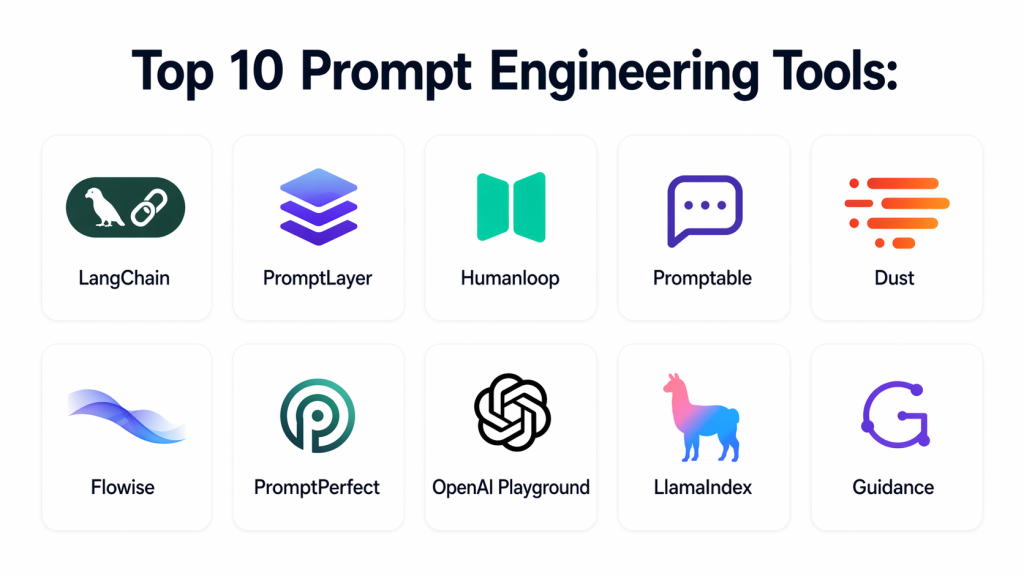
Top 10 Prompt Engineering Tools
#1 — LangChain
Short description: A widely adopted framework for building LLM applications, enabling prompt chaining, memory, and integrations. Best for developers building complex AI workflows.
Key Features
- Prompt templates and chaining
- Memory and context management
- Multi-model support
- Agent-based workflows
- Extensive integrations
- Debugging and tracing tools
Pros
- Highly flexible and customizable
- Large developer ecosystem
Cons
- Steep learning curve
- Requires coding knowledge
Platforms / Deployment
Cloud / Self-hosted
Security & Compliance
Varies / Not publicly stated
Integrations & Ecosystem
Strong integration ecosystem including APIs, vector databases, and cloud services.
- OpenAI
- Hugging Face
- Pinecone
- AWS
- Google Cloud
Support & Community
Large open-source community, extensive documentation, active forums.
#2 — PromptLayer
Short description: A tool focused on prompt tracking, logging, and versioning. Ideal for teams needing visibility into prompt performance.
Key Features
- Prompt logging and history
- Version control
- Performance tracking
- Debugging tools
- API monitoring
Pros
- Easy to integrate
- Strong observability
Cons
- Limited advanced features
- Depends on external LLMs
Platforms / Deployment
Cloud
Security & Compliance
Not publicly stated
Integrations & Ecosystem
Works with major LLM APIs and developer tools.
- OpenAI
- Python SDKs
- API integrations
Support & Community
Moderate documentation and developer support.
#3 — Humanloop
Short description: A collaborative prompt engineering platform designed for teams building AI products with evaluation and feedback loops.
Key Features
- Prompt testing and evaluation
- Human-in-the-loop feedback
- Version control
- Dataset management
- Experiment tracking
Pros
- Strong collaboration features
- Built-in evaluation tools
Cons
- Enterprise-focused pricing
- Learning curve for beginners
Platforms / Deployment
Cloud
Security & Compliance
Not publicly stated
Integrations & Ecosystem
Supports AI model APIs and data workflows.
- OpenAI
- APIs
- Data pipelines
Support & Community
Enterprise-grade support, growing community.
#4 — Promptable
Short description: A prompt management tool focused on testing, evaluation, and versioning workflows.
Key Features
- Prompt versioning
- Testing frameworks
- Performance evaluation
- Prompt comparison tools
- Collaboration features
Pros
- Structured workflow
- Easy prompt comparison
Cons
- Limited ecosystem
- Smaller community
Platforms / Deployment
Cloud
Security & Compliance
Not publicly stated
Integrations & Ecosystem
Basic integrations with LLM APIs.
- OpenAI
- API-based integrations
Support & Community
Limited but improving documentation.
#5 — Dust
Short description: A platform for building and deploying AI assistants with strong prompt customization capabilities.
Key Features
- AI workflow builder
- Prompt customization
- Multi-agent orchestration
- Data integration
- Automation tools
Pros
- Strong enterprise capabilities
- Flexible workflows
Cons
- Complex setup
- Pricing not transparent
Platforms / Deployment
Cloud
Security & Compliance
Not publicly stated
Integrations & Ecosystem
Supports enterprise integrations and APIs.
- Internal data sources
- APIs
- SaaS tools
Support & Community
Enterprise-focused support.
#6 — Flowise
Short description: A low-code tool for building LLM workflows using visual interfaces.
Key Features
- Drag-and-drop interface
- Prompt chaining
- API integration
- Open-source support
- Multi-model compatibility
Pros
- Beginner-friendly
- Open-source flexibility
Cons
- Limited enterprise features
- Requires hosting setup
Platforms / Deployment
Self-hosted / Cloud
Security & Compliance
Varies
Integrations & Ecosystem
Supports common AI tools and APIs.
- LangChain
- OpenAI
- APIs
Support & Community
Active open-source community.
#7 — PromptPerfect
Short description: A tool focused on automatic prompt optimization and enhancement.
Key Features
- Prompt rewriting
- Optimization algorithms
- Multi-model support
- Performance improvement tools
- AI-assisted suggestions
Pros
- Saves time
- Improves output quality
Cons
- Limited customization
- Black-box optimization
Platforms / Deployment
Cloud
Security & Compliance
Not publicly stated
Integrations & Ecosystem
Works with major AI models.
- OpenAI
- LLM APIs
Support & Community
Moderate support resources.
#8 — Playground AI (OpenAI Playground)
Short description: A testing environment for experimenting with prompts and model configurations.
Key Features
- Prompt testing
- Parameter tuning
- Model comparison
- Output preview
- Iteration workflows
Pros
- Easy to use
- Direct access to models
Cons
- Limited collaboration
- Not a full platform
Platforms / Deployment
Cloud
Security & Compliance
Varies
Integrations & Ecosystem
Primarily tied to OpenAI ecosystem.
Support & Community
Strong documentation and community.
#9 — LlamaIndex
Short description: A framework for building context-aware AI applications with strong prompt control.
Key Features
- Data indexing
- Context management
- Prompt customization
- Integration with LLMs
- Retrieval-augmented generation
Pros
- Powerful for data-driven apps
- Flexible architecture
Cons
- Developer-focused
- Setup complexity
Platforms / Deployment
Cloud / Self-hosted
Security & Compliance
Varies
Integrations & Ecosystem
Works with multiple data sources and APIs.
- Vector databases
- OpenAI
- APIs
Support & Community
Growing open-source ecosystem.
#10 — Guidance
Short description: A developer-focused tool for controlling LLM outputs using structured prompt programming.
Key Features
- Prompt programming
- Control over outputs
- Template-based prompts
- Conditional logic
- Advanced debugging
Pros
- High precision control
- Suitable for developers
Cons
- Not beginner-friendly
- Limited UI
Platforms / Deployment
Self-hosted / Cloud
Security & Compliance
Not publicly stated
Integrations & Ecosystem
Works with LLM APIs and developer tools.
Support & Community
Smaller but active developer community.
Comparison Table (Top 10)
| Tool Name | Best For | Platform(s) Supported | Deployment | Standout Feature | Public Rating |
|---|---|---|---|---|---|
| LangChain | Developers | Multi-platform | Hybrid | Prompt chaining | N/A |
| PromptLayer | Monitoring | Web | Cloud | Prompt tracking | N/A |
| Humanloop | Teams | Web | Cloud | Evaluation workflows | N/A |
| Promptable | Testing | Web | Cloud | Prompt comparison | N/A |
| Dust | Enterprise | Web | Cloud | AI workflow builder | N/A |
| Flowise | Beginners | Web | Hybrid | Visual builder | N/A |
| PromptPerfect | Optimization | Web | Cloud | Auto prompt tuning | N/A |
| Playground AI | Testing | Web | Cloud | Model experimentation | N/A |
| LlamaIndex | Data apps | Multi-platform | Hybrid | Context management | N/A |
| Guidance | Developers | Multi-platform | Hybrid | Prompt programming | N/A |
Evaluation & Scoring of Prompt Engineering Tools
| Tool Name | Core | Ease | Integrations | Security | Performance | Support | Value | Weighted Total |
|---|---|---|---|---|---|---|---|---|
| LangChain | 9 | 6 | 9 | 6 | 8 | 8 | 7 | 7.9 |
| PromptLayer | 7 | 8 | 7 | 6 | 7 | 7 | 7 | 7.1 |
| Humanloop | 8 | 7 | 7 | 6 | 8 | 8 | 6 | 7.3 |
| Promptable | 7 | 7 | 6 | 6 | 7 | 6 | 7 | 6.8 |
| Dust | 8 | 6 | 8 | 7 | 8 | 7 | 6 | 7.4 |
| Flowise | 7 | 9 | 7 | 6 | 7 | 7 | 8 | 7.5 |
| PromptPerfect | 7 | 9 | 6 | 5 | 7 | 6 | 8 | 7.2 |
| Playground AI | 6 | 9 | 6 | 6 | 7 | 7 | 8 | 7.0 |
| LlamaIndex | 9 | 6 | 8 | 6 | 8 | 7 | 7 | 7.8 |
| Guidance | 8 | 5 | 7 | 6 | 8 | 6 | 7 | 7.0 |
How to interpret scores:
These scores are comparative and help you evaluate strengths across categories. A higher score indicates a stronger overall tool, but the best choice depends on your specific use case. Tools with lower ease-of-use scores may still be powerful for technical teams. Always align scoring with your workflow needs and team expertise.
Which Prompt Engineering Tool Is Right for You?
Solo / Freelancer
Flowise or PromptPerfect are ideal due to ease of use and quick setup.
SMB
PromptLayer and Humanloop offer a balance of usability and collaboration.
Mid-Market
Dust and Promptable provide structured workflows and scalability.
Enterprise
LangChain and Humanloop are strong choices for complex AI deployments.
Budget vs Premium
Open-source tools like Flowise and LlamaIndex are budget-friendly, while enterprise tools offer advanced capabilities.
Feature Depth vs Ease of Use
LangChain provides deep flexibility, while Flowise is easier for beginners.
Integrations & Scalability
LangChain and LlamaIndex excel in integration-heavy environments.
Security & Compliance Needs
Enterprises should prioritize tools with audit logs and access controls.
Frequently Asked Questions (FAQs)
1. What are Prompt Engineering Tools?
They help design, test, and optimize prompts for AI models, ensuring consistent and high-quality outputs across different use cases.
2. Are these tools only for developers?
No, some tools are beginner-friendly with visual interfaces, while others are designed for advanced users and developers.
3. How much do these tools cost?
Pricing varies widely. Some are open-source or free, while others follow subscription-based models.
4. Do they support multiple AI models?
Most tools support multiple LLM providers, enabling flexibility across platforms.
5. How long does implementation take?
Basic setup may take a few hours, while complex enterprise deployments may take longer depending on integrations.
6. Are these tools secure?
Security features vary. Some offer enterprise-grade protections, while others require custom implementation.
7. Can I switch tools later?
Yes, but migrating prompts and workflows may require effort depending on compatibility.
8. Do these tools improve AI accuracy?
Yes, optimized prompts can significantly improve consistency and output quality.
9. What are common mistakes?
Not testing prompts, skipping version control, and ignoring evaluation frameworks are common issues.
10. Are there alternatives?
Basic AI tools can be used, but they lack structured prompt management and optimization features.
Conclusion
Prompt engineering tools are becoming essential as AI adoption continues to grow across industries. They provide structure, consistency, and scalability to prompt design, which directly impacts the performance of AI systems. Without proper tools, managing prompts at scale becomes inefficient and error-prone. There is no single “best” tool for every use case. Developers may prefer flexible frameworks like LangChain or LlamaIndex, while teams may benefit from collaborative platforms like Humanloop. Beginners and smaller teams might find tools like Flowise or PromptPerfect more accessible and easier to implement. The right approach is to evaluate your requirements carefully—consider your team’s expertise, integration needs, and scalability goals. Start by shortlisting two or three tools that align with your workflow. Run pilot projects, test prompt performance, and validate integrations before making a final decision. This ensures the selected tool delivers long-term value and supports your AI strategy effectively.
