Introduction
AI Content Generation Tools are platforms that use artificial intelligence—especially natural language processing and generative models—to create written content such as blogs, ads, emails, product descriptions, and social media posts. Instead of starting from scratch, users can generate high-quality drafts, refine messaging, and scale content production efficiently.
As content demand continues to grow across digital channels, these tools have become essential for marketing teams, creators, and businesses aiming to maintain consistency and speed without compromising quality. Modern platforms now go beyond basic text generation, offering tone control, SEO optimization, brand voice alignment, and even multilingual content creation.
Real-world use cases include:
- Blog writing and long-form content creation
- Social media posts and ad copy generation
- Email marketing campaigns
- Product descriptions for e-commerce
- Content repurposing and summarization
What buyers should evaluate:
- Content quality and coherence
- Customization (tone, style, brand voice)
- SEO and optimization features
- Ease of use and interface
- Integration with marketing and CMS tools
- Multilingual support
- Collaboration and workflow features
- Output speed and scalability
- Data privacy and security
- Pricing and usage limits
Best for: Marketers, content creators, agencies, startups, and enterprises scaling content production.
Not ideal for: Highly specialized or regulated content requiring strict human oversight, or teams that need fully original research-driven outputs without AI assistance.
Key Trends in AI Content Generation Tools
- Integration with large language models for high-quality outputs
- Built-in SEO optimization and keyword suggestions
- Brand voice customization and tone control
- Multilingual and localization capabilities
- AI-assisted editing, rewriting, and summarization
- Workflow automation and team collaboration features
- Expansion into multimodal content (text + image + video)
- Increased focus on content originality and detection tools
- Real-time content suggestions and auto-completion
- API-based integrations for scalable content pipelines
How We Selected These Tools (Methodology)
We selected the top tools based on:
- Market popularity and adoption
- Content quality and reliability
- Feature depth and versatility
- Ease of use for different user levels
- Integration with marketing ecosystems
- Scalability for individuals and enterprises
- Performance and speed
- Security and privacy considerations
- Customer support and documentation
- Overall value for content creation workflows
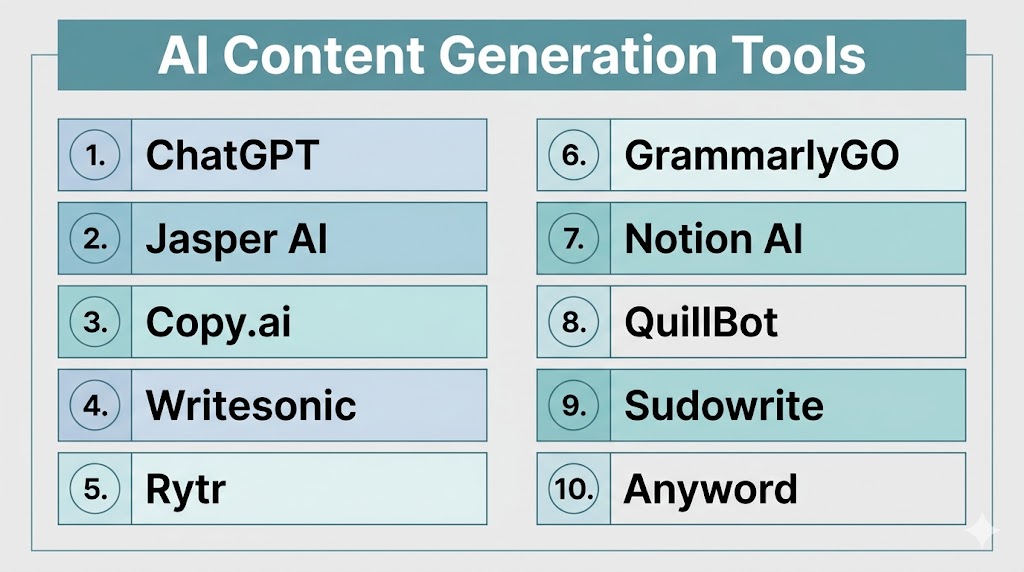
Top 10 AI Content Generation Tools
#1 — ChatGPT
Short description: A versatile AI platform for generating conversational and long-form content across multiple use cases.
Key Features
- Long-form content generation
- Conversational AI interface
- Code and text generation
- Custom instructions and prompts
- Multi-use capabilities
- Context-aware responses
Pros
- Highly flexible
- Strong content quality
Cons
- Requires prompt refinement
- Output may need editing
Platforms / Deployment
Web / Cloud
Security & Compliance
Not publicly stated
Integrations & Ecosystem
Widely used across workflows with APIs and integrations.
- APIs
- Automation tools
- Content platforms
Support & Community
Very large global user base
#2 — Jasper AI
Short description: A marketing-focused AI writing tool designed for brands and teams.
Key Features
- Brand voice customization
- Marketing templates
- SEO integration
- Campaign workflows
- Collaboration tools
- Long-form editor
Pros
- Strong for marketing teams
- Easy to use
Cons
- Higher pricing
- Limited flexibility outside marketing
Platforms / Deployment
Web / Cloud
Security & Compliance
Not publicly stated
Integrations & Ecosystem
- Marketing tools
- APIs
- CMS platforms
Support & Community
Strong enterprise support
#3 — Copy.ai
Short description: A user-friendly platform for generating marketing and sales content quickly.
Key Features
- Content templates
- Sales and marketing workflows
- Blog generation
- Automation features
- Multi-language support
Pros
- Easy for beginners
- Fast output
Cons
- Limited advanced customization
- Repetitive outputs sometimes
Platforms / Deployment
Web / Cloud
Security & Compliance
Not publicly stated
Integrations & Ecosystem
- APIs
- CRM tools
Support & Community
Growing user community
#4 — Writesonic
Short description: An AI writing platform focused on SEO and long-form content creation.
Key Features
- Blog and article generation
- SEO optimization tools
- AI chatbot integration
- Content templates
- Multi-language support
Pros
- Strong SEO features
- Versatile
Cons
- Learning curve
- Output quality varies
Platforms / Deployment
Web / Cloud
Security & Compliance
Not publicly stated
Integrations & Ecosystem
- APIs
- Marketing tools
Support & Community
Moderate support
#5 — Rytr
Short description: A budget-friendly AI writing tool for short-form content.
Key Features
- Content templates
- Tone customization
- Short-form content generation
- Multi-language support
- Simple interface
Pros
- Affordable
- Easy to use
Cons
- Limited long-form capabilities
- Basic features
Platforms / Deployment
Web / Cloud
Security & Compliance
Not publicly stated
Integrations & Ecosystem
- APIs
Support & Community
Moderate support
#6 — GrammarlyGO
Short description: An AI-powered writing assistant integrated with grammar and style checking tools.
Key Features
- Writing suggestions
- Tone adjustments
- Content rewriting
- Grammar and clarity checks
- Email drafting
Pros
- Strong editing capabilities
- Easy integration
Cons
- Limited content generation depth
- Focused on editing
Platforms / Deployment
Web / Desktop / Mobile
Security & Compliance
Not publicly stated
Integrations & Ecosystem
- Writing tools
- Browser extensions
Support & Community
Large user base
#7 — Notion AI
Short description: An AI assistant integrated into a productivity and note-taking platform.
Key Features
- Content generation inside documents
- Summarization
- Task automation
- Collaboration features
- Knowledge management
Pros
- Seamless workflow integration
- Great for teams
Cons
- Limited standalone use
- Requires Notion ecosystem
Platforms / Deployment
Web / Desktop / Mobile
Security & Compliance
Not publicly stated
Integrations & Ecosystem
- Productivity tools
- APIs
Support & Community
Strong community
#8 — QuillBot
Short description: A tool focused on rewriting, paraphrasing, and improving text.
Key Features
- Paraphrasing
- Grammar checking
- Summarization
- Citation tools
- Tone adjustment
Pros
- Excellent for rewriting
- Easy to use
Cons
- Limited content generation
- Basic features
Platforms / Deployment
Web
Security & Compliance
Not publicly stated
Integrations & Ecosystem
- Writing tools
Support & Community
Moderate support
#9 — Sudowrite
Short description: A creative writing tool designed for authors and storytellers.
Key Features
- Story generation
- Creative prompts
- Character and plot tools
- Writing assistance
- Idea expansion
Pros
- Great for creative writing
- Unique features
Cons
- Not for business content
- Niche use case
Platforms / Deployment
Web
Security & Compliance
Not publicly stated
Integrations & Ecosystem
- Writing tools
Support & Community
Niche community
#10 — Anyword
Short description: A data-driven AI writing platform focused on performance marketing.
Key Features
- Predictive performance scoring
- Ad copy generation
- A/B testing insights
- Marketing templates
- Analytics integration
Pros
- Data-driven insights
- Strong for ads
Cons
- Expensive
- Limited general use
Platforms / Deployment
Web / Cloud
Security & Compliance
Not publicly stated
Integrations & Ecosystem
- Marketing platforms
- APIs
Support & Community
Enterprise support
Comparison Table (Top 10)
| Tool Name | Best For | Platform(s) Supported | Deployment | Standout Feature | Public Rating |
|---|---|---|---|---|---|
| ChatGPT | General use | Web | Cloud | Versatility | N/A |
| Jasper | Marketing teams | Web | Cloud | Brand voice | N/A |
| Copy.ai | Beginners | Web | Cloud | Templates | N/A |
| Writesonic | SEO content | Web | Cloud | Optimization | N/A |
| Rytr | Budget users | Web | Cloud | Affordability | N/A |
| GrammarlyGO | Editing | Multi-platform | Cloud | Grammar AI | N/A |
| Notion AI | Productivity | Multi-platform | Cloud | Workflow integration | N/A |
| QuillBot | Rewriting | Web | Cloud | Paraphrasing | N/A |
| Sudowrite | Creative writing | Web | Cloud | Story tools | N/A |
| Anyword | Ads | Web | Cloud | Predictive scoring | N/A |
Evaluation & Scoring of AI Content Generation Tools
| Tool Name | Core (25%) | Ease (15%) | Integrations (15%) | Security (10%) | Performance (10%) | Support (10%) | Value (15%) | Weighted Total |
|---|---|---|---|---|---|---|---|---|
| ChatGPT | 10 | 9 | 9 | 8 | 9 | 9 | 9 | 9.3 |
| Jasper | 9 | 9 | 8 | 8 | 8 | 8 | 7 | 8.3 |
| Copy.ai | 8 | 9 | 7 | 7 | 8 | 7 | 8 | 7.9 |
| Writesonic | 8 | 8 | 7 | 7 | 8 | 7 | 8 | 7.8 |
| Rytr | 7 | 9 | 6 | 6 | 7 | 6 | 9 | 7.5 |
| GrammarlyGO | 7 | 9 | 7 | 7 | 8 | 8 | 7 | 7.7 |
| Notion AI | 8 | 9 | 8 | 7 | 8 | 8 | 7 | 8.0 |
| QuillBot | 6 | 9 | 6 | 6 | 7 | 7 | 8 | 7.2 |
| Sudowrite | 7 | 8 | 5 | 6 | 7 | 6 | 7 | 6.9 |
| Anyword | 8 | 8 | 8 | 7 | 8 | 7 | 6 | 7.6 |
How to interpret scores:
- Scores are relative comparisons
- Higher scores indicate broader capability
- Marketing tools excel in specific use cases
- General tools offer more flexibility
- Choose based on your workflow needs
Which AI Content Generation Tool Is Right for You?
Solo / Freelancer
- Best: Rytr, ChatGPT
- Affordable and flexible
SMB
- Best: Copy.ai, Writesonic
- Balanced features and usability
Mid-Market
- Best: Jasper, Notion AI
- Scalable and collaborative
Enterprise
- Best: Jasper, Anyword
- Advanced workflows and analytics
Budget vs Premium
- Budget: Rytr, QuillBot
- Premium: Jasper, Anyword
Feature Depth vs Ease of Use
- Depth: ChatGPT, Jasper
- Ease: Copy.ai, Rytr
Integrations & Scalability
- Strong: ChatGPT, Jasper
- Moderate: QuillBot, Rytr
Security & Compliance Needs
- Enterprise tools provide better governance
- Simpler tools require additional checks
Frequently Asked Questions (FAQs)
What are AI content generation tools?
These are platforms that use AI to create written content automatically. They help generate blogs, ads, emails, and more. They improve productivity and consistency.
Are AI-generated contents high quality?
Yes, modern tools can produce high-quality drafts. However, human editing is often required. Quality depends on prompts and tool capability.
Can these tools replace human writers?
They assist rather than replace writers. Creativity and strategy still require human input. They are best used as productivity tools.
Are these tools SEO-friendly?
Many tools include SEO features. They help optimize content for search engines. However, strategy still matters.
Do I need technical skills?
Most tools are beginner-friendly. Some advanced features may require basic understanding. No coding is usually needed.
Are AI tools expensive?
Costs vary widely. Some tools offer free plans. Enterprise tools can be expensive.
Can AI tools generate plagiarism-free content?
Most tools generate original content. However, checking is recommended. Use plagiarism tools if needed.
Which tool is best for beginners?
Copy.ai and Rytr are beginner-friendly. They offer simple interfaces. ChatGPT is also flexible.
Can AI generate long-form blogs?
Yes, many tools support long-form content. Quality depends on prompts. Editing is often required.
How do I choose the right tool?
Consider your use case and budget. Evaluate features and ease of use. Testing tools is recommended.
Conclusion
AI content generation tools are transforming how individuals and businesses create content at scale. They enable faster production, improved consistency, and enhanced creativity across various content formats. Choosing the right tool depends on your goals—whether you need quick social media posts, SEO-optimized blogs, or data-driven marketing copy. While these tools offer powerful capabilities, human oversight remains essential to ensure quality and originality. Integration with existing workflows can significantly improve efficiency and output. Budget and scalability should be carefully evaluated before selecting a platform. Testing multiple tools can help identify the best fit for your needs. As AI continues to evolve, these platforms will become even more advanced and integral to digital content strategies.
