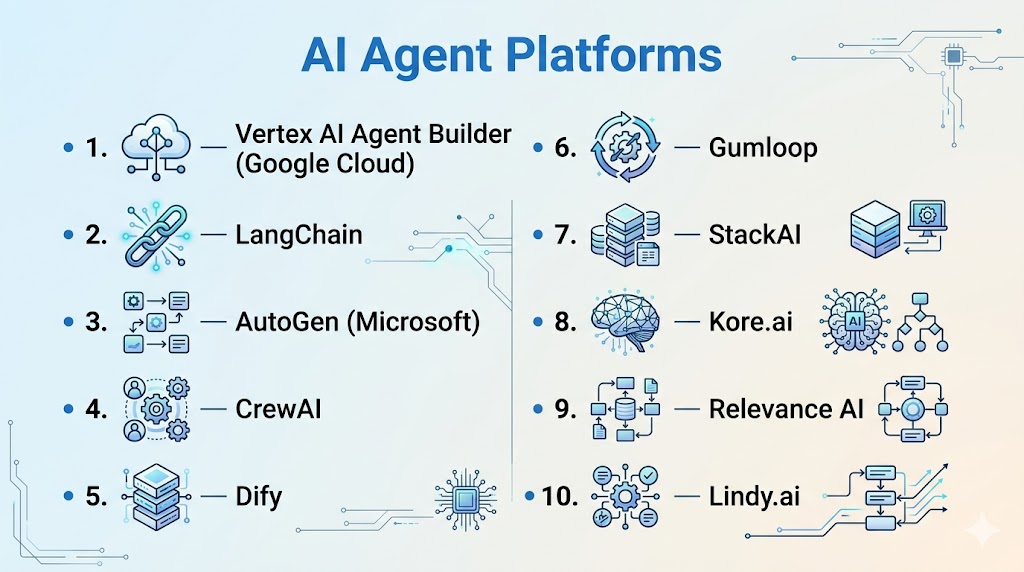
Introduction
AI Agent Platforms are systems that allow you to build, deploy, and manage autonomous AI agents—software entities that can reason, plan, and take actions across tools, APIs, and workflows. Unlike traditional chatbots, these agents don’t just respond—they execute tasks like sending emails, analyzing data, updating systems, or orchestrating multi-step workflows.
The importance of AI agent platforms has grown rapidly as businesses move from simple automation to end-to-end intelligent workflows. Modern agents can operate continuously, integrate with business systems, and even collaborate with other agents to complete complex objectives.
Real-world use cases include:
- Customer support automation
- Sales outreach and lead qualification
- Workflow automation (HR, finance, operations)
- Data analysis and reporting
- Software development and DevOps automation
What buyers should evaluate:
- Level of autonomy (simple vs multi-step agents)
- Integration ecosystem (APIs, apps, tools)
- Ease of setup (no-code vs developer-first)
- Scalability and performance
- Observability and debugging tools
- Security and access controls
- Multi-agent orchestration capabilities
- Deployment flexibility (cloud vs self-hosted)
- Cost structure (usage vs subscription)
- Vendor ecosystem and support
Best for: Developers, product teams, enterprises, startups, and automation-focused businesses.
Not ideal for: Simple automation needs (where basic workflow tools are enough) or teams without technical capacity for advanced agent systems.
Key Trends in AI Agent Platforms
- Shift from chatbots to fully autonomous agents that take actions
- Rise of multi-agent systems with task delegation
- Explosion of no-code and low-code agent builders
- Deep integration with enterprise tools (CRM, ERP, cloud)
- Growth of agent observability and debugging platforms
- Emergence of agent-native runtimes and infrastructure layers
- Increased focus on security, governance, and compliance
- API-first design for embedding agents into products
- Movement toward open agent ecosystems and interoperability
- Hybrid human + AI workflows (human-in-the-loop systems)
How We Selected These Tools (Methodology)
We selected the top AI agent platforms based on:
- Market adoption and ecosystem presence
- Feature completeness (agent creation, orchestration, execution)
- Reliability and real-world deployment capability
- Integration breadth (apps, APIs, enterprise tools)
- Ease of use across technical levels
- Security posture and enterprise readiness
- Developer flexibility and customization
- Community and documentation quality
- Scalability across small and large workloads
- Overall value for different business needs
Top 10 AI Agent Platforms Tools
#1 — LangChain
Short description: A leading developer framework for building custom AI agents with deep control and extensibility.
Key Features
- Agent orchestration framework
- Tool and API integrations
- Memory and context handling
- LangGraph for multi-agent workflows
- Observability with LangSmith
- Flexible architecture
Pros
- Highly customizable
- Strong ecosystem
Cons
- Steep learning curve
- Requires development effort
Platforms / Deployment
Cloud / Self-hosted
Security & Compliance
Not publicly stated
Integrations & Ecosystem
Extensive developer ecosystem with APIs and tools.
- Databases
- APIs
- ML models
- Cloud platforms
Support & Community
Very large open-source community
#2 — AutoGen (Microsoft)
Short description: A framework for building multi-agent systems that collaborate to complete tasks.
Key Features
- Multi-agent orchestration
- Task delegation
- Conversational agents
- Tool integration
- Workflow automation
Pros
- Strong multi-agent support
- Backed by Microsoft
Cons
- Developer-focused
- Requires setup
Platforms / Deployment
Cloud / Local
Security & Compliance
Not publicly stated
Integrations & Ecosystem
- Microsoft ecosystem
- APIs
- Developer tools
Support & Community
Growing developer adoption
#3 — CrewAI
Short description: A platform for building collaborative AI agents with defined roles and workflows.
Key Features
- Role-based agent design
- Multi-agent collaboration
- Workflow automation
- Tool integration
- Lightweight setup
Pros
- Easy to get started
- Strong collaboration model
Cons
- Limited enterprise features
- Smaller ecosystem
Platforms / Deployment
Cloud / Local
Security & Compliance
Not publicly stated
Integrations & Ecosystem
- APIs
- Workflow tools
Support & Community
Growing open-source community
#4 — Dify
Short description: A low-code platform for building AI agents and applications quickly.
Key Features
- Visual workflow builder
- API integrations
- Agent orchestration
- Data pipeline integration
- App deployment
Pros
- Beginner-friendly
- Fast deployment
Cons
- Limited advanced control
- Smaller ecosystem
Platforms / Deployment
Cloud / Self-hosted
Security & Compliance
Not publicly stated
Integrations & Ecosystem
- APIs
- Data tools
Support & Community
Active community
#5 — Kore.ai
Short description: An enterprise-grade AI platform for building conversational and task-driven agents.
Key Features
- Enterprise automation
- Conversational AI
- Workflow orchestration
- Analytics and monitoring
- Multi-channel support
Pros
- Strong enterprise features
- Scalable
Cons
- Expensive
- Complex setup
Platforms / Deployment
Cloud
Security & Compliance
Not publicly stated
Integrations & Ecosystem
- Enterprise systems
- APIs
Support & Community
Enterprise support
#6 — Relevance AI
Short description: A platform focused on building AI agents for business workflows and automation.
Key Features
- Workflow automation
- Data integration
- Multi-agent systems
- Business analytics
- No-code tools
Pros
- Business-focused
- Easy integration
Cons
- Limited customization
- Growing ecosystem
Platforms / Deployment
Cloud
Security & Compliance
Not publicly stated
Integrations & Ecosystem
- Business tools
- APIs
Support & Community
Growing adoption
#7 — StackAI
Short description: A platform for building and deploying AI agents with strong API integration capabilities.
Key Features
- Agent orchestration
- API-first design
- Workflow automation
- Custom integrations
- Deployment tools
Pros
- Developer-friendly
- Flexible
Cons
- Requires technical knowledge
- Smaller community
Platforms / Deployment
Cloud
Security & Compliance
Not publicly stated
Integrations & Ecosystem
- APIs
- Developer tools
Support & Community
Moderate support
#8 — Lindy AI
Short description: A no-code AI agent platform focused on automating business workflows.
Key Features
- Workflow automation
- Email and calendar integration
- Task automation
- No-code builder
- AI assistants
Pros
- Easy to use
- Fast setup
Cons
- Limited advanced features
- Narrow use cases
Platforms / Deployment
Cloud
Security & Compliance
Not publicly stated
Integrations & Ecosystem
- Business apps
- APIs
Support & Community
Growing user base
#9 — Vertex AI Agent Builder (Google Cloud)
Short description: A cloud-native platform for building enterprise-grade AI agents with deep integration into Google Cloud.
Key Features
- Agent development tools
- Cloud integration
- Scalable infrastructure
- Data integration
- AI model access
Pros
- Enterprise-grade
- Highly scalable
Cons
- Requires Google Cloud
- Complex setup
Platforms / Deployment
Cloud
Security & Compliance
Not publicly stated
Integrations & Ecosystem
- Google Cloud services
- APIs
Support & Community
Strong enterprise ecosystem
#10 — Zapier AI Agents
Short description: A no-code platform for building AI agents connected to thousands of apps.
Key Features
- Workflow automation
- App integrations (thousands)
- Trigger-based agents
- No-code builder
- Task automation
Pros
- Extremely easy to use
- Massive integration ecosystem
Cons
- Limited deep reasoning
- Less flexible
Platforms / Deployment
Cloud
Security & Compliance
Not publicly stated
Integrations & Ecosystem
- 7,000+ app integrations
- APIs
Support & Community
Very large user base
Comparison Table (Top 10)
| Tool Name | Best For | Platform(s) Supported | Deployment | Standout Feature | Public Rating |
|---|---|---|---|---|---|
| LangChain | Developers | Multi-platform | Hybrid | Custom agents | N/A |
| AutoGen | Multi-agent systems | Multi-platform | Hybrid | Collaboration | N/A |
| CrewAI | Lightweight agents | Multi-platform | Hybrid | Role-based agents | N/A |
| Dify | Beginners | Web | Cloud | Visual builder | N/A |
| Kore.ai | Enterprise | Web | Cloud | Enterprise automation | N/A |
| Relevance AI | Business workflows | Web | Cloud | Data automation | N/A |
| StackAI | Developers | Web | Cloud | API-first design | N/A |
| Lindy AI | No-code users | Web | Cloud | Workflow automation | N/A |
| Vertex AI | Enterprise cloud | Web | Cloud | Scalability | N/A |
| Zapier AI | Automation | Web | Cloud | Integrations | N/A |
Evaluation & Scoring of AI Agent Platforms
| Tool Name | Core (25%) | Ease (15%) | Integrations (15%) | Security (10%) | Performance (10%) | Support (10%) | Value (15%) | Weighted Total |
|---|---|---|---|---|---|---|---|---|
| LangChain | 10 | 6 | 9 | 7 | 9 | 8 | 8 | 8.5 |
| AutoGen | 9 | 6 | 8 | 7 | 8 | 7 | 8 | 7.9 |
| CrewAI | 8 | 7 | 7 | 6 | 7 | 7 | 8 | 7.4 |
| Dify | 7 | 9 | 7 | 6 | 7 | 7 | 8 | 7.6 |
| Kore.ai | 9 | 7 | 9 | 8 | 8 | 8 | 6 | 8.0 |
| Relevance AI | 8 | 8 | 8 | 6 | 7 | 7 | 8 | 7.7 |
| StackAI | 8 | 7 | 8 | 6 | 8 | 7 | 7 | 7.5 |
| Lindy AI | 7 | 9 | 7 | 6 | 7 | 7 | 8 | 7.5 |
| Vertex AI | 9 | 7 | 9 | 8 | 9 | 8 | 7 | 8.3 |
| Zapier AI | 7 | 10 | 10 | 6 | 7 | 8 | 8 | 8.1 |
How to interpret scores:
- Scores are comparative within this category
- Higher scores indicate stronger overall capability
- Developer tools score high in flexibility
- No-code tools score high in ease of use
- Choose based on your technical level and use case
Which AI Agent Platform Is Right for You?
Solo / Freelancer
- Best: Zapier AI, Lindy AI
- Easy setup and automation
SMB
- Best: Dify, Relevance AI
- Balanced features
Mid-Market
- Best: CrewAI, AutoGen
- Scalable workflows
Enterprise
- Best: Vertex AI, Kore.ai
- Security and scalability
Budget vs Premium
- Budget: CrewAI, Dify
- Premium: Kore.ai, Vertex AI
Feature Depth vs Ease of Use
- Depth: LangChain, AutoGen
- Ease: Zapier, Lindy
Integrations & Scalability
- Strong: Zapier, Vertex AI
- Moderate: CrewAI
Security & Compliance Needs
- Enterprise platforms provide better governance
- Open-source tools require manual controls
Frequently Asked Questions (FAQs)
What are AI agent platforms?
They are platforms that allow you to build AI systems that can perform tasks autonomously. These agents can interact with tools and APIs. They go beyond chatbots by taking actions.
How are AI agents different from chatbots?
Chatbots respond to queries, while agents execute tasks. Agents can plan, decide, and act. They are more autonomous.
Do I need coding skills?
Some platforms are no-code. Others require development skills. Choose based on your technical level.
Are AI agents reliable?
They are improving rapidly but still require monitoring. Many systems use human-in-the-loop controls. Testing is important.
Can AI agents replace employees?
They automate repetitive tasks. They support employees rather than replace them. Human oversight is still required.
What industries use AI agents?
Almost all industries use them. Common sectors include finance, healthcare, SaaS, and e-commerce. Use cases vary widely.
Are AI agent platforms expensive?
Pricing varies. Some tools are free or open-source. Enterprise platforms can be costly.
Can agents integrate with business tools?
Yes, most platforms support APIs and integrations. Integration is a key feature. It enables automation.
What is a multi-agent system?
It is a system where multiple agents collaborate. Each agent has a specific role. They work together to complete tasks.
How do I choose the right platform?
Evaluate your use case and budget. Consider ease of use and integrations. Test a few tools before deciding.
Conclusion
AI agent platforms represent a major shift in how software is built and how work gets done. Instead of relying on static automation or manual workflows, businesses can now deploy intelligent agents that understand context, make decisions, and execute tasks autonomously. From developer-first frameworks like LangChain to no-code tools like Zapier AI, the ecosystem offers solutions for every level of technical expertise. The key to choosing the right platform lies in aligning it with your workflow complexity, scalability needs, and integration requirements. While these platforms can significantly boost productivity and reduce operational overhead, they still require careful setup, monitoring, and governance. Human oversight remains essential to ensure reliability, security, and quality outcomes. As the technology continues to evolve, AI agents will become more autonomous, collaborative, and deeply integrated into everyday business processes. The best next step is to shortlist a few platforms, test them on real workflows, and validate how well they fit your operational needs.
