Introduction
RAG (Retrieval-Augmented Generation) Tooling refers to the set of frameworks, vector databases, and orchestration platforms used to build AI systems that combine information retrieval with generative AI models. Instead of relying only on pre-trained knowledge, RAG systems fetch relevant external data and inject it into prompts before generating responses.
This approach significantly improves accuracy, reduces hallucinations, and enables AI to work with real-time or proprietary data. As AI moves into enterprise production, RAG has become a foundational architecture for building reliable, domain-specific AI applications.
Common use cases include:
- AI chatbots powered by internal knowledge bases
- Enterprise search and knowledge assistants
- Customer support automation with documentation grounding
- Code and technical documentation assistants
- Data-driven decision support systems
Key evaluation criteria:
- Retrieval quality and search performance
- LLM integration flexibility
- Vector database compatibility
- Scalability and latency
- Ease of pipeline orchestration
- Monitoring and evaluation capabilities
- Security and access control
- Developer experience and ecosystem
Best for: AI engineers, data teams, enterprises building knowledge-driven AI systems, SaaS companies, and developers building LLM applications.
Not ideal for: Simple AI use cases without external data dependency or teams that do not require contextual grounding.
Key Trends in RAG Tooling
- Growth of vector databases as core infrastructure
- Adoption of hybrid search (semantic + keyword)
- Rise of agent-based and multi-step RAG pipelines
- Integration with real-time data sources and APIs
- Increased focus on retrieval quality and re-ranking
- Emergence of RAG evaluation frameworks
- Expansion of low-code RAG builders
- Stronger security and access control layers
- Integration with enterprise data systems
- Movement toward end-to-end RAG platforms
How We Selected These Tools (Methodology)
- Evaluated industry adoption and developer popularity
- Assessed retrieval and generation capabilities
- Reviewed integration with LLM ecosystems
- Considered performance and scalability
- Included frameworks + vector DBs + search tools
- Balanced open-source and enterprise tools
- Focused on real-world production readiness
- Analyzed community and ecosystem strength
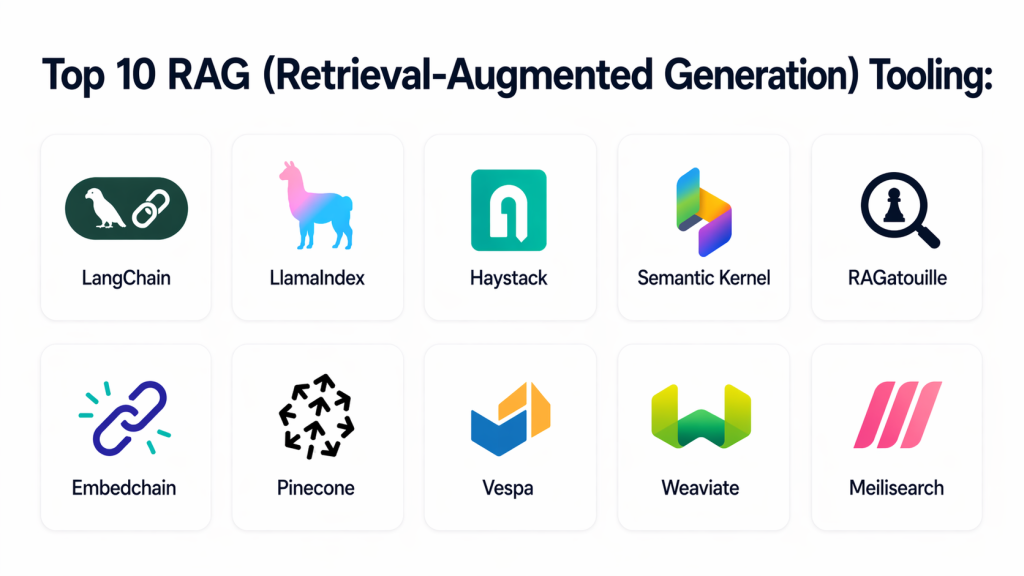
Top 10 RAG Tooling Platforms
#1 — LangChain
Short description: A leading framework for building RAG pipelines with chaining, agents, and integrations. Widely used by developers for building production-grade AI applications.
Key Features
- Prompt chaining and orchestration
- Built-in RAG pipeline components
- Memory and context management
- Multi-model support
- Agent workflows
- Debugging tools
Pros
- Highly flexible
- Massive ecosystem
Cons
- Complex for beginners
- Requires coding
Platforms / Deployment
Cloud / Self-hosted
Security & Compliance
Varies / Not publicly stated
Integrations & Ecosystem
Supports extensive integrations across AI and data stack.
- OpenAI
- Hugging Face
- Vector DBs
- APIs
Support & Community
Very large open-source community.
#2 — LlamaIndex
Short description: A powerful data framework designed specifically for building RAG applications with structured and unstructured data.
Key Features
- Data connectors
- Indexing and retrieval pipelines
- Query engines
- Context management
- Multi-source integration
Pros
- Strong data handling
- Optimized for RAG
Cons
- Developer-focused
- Setup complexity
Platforms / Deployment
Cloud / Self-hosted
Security & Compliance
Varies
Integrations & Ecosystem
Works with data sources and vector stores.
- Databases
- APIs
- ML tools
Support & Community
Growing open-source ecosystem.
#3 — Haystack
Short description: An open-source NLP framework designed for building search and RAG pipelines.
Key Features
- Document retrieval pipelines
- Question answering systems
- Multi-model support
- Pipeline orchestration
- Evaluation tools
Pros
- Open-source flexibility
- Strong search capabilities
Cons
- Requires setup effort
- Less beginner-friendly
Platforms / Deployment
Self-hosted / Cloud
Security & Compliance
Varies
Integrations & Ecosystem
Supports search engines and ML tools.
Support & Community
Active developer community.
#4 — Semantic Kernel
Short description: A framework for integrating AI with applications, enabling RAG workflows with structured orchestration.
Key Features
- AI orchestration
- Plugin architecture
- Memory integration
- Prompt templates
- Multi-model support
Pros
- Strong enterprise integration
- Flexible design
Cons
- Requires coding
- Limited UI
Platforms / Deployment
Cloud / Hybrid
Security & Compliance
Not publicly stated
Integrations & Ecosystem
Integrates with enterprise applications and APIs.
Support & Community
Backed by enterprise ecosystem.
#5 — RAGatouille
Short description: A specialized library for building RAG pipelines using advanced retrieval techniques.
Key Features
- Dense retrieval models
- Ranking optimization
- Pipeline integration
- Performance tuning
- Open-source flexibility
Pros
- High retrieval accuracy
- Lightweight
Cons
- Niche tool
- Limited UI
Platforms / Deployment
Self-hosted
Security & Compliance
Varies
Integrations & Ecosystem
Works with ML pipelines and frameworks.
Support & Community
Smaller but focused community.
#6 — Embedchain
Short description: A developer-friendly framework for quickly building RAG applications with minimal setup.
Key Features
- Simple API
- Data ingestion tools
- Embedding generation
- Retrieval pipelines
- Quick deployment
Pros
- Easy to use
- Fast setup
Cons
- Limited advanced features
- Less scalable
Platforms / Deployment
Cloud / Self-hosted
Security & Compliance
Not publicly stated
Integrations & Ecosystem
Supports APIs and data sources.
Support & Community
Growing community.
#7 — Pinecone
Short description: A leading vector database platform designed for fast and scalable retrieval in RAG systems.
Key Features
- Vector indexing
- High-speed similarity search
- Scalable architecture
- Low latency retrieval
- Managed infrastructure
Pros
- High performance
- Fully managed
Cons
- Cost considerations
- Vendor dependency
Platforms / Deployment
Cloud
Security & Compliance
Enterprise-grade features; details vary
Integrations & Ecosystem
Works with RAG frameworks and ML tools.
Support & Community
Strong enterprise support.
#8 — Vespa
Short description: A search and analytics engine optimized for large-scale RAG and real-time retrieval.
Key Features
- Real-time search
- Hybrid retrieval
- Scalability
- Machine learning integration
- Low latency
Pros
- High scalability
- Strong search performance
Cons
- Complex setup
- Requires expertise
Platforms / Deployment
Self-hosted / Cloud
Security & Compliance
Varies
Integrations & Ecosystem
Supports enterprise search systems.
Support & Community
Active open-source community.
#9 — Weaviate
Short description: An open-source vector database designed for semantic search and RAG pipelines.
Key Features
- Vector search
- GraphQL API
- Hybrid search
- Data indexing
- Scalable architecture
Pros
- Open-source
- Flexible
Cons
- Requires setup
- Performance tuning needed
Platforms / Deployment
Cloud / Self-hosted
Security & Compliance
Varies
Integrations & Ecosystem
Works with ML and AI tools.
Support & Community
Strong community support.
#10 — Meilisearch
Short description: A fast search engine optimized for developer-friendly RAG implementations.
Key Features
- Fast search indexing
- Easy API integration
- Lightweight setup
- Typo tolerance
- Real-time search
Pros
- Easy to use
- Fast performance
Cons
- Limited advanced AI features
- Not a full RAG framework
Platforms / Deployment
Cloud / Self-hosted
Security & Compliance
Not publicly stated
Integrations & Ecosystem
Supports APIs and search integrations.
Support & Community
Growing developer community.
Comparison Table (Top 10)
| Tool Name | Best For | Platform(s) Supported | Deployment | Standout Feature | Public Rating |
|---|---|---|---|---|---|
| LangChain | Developers | Multi-platform | Hybrid | Pipeline orchestration | N/A |
| LlamaIndex | Data-driven apps | Multi-platform | Hybrid | Data indexing | N/A |
| Haystack | Search pipelines | Multi-platform | Hybrid | NLP pipelines | N/A |
| Semantic Kernel | Enterprise apps | Multi-platform | Hybrid | AI orchestration | N/A |
| RAGatouille | Retrieval optimization | Multi-platform | Self-hosted | Ranking models | N/A |
| Embedchain | Quick builds | Multi-platform | Hybrid | Simple API | N/A |
| Pinecone | Vector DB | Web | Cloud | High-speed retrieval | N/A |
| Vespa | Large-scale search | Multi-platform | Hybrid | Real-time search | N/A |
| Weaviate | Open-source vector DB | Multi-platform | Hybrid | GraphQL API | N/A |
| Meilisearch | Lightweight search | Multi-platform | Hybrid | Fast indexing | N/A |
Evaluation & Scoring of RAG Tooling
| Tool Name | Core | Ease | Integrations | Security | Performance | Support | Value | Weighted Total |
|---|---|---|---|---|---|---|---|---|
| LangChain | 9 | 6 | 9 | 6 | 8 | 8 | 7 | 7.9 |
| LlamaIndex | 9 | 6 | 8 | 6 | 8 | 7 | 7 | 7.7 |
| Haystack | 8 | 6 | 7 | 6 | 7 | 7 | 7 | 7.1 |
| Semantic Kernel | 8 | 7 | 8 | 7 | 8 | 7 | 7 | 7.6 |
| RAGatouille | 7 | 6 | 6 | 6 | 8 | 6 | 7 | 6.9 |
| Embedchain | 7 | 9 | 6 | 5 | 7 | 6 | 8 | 7.2 |
| Pinecone | 9 | 8 | 8 | 7 | 9 | 8 | 6 | 8.2 |
| Vespa | 8 | 6 | 7 | 7 | 9 | 7 | 6 | 7.5 |
| Weaviate | 8 | 7 | 7 | 6 | 8 | 7 | 7 | 7.5 |
| Meilisearch | 7 | 9 | 6 | 5 | 8 | 6 | 8 | 7.3 |
How to interpret scores:
These scores are comparative and reflect strengths across features, usability, and performance. Higher scores indicate better overall capability, but the ideal tool depends on your use case. For example, developers may prioritize flexibility, while enterprises may focus on scalability and security.
Which RAG Tool Is Right for You?
Solo / Freelancer
Embedchain or Meilisearch for quick setup and simplicity.
SMB
Weaviate and LlamaIndex offer a balance of power and usability.
Mid-Market
Semantic Kernel and Haystack provide structured pipelines.
Enterprise
LangChain, Pinecone, and Vespa are ideal for large-scale deployments.
Budget vs Premium
Open-source tools reduce cost, while managed services offer convenience.
Feature Depth vs Ease of Use
LangChain offers depth; Embedchain offers simplicity.
Integrations & Scalability
Pinecone and LangChain excel in integration-heavy systems.
Security & Compliance Needs
Enterprises should prioritize tools with strong access control and monitoring.
Frequently Asked Questions (FAQs)
1. What is RAG in AI?
RAG is a technique that combines retrieval systems with generative AI to produce more accurate and context-aware outputs using external data.
2. Why is RAG important?
It improves AI accuracy and reduces hallucinations by grounding responses in real, relevant information sources.
3. What tools are used in RAG pipelines?
RAG pipelines typically include frameworks, vector databases, and retrieval systems working together.
4. Are RAG tools only for developers?
Mostly yes, but some tools offer low-code interfaces for easier adoption.
5. Can RAG work with private data?
Yes, RAG is commonly used to integrate internal knowledge bases and enterprise data.
6. How complex is RAG implementation?
It can range from simple setups to complex enterprise architectures depending on requirements.
7. Do RAG systems require vector databases?
Most implementations use vector databases for efficient retrieval.
8. Are RAG systems scalable?
Yes, with the right infrastructure, they can scale to enterprise-level workloads.
9. What are common challenges?
Data quality, retrieval accuracy, and latency are common challenges.
10. Are there alternatives to RAG?
Alternatives include fine-tuning models, but RAG is more flexible and cost-efficient.
Conclusion
RAG tooling has become a foundational component of modern AI systems, enabling organizations to build more accurate, reliable, and context-aware applications. By combining retrieval mechanisms with generative models, these tools address one of the biggest limitations of AI—lack of up-to-date and domain-specific knowledge. There is no universal “best” tool. Developers may prefer frameworks like LangChain or LlamaIndex for flexibility, while enterprises may rely on Pinecone or Vespa for scalability and performance. Smaller teams can benefit from lightweight tools like Embedchain or Meilisearch. Choosing the right tool depends on your data complexity, scale, and integration needs. Focus on tools that align with your architecture and long-term goals. Start by shortlisting a few tools, building a prototype, and testing retrieval quality. Validate performance, scalability, and integration before moving to production. This approach ensures your RAG system delivers real value.
