Introduction
Manufacturing Execution Systems (MES) are software platforms that manage, monitor, and control production processes on the factory floor in real time. These systems act as a bridge between enterprise planning systems (ERP) and physical manufacturing operations, ensuring that production is efficient, traceable, and optimized.
MES tools are critical in modern Industry 4.0 environments because they provide real-time visibility into machines, materials, and workflows, helping manufacturers improve quality, reduce downtime, and increase productivity.
Common use cases include:
- Production monitoring and control
- Quality management and compliance tracking
- Shop floor scheduling and optimization
- Inventory and material tracking
- Performance analytics and reporting
Key evaluation criteria:
- Real-time production visibility
- Integration with ERP, SCADA, and PLC systems
- Scalability across multiple plants
- Data collection and traceability
- Workflow and scheduling capabilities
- Quality and compliance management
- Ease of deployment and usability
- Cybersecurity and system reliability
Best for: Manufacturing companies, automotive industries, electronics production, pharmaceuticals, and large-scale industrial operations.
Not ideal for: Small businesses with minimal production processes or companies without automated manufacturing lines.
Key Trends in Manufacturing Execution Systems (MES)
- Growth of cloud-based MES platforms
- Adoption of AI-driven predictive manufacturing
- Integration with IoT and smart factory systems
- Expansion of digital twin technology
- Increased focus on real-time analytics dashboards
- Stronger cybersecurity in industrial systems
- Integration with ERP and supply chain systems
- Rise of low-code MES customization tools
- Use of edge computing in factories
- Shift toward fully connected Industry 4.0 ecosystems
How We Selected These Tools (Methodology)
- Evaluated industry adoption and market leadership
- Assessed production control and monitoring capabilities
- Reviewed integration with industrial systems (ERP, PLC, SCADA)
- Considered scalability for enterprise manufacturing
- Included both global enterprise and mid-market tools
- Analyzed real-time data processing capabilities
- Focused on reliability and production readiness
- Balanced legacy and modern MES platforms
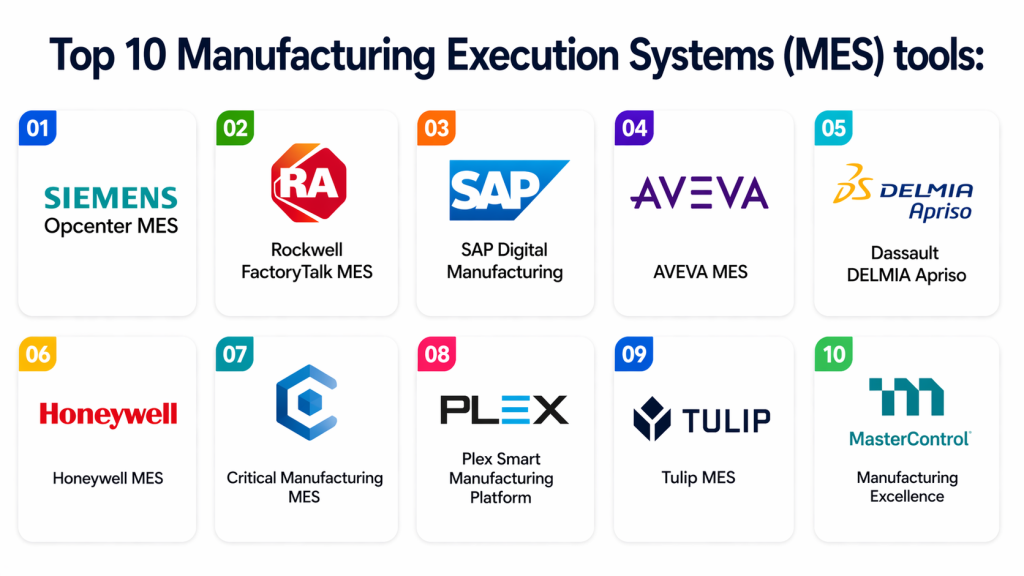
Top 10 Manufacturing Execution Systems (MES) Tools
#1 — Siemens Opcenter MES
Short description: A leading MES platform used for complex manufacturing operations, offering real-time production monitoring, scheduling, and quality control across global factories. It is widely adopted in discrete and process industries.
Key Features
- Real-time production monitoring
- Advanced scheduling and planning
- Quality management systems
- Traceability and genealogy tracking
- ERP integration
Pros
- Highly scalable
- Strong industrial ecosystem
Cons
- Complex implementation
- High cost
Platforms / Deployment
Cloud / On-prem
Security & Compliance
Enterprise-grade industrial security
Integrations & Ecosystem
Works with Siemens automation and industrial systems.
Support & Community
Strong global enterprise support.
#2 — Rockwell FactoryTalk MES
Short description: A manufacturing execution platform designed for real-time production control and integration with Rockwell Automation systems, widely used in discrete manufacturing environments.
Key Features
- Production tracking
- Quality control
- Real-time monitoring
- Inventory management
- Workflow automation
Pros
- Strong reliability
- Deep automation integration
Cons
- Vendor lock-in
- Expensive ecosystem
Platforms / Deployment
Windows / Cloud
Security & Compliance
Industrial-grade security
Integrations & Ecosystem
Works with Rockwell PLC and SCADA systems.
Support & Community
Strong enterprise support.
#3 — SAP Digital Manufacturing
Short description: A cloud-based MES solution integrated with SAP ERP, designed for end-to-end manufacturing visibility and global production control.
Key Features
- Cloud manufacturing execution
- ERP integration
- Real-time analytics
- Production tracking
- Quality management
Pros
- Strong ERP integration
- Scalable cloud system
Cons
- Complex deployment
- High cost
Platforms / Deployment
Cloud
Security & Compliance
Enterprise-grade cloud security
Integrations & Ecosystem
Deep integration with SAP ecosystem.
Support & Community
Enterprise support.
#4 — Plex Smart Manufacturing Platform
Short description: A cloud MES platform focused on real-time manufacturing operations, quality management, and production tracking for modern smart factories. ([turn0search19])
Key Features
- Real-time shop floor visibility
- Quality management
- Inventory tracking
- Production analytics
- Cloud MES architecture
Pros
- Easy deployment
- Strong visibility
Cons
- Subscription cost
- Limited customization
Platforms / Deployment
Cloud
Security & Compliance
Enterprise-grade
Integrations & Ecosystem
Works with ERP and industrial systems.
Support & Community
Strong enterprise support.
#5 — AVEVA MES
Short description: A manufacturing operations management platform designed for process and discrete industries with strong real-time production control capabilities. ([turn0search10])
Key Features
- Production control
- Quality management
- Real-time dashboards
- Data analytics
- Multi-site scalability
Pros
- Strong scalability
- Good visualization tools
Cons
- Complex setup
- Licensing cost
Platforms / Deployment
Cloud / Hybrid
Security & Compliance
Enterprise-grade security
Integrations & Ecosystem
Works with industrial automation systems.
Support & Community
Strong enterprise support.
#6 — Dassault DELMIA Apriso
Short description: A global MES solution focused on manufacturing operations management and digital transformation across production environments.
Key Features
- Manufacturing execution control
- Process standardization
- Quality tracking
- Global production visibility
- Workflow automation
Pros
- Strong global deployment
- Flexible architecture
Cons
- Complex implementation
- High cost
Platforms / Deployment
Cloud / On-prem
Security & Compliance
Enterprise-grade
Integrations & Ecosystem
Works with Dassault systems.
Support & Community
Enterprise support.
#7 — Honeywell MES
Short description: A process-focused MES solution designed for industrial automation and process manufacturing environments.
Key Features
- Real-time monitoring
- Process control
- Quality management
- Data acquisition
- Compliance tracking
Pros
- Strong process industry focus
- Reliable performance
Cons
- Limited flexibility
- Vendor dependency
Platforms / Deployment
On-prem / Hybrid
Security & Compliance
Not publicly stated
Integrations & Ecosystem
Works with Honeywell industrial systems.
Support & Community
Enterprise support.
#8 — Critical Manufacturing MES
Short description: A modern MES platform designed for high-tech industries with strong support for digital twin and Industry 4.0 capabilities. ([turn0search17])
Key Features
- Digital twin integration
- Real-time shop floor control
- Quality management
- Traceability
- Modular architecture
Pros
- Modern architecture
- Highly scalable
Cons
- Complex setup
- Enterprise-focused
Platforms / Deployment
Cloud / Hybrid
Security & Compliance
Enterprise-grade
Integrations & Ecosystem
Supports IoT and ERP systems.
Support & Community
Strong enterprise support.
#9 — Tulip MES
Short description: A no-code MES platform that enables manufacturers to build and deploy shop floor applications quickly.
Key Features
- No-code app builder
- Real-time dashboards
- Workflow automation
- Production tracking
- IoT integration
Pros
- Easy to use
- Fast deployment
Cons
- Limited advanced features
- Smaller ecosystem
Platforms / Deployment
Cloud
Security & Compliance
Not publicly stated
Integrations & Ecosystem
Supports APIs and IoT devices.
Support & Community
Growing community.
#10 — Epsilon3 MES
Short description: A modern MES platform focused on mission-critical operations like aerospace, defense, and high-tech manufacturing. ([turn0search6])
Key Features
- AI-driven workflows
- Production tracking
- Inventory management
- Quality assurance
- Compliance tools
Pros
- Modern interface
- Strong traceability
Cons
- Niche focus
- Smaller adoption base
Platforms / Deployment
Cloud
Security & Compliance
Not publicly stated
Integrations & Ecosystem
Supports APIs and enterprise systems.
Support & Community
Growing enterprise adoption.
Comparison Table (Top 10)
| Tool Name | Best For | Platform(s) Supported | Deployment | Standout Feature | Public Rating |
|---|---|---|---|---|---|
| Siemens Opcenter | Complex manufacturing | Multi-platform | Hybrid | Global MES control | N/A |
| Rockwell FactoryTalk | Discrete manufacturing | Windows | Hybrid | PLC integration | N/A |
| SAP Digital Manufacturing | ERP-driven plants | Cloud | Cloud | SAP integration | N/A |
| Plex MES | Smart factories | Web | Cloud | Real-time visibility | N/A |
| AVEVA MES | Industrial operations | Multi-platform | Hybrid | Process control | N/A |
| DELMIA Apriso | Global enterprises | Multi-platform | Hybrid | Workflow standardization | N/A |
| Honeywell MES | Process industries | Multi-platform | Hybrid | Process control | N/A |
| Critical Manufacturing | Industry 4.0 | Multi-platform | Hybrid | Digital twin support | N/A |
| Tulip MES | No-code manufacturing | Web | Cloud | No-code apps | N/A |
| Epsilon3 | High-tech industries | Web | Cloud | AI workflows | N/A |
Evaluation & Scoring of MES Tools
| Tool Name | Core | Ease | Integrations | Security | Performance | Support | Value | Weighted Total |
|---|---|---|---|---|---|---|---|---|
| Siemens Opcenter | 10 | 7 | 9 | 9 | 9 | 9 | 7 | 8.7 |
| Rockwell FactoryTalk | 9 | 7 | 9 | 8 | 9 | 9 | 7 | 8.4 |
| SAP Digital Manufacturing | 9 | 7 | 9 | 9 | 9 | 9 | 7 | 8.6 |
| Plex MES | 8 | 8 | 8 | 8 | 8 | 8 | 8 | 8.0 |
| AVEVA MES | 9 | 7 | 8 | 8 | 9 | 8 | 7 | 8.3 |
| DELMIA Apriso | 9 | 6 | 8 | 9 | 9 | 8 | 6 | 8.1 |
| Honeywell MES | 8 | 7 | 7 | 8 | 8 | 8 | 7 | 7.8 |
| Critical Manufacturing | 9 | 7 | 8 | 8 | 9 | 8 | 7 | 8.2 |
| Tulip MES | 7 | 9 | 8 | 7 | 7 | 7 | 8 | 7.6 |
| Epsilon3 | 8 | 8 | 7 | 7 | 8 | 7 | 7 | 7.7 |
Which MES Tool Is Right for You?
Solo / Small Teams
Tulip MES or Epsilon3 for fast deployment and simplicity.
SMB Manufacturers
Plex MES or Honeywell MES for balanced control and usability.
Mid-Market
AVEVA MES or Critical Manufacturing for scalability.
Enterprise
Siemens Opcenter, SAP Digital Manufacturing, and Rockwell FactoryTalk for large-scale operations.
Budget vs Premium
Open and cloud MES reduce cost; enterprise MES offers full control and compliance.
Feature Depth vs Ease of Use
Siemens offers depth; Tulip offers ease of use.
Integrations & Scalability
SAP and Siemens excel in large enterprise environments.
Security & Compliance Needs
Enterprise MES platforms provide strong industrial security controls.
Frequently Asked Questions (FAQs)
1. What is an MES system?
An MES system is software that manages and monitors production processes on the factory floor. It ensures real-time tracking of manufacturing operations and improves efficiency, quality, and traceability.
2. Why is MES important in manufacturing?
MES improves visibility, reduces production errors, and increases efficiency by connecting machines, operators, and systems in real time for better decision-making.
3. How is MES different from ERP?
ERP manages business-level processes like finance and supply chain, while MES focuses on real-time shop floor production control and execution.
4. What industries use MES systems?
Industries like automotive, electronics, pharmaceuticals, food & beverage, and aerospace heavily use MES systems for production management.
5. Can MES integrate with IoT?
Yes, modern MES platforms integrate with IoT devices to collect real-time data from machines and sensors on the factory floor.
6. Are MES systems cloud-based?
Many modern MES systems are cloud-based, but some still support on-premise and hybrid deployments depending on industrial needs.
7. What are key MES features?
Key features include production tracking, quality management, scheduling, inventory control, and real-time analytics dashboards.
8. Is MES suitable for small factories?
Yes, but smaller factories may prefer lightweight or cloud-based MES solutions to avoid complexity and high cost.
9. What are MES implementation challenges?
Challenges include high cost, integration complexity, data migration, and employee training requirements.
10. Do MES systems improve productivity?
Yes, MES systems significantly improve productivity by reducing downtime, optimizing workflows, and ensuring real-time visibility into operations.
Conclusion
Manufacturing Execution Systems (MES) are a critical part of modern industrial automation, enabling real-time control, monitoring, and optimization of production processes. They act as the backbone of smart factories and Industry 4.0 transformation. There is no single best MES for all companies. Enterprises often choose Siemens Opcenter or SAP Digital Manufacturing, while mid-sized manufacturers prefer AVEVA or Plex. Smaller teams can benefit from simpler platforms like Tulip or Epsilon3. The right MES depends on your production scale, integration needs, and budget. The best strategy is to evaluate a few platforms, run pilot implementations, and validate real-world performance before full deployment. With the right MES solution, manufacturers can achieve higher efficiency, better quality, and stronger operational control across their entire production lifecycle.
