Introduction
LLM Orchestration Frameworks are tools that help developers connect large language models (LLMs) with data, APIs, tools, and workflows to build real-world AI applications. Instead of calling an LLM directly, these frameworks manage prompt flows, memory, tool usage, and multi-step reasoning pipelines.
In simple terms, they act as the “control layer” that turns raw AI models into usable systems like chatbots, copilots, and autonomous agents. They handle complex tasks such as chaining multiple model calls, retrieving external data, and coordinating multi-agent workflows.
With the rise of AI-powered apps, orchestration frameworks are now essential for building scalable, reliable, and production-ready systems.
Real-world use cases include:
- Retrieval-Augmented Generation (RAG) systems
- AI copilots and assistants
- Multi-agent automation workflows
- Document search and knowledge systems
- API-connected AI applications
What buyers should evaluate:
- Workflow orchestration capabilities
- Data integration (vector DBs, APIs, files)
- Multi-agent support
- Ease of use vs flexibility
- Performance and latency overhead
- Debugging and observability tools
- Deployment options (cloud/local)
- Ecosystem and integrations
- Security and governance
- Cost and scalability
Best for: Developers, AI engineers, startups, and enterprises building AI-powered applications.
Not ideal for: Simple use cases where direct API calls are enough or teams without technical expertise.
Key Trends in LLM Orchestration Frameworks
- Shift toward agent-based orchestration systems
- Rise of RAG-first architectures for data-driven AI
- Growth of multi-agent collaboration frameworks
- Increasing focus on observability and debugging tools
- Hybrid stacks combining multiple frameworks together
- Expansion of open-source ecosystems
- API-first design for embedding AI into products
- Performance optimization (lower latency, token efficiency)
- Enterprise demand for secure and governed AI workflows
- Movement toward custom orchestration layers for production
How We Selected These Tools (Methodology)
We selected these frameworks based on:
- Market adoption and developer usage
- Feature completeness (RAG, agents, pipelines)
- Integration ecosystem (APIs, tools, vector DBs)
- Performance and scalability
- Flexibility vs ease of use
- Open-source vs enterprise availability
- Community and documentation strength
- Production readiness
- Innovation in orchestration patterns
- Value across different use cases
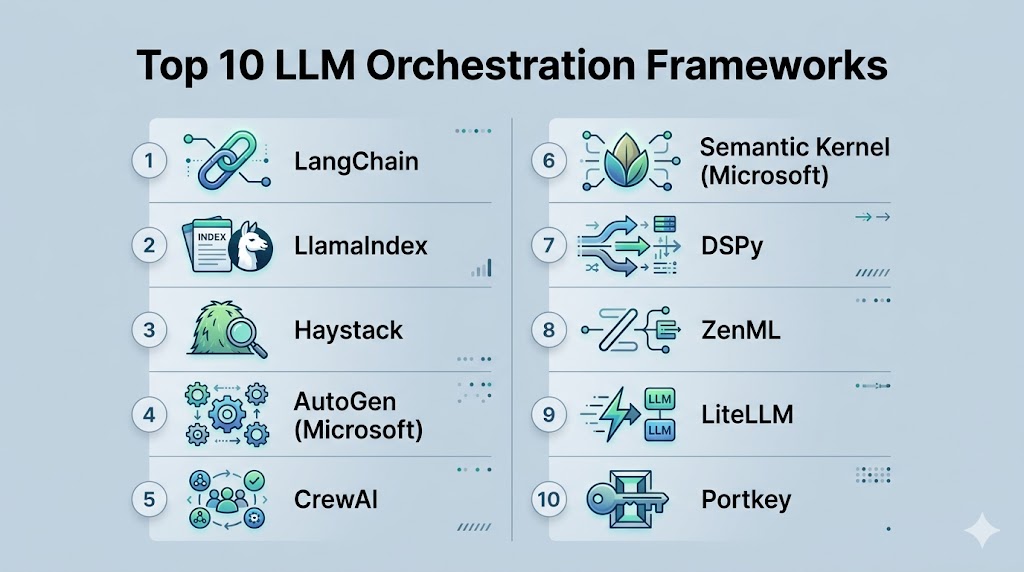
Top 10 LLM Orchestration Frameworks Tools
#1 — LangChain
Short description: The most widely adopted orchestration framework for building LLM-powered applications and agent workflows.
Key Features
- Chain-based workflows
- Tool and API integrations
- Memory management
- Agent frameworks (LangGraph)
- Large ecosystem
- Observability tools
Pros
- Extremely flexible
- Massive ecosystem
Cons
- Complex architecture
- Higher overhead
Platforms / Deployment
Python / JavaScript / Cloud / Self-hosted
Security & Compliance
Not publicly stated
Integrations & Ecosystem
Extensive integrations across LLMs, vector stores, and APIs.
- Pinecone, FAISS, Weaviate
- OpenAI, Anthropic, Google
- Databases and APIs
Support & Community
Very large global developer community
#2 — LlamaIndex
Short description: A framework focused on connecting LLMs to structured and unstructured data for RAG systems.
Key Features
- Data ingestion pipelines
- Advanced indexing strategies
- Retrieval optimization
- RAG workflows
- Document processing
- Query engines
Pros
- Best for data-heavy use cases
- Strong retrieval performance
Cons
- Limited orchestration flexibility
- Often used with other frameworks
Platforms / Deployment
Python / Cloud / Local
Security & Compliance
Not publicly stated
Integrations & Ecosystem
Strong integrations for data sources and vector databases.
- Document loaders
- Vector DBs
- APIs
Support & Community
Large and growing community
#3 — Haystack
Short description: A production-focused framework for building NLP pipelines and search systems.
Key Features
- Pipeline-based architecture
- Typed components
- RAG support
- Search and QA systems
- Evaluation tools
- Modular design
Pros
- Strong for enterprise use
- High reliability
Cons
- Smaller ecosystem
- Learning curve
Platforms / Deployment
Python / Cloud / Self-hosted
Security & Compliance
Not publicly stated
Integrations & Ecosystem
- Elasticsearch
- Vector databases
- APIs
Support & Community
Enterprise-focused community
#4 — Semantic Kernel
Short description: A Microsoft-backed framework combining orchestration and agent capabilities.
Key Features
- Memory management
- Plugin system
- Multi-agent orchestration
- .NET and Java support
- Workflow automation
Pros
- Strong enterprise integration
- Structured architecture
Cons
- Best for Microsoft stack
- Less flexible outside ecosystem
Platforms / Deployment
Cloud / Local
Security & Compliance
Not publicly stated
Integrations & Ecosystem
- Azure services
- APIs
Support & Community
Enterprise-grade support
#5 — AutoGen
Short description: A framework designed for building multi-agent systems with collaborative workflows.
Key Features
- Multi-agent communication
- Task delegation
- Conversational workflows
- Tool integration
- Automation
Pros
- Strong agent collaboration
- Flexible
Cons
- Developer-focused
- Setup complexity
Platforms / Deployment
Cloud / Local
Security & Compliance
Not publicly stated
Integrations & Ecosystem
- APIs
- Developer tools
Support & Community
Growing adoption
#6 — CrewAI
Short description: A lightweight framework for building role-based AI agent teams.
Key Features
- Role-based agents
- Workflow orchestration
- Tool integration
- Task automation
- Simple architecture
Pros
- Easy to start
- Good for multi-agent workflows
Cons
- Limited enterprise features
- Smaller ecosystem
Platforms / Deployment
Cloud / Local
Security & Compliance
Not publicly stated
Integrations & Ecosystem
- APIs
- Workflow tools
Support & Community
Active open-source community
#7 — DSPy
Short description: A research-driven framework focused on optimizing LLM pipelines programmatically.
Key Features
- Prompt optimization
- Declarative programming
- Pipeline tuning
- Model-agnostic design
- Performance optimization
Pros
- High efficiency
- Research-backed
Cons
- Not beginner-friendly
- Smaller ecosystem
Platforms / Deployment
Python / Local
Security & Compliance
Not publicly stated
Integrations & Ecosystem
- ML frameworks
- APIs
Support & Community
Academic and developer community
#8 — LiteLLM
Short description: A lightweight framework for managing multiple LLM APIs through a unified interface.
Key Features
- API abstraction layer
- Multi-model support
- Cost tracking
- Routing and fallback
- Logging
Pros
- Simple and efficient
- Good for production
Cons
- Limited orchestration depth
- Focused on API layer
Platforms / Deployment
Cloud / Local
Security & Compliance
Not publicly stated
Integrations & Ecosystem
- LLM providers
- APIs
Support & Community
Growing adoption
#9 — ZenML
Short description: A pipeline orchestration platform extended for LLM workflows and ML pipelines.
Key Features
- Pipeline orchestration
- Experiment tracking
- ML + LLM workflows
- CI/CD integration
- Modular pipelines
Pros
- Strong for MLOps
- Scalable
Cons
- Not LLM-specific
- Requires setup
Platforms / Deployment
Cloud / Self-hosted
Security & Compliance
Not publicly stated
Integrations & Ecosystem
- ML tools
- Cloud platforms
Support & Community
Active ML community
#10 — Portkey
Short description: An LLM gateway and orchestration layer focused on reliability and observability.
Key Features
- Request routing
- Observability tools
- Error handling
- Performance tracking
- API management
Pros
- Strong monitoring
- Production-ready
Cons
- Limited workflow depth
- Focused on API layer
Platforms / Deployment
Cloud
Security & Compliance
Not publicly stated
Integrations & Ecosystem
- LLM APIs
- Monitoring tools
Support & Community
Growing enterprise adoption
Comparison Table (Top 10)
| Tool Name | Best For | Platform(s) Supported | Deployment | Standout Feature | Public Rating |
|---|---|---|---|---|---|
| LangChain | General orchestration | Python/JS | Hybrid | Ecosystem | N/A |
| LlamaIndex | RAG systems | Python | Hybrid | Data indexing | N/A |
| Haystack | Enterprise NLP | Python | Hybrid | Pipelines | N/A |
| Semantic Kernel | Microsoft stack | Multi | Hybrid | Plugins | N/A |
| AutoGen | Multi-agent systems | Multi | Hybrid | Collaboration | N/A |
| CrewAI | Agent teams | Multi | Hybrid | Roles | N/A |
| DSPy | Optimization | Python | Local | Efficiency | N/A |
| LiteLLM | API orchestration | Multi | Hybrid | Routing | N/A |
| ZenML | Pipelines | Multi | Hybrid | MLOps | N/A |
| Portkey | Observability | Cloud | Cloud | Monitoring | N/A |
Evaluation & Scoring of LLM Orchestration Frameworks
| Tool Name | Core (25%) | Ease (15%) | Integrations (15%) | Security (10%) | Performance (10%) | Support (10%) | Value (15%) | Weighted Total |
|---|---|---|---|---|---|---|---|---|
| LangChain | 10 | 6 | 10 | 7 | 8 | 9 | 8 | 8.6 |
| LlamaIndex | 9 | 7 | 9 | 7 | 9 | 8 | 8 | 8.4 |
| Haystack | 9 | 6 | 8 | 8 | 8 | 7 | 7 | 8.0 |
| Semantic Kernel | 8 | 7 | 9 | 8 | 8 | 8 | 7 | 8.1 |
| AutoGen | 9 | 6 | 8 | 7 | 8 | 7 | 8 | 7.9 |
| CrewAI | 8 | 7 | 7 | 6 | 7 | 7 | 8 | 7.5 |
| DSPy | 8 | 5 | 7 | 6 | 9 | 6 | 8 | 7.4 |
| LiteLLM | 7 | 9 | 8 | 6 | 8 | 7 | 9 | 7.9 |
| ZenML | 8 | 6 | 8 | 7 | 8 | 7 | 7 | 7.7 |
| Portkey | 7 | 8 | 8 | 7 | 8 | 7 | 8 | 7.8 |
How to interpret scores:
- Scores are relative comparisons
- Higher scores indicate broader capabilities
- Developer frameworks rank high in flexibility
- Lightweight tools rank high in ease and value
- Choose based on your use case
Which LLM Orchestration Framework Is Right for You?
Solo / Freelancer
- Best: LiteLLM, CrewAI
- Simple and lightweight
SMB
- Best: LlamaIndex, LangChain
- Balanced capabilities
Mid-Market
- Best: AutoGen, Haystack
- Scalable workflows
Enterprise
- Best: Semantic Kernel, ZenML
- Governance and scalability
Budget vs Premium
- Budget: CrewAI, LiteLLM
- Premium: Semantic Kernel, enterprise setups
Feature Depth vs Ease of Use
- Depth: LangChain, AutoGen
- Ease: LiteLLM, CrewAI
Integrations & Scalability
- Strong: LangChain, Semantic Kernel
- Moderate: DSPy
Security & Compliance Needs
- Enterprise frameworks offer better governance
- Open-source tools require custom setup
Frequently Asked Questions (FAQs)
What are LLM orchestration frameworks?
They help connect LLMs with tools, data, and workflows. They manage multi-step logic. They enable production AI systems.
Why not call APIs directly?
Direct calls work for simple tasks. Complex systems need orchestration. Frameworks manage workflows and memory.
What is RAG?
Retrieval-Augmented Generation combines LLMs with external data. It improves accuracy. It is a key use case.
Which framework is best?
It depends on your needs. LangChain is general-purpose. LlamaIndex is best for data-heavy apps.
Are these tools free?
Many are open-source. Some offer paid enterprise features. Pricing varies.
Do I need coding skills?
Yes, most frameworks require development knowledge. Some offer low-code options.
Can I combine frameworks?
Yes, many teams use multiple frameworks. Hybrid setups are common.
Are they production-ready?
Some are production-ready. Others need customization. Testing is essential.
What is multi-agent orchestration?
It involves multiple AI agents working together. Each agent performs a task. They collaborate to solve problems.
How do I choose the right framework?
Define your use case first. Evaluate features and complexity. Test with real workloads.
Conclusion
LLM orchestration frameworks are the backbone of modern AI application development, enabling developers to transform standalone language models into powerful, real-world systems. From flexible ecosystems like LangChain to data-focused tools like LlamaIndex and production-ready frameworks like Haystack, each platform serves a specific purpose in the AI stack. The key challenge is not choosing the most popular tool, but selecting the one that aligns with your application architecture, data requirements, and scalability goals. Many teams now adopt hybrid approaches, combining multiple frameworks to maximize performance and flexibility. While these frameworks significantly accelerate development, they can also introduce complexity, making it important to balance abstraction with control. As AI systems evolve toward multi-agent and autonomous workflows, orchestration layers will become even more critical. The best next step is to shortlist a few frameworks, build a small prototype, and evaluate how well they integrate into your workflow. The right choice will ultimately depend on your use case, technical expertise, and long-term scalability needs.
