Introduction
AI Governance & Policy Tools are platforms designed to help organizations manage, monitor, and control how artificial intelligence systems are built, deployed, and used. These tools ensure that AI systems are ethical, compliant, transparent, and aligned with business and regulatory requirements.
As AI adoption accelerates across industries, governance is no longer optional. Organizations must address risks like bias, lack of explainability, data privacy issues, and regulatory compliance. Without proper governance, AI systems can create legal, reputational, and operational risks.
Common use cases include:
- Monitoring AI models for bias and fairness
- Ensuring compliance with regulatory frameworks
- Managing AI lifecycle and audit trails
- Risk assessment and policy enforcement
- Explainability and transparency reporting
Key evaluation criteria:
- Model monitoring and explainability
- Bias detection and fairness tools
- Policy management and governance workflows
- Integration with ML pipelines
- Security and compliance capabilities
- Scalability across multiple models
- Ease of implementation and usability
- Reporting and audit capabilities
Best for: Enterprises, regulated industries, AI teams, risk and compliance officers, and organizations deploying AI at scale.
Not ideal for: Small teams or individuals with minimal AI usage or non-critical AI applications.
Key Trends in AI Governance & Policy Tools
- Growing demand for AI transparency and explainability
- Integration with ML lifecycle management platforms
- Increased focus on bias detection and fairness auditing
- Expansion of automated compliance monitoring
- Adoption of policy-as-code frameworks
- Rise of real-time AI monitoring and alerting
- Stronger emphasis on data privacy and governance
- Development of standardized AI governance frameworks
- Integration with enterprise risk management systems
- Shift toward centralized AI governance platforms
How We Selected These Tools (Methodology)
- Assessed market presence and enterprise adoption
- Evaluated feature depth and governance capabilities
- Reviewed integration with AI/ML pipelines
- Considered security and compliance readiness
- Analyzed ease of use and deployment flexibility
- Included tools for different organization sizes
- Evaluated scalability and performance reliability
- Balanced commercial and emerging platforms
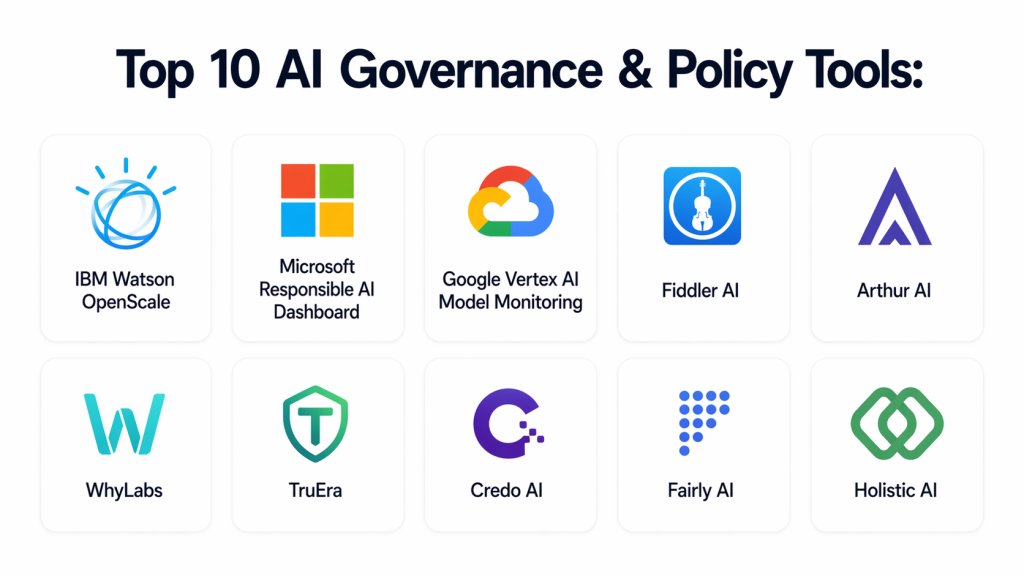
Top 10 AI Governance & Policy Tools
#1 — IBM Watson OpenScale
Short description: A comprehensive AI governance platform for monitoring, explaining, and managing AI models in production environments.
Key Features
- Bias detection and mitigation
- Explainable AI insights
- Model performance monitoring
- Lifecycle governance
- Automated alerts
Pros
- Strong enterprise capabilities
- Deep integration with AI pipelines
Cons
- Complex setup
- Higher cost
Platforms / Deployment
Cloud / Hybrid
Security & Compliance
Supports enterprise-grade security; specific certifications not publicly stated
Integrations & Ecosystem
Integrates with enterprise ML platforms and cloud environments.
- IBM Cloud
- APIs
- Data platforms
Support & Community
Enterprise-level support with strong documentation.
#2 — Microsoft Responsible AI Dashboard
Short description: A governance and monitoring tool integrated into Microsoft’s AI ecosystem for fairness, interpretability, and compliance.
Key Features
- Fairness assessment tools
- Model interpretability
- Error analysis
- Responsible AI insights
- Integration with ML workflows
Pros
- Easy integration with Microsoft ecosystem
- Strong visualization tools
Cons
- Limited outside Microsoft ecosystem
- Requires Azure familiarity
Platforms / Deployment
Cloud
Security & Compliance
Aligned with enterprise security practices; details not publicly stated
Integrations & Ecosystem
Deep integration with Microsoft services.
- Azure ML
- Power BI
- APIs
Support & Community
Strong enterprise support and documentation.
#3 — Google Vertex AI Model Monitoring
Short description: A monitoring and governance tool within Google Cloud for tracking model performance and detecting anomalies.
Key Features
- Model drift detection
- Data monitoring
- Performance tracking
- Alerting system
- Integration with ML pipelines
Pros
- Scalable cloud infrastructure
- Real-time monitoring
Cons
- Limited governance features compared to dedicated tools
- Cloud dependency
Platforms / Deployment
Cloud
Security & Compliance
Enterprise-grade cloud security; certifications vary
Integrations & Ecosystem
Integrates with Google Cloud ecosystem.
- BigQuery
- APIs
- ML pipelines
Support & Community
Strong support through Google Cloud ecosystem.
#4 — Fiddler AI
Short description: A platform focused on explainable AI, model monitoring, and governance for enterprise AI systems.
Key Features
- Explainability dashboards
- Bias detection
- Model monitoring
- Performance analytics
- Data drift detection
Pros
- Strong explainability features
- Enterprise-ready
Cons
- Pricing not transparent
- Learning curve
Platforms / Deployment
Cloud
Security & Compliance
Not publicly stated
Integrations & Ecosystem
Supports integration with ML workflows and APIs.
- APIs
- ML tools
Support & Community
Enterprise-focused support.
#5 — Arthur AI
Short description: A monitoring and governance platform designed to ensure reliability and fairness of AI systems.
Key Features
- Model monitoring
- Bias detection
- Performance analytics
- Explainability tools
- Alerts and reporting
Pros
- Strong monitoring capabilities
- Scalable
Cons
- Limited public documentation
- Enterprise-focused
Platforms / Deployment
Cloud
Security & Compliance
Not publicly stated
Integrations & Ecosystem
Integrates with ML pipelines and data platforms.
- APIs
- Data tools
Support & Community
Enterprise support model.
#6 — WhyLabs
Short description: A platform for AI observability and governance focusing on data quality and model performance.
Key Features
- Data monitoring
- Model observability
- Drift detection
- Performance tracking
- Alerting
Pros
- Strong observability focus
- Easy integration
Cons
- Limited policy management
- Focused more on monitoring
Platforms / Deployment
Cloud
Security & Compliance
Not publicly stated
Integrations & Ecosystem
Works with data and ML tools.
- Data pipelines
- APIs
Support & Community
Active community and documentation.
#7 — TruEra
Short description: A governance and explainability platform focused on improving model quality and trust.
Key Features
- Model explainability
- Bias detection
- Performance evaluation
- Model debugging
- Governance tools
Pros
- Strong model analysis
- Developer-friendly
Cons
- Limited policy automation
- Requires expertise
Platforms / Deployment
Cloud
Security & Compliance
Not publicly stated
Integrations & Ecosystem
Supports ML frameworks and APIs.
Support & Community
Growing enterprise adoption.
#8 — Credo AI
Short description: A governance platform focused on AI risk management, compliance, and policy enforcement.
Key Features
- Policy management
- Risk assessment
- Compliance tracking
- Governance workflows
- Audit trails
Pros
- Strong governance focus
- Compliance-ready
Cons
- Less focus on technical monitoring
- Enterprise-oriented
Platforms / Deployment
Cloud
Security & Compliance
Not publicly stated
Integrations & Ecosystem
Integrates with enterprise systems.
Support & Community
Enterprise support model.
#9 — Fairly AI
Short description: A platform designed to audit and certify AI systems for fairness and compliance.
Key Features
- AI auditing
- Bias detection
- Risk analysis
- Certification workflows
- Reporting tools
Pros
- Strong compliance focus
- Easy reporting
Cons
- Limited scalability features
- Smaller ecosystem
Platforms / Deployment
Cloud
Security & Compliance
Not publicly stated
Integrations & Ecosystem
Basic API integrations.
Support & Community
Limited but growing.
#10 — Holistic AI
Short description: A governance platform providing risk management, auditing, and monitoring for AI systems.
Key Features
- Risk assessment tools
- Monitoring and evaluation
- Policy enforcement
- Reporting dashboards
- Compliance support
Pros
- Comprehensive governance features
- Strong reporting
Cons
- Enterprise-focused
- Limited public info
Platforms / Deployment
Cloud
Security & Compliance
Not publicly stated
Integrations & Ecosystem
Supports enterprise integrations and APIs.
Support & Community
Enterprise support available.
Comparison Table (Top 10)
| Tool Name | Best For | Platform(s) Supported | Deployment | Standout Feature | Public Rating |
|---|---|---|---|---|---|
| IBM Watson OpenScale | Enterprise AI | Multi-platform | Hybrid | Bias detection | N/A |
| Microsoft Responsible AI | Microsoft users | Web | Cloud | Fairness tools | N/A |
| Google Vertex AI Monitoring | Cloud AI | Web | Cloud | Drift detection | N/A |
| Fiddler AI | Explainability | Web | Cloud | Explainability dashboards | N/A |
| Arthur AI | Monitoring | Web | Cloud | Performance tracking | N/A |
| WhyLabs | Observability | Web | Cloud | Data monitoring | N/A |
| TruEra | Model quality | Web | Cloud | Model analysis | N/A |
| Credo AI | Governance | Web | Cloud | Policy management | N/A |
| Fairly AI | Compliance | Web | Cloud | AI auditing | N/A |
| Holistic AI | Risk management | Web | Cloud | Risk assessment | N/A |
Evaluation & Scoring of AI Governance & Policy Tools
| Tool Name | Core | Ease | Integrations | Security | Performance | Support | Value | Weighted Total |
|---|---|---|---|---|---|---|---|---|
| IBM Watson OpenScale | 9 | 6 | 8 | 8 | 8 | 8 | 6 | 7.9 |
| Microsoft Responsible AI | 8 | 8 | 8 | 7 | 8 | 8 | 7 | 7.9 |
| Google Vertex AI | 8 | 7 | 9 | 7 | 9 | 8 | 7 | 8.1 |
| Fiddler AI | 8 | 7 | 7 | 6 | 8 | 7 | 6 | 7.3 |
| Arthur AI | 8 | 6 | 7 | 6 | 8 | 7 | 6 | 7.1 |
| WhyLabs | 7 | 8 | 7 | 6 | 7 | 7 | 8 | 7.4 |
| TruEra | 8 | 7 | 7 | 6 | 8 | 7 | 6 | 7.2 |
| Credo AI | 8 | 7 | 6 | 7 | 7 | 7 | 6 | 7.1 |
| Fairly AI | 7 | 8 | 6 | 6 | 7 | 6 | 7 | 7.0 |
| Holistic AI | 8 | 7 | 6 | 7 | 7 | 7 | 6 | 7.2 |
How to interpret scores:
These scores provide a comparative view across key evaluation factors. Higher scores indicate stronger overall capability, but the right choice depends on your organization’s priorities. For example, enterprise users may prioritize security and governance depth, while smaller teams may focus on ease of use and cost efficiency.
Which AI Governance & Policy Tool Is Right for You?
Solo / Freelancer
Most governance tools may be unnecessary unless working on regulated AI systems.
SMB
WhyLabs or Fairly AI are good starting points due to simplicity and cost-effectiveness.
Mid-Market
Fiddler AI and TruEra offer balanced monitoring and governance features.
Enterprise
IBM Watson OpenScale, Google Vertex AI, and Microsoft Responsible AI provide comprehensive solutions.
Budget vs Premium
Cloud-native tools offer flexible pricing, while enterprise platforms require larger investment.
Feature Depth vs Ease of Use
Advanced tools provide deeper governance but require expertise; simpler tools focus on usability.
Integrations & Scalability
Google Vertex AI and IBM Watson OpenScale excel in scalability and integrations.
Security & Compliance Needs
Highly regulated industries should prioritize tools with audit logs, compliance tracking, and policy enforcement.
Frequently Asked Questions (FAQs)
1. What are AI Governance & Policy Tools?
They help organizations manage AI systems responsibly by ensuring fairness, compliance, transparency, and risk management across the AI lifecycle.
2. Why are these tools important?
They reduce risks related to bias, regulatory violations, and lack of transparency, which can impact trust and business outcomes.
3. Who should use these tools?
AI teams, compliance officers, enterprises, and regulated industries benefit the most from these tools.
4. Are they required for all AI projects?
No, small or low-risk projects may not need full governance tools, but larger deployments typically do.
5. Do these tools detect bias automatically?
Most tools provide automated bias detection and reporting, but human oversight is still required.
6. How long does implementation take?
Implementation varies from a few days to several weeks depending on system complexity and integrations.
7. Are these tools secure?
Security features vary by platform; enterprise tools generally offer stronger protections.
8. Can they integrate with existing ML pipelines?
Yes, most tools are designed to integrate with common ML frameworks and data systems.
9. What are common mistakes?
Ignoring governance early, lack of monitoring, and not defining clear AI policies are common issues.
10. Are there alternatives?
Manual governance processes exist, but they are less scalable and more error-prone compared to dedicated tools.
Conclusion
AI Governance & Policy Tools play a critical role in ensuring that artificial intelligence systems are used responsibly, ethically, and in compliance with regulations. As organizations scale their AI initiatives, governance becomes essential to manage risks, maintain transparency, and build trust. There is no one-size-fits-all solution. Enterprises may require comprehensive platforms like IBM Watson OpenScale or Google Vertex AI, while mid-sized organizations might prefer tools like Fiddler AI or TruEra for balanced capabilities. Smaller teams can start with simpler solutions such as WhyLabs or Fairly AI. The best approach is to align your tool selection with your organization’s maturity level, regulatory requirements, and technical capabilities. Focus on tools that integrate well with your existing systems and support long-term scalability. Start by shortlisting a few tools that match your needs. Run pilot implementations, evaluate governance workflows, and validate compliance features before making a final decision. This ensures that your AI governance strategy is both effective and sustainable.
