Introduction
Text Analytics Platforms are tools that help organizations analyze large volumes of unstructured text—like emails, reviews, chat logs, documents, and survey responses—and convert them into structured, actionable insights. In simple terms, they “read” text data and extract meaning such as sentiment, topics, intent, and key entities.
This capability has become essential as businesses generate massive amounts of text across digital channels. Modern platforms go beyond basic keyword analysis and use advanced natural language processing (NLP), machine learning, and AI models to deliver deeper insights at scale.
Real-world use cases include:
- Customer feedback and Voice of Customer (VoC) analysis
- Social media and brand sentiment tracking
- Automated document classification and tagging
- Fraud detection and compliance monitoring
- Product insights and churn prediction
What buyers should evaluate:
- Accuracy of sentiment and entity extraction
- Multilingual capabilities
- Custom model training and domain adaptation
- Integration with business systems and APIs
- Real-time vs batch processing
- Scalability and performance
- Data privacy and compliance
- Ease of use for technical and non-technical users
- Visualization and reporting features
- Pricing and cost predictability
Best for: Data analysts, CX teams, product managers, enterprises, and AI teams working with large-scale text data.
Not ideal for: Small teams with minimal text data or use cases that only require basic keyword searches.
Key Trends in Text Analytics Platforms
- Shift from basic sentiment analysis to advanced AI-driven insights
- Integration with large language models for summarization and automation
- Real-time text analytics for customer support and chat systems
- Increased focus on multilingual and global text processing
- Rise of no-code and low-code platforms for business users
- Stronger emphasis on privacy, governance, and auditability
- Integration with BI tools and analytics dashboards
- Hybrid architectures combining APIs and business interfaces
- Domain-specific customization (healthcare, finance, legal)
- Growth of conversational analytics and AI assistants
How We Selected These Tools (Methodology)
We selected the top platforms based on:
- Market adoption and industry credibility
- Breadth of NLP and text analysis features
- Scalability for enterprise and high-volume workloads
- Ease of use for both developers and business users
- Integration with modern data ecosystems
- Security and compliance readiness
- Performance in real-world use cases
- Flexibility in deployment (cloud, hybrid, on-prem)
- Vendor support and community strength
- Overall value across different business sizes
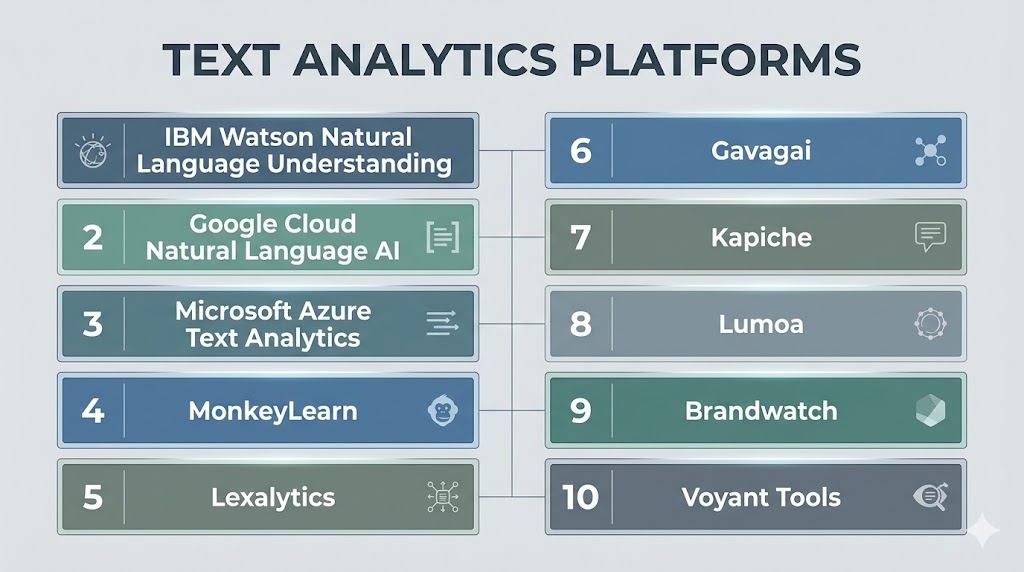
Top 10 Text Analytics Platforms Tools
#1 — IBM Watson Natural Language Understanding
Short description: A powerful enterprise-grade NLP platform designed for deep linguistic analysis and customization.
Key Features
- Entity and keyword extraction
- Sentiment and emotion analysis
- Relation and semantic analysis
- Custom model training
- Content categorization
- Industry-specific language models
Pros
- High accuracy for complex domains
- Strong enterprise capabilities
Cons
- Steep learning curve
- Pricing can scale quickly
Platforms / Deployment
Cloud / Hybrid
Security & Compliance
SOC 2, HIPAA, GDPR, ISO 27001
Integrations & Ecosystem
Widely used in enterprise AI workflows and analytics pipelines.
- APIs
- Enterprise systems
- Data platforms
Support & Community
Strong enterprise support and global ecosystem
#2 — Google Cloud Natural Language AI
Short description: A scalable cloud-based NLP platform for analyzing large-scale text data.
Key Features
- Sentiment analysis
- Entity recognition
- Syntax analysis
- Content classification
- Multilingual support
- API-based processing
Pros
- Highly scalable
- Strong multilingual capabilities
Cons
- Limited customization without additional tools
- Cost increases with scale
Platforms / Deployment
Cloud
Security & Compliance
Not publicly stated
Integrations & Ecosystem
- Cloud ecosystem
- APIs
- Data pipelines
Support & Community
Extensive documentation and developer adoption
#3 — Microsoft Azure Text Analytics
Short description: A comprehensive NLP service integrated into a broader cloud ecosystem.
Key Features
- Sentiment analysis
- Named entity recognition
- Language detection
- Key phrase extraction
- Custom models
- Integration with Azure AI
Pros
- Strong enterprise integration
- Flexible deployment
Cons
- Learning curve
- Requires Azure ecosystem
Platforms / Deployment
Cloud / Hybrid
Security & Compliance
Not publicly stated
Integrations & Ecosystem
- Enterprise tools
- APIs
- Data services
Support & Community
Enterprise-grade support
#4 — Amazon Comprehend
Short description: A cloud-native text analytics service for extracting insights from unstructured data.
Key Features
- Sentiment analysis
- Entity and key phrase extraction
- Topic modeling
- Custom classification
- PII detection
Pros
- Easy to integrate
- Strong scalability
Cons
- AWS dependency
- Pricing complexity
Platforms / Deployment
Cloud
Security & Compliance
Not publicly stated
Integrations & Ecosystem
- AWS ecosystem
- APIs
- Data pipelines
Support & Community
Strong ecosystem support
#5 — MonkeyLearn
Short description: A no-code text analytics platform focused on ease of use and quick deployment.
Key Features
- Drag-and-drop model builder
- Pre-built templates
- Sentiment and classification
- Keyword extraction
- API integration
Pros
- Beginner-friendly
- Fast setup
Cons
- Limited scalability
- Fewer advanced features
Platforms / Deployment
Web / Cloud
Security & Compliance
Not publicly stated
Integrations & Ecosystem
- APIs
- Spreadsheet tools
- Automation tools
Support & Community
Good documentation and onboarding
#6 — Lexalytics
Short description: A robust NLP platform known for explainable AI and enterprise control.
Key Features
- Intent and sentiment analysis
- Explainable NLP models
- Entity recognition
- Custom rules and dictionaries
- On-prem deployment
Pros
- Strong compliance support
- High customization
Cons
- Requires expertise
- Less beginner-friendly
Platforms / Deployment
Cloud / On-prem
Security & Compliance
Not publicly stated
Integrations & Ecosystem
- APIs
- Enterprise systems
Support & Community
Enterprise support
#7 — Gavagai
Short description: A platform focused on multilingual text analytics and sentiment insights.
Key Features
- Multilingual analysis
- Sentiment detection
- Topic modeling
- Real-time processing
- API access
Pros
- Strong language support
- Good for global use cases
Cons
- Smaller ecosystem
- Limited customization
Platforms / Deployment
Cloud
Security & Compliance
Not publicly stated
Integrations & Ecosystem
- APIs
- Data tools
Support & Community
Moderate support
#8 — Kapiche
Short description: A customer insights platform designed for analyzing feedback at scale.
Key Features
- Automated theme discovery
- Sentiment tracking
- Feedback analytics
- Data visualization
- Integration with CX tools
Pros
- Strong for CX teams
- Easy to use
Cons
- Limited general NLP use
- Enterprise pricing
Platforms / Deployment
Cloud
Security & Compliance
Not publicly stated
Integrations & Ecosystem
- CX platforms
- APIs
Support & Community
Business-focused support
#9 — Lumoa
Short description: A platform focused on customer feedback and experience analytics.
Key Features
- Sentiment analysis
- Feedback categorization
- Automated insights
- Dashboard visualization
- Trend tracking
Pros
- Simple interface
- Fast insights
Cons
- Limited advanced NLP features
- Focused on CX use cases
Platforms / Deployment
Cloud
Security & Compliance
Not publicly stated
Integrations & Ecosystem
- APIs
- CX tools
Support & Community
Moderate support
#10 — Brandwatch
Short description: A social listening and text analytics platform for brand and market insights.
Key Features
- Social media analytics
- Sentiment analysis
- Trend detection
- Data visualization
- Competitive insights
Pros
- Strong social analytics
- Rich dashboards
Cons
- Expensive
- Limited general NLP flexibility
Platforms / Deployment
Cloud
Security & Compliance
Not publicly stated
Integrations & Ecosystem
- Social platforms
- APIs
Support & Community
Enterprise support
Comparison Table (Top 10)
| Tool Name | Best For | Platform(s) Supported | Deployment | Standout Feature | Public Rating |
|---|---|---|---|---|---|
| IBM Watson | Enterprise NLP | Web | Hybrid | Deep linguistic analysis | N/A |
| Google NLP | Scalability | Web | Cloud | Multilingual AI | N/A |
| Azure Text | Enterprise | Web | Hybrid | Integration | N/A |
| Amazon Comprehend | AWS users | Web | Cloud | PII detection | N/A |
| MonkeyLearn | SMB | Web | Cloud | No-code builder | N/A |
| Lexalytics | Compliance | Web | Hybrid | Explainable AI | N/A |
| Gavagai | Global teams | Web | Cloud | Multilingual support | N/A |
| Kapiche | CX teams | Web | Cloud | Theme discovery | N/A |
| Lumoa | Feedback analysis | Web | Cloud | Simplicity | N/A |
| Brandwatch | Social insights | Web | Cloud | Social analytics | N/A |
Evaluation & Scoring of Text Analytics Platforms
| Tool Name | Core (25%) | Ease (15%) | Integrations (15%) | Security (10%) | Performance (10%) | Support (10%) | Value (15%) | Weighted Total |
|---|---|---|---|---|---|---|---|---|
| IBM Watson | 9 | 6 | 9 | 9 | 8 | 9 | 7 | 8.4 |
| Google NLP | 9 | 8 | 9 | 8 | 9 | 8 | 7 | 8.5 |
| Azure | 9 | 7 | 9 | 8 | 8 | 8 | 7 | 8.3 |
| Amazon | 8 | 8 | 9 | 8 | 8 | 8 | 7 | 8.2 |
| MonkeyLearn | 7 | 9 | 7 | 6 | 7 | 7 | 9 | 7.8 |
| Lexalytics | 8 | 6 | 8 | 8 | 8 | 8 | 7 | 7.9 |
| Gavagai | 7 | 7 | 7 | 7 | 7 | 7 | 7 | 7.0 |
| Kapiche | 8 | 8 | 7 | 7 | 7 | 7 | 7 | 7.6 |
| Lumoa | 7 | 9 | 6 | 6 | 7 | 7 | 8 | 7.5 |
| Brandwatch | 8 | 8 | 8 | 7 | 8 | 8 | 6 | 7.8 |
How to interpret scores:
- Scores are comparative within this category
- Enterprise tools score higher in depth and security
- No-code tools rank higher in ease of use
- Open and flexible tools provide better value
- Choose based on your specific use case and team capabilities
Which Text Analytics Platform Is Right for You?
Solo / Freelancer
- Best: MonkeyLearn, Lumoa
- Simple, fast, and affordable
SMB
- Best: MonkeyLearn, Kapiche
- Balance of usability and insights
Mid-Market
- Best: Amazon Comprehend, Azure Text Analytics
- Scalable and flexible
Enterprise
- Best: IBM Watson, Google NLP
- Advanced features and governance
Budget vs Premium
- Budget: MonkeyLearn, Lumoa
- Premium: IBM Watson, Brandwatch
Feature Depth vs Ease of Use
- Depth: IBM Watson, Lexalytics
- Ease: MonkeyLearn, Lumoa
Integrations & Scalability
- Strong: Google NLP, AWS
- Moderate: Kapiche, Gavagai
Security & Compliance Needs
- Enterprise tools provide stronger compliance
- Simpler tools may require additional safeguards
Frequently Asked Questions (FAQs)
What is a text analytics platform?
A text analytics platform is a tool that processes unstructured text and extracts insights like sentiment, topics, and entities. It helps organizations understand large volumes of textual data. These insights support better decision-making.
How is text analytics different from NLP?
NLP is the underlying technology that processes language, while text analytics applies NLP to extract business insights. Text analytics focuses on outcomes like sentiment and trends. NLP is the broader field.
Do I need coding skills?
Some platforms require APIs and coding, while others offer no-code interfaces. Beginners can use tools like MonkeyLearn. Developers may prefer API-based platforms.
Can text analytics handle multiple languages?
Yes, many platforms support multilingual analysis. This is important for global businesses. Accuracy may vary by language.
Is text analytics secure?
Security depends on the platform and deployment model. Enterprise tools offer compliance features. Always review data policies.
What industries use text analytics?
Industries include retail, healthcare, finance, and technology. It is widely used in customer experience and marketing. Any data-rich business can benefit.
Can text analytics work in real time?
Yes, many platforms support real-time analysis. This is useful for chatbots and customer support. It enables faster decision-making.
How accurate are text analytics tools?
Accuracy depends on the model and training data. Advanced platforms provide high accuracy. Customization improves results.
Are these tools expensive?
Costs vary widely. Cloud tools often use pay-as-you-go pricing. Enterprise platforms can be expensive.
How do I choose the right tool?
Evaluate your use case, data volume, and budget. Consider scalability and integrations. Testing tools with real data is recommended.
Conclusion
Text analytics platforms have become essential for turning unstructured text into meaningful business insights. They help organizations understand customer sentiment, detect trends, and make data-driven decisions at scale. The right platform depends on your specific needs—whether you prioritize ease of use, scalability, or advanced NLP capabilities. Enterprise solutions offer deep customization and governance, while no-code tools provide faster adoption and simplicity. Integration with existing systems is critical for long-term success. Performance and accuracy should be validated using real datasets. Security and compliance must be considered, especially for sensitive data. Running pilot projects can help identify the best fit. A well-chosen text analytics platform can unlock valuable insights hidden within everyday text data.
