Introduction
Synthetic data generation tools are platforms that create artificial datasets designed to mimic the statistical patterns and structure of real-world data—without exposing sensitive or personally identifiable information. These tools use techniques like generative AI, simulations, and statistical modeling to produce high-quality data for testing, training, and analytics.
In today’s data-driven landscape, access to real data is often limited due to privacy regulations, cost, or scarcity. Synthetic data solves this problem by enabling organizations to safely generate scalable datasets for experimentation and AI development. It’s especially valuable in industries like finance, healthcare, and technology where data sensitivity is critical.
Real-world use cases include:
- Training machine learning and AI models
- Software testing and QA environments
- Data sharing without privacy risks
- Simulation of rare or edge-case scenarios
- Benchmarking and analytics development
What buyers should evaluate:
- Data realism and statistical accuracy
- Privacy preservation capabilities
- Support for structured, unstructured, and multimodal data
- Ease of use and automation features
- Integration with data pipelines and ML tools
- Scalability and performance
- Compliance and governance features
- Customization and control over outputs
- Deployment flexibility
- Cost and licensing
Best for: Data scientists, ML engineers, enterprises handling sensitive data, and teams needing scalable training datasets.
Not ideal for: Simple datasets where real data is already available and compliant, or low-complexity testing scenarios.
Key Trends in Synthetic Data Generation Tools
- Rapid adoption of generative AI for realistic data creation
- Increased focus on privacy-preserving data generation
- Growth of multimodal synthetic data (text, image, video, tabular)
- Integration with AI/ML pipelines and MLOps platforms
- Use of synthetic data to solve data scarcity challenges
- Expansion of enterprise-grade governance and compliance tools
- Real-time synthetic data generation for streaming use cases
- Hybrid approaches combining real and synthetic datasets
- Improved explainability and validation tools
- Rising demand in regulated industries like healthcare and finance
How We Selected These Tools (Methodology)
The tools were selected based on:
- Industry adoption and credibility
- Ability to generate high-quality, realistic data
- Coverage of different data types (tabular, text, image, etc.)
- Ease of use for both technical and non-technical users
- Integration with AI, analytics, and data platforms
- Privacy and compliance capabilities
- Scalability and enterprise readiness
- Community and vendor support
- Innovation in generative AI and automation
- Overall value across different use cases
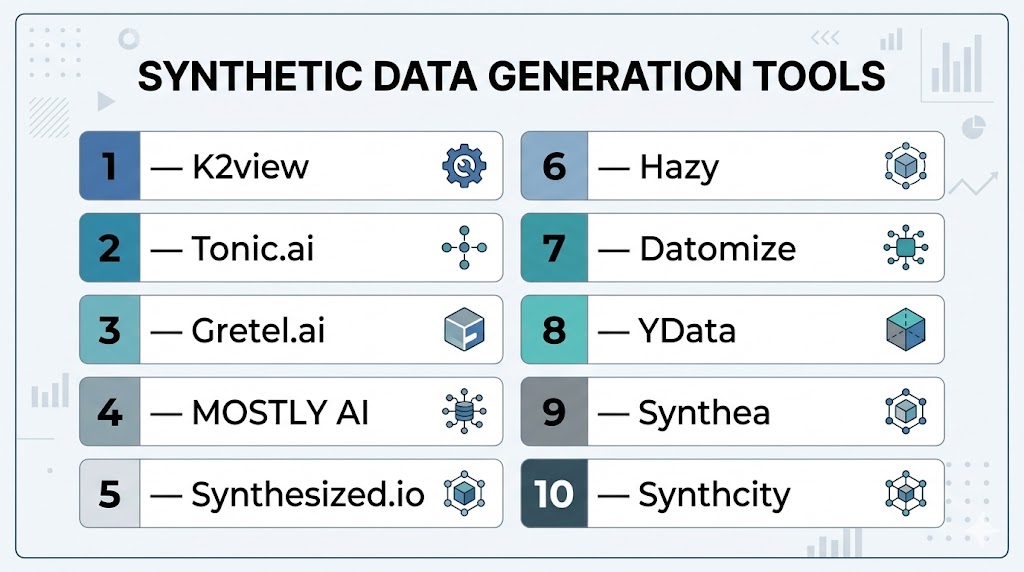
Top 10 Synthetic Data Generation Tools
#1 — K2view
Short description: An enterprise-grade platform for generating synthetic data at scale with strong governance and compliance features.
Key Features
- Multi-method data generation
- Data masking and privacy controls
- Data subsetting and versioning
- Scalable enterprise architecture
- Self-service data generation
- Real-time data provisioning
Pros
- Strong enterprise capabilities
- High scalability
Cons
- Complex setup
- Enterprise-focused pricing
Platforms / Deployment
Cloud / Self-hosted
Security & Compliance
Not publicly stated
Integrations & Ecosystem
Integrates with enterprise data systems and pipelines.
- APIs
- Data warehouses
- ETL tools
Support & Community
Enterprise-level support.
#2 — Tonic.ai
Short description: A developer-focused platform for generating realistic test data with strong privacy controls.
Key Features
- Synthetic data generation
- Data masking and de-identification
- CI/CD integration
- Database support
- Test data automation
Pros
- Developer-friendly
- Strong privacy features
Cons
- Limited advanced AI features
- Focused on structured data
Platforms / Deployment
Cloud / Self-hosted
Security & Compliance
Not publicly stated
Integrations & Ecosystem
- Databases
- APIs
- DevOps tools
Support & Community
Good documentation and support.
#3 — Gretel.ai
Short description: A generative AI platform for creating synthetic datasets across multiple data types.
Key Features
- AI-powered data generation
- Privacy-preserving models
- APIs for developers
- Text and structured data support
- Model training tools
Pros
- Strong AI capabilities
- Flexible APIs
Cons
- Requires technical knowledge
- Pricing varies
Platforms / Deployment
Cloud
Security & Compliance
Not publicly stated
Integrations & Ecosystem
- APIs
- ML tools
- Data pipelines
Support & Community
Growing developer community.
#4 — MOSTLY AI
Short description: A platform focused on generating privacy-safe synthetic data for enterprises.
Key Features
- High-fidelity synthetic data
- Privacy-first approach
- Structured data generation
- Data sharing capabilities
- Compliance-focused features
Pros
- Strong privacy protection
- High data accuracy
Cons
- Limited multimodal support
- Enterprise pricing
Platforms / Deployment
Cloud / Self-hosted
Security & Compliance
Not publicly stated
Integrations & Ecosystem
- Data platforms
- APIs
Support & Community
Enterprise support available.
#5 — Synthesized.io
Short description: A platform that combines synthetic data generation with testing and QA automation.
Key Features
- Data generation and masking
- Test data automation
- Data privacy tools
- Integration with testing workflows
- Scalable architecture
Pros
- Strong for QA/testing
- Automation-focused
Cons
- Less focus on AI training
- Limited ecosystem
Platforms / Deployment
Cloud
Security & Compliance
Not publicly stated
Integrations & Ecosystem
- Testing tools
- APIs
Support & Community
Moderate support.
#6 — Hazy
Short description: A synthetic data platform designed for privacy-compliant data sharing in enterprises.
Key Features
- Privacy-first data generation
- Structured data support
- Compliance tools
- Data governance features
- Scalable architecture
Pros
- Strong compliance focus
- Enterprise-ready
Cons
- Limited flexibility
- Requires expertise
Platforms / Deployment
Cloud
Security & Compliance
Not publicly stated
Integrations & Ecosystem
- Enterprise systems
- APIs
Support & Community
Enterprise support.
#7 — Datomize
Short description: A platform focused on creating secure and realistic synthetic data for testing and analytics.
Key Features
- Data masking and anonymization
- Synthetic data generation
- Test data provisioning
- Compliance tools
- Scalable workflows
Pros
- Strong security features
- Good for testing
Cons
- Limited AI features
- Smaller ecosystem
Platforms / Deployment
Cloud / Self-hosted
Security & Compliance
Not publicly stated
Integrations & Ecosystem
- APIs
- Data systems
Support & Community
Moderate support.
#8 — YData
Short description: A synthetic data platform focused on data science workflows and AI training.
Key Features
- Synthetic data generation
- Data quality monitoring
- ML integration
- Data profiling
- Automation tools
Pros
- Strong for data science
- Flexible
Cons
- Requires expertise
- Limited enterprise features
Platforms / Deployment
Cloud
Security & Compliance
Not publicly stated
Integrations & Ecosystem
- ML tools
- APIs
Support & Community
Growing community.
#9 — Synthea
Short description: An open-source tool for generating synthetic healthcare data.
Key Features
- Healthcare-specific datasets
- Open-source flexibility
- Simulation-based generation
- Realistic patient data
- Customizable scenarios
Pros
- Free and open-source
- Industry-specific
Cons
- Limited to healthcare
- Requires setup
Platforms / Deployment
Self-hosted
Security & Compliance
Not publicly stated
Integrations & Ecosystem
- Healthcare systems
- APIs
Support & Community
Active open-source community.
#10 — Synthcity
Short description: An open-source framework for generating synthetic data using advanced ML techniques.
Key Features
- ML-based data generation
- Support for multiple data types
- Privacy-preserving models
- Research-focused tools
- Extensible framework
Pros
- Flexible and customizable
- Open-source
Cons
- Requires coding
- Limited UI
Platforms / Deployment
Self-hosted
Security & Compliance
Not publicly stated
Integrations & Ecosystem
- Python ecosystem
- ML libraries
Support & Community
Research-focused community.
Comparison Table (Top 10)
| Tool Name | Best For | Platform(s) Supported | Deployment | Standout Feature | Public Rating |
|---|---|---|---|---|---|
| K2view | Enterprise | Web | Hybrid | Data governance | N/A |
| Tonic.ai | Developers | Web | Hybrid | Test data automation | N/A |
| Gretel.ai | AI teams | Web | Cloud | Generative AI | N/A |
| MOSTLY AI | Privacy | Web | Hybrid | Data accuracy | N/A |
| Synthesized | QA/testing | Web | Cloud | Automation | N/A |
| Hazy | Compliance | Web | Cloud | Privacy focus | N/A |
| Datomize | Testing | Web | Hybrid | Security | N/A |
| YData | Data science | Web | Cloud | ML integration | N/A |
| Synthea | Healthcare | Local | Self-hosted | Simulation | N/A |
| Synthcity | Research | Local | Self-hosted | ML models | N/A |
Evaluation & Scoring of Synthetic Data Generation Tools
| Tool Name | Core (25%) | Ease (15%) | Integrations (15%) | Security (10%) | Performance (10%) | Support (10%) | Value (15%) | Weighted Total |
|---|---|---|---|---|---|---|---|---|
| K2view | 9 | 6 | 8 | 8 | 9 | 8 | 7 | 8.1 |
| Tonic | 8 | 9 | 8 | 7 | 8 | 8 | 8 | 8.1 |
| Gretel | 9 | 7 | 8 | 7 | 8 | 7 | 7 | 7.9 |
| MOSTLY | 9 | 7 | 7 | 9 | 8 | 8 | 6 | 8.0 |
| Synthesized | 8 | 8 | 7 | 8 | 7 | 7 | 7 | 7.7 |
| Hazy | 8 | 7 | 7 | 9 | 7 | 7 | 6 | 7.6 |
| Datomize | 7 | 7 | 7 | 8 | 7 | 6 | 7 | 7.2 |
| YData | 8 | 7 | 8 | 7 | 8 | 7 | 8 | 7.8 |
| Synthea | 7 | 6 | 6 | 7 | 7 | 7 | 9 | 7.2 |
| Synthcity | 8 | 6 | 7 | 7 | 8 | 7 | 9 | 7.7 |
How to interpret scores:
- Scores are relative comparisons within this category
- Enterprise tools rank higher in security and scalability
- Open-source tools score higher in value
- Ease of use varies significantly across tools
- Choose based on your technical expertise and use case
Which Synthetic Data Generation Tool Is Right for You?
Solo / Freelancer
- Best: Synthcity, Synthea
- Open-source and cost-effective
SMB
- Best: Tonic.ai, YData
- Balanced usability and features
Mid-Market
- Best: Gretel.ai, Synthesized
- Scalable and flexible
Enterprise
- Best: K2view, MOSTLY AI
- Strong governance and compliance
Budget vs Premium
- Budget: Open-source tools
- Premium: Enterprise platforms
Feature Depth vs Ease of Use
- Depth: K2view, Gretel
- Ease: Tonic, YData
Integrations & Scalability
- Strong: K2view, MOSTLY AI
- Moderate: Synthcity, Datomize
Security & Compliance Needs
- Enterprise tools offer better privacy controls
- Open-source tools require manual setup
Frequently Asked Questions (FAQs)
What is synthetic data?
Synthetic data is artificially generated data that mimics real-world datasets without containing actual user information. It preserves statistical patterns while ensuring privacy. It is widely used in AI and analytics.
Why use synthetic data instead of real data?
Synthetic data helps avoid privacy risks and compliance issues. It also allows teams to generate large datasets quickly. This is useful when real data is limited or sensitive.
Is synthetic data accurate?
High-quality synthetic data can closely match real data patterns. However, accuracy depends on the generation method and tool used. Validation is essential before using it in production.
Can synthetic data replace real data?
It can complement real data but not fully replace it in all cases. Some real-world complexity may not be captured. A hybrid approach is often recommended.
Is synthetic data secure?
Yes, it reduces the risk of exposing sensitive information. However, proper validation is required to ensure no data leakage. Security depends on the tool and configuration.
What industries use synthetic data?
Industries like healthcare, finance, retail, and technology use synthetic data. It is especially valuable where privacy is critical. AI and ML teams also rely on it heavily.
Can synthetic data be used for AI training?
Yes, it is commonly used to train machine learning models. It helps generate diverse and balanced datasets. This improves model performance.
Are synthetic data tools expensive?
Costs vary widely depending on the platform. Open-source tools are free, while enterprise tools can be costly. Pricing often depends on scale and usage.
What types of data can be generated?
Synthetic data tools can generate structured, unstructured, and multimodal data. This includes text, images, and tabular datasets. Capabilities vary by tool.
How do I choose the right tool?
Evaluate your use case, data type, and privacy requirements. Consider scalability, integrations, and cost. Running pilot tests is recommended.
Conclusion
Synthetic data generation tools are becoming a critical part of modern data and AI strategies. They enable organizations to overcome data limitations while maintaining privacy and compliance. These tools provide scalable solutions for testing, training, and analytics across industries. Choosing the right tool depends on your data type, technical expertise, and business requirements. Open-source options offer flexibility, while enterprise platforms deliver advanced governance and performance. Integration with existing systems is essential for long-term success. Cost planning should consider both infrastructure and scaling needs. Validation and quality checks are important to ensure realistic outputs. A balanced approach using both synthetic and real data often delivers the best results. Ultimately, the right tool will help accelerate innovation while keeping data secure and accessible.
