Introduction
MLOps platforms are systems designed to manage the complete lifecycle of machine learning models—from development and training to deployment, monitoring, and continuous improvement. They bring together practices from DevOps, data engineering, and machine learning to ensure models are reliable, scalable, and production-ready.
As organizations increasingly rely on machine learning for critical decision-making, MLOps has become essential for maintaining model performance, reducing operational risk, and enabling faster iteration cycles. Without proper MLOps, even high-performing models can fail in production due to data drift, scalability issues, or lack of monitoring.
Real-world use cases include:
- Continuous model deployment and updates
- Fraud detection systems with real-time monitoring
- Recommendation engines with ongoing optimization
- Predictive maintenance pipelines
- AI-powered customer insights and personalization
What buyers should evaluate:
- End-to-end ML lifecycle support
- Automation of pipelines and workflows
- Model deployment and serving capabilities
- Monitoring and drift detection
- Integration with data and ML tools
- Scalability and performance
- Versioning and experiment tracking
- Security and compliance features
- Ease of collaboration across teams
- Cost and infrastructure requirements
Best for: ML engineers, data scientists, DevOps teams, and enterprises scaling machine learning in production.
Not ideal for: Small projects with minimal deployment needs or teams only focused on experimentation.
Key Trends in MLOps Platforms
- Increasing adoption of automated ML pipelines
- Integration with real-time data streaming systems
- Growth of model monitoring and observability tools
- Expansion of cloud-native MLOps platforms
- Focus on governance and compliance
- Integration with CI/CD workflows
- Rise of low-code MLOps solutions
- Multi-cloud and hybrid deployment strategies
- Improved collaboration between data and engineering teams
- Emphasis on reproducibility and version control
How We Selected These Tools (Methodology)
The platforms were selected based on:
- Industry adoption and enterprise usage
- Coverage of the full ML lifecycle
- Ease of integration with existing tools
- Scalability and performance capabilities
- Strength of monitoring and governance features
- Community and vendor support
- Flexibility across deployment environments
- Innovation in automation and pipelines
- Reliability in production environments
- Overall value for different user segments
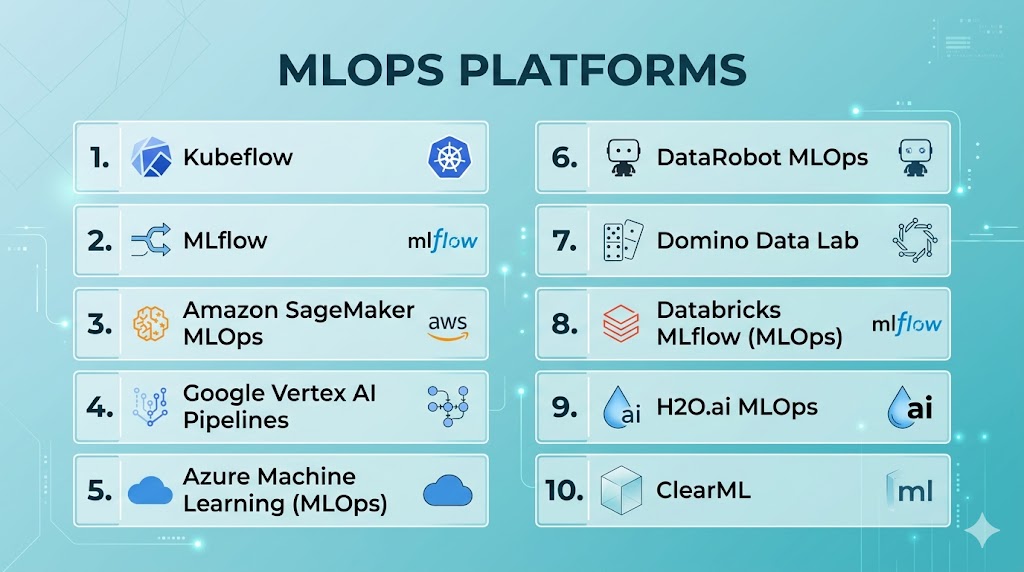
Top 10 MLOps Platforms Tools
#1 — Kubeflow
Short description: An open-source platform designed for managing machine learning workflows on Kubernetes.
Key Features
- Pipeline orchestration
- Kubernetes-native deployment
- Scalable workflows
- Experiment tracking
- Model serving
- Modular components
Pros
- Highly flexible
- Open-source and customizable
Cons
- Complex setup
- Requires Kubernetes expertise
Platforms / Deployment
Cloud / Self-hosted
Security & Compliance
Not publicly stated
Integrations & Ecosystem
Integrates with containerized environments and ML tools.
- Kubernetes
- APIs
- Data platforms
Support & Community
Strong open-source community.
#2 — MLflow
Short description: An open-source platform for managing the ML lifecycle, including tracking experiments and models.
Key Features
- Experiment tracking
- Model registry
- Deployment support
- Reproducibility tools
- Integration with ML libraries
Pros
- Lightweight and flexible
- Easy integration
Cons
- Limited built-in orchestration
- Requires additional tools
Platforms / Deployment
Cloud / Self-hosted
Security & Compliance
Not publicly stated
Integrations & Ecosystem
- Python ecosystem
- APIs
- Data tools
Support & Community
Large developer community.
#3 — Amazon SageMaker MLOps
Short description: A managed MLOps solution for automating ML workflows within a cloud ecosystem.
Key Features
- Pipeline automation
- Model deployment
- Monitoring tools
- Integration with cloud services
- Scalable infrastructure
Pros
- Fully managed
- Scalable
Cons
- Cloud dependency
- Pricing complexity
Platforms / Deployment
Cloud
Security & Compliance
Not publicly stated
Integrations & Ecosystem
- Cloud services
- APIs
- Data pipelines
Support & Community
Strong enterprise support.
#4 — Google Vertex AI Pipelines
Short description: A managed pipeline orchestration platform for machine learning workflows.
Key Features
- Pipeline orchestration
- Model deployment
- Monitoring tools
- Integration with AI services
- Scalable infrastructure
Pros
- Easy integration
- Fully managed
Cons
- Cloud dependency
- Learning curve
Platforms / Deployment
Cloud
Security & Compliance
Not publicly stated
Integrations & Ecosystem
- Cloud tools
- APIs
- Data platforms
Support & Community
Strong documentation.
#5 — Azure Machine Learning (MLOps)
Short description: A platform for managing ML workflows with strong enterprise integration.
Key Features
- Model lifecycle management
- Pipeline automation
- Deployment tools
- Monitoring capabilities
- Integration with enterprise tools
Pros
- Enterprise-ready
- Strong integrations
Cons
- Learning curve
- Cloud dependency
Platforms / Deployment
Cloud
Security & Compliance
Not publicly stated
Integrations & Ecosystem
- Enterprise systems
- APIs
- Data tools
Support & Community
Enterprise support available.
#6 — DataRobot MLOps
Short description: A platform focused on monitoring and managing deployed machine learning models.
Key Features
- Model monitoring
- Automated deployment
- Governance tools
- Performance tracking
- Alerts and reporting
Pros
- Strong monitoring
- Enterprise-grade features
Cons
- Expensive
- Less flexible
Platforms / Deployment
Cloud / Hybrid
Security & Compliance
Not publicly stated
Integrations & Ecosystem
- APIs
- Data platforms
Support & Community
Enterprise-level support.
#7 — Domino Data Lab
Short description: A platform designed for collaboration, governance, and reproducibility in ML workflows.
Key Features
- Experiment tracking
- Collaboration tools
- Governance features
- Scalable infrastructure
- Model management
Pros
- Strong governance
- Enterprise-focused
Cons
- Expensive
- Requires expertise
Platforms / Deployment
Cloud / Hybrid
Security & Compliance
Not publicly stated
Integrations & Ecosystem
- Data platforms
- APIs
Support & Community
Enterprise support.
#8 — Databricks MLflow (MLOps)
Short description: A unified platform combining data engineering and MLOps capabilities.
Key Features
- Experiment tracking
- Model deployment
- Integration with data pipelines
- Scalable infrastructure
- Collaboration tools
Pros
- Unified data and ML platform
- Strong scalability
Cons
- Cost considerations
- Requires platform adoption
Platforms / Deployment
Cloud
Security & Compliance
Not publicly stated
Integrations & Ecosystem
- Data lakes
- APIs
- ML tools
Support & Community
Strong enterprise support.
#9 — H2O.ai MLOps
Short description: A platform focused on deploying and monitoring machine learning models.
Key Features
- Model deployment
- Monitoring tools
- Performance tracking
- Scalable infrastructure
- Integration with ML tools
Pros
- Strong performance
- Easy deployment
Cons
- Limited ecosystem
- Requires setup
Platforms / Deployment
Cloud / Self-hosted
Security & Compliance
Not publicly stated
Integrations & Ecosystem
- APIs
- Data tools
Support & Community
Active community.
#10 — ClearML
Short description: An open-source MLOps platform for experiment tracking and workflow automation.
Key Features
- Experiment tracking
- Pipeline automation
- Resource management
- Model versioning
- Open-source flexibility
Pros
- Free and flexible
- Easy integration
Cons
- Limited enterprise features
- Requires setup
Platforms / Deployment
Cloud / Self-hosted
Security & Compliance
Not publicly stated
Integrations & Ecosystem
- Python ecosystem
- APIs
Support & Community
Growing community.
Comparison Table (Top 10)
| Tool Name | Best For | Platform(s) Supported | Deployment | Standout Feature | Public Rating |
|---|---|---|---|---|---|
| Kubeflow | Open-source | Kubernetes | Hybrid | Pipelines | N/A |
| MLflow | Tracking | Multi-platform | Hybrid | Experiment tracking | N/A |
| SageMaker | AWS users | Web | Cloud | Automation | N/A |
| Vertex AI | Google users | Web | Cloud | Pipelines | N/A |
| Azure ML | Enterprise | Web | Cloud | Integration | N/A |
| DataRobot | Monitoring | Web | Hybrid | Governance | N/A |
| Domino | Enterprise | Web | Hybrid | Collaboration | N/A |
| Databricks | Unified platform | Web | Cloud | Lakehouse | N/A |
| H2O | Deployment | Web | Hybrid | Performance | N/A |
| ClearML | Open-source | Multi-platform | Hybrid | Flexibility | N/A |
Evaluation & Scoring of MLOps Platforms
| Tool Name | Core (25%) | Ease (15%) | Integrations (15%) | Security (10%) | Performance (10%) | Support (10%) | Value (15%) | Weighted Total |
|---|---|---|---|---|---|---|---|---|
| Kubeflow | 9 | 5 | 9 | 7 | 9 | 8 | 9 | 8.2 |
| MLflow | 8 | 8 | 9 | 6 | 8 | 9 | 9 | 8.4 |
| SageMaker | 9 | 7 | 9 | 8 | 9 | 8 | 7 | 8.4 |
| Vertex | 9 | 7 | 9 | 8 | 8 | 8 | 7 | 8.3 |
| Azure | 9 | 7 | 9 | 8 | 8 | 8 | 7 | 8.3 |
| DataRobot | 9 | 8 | 8 | 8 | 8 | 8 | 6 | 8.0 |
| Domino | 9 | 6 | 8 | 8 | 8 | 8 | 6 | 7.9 |
| Databricks | 9 | 7 | 9 | 8 | 9 | 9 | 7 | 8.6 |
| H2O | 8 | 7 | 7 | 7 | 8 | 7 | 8 | 7.8 |
| ClearML | 8 | 8 | 8 | 6 | 7 | 7 | 9 | 8.0 |
How to interpret scores:
- Scores are comparative within this category
- Higher scores indicate stronger overall capabilities
- Open-source tools offer flexibility and value
- Enterprise tools provide scalability and governance
- Choose based on your deployment and team needs
Which MLOps Platform Is Right for You?
Solo / Freelancer
- Best: MLflow, ClearML
- Lightweight and flexible
SMB
- Best: H2O, MLflow
- Balanced usability and features
Mid-Market
- Best: SageMaker, Azure ML
- Scalable and integrated
Enterprise
- Best: Databricks, Domino
- Advanced governance and performance
Budget vs Premium
- Budget: MLflow, ClearML
- Premium: Databricks, DataRobot
Feature Depth vs Ease of Use
- Depth: Kubeflow, Databricks
- Ease: MLflow, ClearML
Integrations & Scalability
- Strong: Databricks, SageMaker
- Moderate: ClearML, H2O
Security & Compliance Needs
- Enterprise tools offer better governance
- Open-source requires manual setup
Frequently Asked Questions (FAQs)
What is MLOps?
MLOps is a set of practices that combines machine learning, DevOps, and data engineering. It helps manage the lifecycle of ML models from development to deployment. The goal is to make ML systems reliable and scalable.
Why is MLOps important?
MLOps ensures that machine learning models perform well in production. It helps manage updates, monitor performance, and reduce risks. Without it, models can fail due to data changes or lack of monitoring.
Do I need MLOps for small projects?
Not always. Small projects may not require full MLOps platforms. However, as projects grow, MLOps becomes essential for managing complexity.
What tools are used in MLOps?
MLOps tools include platforms for pipeline automation, model tracking, deployment, and monitoring. Examples include Kubeflow, MLflow, and cloud-based solutions. These tools help streamline ML workflows.
Is MLOps only for enterprises?
No, MLOps can be used by teams of all sizes. Open-source tools make it accessible for small teams. Enterprises use advanced platforms for scalability and governance.
How does MLOps improve model performance?
MLOps enables continuous monitoring and updates. It helps detect issues like data drift and retrain models. This ensures models remain accurate over time.
Can MLOps integrate with existing systems?
Yes, most MLOps platforms integrate with data pipelines, cloud services, and ML tools. Integration is key for building complete workflows. A strong ecosystem improves efficiency.
What is model drift?
Model drift occurs when the performance of a model decreases over time due to changes in data. MLOps platforms help detect and manage drift. This ensures consistent performance.
How do I choose an MLOps platform?
Evaluate your team size, infrastructure, and use cases. Consider scalability, integrations, and cost. Testing platforms through pilot projects is recommended.
Are MLOps platforms expensive?
Costs vary depending on the platform and deployment model. Open-source tools are free but require setup. Enterprise platforms offer advanced features at higher costs.
Conclusion
MLOps platforms are essential for scaling machine learning from experimentation to production. They provide the tools needed to automate workflows, monitor performance, and ensure reliability. Choosing the right platform depends on your team’s expertise, infrastructure, and business goals. Open-source solutions offer flexibility and cost savings, while enterprise platforms provide advanced features and governance. Integration with existing systems is critical for seamless workflows. Scalability and performance should be evaluated based on real-world use cases. Cost planning must include infrastructure and operational overhead. Security and compliance are key considerations for production environments. Running pilot implementations can help validate platform capabilities. Ultimately, the right MLOps platform enables organizations to deliver reliable and scalable AI solutions efficiently.
