Introduction
AutoML platforms are tools designed to automate the process of building, training, and optimizing machine learning models. Instead of requiring deep expertise in algorithms and coding, these platforms enable users to generate high-quality models using automation, guided workflows, and intelligent recommendations.
As organizations push toward faster AI adoption, AutoML has become a critical solution for reducing development time and making machine learning accessible to a broader audience. It empowers both technical and non-technical users to experiment with data, build predictive models, and deploy them efficiently.
Real-world use cases include:
- Customer churn prediction
- Sales forecasting
- Fraud detection
- Demand planning
- Predictive analytics for business operations
What buyers should evaluate:
- Level of automation vs control
- Model performance and optimization
- Ease of use and UI/UX
- Data preparation capabilities
- Integration with existing data systems
- Deployment and MLOps features
- Explainability and model transparency
- Scalability and compute resources
- Security and compliance features
- Pricing and usage limits
Best for: Business analysts, data scientists, startups, and enterprises looking to accelerate machine learning development.
Not ideal for: Highly specialized ML use cases requiring full manual control or custom algorithm development.
Key Trends in AutoML Platforms
- Growth of no-code and low-code machine learning tools
- Integration of AI assistants for model building
- Increased focus on explainable AI
- Expansion of cloud-native AutoML solutions
- Real-time model deployment and monitoring
- Integration with data pipelines and analytics platforms
- Automated feature engineering and hyperparameter tuning
- Improved governance and compliance features
- Support for multi-model experimentation
- Democratization of machine learning across teams
How We Selected These Tools (Methodology)
The platforms were selected based on:
- Market adoption and popularity
- Automation capabilities and accuracy
- Ease of use for non-technical users
- Integration with data ecosystems
- Scalability and performance
- Deployment and monitoring features
- Community and vendor support
- Flexibility across industries
- Innovation in AutoML features
- Overall value and reliability
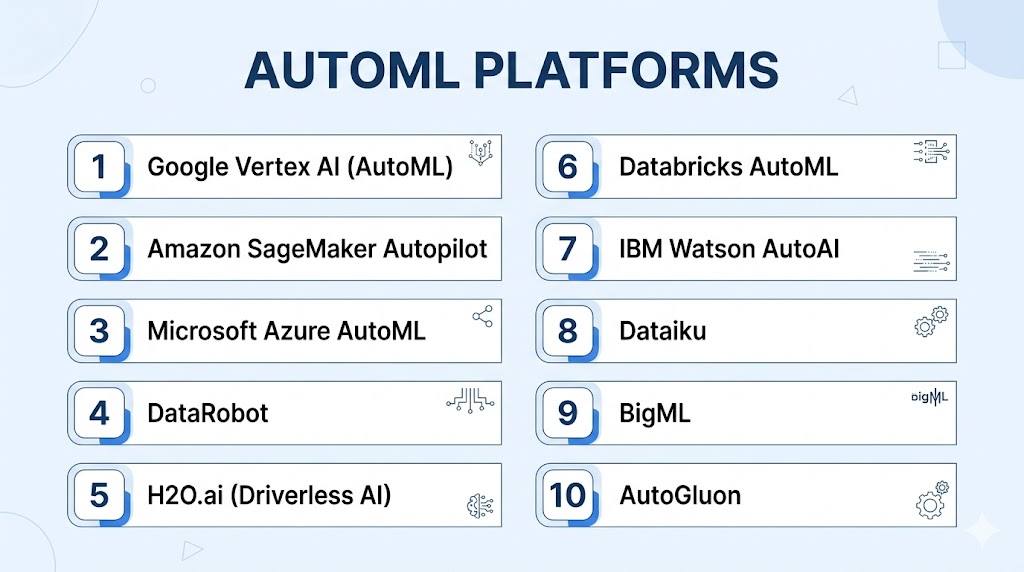
Top 10 AutoML Platforms Tools
#1 — Google AutoML (Vertex AI AutoML)
Short description: A powerful AutoML platform that enables users to build custom machine learning models with minimal effort.
Key Features
- Automated model training
- Custom model creation
- Integration with cloud services
- Scalable infrastructure
- Advanced AI capabilities
- Model deployment tools
Pros
- High accuracy models
- Fully managed service
Cons
- Pricing complexity
- Cloud dependency
Platforms / Deployment
Cloud
Security & Compliance
Not publicly stated
Integrations & Ecosystem
Integrates with cloud data services and AI tools.
- APIs
- Data platforms
- ML pipelines
Support & Community
Strong enterprise support.
#2 — Amazon SageMaker Autopilot
Short description: An AutoML feature within SageMaker that automates model building and tuning.
Key Features
- Automated model selection
- Feature engineering
- Hyperparameter tuning
- Model deployment
- Integration with AWS
Pros
- End-to-end automation
- Scalable
Cons
- AWS dependency
- Learning curve
Platforms / Deployment
Cloud
Security & Compliance
Not publicly stated
Integrations & Ecosystem
- AWS services
- APIs
- Data tools
Support & Community
Strong support ecosystem.
#3 — Microsoft Azure AutoML
Short description: A cloud-based AutoML service that simplifies model creation and deployment.
Key Features
- Automated model training
- Built-in algorithms
- Integration with Azure services
- Scalable compute
- Model evaluation tools
Pros
- Enterprise-ready
- Easy integration
Cons
- Requires Azure knowledge
- Pricing considerations
Platforms / Deployment
Cloud
Security & Compliance
Not publicly stated
Integrations & Ecosystem
- Azure services
- APIs
- Data tools
Support & Community
Enterprise-level support.
#4 — DataRobot
Short description: A leading enterprise AutoML platform focused on automation and predictive analytics.
Key Features
- Automated modeling
- Model deployment
- Explainable AI
- Data preparation
- Model monitoring
Pros
- Strong automation
- Enterprise-grade features
Cons
- Expensive
- Less flexibility
Platforms / Deployment
Cloud / Hybrid
Security & Compliance
Not publicly stated
Integrations & Ecosystem
- APIs
- Data tools
- BI platforms
Support & Community
Enterprise support available.
#5 — H2O.ai (Driverless AI)
Short description: An AutoML platform designed for high-performance model building and automation.
Key Features
- Automated feature engineering
- Model interpretability
- High-performance computing
- Scalable architecture
- Advanced algorithms
Pros
- Strong performance
- Good explainability
Cons
- Requires expertise
- UI limitations
Platforms / Deployment
Cloud / Self-hosted
Security & Compliance
Not publicly stated
Integrations & Ecosystem
- APIs
- Data tools
- ML libraries
Support & Community
Active community.
#6 — Dataiku
Short description: A collaborative data platform with strong AutoML capabilities and visual workflows.
Key Features
- Visual pipelines
- Automated modeling
- Collaboration tools
- Data preparation
- Model deployment
Pros
- User-friendly
- Strong collaboration
Cons
- Expensive
- Limited deep customization
Platforms / Deployment
Cloud / Self-hosted
Security & Compliance
Not publicly stated
Integrations & Ecosystem
- Databases
- APIs
- Data tools
Support & Community
Good enterprise support.
#7 — RapidMiner
Short description: A user-friendly AutoML platform focused on ease of use and automation.
Key Features
- Visual workflows
- Automated modeling
- Data preparation
- Predictive analytics
- Deployment tools
Pros
- Beginner-friendly
- Easy automation
Cons
- Limited scalability
- Performance constraints
Platforms / Deployment
Cloud / Desktop
Security & Compliance
Not publicly stated
Integrations & Ecosystem
- APIs
- Data tools
Support & Community
Active user community.
#8 — KNIME
Short description: An open-source analytics platform with AutoML capabilities through extensions.
Key Features
- Visual workflows
- AutoML extensions
- Data integration
- Machine learning tools
- Extensible plugins
Pros
- Free and flexible
- Strong community
Cons
- UI limitations
- Requires setup
Platforms / Deployment
Desktop / Cloud
Security & Compliance
Not publicly stated
Integrations & Ecosystem
- Plugins
- Data tools
Support & Community
Large open-source community.
#9 — BigML
Short description: A cloud-based AutoML platform for building and deploying predictive models.
Key Features
- Automated modeling
- Visual interface
- Model evaluation
- Deployment tools
- Scalable infrastructure
Pros
- Easy to use
- Good for small teams
Cons
- Limited advanced features
- Smaller ecosystem
Platforms / Deployment
Cloud
Security & Compliance
Not publicly stated
Integrations & Ecosystem
- APIs
- Data tools
Support & Community
Moderate support.
#10 — AutoGluon
Short description: An open-source AutoML toolkit designed for fast and accurate model development.
Key Features
- Automated model selection
- Fast training
- Multi-model support
- Scalable performance
- Open-source flexibility
Pros
- High accuracy
- Flexible
Cons
- Requires coding
- Limited UI
Platforms / Deployment
Cloud / Self-hosted
Security & Compliance
Not publicly stated
Integrations & Ecosystem
- Python ecosystem
- APIs
Support & Community
Growing community.
Comparison Table (Top 10)
| Tool Name | Best For | Platform(s) Supported | Deployment | Standout Feature | Public Rating |
|---|---|---|---|---|---|
| Vertex AutoML | Cloud AI | Web | Cloud | Automated ML | N/A |
| SageMaker Autopilot | AWS users | Web | Cloud | End-to-end AutoML | N/A |
| Azure AutoML | Enterprise | Web | Cloud | Integration | N/A |
| DataRobot | Enterprise AI | Web | Hybrid | Explainability | N/A |
| H2O Driverless | Performance | Web | Hybrid | Feature engineering | N/A |
| Dataiku | Collaboration | Web | Hybrid | Visual pipelines | N/A |
| RapidMiner | Beginners | Desktop/Web | Hybrid | Ease of use | N/A |
| KNIME | Open-source | Desktop | Hybrid | Free workflows | N/A |
| BigML | Small teams | Web | Cloud | Simplicity | N/A |
| AutoGluon | Developers | Python | Self-hosted | Automation | N/A |
Evaluation & Scoring of AutoML Platforms
| Tool Name | Core (25%) | Ease (15%) | Integrations (15%) | Security (10%) | Performance (10%) | Support (10%) | Value (15%) | Weighted Total |
|---|---|---|---|---|---|---|---|---|
| Vertex | 9 | 8 | 9 | 8 | 8 | 8 | 7 | 8.3 |
| SageMaker | 9 | 7 | 9 | 8 | 9 | 8 | 7 | 8.4 |
| Azure | 9 | 8 | 9 | 8 | 8 | 8 | 7 | 8.3 |
| DataRobot | 9 | 8 | 8 | 8 | 8 | 8 | 6 | 8.0 |
| H2O | 8 | 7 | 7 | 7 | 9 | 7 | 8 | 7.9 |
| Dataiku | 8 | 9 | 8 | 7 | 8 | 8 | 7 | 8.0 |
| RapidMiner | 7 | 9 | 7 | 6 | 7 | 7 | 8 | 7.5 |
| KNIME | 7 | 8 | 7 | 6 | 7 | 7 | 9 | 7.6 |
| BigML | 7 | 8 | 6 | 6 | 7 | 6 | 8 | 7.2 |
| AutoGluon | 8 | 6 | 7 | 6 | 9 | 7 | 8 | 7.8 |
How to interpret scores:
- Scores are comparative within this category
- Higher scores indicate stronger capabilities
- Enterprise tools rank higher in automation and scalability
- Beginner tools rank higher in ease of use
- Choose based on your workflow needs
Which AutoML Platform Is Right for You?
Solo / Freelancer
- Best: KNIME, BigML
- Easy and cost-effective
SMB
- Best: RapidMiner, Dataiku
- Balanced usability and features
Mid-Market
- Best: Azure AutoML, SageMaker Autopilot
- Scalable solutions
Enterprise
- Best: DataRobot, Vertex AutoML
- Advanced automation and governance
Budget vs Premium
- Budget: KNIME, AutoGluon
- Premium: DataRobot, Vertex
Feature Depth vs Ease of Use
- Depth: H2O, SageMaker
- Ease: RapidMiner, BigML
Integrations & Scalability
- Strong: Vertex, Azure
- Moderate: KNIME, BigML
Security & Compliance Needs
- Enterprise tools provide better controls
- Open-source tools require setup
Frequently Asked Questions (FAQs)
What is AutoML?
AutoML automates the process of building machine learning models, including data preparation, feature selection, and tuning. It reduces the need for manual coding and expertise. This makes machine learning accessible to a wider audience.
Do I need coding skills for AutoML?
Many AutoML platforms offer no-code or low-code interfaces, making them accessible to beginners. However, some tools still require coding for advanced customization. Teams often combine both approaches.
Which AutoML platform is best?
There is no single best platform; it depends on your use case and budget. Enterprise tools offer more features, while open-source tools provide flexibility. Evaluating performance and ease of use is key.
Are AutoML platforms expensive?
Costs vary depending on the platform and usage. Open-source tools are free but require setup. Enterprise platforms can be costly but provide advanced automation and support.
Can AutoML handle big data?
Yes, many AutoML platforms are designed to scale with large datasets. They use distributed computing and cloud infrastructure. This makes them suitable for enterprise workloads.
What industries use AutoML?
Industries like finance, healthcare, retail, and technology use AutoML for predictive analytics. It helps automate decision-making and improve efficiency. Any data-driven organization can benefit.
Can AutoML replace data scientists?
AutoML simplifies many tasks but does not replace data scientists. Experts are still needed for complex problems and model interpretation. It acts as a productivity tool rather than a replacement.
Are AutoML models accurate?
AutoML platforms can produce highly accurate models, especially for standard use cases. However, results depend on data quality and problem complexity. Validation is always necessary.
Can AutoML integrate with other tools?
Yes, most platforms integrate with data sources, APIs, and analytics tools. Integration is essential for building complete workflows. A strong ecosystem improves scalability.
How do I choose the right AutoML platform?
Evaluate your business needs, data size, and technical expertise. Consider ease of use, scalability, and cost. Running pilot tests is the best way to decide.
Conclusion
AutoML platforms are transforming the way organizations build and deploy machine learning models by making the process faster and more accessible. They reduce the complexity of model development while maintaining strong performance and scalability. Choosing the right platform depends on your technical expertise, data requirements, and business goals. Open-source tools offer flexibility and cost advantages, while enterprise platforms provide advanced automation and governance. Integration with existing systems is a key factor for long-term success. Cost planning should include compute resources and scaling needs. Security and compliance must align with organizational standards. Testing multiple platforms through pilot projects helps validate their capabilities. A well-chosen AutoML platform can significantly improve productivity and accelerate AI adoption. Ultimately, the best choice is the one that fits your workflow and growth strategy.
