Introduction
No-code app builders are platforms that allow users to create applications without writing code, using visual interfaces, drag-and-drop components, and pre-built logic systems. These tools enable businesses and individuals to build web and mobile apps quickly, reducing reliance on traditional development teams.
As demand for faster digital product development increases, no-code platforms are becoming essential for rapid prototyping, internal tools, MVPs, and even full-scale applications. They empower non-technical users while also helping developers accelerate workflows.
Common Use Cases
- Building internal business tools and dashboards
- Creating MVPs for startups
- Developing mobile apps without coding
- Automating workflows and processes
- Launching SaaS products quickly
What Buyers Should Evaluate
- Ease of use and learning curve
- Customization and flexibility
- Database and backend capabilities
- Integration with APIs and third-party tools
- Scalability and performance
- Mobile and web app support
- Security and compliance features
- Pricing and usage limits
- Collaboration and team workflows
Best for: Founders, product managers, marketers, startups, SMBs, and operations teams looking to build apps quickly without engineering resources.
Not ideal for: Highly complex applications requiring deep backend logic, real-time processing at scale, or full control over infrastructure.
Key Trends in No-Code App Builders
- AI-assisted app creation: Automated UI generation and workflow suggestions
- Full-stack no-code platforms: Combining frontend, backend, and database
- API-first integrations: Connecting easily with external services
- Workflow automation: Built-in logic builders for business processes
- Cross-platform deployment: Web and mobile apps from a single build
- Scalability improvements: Handling larger user bases and data volumes
- Component-based design: Reusable blocks for faster development
- Collaboration tools: Multi-user editing and version control
- Security enhancements: Role-based access and audit logs
How We Selected These Tools (Methodology)
- Market adoption and popularity
- Feature completeness across frontend, backend, and automation
- Ease of use for non-technical users
- Flexibility for advanced use cases
- Integration capabilities with modern tools
- Performance and scalability indicators
- Support for mobile and web platforms
- Community and ecosystem strength
- Ongoing innovation and updates
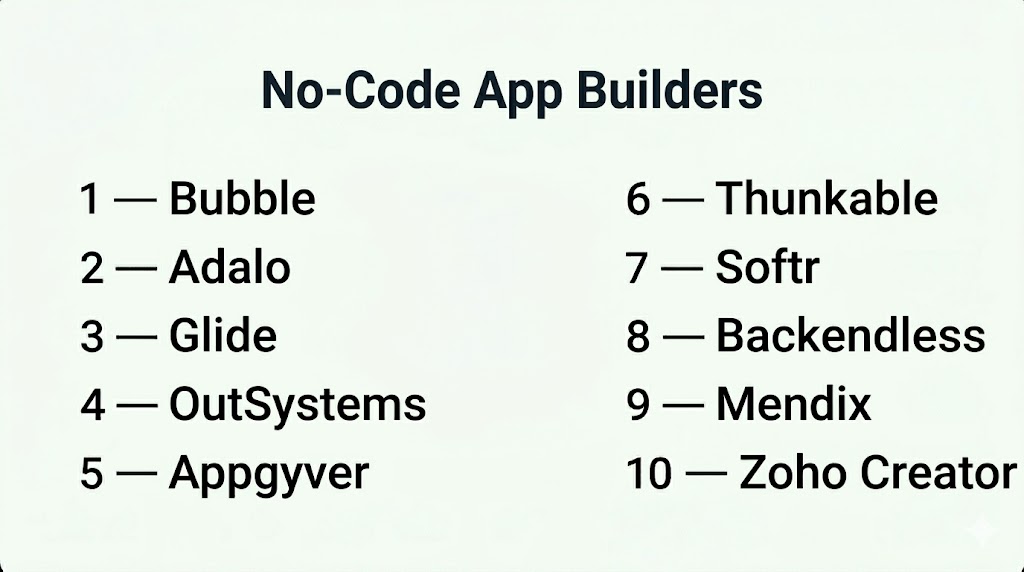
Top 10 No-Code App Builders
#1 — Bubble
Short description: A powerful no-code platform for building full web applications with backend logic and workflows.
Key Features
- Visual app builder
- Built-in database
- Workflow automation
- API integrations
- User authentication
- Plugin marketplace
Pros
- Highly flexible for complex apps
- Strong backend capabilities
Cons
- Steep learning curve
- Performance may vary at scale
Platforms / Deployment
Web / Cloud
Security & Compliance
Encryption and role-based access. Additional details: Not publicly stated
Integrations & Ecosystem
- APIs
- Plugin marketplace
- Third-party integrations
Support & Community
Large and active community with extensive tutorials
#2 — Adalo
Short description: A no-code platform focused on building mobile and web apps with ease.
Key Features
- Drag-and-drop builder
- Native mobile app creation
- Database management
- Components and templates
- User authentication
- App publishing
Pros
- Easy to use
- Strong mobile app capabilities
Cons
- Limited scalability
- Performance constraints
Platforms / Deployment
Web / iOS / Android
Security & Compliance
Not publicly stated
Integrations & Ecosystem
- APIs
- External services
Support & Community
Good documentation and tutorials
#3 — Glide
Short description: A no-code platform for building apps from spreadsheets and simple data sources.
Key Features
- Spreadsheet-based backend
- Drag-and-drop UI
- Mobile-first apps
- Templates
- User authentication
- Real-time updates
Pros
- Very beginner-friendly
- Fast setup
Cons
- Limited customization
- Not suitable for complex apps
Platforms / Deployment
Web / iOS / Android
Security & Compliance
Not publicly stated
Integrations & Ecosystem
- Google Sheets
- APIs
Support & Community
Strong community and support resources
#4 — OutSystems
Short description: A low-code/no-code platform designed for enterprise-grade application development.
Key Features
- Visual development tools
- Full-stack capabilities
- Integration tools
- Automation workflows
- Deployment management
- Performance monitoring
Pros
- Enterprise scalability
- Strong integration capabilities
Cons
- Expensive
- Requires technical knowledge
Platforms / Deployment
Web / Cloud / Hybrid
Security & Compliance
Enterprise-grade controls. Details: Not publicly stated
Integrations & Ecosystem
- Enterprise systems
- APIs
Support & Community
Enterprise-level support
#5 — Appgyver
Short description: A no-code platform for building apps with strong logic and integration capabilities.
Key Features
- Visual builder
- Logic editor
- API integration
- Cross-platform support
- UI components
- Data modeling
Pros
- Flexible logic system
- Free usage tiers
Cons
- Smaller ecosystem
- Learning curve
Platforms / Deployment
Web / iOS / Android
Security & Compliance
Not publicly stated
Integrations & Ecosystem
- APIs
- Third-party services
Support & Community
Growing community
#6 — Thunkable
Short description: A platform focused on building mobile apps with drag-and-drop simplicity.
Key Features
- Drag-and-drop UI
- Logic blocks
- Native mobile apps
- API integration
- Live testing
Pros
- Easy mobile app creation
- Beginner-friendly
Cons
- Limited advanced features
- Performance constraints
Platforms / Deployment
Web / iOS / Android
Security & Compliance
Not publicly stated
Integrations & Ecosystem
- APIs
- Third-party tools
Support & Community
Active community and documentation
#7 — Softr
Short description: A no-code platform for building web apps and client portals from databases.
Key Features
- Database integration
- Drag-and-drop builder
- Templates
- User authentication
- Web app creation
Pros
- Easy to use
- Great for internal tools
Cons
- Limited customization
- Not ideal for complex apps
Platforms / Deployment
Web / Cloud
Security & Compliance
Not publicly stated
Integrations & Ecosystem
- Airtable
- APIs
Support & Community
Strong onboarding support
#8 — Backendless
Short description: A no-code backend platform for building scalable applications.
Key Features
- Backend-as-a-service
- Visual logic builder
- Database management
- User authentication
- API services
Pros
- Strong backend capabilities
- Scalable
Cons
- Less focus on frontend design
- Learning curve
Platforms / Deployment
Cloud / Self-hosted
Security & Compliance
Not publicly stated
Integrations & Ecosystem
- APIs
- Backend services
Support & Community
Moderate community support
#9 — Mendix
Short description: A low-code/no-code platform designed for enterprise application development.
Key Features
- Visual development
- Collaboration tools
- Integration capabilities
- Deployment automation
- Analytics
Pros
- Enterprise-ready
- Scalable
Cons
- Complex
- Expensive
Platforms / Deployment
Cloud / Hybrid
Security & Compliance
Enterprise-level features. Details: Not publicly stated
Integrations & Ecosystem
- Enterprise systems
- APIs
Support & Community
Strong enterprise support
#10 — Zoho Creator
Short description: A no-code platform for building business applications and automating workflows.
Key Features
- Drag-and-drop builder
- Workflow automation
- Database management
- Integration tools
- Reporting
Pros
- Strong business use cases
- Good integration with ecosystem
Cons
- Limited UI flexibility
- Learning curve
Platforms / Deployment
Web / iOS / Android
Security & Compliance
Not publicly stated
Integrations & Ecosystem
- Zoho ecosystem
- APIs
Support & Community
Strong documentation and support
Comparison Table (Top 10)
| Tool Name | Best For | Platform(s) Supported | Deployment | Standout Feature | Public Rating |
|---|---|---|---|---|---|
| Bubble | Web apps | Web | Cloud | Full-stack builder | N/A |
| Adalo | Mobile apps | Web | Cloud | Native app creation | N/A |
| Glide | Beginners | Web | Cloud | Spreadsheet-based apps | N/A |
| OutSystems | Enterprise | Web | Hybrid | Enterprise scalability | N/A |
| Appgyver | Logic apps | Web | Cloud | Visual logic builder | N/A |
| Thunkable | Mobile apps | Web | Cloud | Drag-and-drop mobile UI | N/A |
| Softr | Internal tools | Web | Cloud | Database-driven apps | N/A |
| Backendless | Backend apps | Web | Hybrid | Backend-as-a-service | N/A |
| Mendix | Enterprise | Web | Hybrid | Full-stack enterprise tools | N/A |
| Zoho Creator | Business apps | Web | Cloud | Workflow automation | N/A |
Evaluation & Scoring of No-Code App Builders
| Tool Name | Core | Ease | Integrations | Security | Performance | Support | Value | Weighted Total |
|---|---|---|---|---|---|---|---|---|
| Bubble | 9 | 7 | 8 | 7 | 8 | 8 | 8 | 8.1 |
| Adalo | 7 | 9 | 7 | 6 | 7 | 7 | 8 | 7.6 |
| Glide | 6 | 10 | 6 | 6 | 7 | 7 | 9 | 7.5 |
| OutSystems | 9 | 6 | 9 | 8 | 9 | 9 | 6 | 8.2 |
| Appgyver | 8 | 7 | 7 | 6 | 8 | 7 | 8 | 7.7 |
| Thunkable | 7 | 9 | 7 | 6 | 7 | 7 | 8 | 7.6 |
| Softr | 7 | 9 | 7 | 6 | 7 | 8 | 8 | 7.7 |
| Backendless | 8 | 6 | 8 | 7 | 8 | 7 | 7 | 7.6 |
| Mendix | 9 | 6 | 9 | 8 | 9 | 9 | 6 | 8.2 |
| Zoho Creator | 8 | 7 | 8 | 7 | 8 | 8 | 8 | 7.9 |
How to interpret scores:
- Scores are relative comparisons across tools
- Higher scores indicate stronger capabilities overall
- Enterprise tools score higher in features and performance
- Beginner tools score higher in ease of use
- Choose based on your specific needs
Which No-Code App Builder Is Right for You?
Solo / Freelancer
- Best: Glide, Softr
- Focus on simplicity and speed
SMB
- Best: Bubble, Zoho Creator
- Balance between flexibility and ease
Mid-Market
- Best: Bubble, Appgyver
- Need scalability and integrations
Enterprise
- Best: OutSystems, Mendix
- Advanced features and governance
Budget vs Premium
- Budget: Glide, Softr
- Premium: OutSystems, Mendix
Feature Depth vs Ease of Use
- Deep features: Bubble, Mendix
- Easy use: Glide, Adalo
Integrations & Scalability
- Strong integrations: OutSystems, Mendix
- Moderate: Bubble, Zoho Creator
Security & Compliance Needs
- Enterprise-ready: OutSystems, Mendix
- Basic: Glide, Softr
Frequently Asked Questions (FAQs)
What are no-code app builders?
Platforms that allow users to create apps without coding using visual tools.
Are no-code apps scalable?
Some platforms support scalability, but limits vary.
Do I need technical skills?
No, but understanding logic helps.
Can I build mobile apps?
Yes, many tools support mobile app creation.
Are no-code tools secure?
Security varies by platform.
Can I integrate APIs?
Most tools support API integrations.
How fast can I build an app?
From hours to weeks depending on complexity.
Are no-code tools expensive?
Pricing varies widely.
Can I export code?
Some tools allow it, others do not.
When should I use no-code tools?
For rapid development and prototyping.
Conclusion
No-code app builders have transformed how applications are created, enabling faster development, reduced costs, and broader accessibility. They are especially valuable for startups and teams that need to launch quickly without heavy technical investment.
There is no single best platform—the right choice depends on your complexity, scalability needs, and technical comfort level. Tools like Bubble offer flexibility, while Glide and Softr prioritize ease of use, and platforms like OutSystems cater to enterprise needs.
