Introduction
Evidence Chain-of-Custody tools are specialized systems used to track, document, and protect digital and physical evidence throughout its entire lifecycle—from collection to storage, analysis, and courtroom presentation. In simple terms, they ensure that evidence is never tampered with and that every action performed on it is fully traceable and legally defensible.
These tools are critical in 2026 because investigations now involve massive volumes of digital evidence from cloud systems, endpoints, mobile devices, and IoT environments. Without strong chain-of-custody tracking, evidence integrity can be challenged in court, leading to failed prosecutions and compliance risks. Modern DFIR and legal workflows depend on automated, tamper-proof tracking systems to maintain trust and transparency.
Real-world use cases include criminal investigations, cyberattack forensics, ransomware analysis, corporate compliance audits, eDiscovery workflows, law enforcement evidence handling, and incident response documentation. These tools ensure every transfer, access, or modification of evidence is logged with time, user identity, and action history.
When evaluating chain-of-custody tools, organizations should consider audit trail integrity, tamper resistance, automation level, integration with DFIR and SIEM tools, cloud support, access control, evidence lifecycle management, compliance readiness, reporting capabilities, and scalability.
Best for: law enforcement agencies, cybersecurity incident response teams, digital forensic labs, legal discovery teams, enterprise security teams, and government investigative units.
Not ideal for: small IT environments with no compliance requirements, basic monitoring setups, or teams without structured incident response processes.
Key Trends in Evidence Chain-of-Custody Tools
- Blockchain-based immutable evidence tracking for tamper-proof logs
- AI-assisted evidence classification and forensic correlation
- Cloud-native digital evidence management systems replacing local storage
- Integration with DFIR, SIEM, and SOAR platforms for unified investigation
- Automated audit trails with real-time activity logging
- Identity-centric evidence access control using IAM systems
- End-to-end encryption for evidence storage and transfer
- Cross-platform evidence tracking across cloud, mobile, and endpoints
- Court-ready reporting with automated compliance documentation
- Increased adoption in ransomware and cybercrime investigations
Chain-of-custody systems are evolving into fully automated digital evidence ecosystems that ensure traceability, integrity, and legal admissibility across complex distributed environments.
How We Selected These Tools
- Focused on widely used digital evidence and forensic management systems
- Included tools supporting automated chain-of-custody tracking
- Prioritized legal-grade audit trail and evidence integrity features
- Evaluated integration with DFIR, SIEM, and incident response platforms
- Included both enterprise and open-source forensic ecosystems
- Considered scalability for law enforcement and enterprise usage
- Reviewed evidence lifecycle and case management capabilities
- Included tools supporting cloud and hybrid evidence workflows
- Focused on platforms used in real investigative environments
- Avoided basic file storage tools without forensic traceability
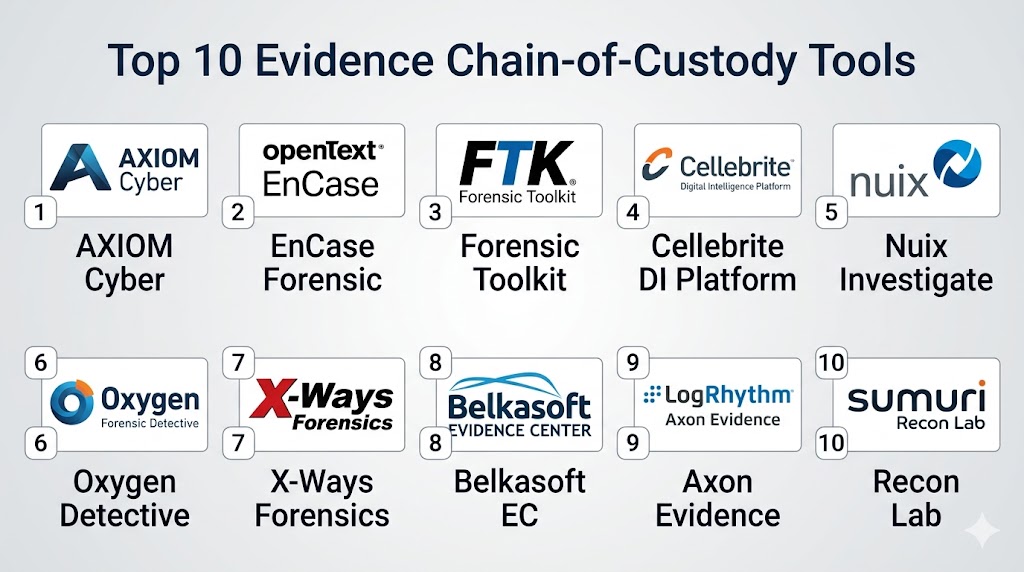
Top 10 Evidence Chain-of-Custody Tools
1- Axon Evidence
Short description: Axon Evidence is a cloud-based digital evidence management platform widely used by law enforcement agencies to capture, store, and manage digital evidence. It ensures a complete and tamper-proof chain of custody across all evidence types. It is designed for large-scale investigative and public safety environments.
Key Features
- Automated chain-of-custody tracking for all evidence
- Secure cloud-based evidence storage
- AI-powered evidence search and classification
- Role-based access control for investigations
- Audit-ready evidence logs
- Multi-format evidence support including video and audio
- Case collaboration tools for agencies
Pros
- Strong law enforcement adoption
- Highly secure and scalable architecture
- Automated chain-of-custody logging
- Easy collaboration across departments
Cons
- Enterprise-focused pricing
- Limited flexibility outside public safety sector
- Requires onboarding and training
- Dependency on vendor ecosystem
Platforms / Deployment
Cloud SaaS.
Security & Compliance
Supports encryption, RBAC, audit logging, and CJIS-aligned compliance controls. Exact certifications depend on deployment.
Integrations & Ecosystem
- Law enforcement RMS systems
- DFIR tools
- Cloud storage systems
- Video and bodycam systems
- Case management platforms
Support & Community
Strong enterprise-grade support and global law enforcement ecosystem.
2- Magnet AXIOM
Short description: Magnet AXIOM is a digital forensics and evidence management platform used for collecting, analyzing, and maintaining chain-of-custody for digital evidence across devices and cloud sources. It is widely used in investigations requiring deep forensic analysis.
Key Features
- Multi-source digital evidence acquisition
- Chain-of-custody tracking for forensic artifacts
- Mobile, cloud, and endpoint evidence analysis
- Timeline reconstruction of incidents
- Deleted file recovery and artifact extraction
- Case management system
- Reporting and documentation tools
Pros
- Excellent forensic depth across multiple sources
- Strong evidence recovery capabilities
- Reliable chain-of-custody documentation
- Widely used in forensic investigations
Cons
- High system resource usage
- Requires forensic expertise
- Enterprise licensing cost
- Longer processing time for large datasets
Platforms / Deployment
Windows. On-premise and hybrid.
Security & Compliance
Supports forensic integrity, audit logs, and chain-of-custody documentation.
Integrations & Ecosystem
- DFIR platforms
- Cloud storage providers
- Endpoint forensic tools
- Legal discovery systems
Support & Community
Strong forensic investigator community and enterprise support.
3- FTK Forensic Toolkit
Short description: FTK is an enterprise digital forensics platform that provides evidence indexing, analysis, and chain-of-custody tracking for investigations. It is widely used in law enforcement and legal environments for structured evidence processing.
Key Features
- High-speed forensic indexing engine
- Evidence chain-of-custody tracking
- Email and file system analysis
- Memory and registry forensics
- Data visualization tools
- Advanced search capabilities
- Case management system
Pros
- Fast forensic processing engine
- Strong evidence tracking capabilities
- Widely used in legal investigations
- Reliable indexing and search
Cons
- High resource consumption
- Complex interface for beginners
- Requires training
- Enterprise cost structure
Platforms / Deployment
Windows. On-premise.
Security & Compliance
Supports forensic integrity, audit logging, and controlled evidence handling.
Integrations & Ecosystem
- DFIR tools
- SIEM systems
- Legal case management platforms
- Security tools
Support & Community
Strong enterprise forensic support and training ecosystem.
4- FileOnQ Evidence Management System
Short description: FileOnQ is a dedicated evidence management platform designed to maintain a complete chain of custody for physical and digital evidence. It provides centralized tracking and secure evidence lifecycle management for law enforcement agencies.
Key Features
- Centralized evidence tracking system
- Automated chain-of-custody logging
- Evidence intake and storage workflows
- Case linking and management
- Audit-ready reporting
- Evidence disposition tracking
- Secure role-based access control
Pros
- Strong evidence lifecycle management
- Simple and structured interface
- Good law enforcement focus
- Reliable chain-of-custody tracking
Cons
- Limited forensic analysis features
- Enterprise-focused deployment
- Requires structured workflows
- Less suitable for advanced DFIR
Platforms / Deployment
Cloud. On-premise.
Security & Compliance
Supports audit logs, secure access control, and evidence integrity tracking.
Integrations & Ecosystem
- Law enforcement RMS systems
- Digital forensic tools
- Case management platforms
- Storage systems
Support & Community
Strong public safety and law enforcement support ecosystem.
5- SAFE by Tracker Products
Short description: SAFE is an evidence management platform that tracks both physical and digital evidence with a strong focus on maintaining chain-of-custody integrity across law enforcement workflows. It automates evidence tracking and accountability processes.
Key Features
- Evidence intake and tracking system
- Automated chain-of-custody documentation
- Physical and digital evidence management
- Audit and inventory tracking
- Secure storage workflows
- Case linkage capabilities
- Disposal and retention management
Pros
- Strong physical and digital evidence support
- Reliable chain-of-custody enforcement
- Good automation features
- Widely used in law enforcement
Cons
- Enterprise deployment complexity
- Limited forensic analysis capabilities
- Requires structured operational setup
- Vendor dependency
Platforms / Deployment
Cloud. On-premise.
Security & Compliance
Supports audit logging, access control, and compliance-ready workflows. CJIS-aligned depending on deployment.
Integrations & Ecosystem
- Law enforcement systems
- DFIR tools
- Storage systems
- Case management platforms
Support & Community
Strong enterprise support for public safety agencies.
6- CaseGuard Studio
Short description: CaseGuard Studio is a digital evidence redaction and chain-of-custody management tool used for processing video, audio, and document evidence in investigations. It is widely used for preparing evidence for legal and courtroom use.
Key Features
- Video and audio evidence processing
- Chain-of-custody tracking for media files
- Automated redaction tools
- Evidence annotation and tagging
- Case management system
- Secure file handling
- Export-ready court evidence packaging
Pros
- Strong multimedia evidence handling
- Easy-to-use interface
- Good redaction capabilities
- Useful for legal workflows
Cons
- Limited forensic depth
- Focused mainly on media evidence
- Enterprise licensing cost
- Not full DFIR platform
Platforms / Deployment
Windows. On-premise.
Security & Compliance
Supports audit logs and secure evidence handling workflows.
Integrations & Ecosystem
- Legal systems
- DFIR platforms
- Evidence storage systems
- Court submission workflows
Support & Community
Good enterprise support and training resources.
7- OpenText Forensic
Short description: OpenText Forensic is an enterprise digital evidence analysis platform that supports investigation workflows and maintains evidence integrity across forensic processes. It helps organizations manage structured chain-of-custody for digital evidence.
Key Features
- Digital evidence analysis and categorization
- Chain-of-custody tracking
- Artifact-first investigation workflow
- Case management tools
- Forensic reporting capabilities
- Data indexing and search
- Multi-source evidence handling
Pros
- Strong enterprise forensic capabilities
- Good evidence categorization tools
- Reliable investigation workflows
- Scalable architecture
Cons
- Complex setup and configuration
- Requires trained investigators
- Enterprise pricing
- Less intuitive for beginners
Platforms / Deployment
Cloud. On-premise.
Security & Compliance
Supports audit logging, secure access, and evidence integrity controls.
Integrations & Ecosystem
- Enterprise security systems
- DFIR tools
- SIEM platforms
- Cloud storage systems
Support & Community
Strong enterprise support ecosystem.
8- Chain of Custody Manager Systems
Short description: Chain of Custody Manager systems are specialized platforms designed to provide basic to advanced evidence tracking and lifecycle management for investigations. They ensure every action on evidence is logged and traceable.
Key Features
- Evidence tracking and logging
- Chain-of-custody documentation
- Case-based evidence organization
- Audit trails for all interactions
- Secure evidence storage support
- User access control
- Evidence transfer tracking
Pros
- Simple and focused functionality
- Easy deployment
- Good for small agencies
- Reliable tracking system
Cons
- Limited forensic capabilities
- Not suitable for advanced DFIR
- Basic analytics and reporting
- Limited integrations
Platforms / Deployment
Cloud. On-premise.
Security & Compliance
Supports basic audit logging and access control.
Integrations & Ecosystem
- Case management systems
- Storage platforms
- Basic DFIR tools
- Law enforcement workflows
Support & Community
Varies by vendor implementation.
9- Digital Evidence Management Systems DEMS
Short description: DEMS platforms centralize digital evidence storage and enforce automated chain-of-custody tracking for law enforcement and enterprise investigations. They are designed for secure evidence lifecycle management.
Key Features
- Centralized digital evidence repository
- Automated chain-of-custody tracking
- Secure evidence ingestion workflows
- Case organization tools
- Controlled evidence sharing
- Audit-ready reporting
- Evidence lifecycle management
Pros
- Strong centralized evidence control
- Good compliance readiness
- Secure evidence storage
- Efficient investigation workflows
Cons
- Limited forensic analysis features
- Enterprise setup complexity
- Requires training
- Vendor dependency
Platforms / Deployment
Cloud SaaS. Hybrid options.
Security & Compliance
Supports encryption, audit logs, and compliance-oriented workflows.
Integrations & Ecosystem
- Law enforcement systems
- DFIR tools
- Cloud storage systems
- Case management platforms
Support & Community
Strong enterprise support depending on vendor.
10- Blockchain-Based Chain of Custody Systems
Short description: Blockchain-based chain-of-custody systems use distributed ledger technology to create immutable, tamper-proof records of evidence handling. These systems are designed to ensure transparency and integrity in digital evidence workflows.
Key Features
- Immutable evidence logging on blockchain
- Tamper-proof audit trails
- Distributed evidence verification
- Smart contract-based workflows
- Secure timestamping of evidence actions
- Transparent chain-of-custody records
- Integration with forensic systems
Pros
- Extremely strong tamper resistance
- High transparency and trust
- Advanced security model
- Ideal for high-integrity investigations
Cons
- Complex implementation
- Limited mainstream adoption
- Performance overhead
- Requires specialized expertise
Platforms / Deployment
Blockchain networks. Hybrid integrations.
Security & Compliance
Provides cryptographic integrity and immutable audit trails.
Integrations & Ecosystem
- DFIR systems
- Digital evidence platforms
- Security tools
- Legal systems
Support & Community
Emerging ecosystem with growing adoption in research and enterprise pilots.
Comparison Table
| Tool Name | Best For | Platforms Supported | Deployment | Standout Feature | Public Rating |
|---|---|---|---|---|---|
| Axon Evidence | Law enforcement evidence management | Cloud | SaaS | Automated chain-of-custody | N/A |
| Magnet AXIOM | Deep forensic investigation | Windows | On-prem/hybrid | Multi-source evidence recovery | N/A |
| FTK | Enterprise forensic analysis | Windows | On-prem | High-speed indexing | N/A |
| FileOnQ | Evidence lifecycle tracking | Cloud/on-prem | Hybrid | Evidence control center | N/A |
| SAFE Tracker | Law enforcement evidence tracking | Cloud/on-prem | Hybrid | Physical + digital tracking | N/A |
| CaseGuard | Media evidence management | Windows | On-prem | Video redaction + tracking | N/A |
| OpenText Forensic | Enterprise investigations | Multi-platform | Hybrid | Artifact-first analysis | N/A |
| Chain Manager | Basic evidence tracking | Multi-platform | Hybrid | Simple chain-of-custody logs | N/A |
| DEMS Platforms | Centralized evidence storage | Cloud | SaaS | Unified evidence repository | N/A |
| Blockchain CoC | Tamper-proof evidence logs | Distributed | Hybrid | Immutable audit trail | N/A |
Evaluation and Scoring of Chain-of-Custody Tools
| Tool Name | Core 25% | Ease 15% | Integrations 15% | Security 10% | Performance 10% | Support 10% | Value 15% | Weighted Total |
|---|---|---|---|---|---|---|---|---|
| Axon Evidence | 10 | 9 | 10 | 10 | 9 | 10 | 8 | 9.30 |
| Magnet AXIOM | 10 | 8 | 9 | 10 | 9 | 9 | 8 | 9.05 |
| FTK | 9 | 7 | 8 | 9 | 9 | 8 | 8 | 8.45 |
| FileOnQ | 9 | 8 | 8 | 9 | 8 | 8 | 8 | 8.35 |
| SAFE Tracker | 9 | 8 | 8 | 9 | 8 | 8 | 8 | 8.35 |
| CaseGuard | 8 | 8 | 7 | 8 | 8 | 8 | 8 | 8.05 |
| OpenText Forensic | 9 | 7 | 9 | 9 | 9 | 9 | 8 | 8.65 |
| Chain Manager | 7 | 9 | 7 | 8 | 7 | 7 | 9 | 7.70 |
| DEMS | 9 | 8 | 9 | 9 | 9 | 8 | 8 | 8.65 |
| Blockchain CoC | 9 | 6 | 8 | 10 | 9 | 7 | 9 | 8.20 |
These scores reflect evidence integrity, forensic depth, automation, scalability, and legal defensibility. Axon Evidence leads due to strong law enforcement adoption and automation, while Magnet AXIOM excels in deep forensic analysis. Blockchain-based systems offer high integrity but are still emerging in mainstream adoption.
Which Evidence Chain-of-Custody Tool Is Right for You
Solo / Freelancer
Freelancers and learners should use open-source or lightweight tools like Autopsy-based workflows or basic chain-of-custody managers for training and small investigations.
SMB
SMBs benefit from simple but structured systems like FileOnQ, CaseGuard, and DEMS platforms for managing structured evidence workflows.
Mid-Market
Mid-market organizations need scalable forensic and chain-of-custody integration. Magnet AXIOM, SAFE, and OpenText Forensic are strong choices.
Enterprise
Enterprises require full evidence lifecycle management and legal-grade tracking. Axon Evidence, FTK, OpenText, and IBM-integrated systems are leading solutions.
Budget vs Premium
Open and basic systems are cost-effective but limited. Enterprise platforms provide automation, compliance, and legal defensibility at higher cost.
Feature Depth vs Ease of Use
Axon and Magnet AXIOM provide deep capabilities but require expertise. Chain-of-custody managers and DEMS platforms are easier but less powerful.
Integrations & Scalability
Axon, OpenText, and Magnet AXIOM offer the strongest integrations with DFIR and law enforcement ecosystems. Blockchain systems are scalable but complex.
Security & Compliance Needs
High-security environments should prioritize Axon Evidence, OpenText Forensic, and blockchain-based systems due to strong auditability and tamper resistance.
Frequently Asked Questions FAQs
1. What is chain of custody?
Chain of custody is the documented process that tracks evidence from collection to final disposal. It ensures evidence integrity and legal validity. Every access or transfer is recorded. It is essential in investigations.
2. Why is chain of custody important?
It ensures evidence is not tampered with or altered. It provides legal defensibility in court. Without it, evidence may be rejected. It maintains investigation credibility.
3. What is a chain-of-custody tool?
It is software that tracks and logs all interactions with evidence. It automates documentation and audit trails. It reduces human error. It ensures forensic integrity.
4. Who uses these tools?
They are used by law enforcement, cybersecurity teams, forensic investigators, and legal professionals. Enterprises also use them for compliance. They are essential in incident response workflows.
5. Can chain-of-custody be digital?
Yes, modern systems fully digitize chain-of-custody processes. They automatically log all actions. Digital systems are more secure and traceable. They replace manual paper logs.
6. What data is tracked in chain of custody?
It tracks who accessed evidence, when it was accessed, and what changes were made. It also logs transfers and storage locations. Every interaction is recorded. This ensures transparency.
7. Are blockchain systems used for chain of custody?
Yes, blockchain is used to create immutable evidence logs. It ensures tamper-proof tracking. However, adoption is still emerging. It is mostly used in advanced or experimental systems.
8. What is evidence lifecycle management?
It is the complete process of managing evidence from collection to disposal. It includes storage, analysis, and sharing. Chain-of-custody tracking is part of it. It ensures structured workflows.
9. Are these tools used in court cases?
Yes, they are widely used in legal proceedings. They provide audit trails and evidence integrity proof. Courts rely on chain-of-custody logs. They strengthen legal cases.
10. What is the future of chain-of-custody tools?
The future includes AI automation, blockchain verification, and cloud-native evidence systems. These tools will become more integrated with DFIR and SIEM platforms. Automation will reduce manual tracking. Security and transparency will improve.
Conclusion
Evidence chain-of-custody tools are critical for ensuring digital and physical evidence integrity across investigations, legal processes, and cybersecurity operations. They provide structured tracking, automated logging, and legal defensibility for every piece of evidence handled. Platforms like Axon Evidence and Magnet AXIOM lead in enterprise and law enforcement environments, while FTK and OpenText provide deep forensic capabilities. Emerging blockchain-based systems offer advanced tamper-proof tracking, while simpler systems like FileOnQ and DEMS platforms provide structured lifecycle management. The best approach is to combine chain-of-custody tools with DFIR and SIEM systems to ensure end-to-end investigation visibility, compliance, and trust in digital evidence handling.

This article clearly explains evidence chain of custody tools and how they help organizations maintain secure, tamper-proof tracking of digital and physical evidence throughout the investigation process.
Useful comparison post explaining how chain of custody tools help maintain secure evidence tracking, accountability, and better forensic investigation workflows.
A key gap often overlooked is how well these tools maintain legally defensible audit trails across multi-system integrations while ensuring tamper-evident logging under real incident-response conditions.