Introduction
Search Indexing Pipelines help organizations collect, process, enrich, transform, and index data so it can be searched quickly and accurately. These pipelines sit between source systems and search platforms, preparing documents, logs, records, metadata, product catalogs, support articles, code repositories, and enterprise knowledge assets for retrieval. A strong indexing pipeline improves search relevance, freshness, scalability, and user experience by ensuring that search engines receive clean, structured, and optimized data.
Modern search systems now support AI-powered retrieval, semantic search, vector embeddings, multilingual content, real-time ingestion, and hybrid keyword plus semantic ranking. Because of this, indexing pipelines are no longer just background data jobs. They are a critical part of enterprise search, e-commerce search, observability, knowledge management, and Retrieval-Augmented Generation architectures.
Common real-world use cases include:
- Indexing enterprise documents and knowledge bases
- Building search pipelines for websites and applications
- Processing product catalogs for e-commerce search
- Feeding logs and events into search analytics systems
- Creating vector and hybrid indexes for AI retrieval
Key evaluation criteria for buyers include:
- Ingestion flexibility
- Transformation and enrichment capabilities
- Real-time indexing support
- Search engine compatibility
- Scalability and reliability
- Error handling and retry logic
- Security and access controls
- Observability and monitoring
- Vector and semantic indexing support
- Cost and operational complexity
Best for: Search engineers, data engineers, platform teams, AI teams, enterprise search teams, e-commerce teams, SaaS companies, DevOps teams, and organizations managing large searchable datasets.
Not ideal for: Small websites with very basic search requirements, teams with static content that rarely changes, or organizations that only need a simple hosted search box without custom ingestion or enrichment needs.
Key Trends in Search Indexing Pipelines
- AI-ready indexing pipelines are increasingly generating embeddings during ingestion.
- Hybrid search pipelines now combine keyword, vector, metadata, and semantic indexing.
- Real-time indexing is becoming more important for customer-facing applications.
- Event-driven ingestion is replacing slow batch-only indexing workflows.
- Data quality checks are being added before documents reach the search layer.
- Access-control-aware indexing is becoming essential for enterprise search.
- Multilingual indexing and language-aware tokenization are growing in importance.
- Pipeline observability is now critical for debugging relevance and freshness issues.
- Cloud-native and Kubernetes-based indexing architectures are becoming common.
- Search pipelines are increasingly integrated with Retrieval-Augmented Generation systems.
How We Selected These Tools
The tools in this list were selected based on search indexing relevance, ingestion capability, ecosystem maturity, scalability, enterprise adoption, and suitability for modern keyword, semantic, and AI search architectures.
Evaluation factors included:
- Market adoption and technical credibility
- Data ingestion and pipeline orchestration strength
- Compatibility with modern search engines
- Real-time and batch indexing support
- Transformation and enrichment capabilities
- Security and governance features
- Observability and operational reliability
- Cloud-native deployment support
- Developer experience and extensibility
- Fit for SMB, mid-market, and enterprise teams
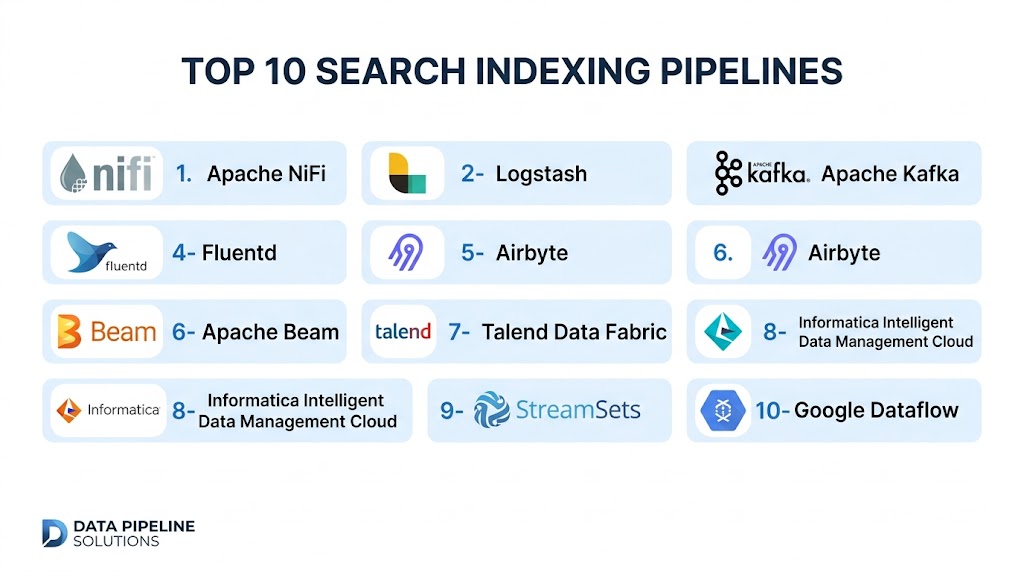
Top 10 Search Indexing Pipelines
1- Logstash
Short Description:
Logstash is a widely used data processing pipeline that ingests, transforms, enriches, and sends data to search and analytics platforms. It is strongly associated with Elasticsearch-based architectures and is commonly used for logs, events, documents, and structured records. Logstash is useful for teams that need flexible parsing, filtering, and routing before indexing data.
Key Features
- Data ingestion from multiple sources
- Filter-based transformation pipeline
- Elasticsearch output support
- Plugin-based architecture
- Log and event processing
- Batch and streaming-style ingestion
- Parsing and enrichment capabilities
Pros
- Strong integration with Elasticsearch
- Flexible plugin ecosystem
- Good for logs and structured events
- Mature and widely adopted
Cons
- Can be resource-intensive
- Configuration may become complex
- Scaling requires planning
- Less modern for AI-native indexing workflows
Platforms / Deployment
Cloud / Self-hosted / Hybrid
Security & Compliance
Authentication integration, encryption support, access controls, and secure pipeline configuration support. Compliance depends on deployment environment.
Integrations & Ecosystem
Logstash integrates with search engines, message queues, databases, cloud services, and monitoring tools. It is especially useful when teams need configurable ingestion and transformation before indexing.
- Elasticsearch
- Kafka
- Beats
- JDBC sources
- Cloud storage
- APIs
Support & Community
Strong documentation, broad user community, and enterprise support options through commercial ecosystem providers.
2- Apache NiFi
Short Description:
Apache NiFi is a visual dataflow automation platform used to build ingestion, transformation, routing, and indexing pipelines. It provides drag-and-drop flow design, back-pressure management, provenance tracking, and real-time processing capabilities. NiFi is well suited for organizations that need visual control over complex data movement into search systems.
Key Features
- Visual pipeline builder
- Real-time dataflow management
- Back-pressure handling
- Data provenance tracking
- Large processor library
- Routing and enrichment workflows
- Secure data movement
Pros
- Excellent visual pipeline control
- Strong data provenance capabilities
- Flexible routing and transformation
- Good for streaming and enterprise dataflows
Cons
- Resource-intensive at scale
- Flows can become complex visually
- Requires operational expertise
- Not search-specific by default
Platforms / Deployment
Self-hosted / Hybrid
Security & Compliance
RBAC, encryption, secure communication, authentication integration, and audit support.
Integrations & Ecosystem
Apache NiFi connects with search platforms, streaming systems, file stores, databases, APIs, and enterprise systems. It is flexible for building custom ingestion and indexing workflows.
- Elasticsearch
- Solr
- Kafka
- Hadoop
- Databases
- REST APIs
Support & Community
Strong Apache open-source community with broad enterprise adoption and documentation.
3- Apache Kafka Connect
Short Description:
Apache Kafka Connect is a scalable framework for streaming data between Kafka and external systems, including search engines and analytics platforms. It is commonly used to build real-time indexing pipelines where source data changes continuously. Kafka Connect is especially useful for event-driven architectures and change data capture workflows.
Key Features
- Streaming data integration
- Source and sink connector framework
- Real-time indexing support
- Distributed worker architecture
- Change data capture support
- Fault tolerance and retries
- Scalable connector ecosystem
Pros
- Excellent real-time indexing foundation
- Strong scalability
- Large connector ecosystem
- Good fit for event-driven architectures
Cons
- Requires Kafka expertise
- Monitoring and operations can be complex
- Connector quality varies
- Not ideal for simple batch-only indexing
Platforms / Deployment
Cloud / Self-hosted / Hybrid
Security & Compliance
Authentication, encryption, access control, audit logging, and secure Kafka deployment capabilities. Compliance depends on the managed or self-hosted environment.
Integrations & Ecosystem
Kafka Connect integrates with databases, search engines, cloud platforms, streaming systems, and data warehouses. It is commonly used to move data into search indexes continuously.
- Elasticsearch
- OpenSearch
- MongoDB
- PostgreSQL
- Snowflake
- Cloud storage
Support & Community
Large open-source ecosystem with strong enterprise adoption and support through multiple vendors.
4- Elastic Beats
Short Description:
Elastic Beats are lightweight data shippers designed to collect logs, metrics, events, and other operational data for indexing into Elasticsearch-based systems. They are commonly used for search indexing pipelines in observability, security analytics, and log search environments. Beats are useful when teams need lightweight agents at the edge.
Key Features
- Lightweight data shipping
- Log and metric collection
- File and event monitoring
- Elasticsearch integration
- Modular configuration
- Secure data forwarding
- Edge collection support
Pros
- Lightweight and efficient
- Easy to deploy on many systems
- Strong Elasticsearch compatibility
- Good for observability search pipelines
Cons
- Less suitable for heavy transformations
- Mostly focused on operational data
- Advanced enrichment needs external tools
- Tied closely to Elastic ecosystem
Platforms / Deployment
Windows / macOS / Linux / Cloud / Hybrid
Security & Compliance
Encryption, authentication, secure forwarding, and access control support through Elastic ecosystem configuration.
Integrations & Ecosystem
Elastic Beats integrates tightly with Elasticsearch, Logstash, and observability systems. It is commonly paired with Logstash or ingest pipelines for enrichment before indexing.
- Elasticsearch
- Logstash
- Kubernetes
- Docker
- Cloud platforms
- Security tools
Support & Community
Strong documentation, active community, and broad adoption in observability and log search use cases.
5- Airbyte
Short Description:
Airbyte is an open-source data integration platform used to move data from many sources into destinations such as warehouses, lakes, and search systems. While it is often used for analytics pipelines, it can also support indexing workflows where data from SaaS tools, databases, and APIs must be prepared for search. Airbyte is useful for teams that need connector-driven ingestion.
Key Features
- Open-source connector framework
- SaaS and database ingestion
- Scheduled sync workflows
- Custom connector support
- Cloud and self-hosted options
- Incremental data movement
- API-based integration
Pros
- Strong connector ecosystem
- Useful for SaaS data ingestion
- Flexible deployment options
- Good for batch indexing workflows
Cons
- Not search-specific by default
- Real-time indexing may require extra architecture
- Transformation depth may be limited
- Connector maintenance can vary
Platforms / Deployment
Cloud / Self-hosted / Hybrid
Security & Compliance
RBAC, encryption, authentication support, and access management features. Compliance details vary by deployment and plan.
Integrations & Ecosystem
Airbyte integrates with databases, SaaS platforms, warehouses, lakes, and custom APIs. It can be used as a source ingestion layer before search indexing.
- PostgreSQL
- MySQL
- Salesforce
- HubSpot
- Snowflake
- APIs
Support & Community
Strong open-source community, growing documentation, and commercial support options.
6- Fivetran
Short Description:
Fivetran is a managed data pipeline platform focused on automated connectors, schema handling, and low-maintenance data movement. It is commonly used to sync SaaS, database, and application data into analytics platforms, and can support search indexing architectures through downstream transformation and indexing layers. Fivetran is best for teams that prioritize managed ingestion.
Key Features
- Managed connector pipelines
- Automated schema change handling
- Incremental synchronization
- Low-maintenance ingestion
- SaaS and database connectors
- Monitoring dashboards
- Cloud-native architecture
Pros
- Very low operational overhead
- Strong managed connector ecosystem
- Good reliability for sync workflows
- Fast onboarding experience
Cons
- Less flexible for custom indexing logic
- Pricing can grow with volume
- Not a dedicated search indexing tool
- Real-time use cases may need additional systems
Platforms / Deployment
Cloud
Security & Compliance
Encryption, RBAC, SSO, audit logging, and enterprise security controls.
Integrations & Ecosystem
Fivetran integrates with SaaS platforms, databases, cloud warehouses, and downstream data tools. It is useful when search indexes depend on structured business data from many systems.
- Salesforce
- PostgreSQL
- MySQL
- Snowflake
- BigQuery
- Databricks
Support & Community
Strong managed support model, enterprise documentation, and onboarding resources.
7- Google Cloud Dataflow
Short Description:
Google Cloud Dataflow is a managed stream and batch processing service that can power scalable search indexing pipelines. It is useful for transforming, enriching, and routing high-volume data into search platforms, analytics systems, and AI retrieval layers. Dataflow is especially strong for teams already using Google Cloud.
Key Features
- Batch and streaming processing
- Managed autoscaling
- Data transformation workflows
- Event-driven ingestion
- Apache Beam compatibility
- Real-time pipeline execution
- Cloud-native monitoring
Pros
- Strong scalability
- Supports both batch and streaming
- Good managed infrastructure experience
- Useful for high-volume indexing workloads
Cons
- Best suited for Google Cloud environments
- Requires Apache Beam knowledge
- Pricing can be complex
- Debugging distributed pipelines may be difficult
Platforms / Deployment
Cloud
Security & Compliance
IAM integration, encryption, audit logging, secure service accounts, and Google Cloud security controls.
Integrations & Ecosystem
Google Cloud Dataflow integrates with cloud storage, messaging, analytics, and search-related destinations through connectors and custom pipelines.
- Pub/Sub
- BigQuery
- Cloud Storage
- Elasticsearch connectors
- APIs
- AI services
Support & Community
Strong cloud documentation, Apache Beam ecosystem support, and enterprise support through Google Cloud.
8- AWS Glue
Short Description:
AWS Glue is a serverless data integration and ETL service that can support search indexing pipelines by preparing, transforming, and cataloging data before it is sent to search systems. It is useful for AWS-centric organizations that need managed transformation and ingestion for structured and semi-structured datasets.
Key Features
- Serverless ETL workflows
- Data catalog integration
- Schema discovery
- Batch transformation jobs
- Workflow scheduling
- AWS-native integrations
- Scalable data processing
Pros
- Minimal infrastructure management
- Strong AWS ecosystem integration
- Good for batch indexing preparation
- Useful metadata cataloging features
Cons
- Best suited for AWS environments
- Not a dedicated search indexing engine
- Debugging can be challenging
- Costs vary by workload size
Platforms / Deployment
Cloud
Security & Compliance
IAM integration, encryption, audit logging, RBAC through AWS controls, and enterprise cloud security features.
Integrations & Ecosystem
AWS Glue integrates with storage, databases, analytics systems, and search-related destinations across AWS-based architectures.
- S3
- Redshift
- Athena
- OpenSearch
- Lambda
- Lake Formation
Support & Community
Strong AWS documentation, enterprise support, and broad cloud ecosystem adoption.
9- Azure Data Factory
Short Description:
Azure Data Factory is a cloud-based data integration and orchestration service that can help build search indexing pipelines across Microsoft and hybrid environments. It supports data movement, transformation, scheduling, and connector-based ingestion. It is especially useful for organizations using Azure AI Search, Microsoft analytics platforms, and enterprise data sources.
Key Features
- Visual pipeline builder
- Data movement workflows
- Hybrid data integration
- Scheduling and orchestration
- Connector library
- Transformation support
- Monitoring dashboards
Pros
- Strong Microsoft ecosystem integration
- Good visual pipeline experience
- Useful hybrid connectivity
- Enterprise-friendly managed service
Cons
- Best optimized for Azure environments
- Complex pricing model
- Custom search indexing may require extra services
- Advanced debugging can take effort
Platforms / Deployment
Cloud / Hybrid
Security & Compliance
SSO, RBAC, encryption, audit logging, identity integration, and Microsoft cloud security controls.
Integrations & Ecosystem
Azure Data Factory integrates with Microsoft services, enterprise applications, cloud storage, and search systems. It can support indexing preparation for Azure AI Search and other search destinations.
- Azure AI Search
- Azure SQL
- Blob Storage
- Synapse
- Power BI
- SaaS connectors
Support & Community
Strong Microsoft documentation, enterprise support, and partner ecosystem.
10- Haystack
Short Description:
Haystack is an open-source framework for building search, question-answering, and Retrieval-Augmented Generation pipelines. It helps teams connect document stores, embedding models, retrievers, rankers, and LLM components into AI-ready search indexing workflows. Haystack is especially useful for semantic search and AI retrieval applications.
Key Features
- AI search pipeline framework
- Document indexing workflows
- Vector search integration
- Retriever and ranker components
- LLM application support
- Retrieval-Augmented Generation pipelines
- Modular architecture
Pros
- Strong AI and semantic search focus
- Flexible pipeline design
- Good open-source developer experience
- Useful for RAG indexing workflows
Cons
- Requires AI engineering knowledge
- Not a traditional ETL platform
- Production operations require planning
- Enterprise governance depends on architecture
Platforms / Deployment
Cloud / Self-hosted / Hybrid
Security & Compliance
Varies / Not publicly stated. Security depends on deployment environment, connected data stores, and infrastructure configuration.
Integrations & Ecosystem
Haystack integrates with vector databases, search engines, embedding models, document stores, and LLM frameworks. It is useful for building AI-native indexing pipelines.
- Elasticsearch
- OpenSearch
- Weaviate
- Pinecone
- Hugging Face
- LLM frameworks
Support & Community
Active open-source community with strong developer documentation and growing AI search adoption.
Comparison Table
| Tool Name | Best For | Platform(s) Supported | Deployment | Standout Feature | Public Rating |
|---|---|---|---|---|---|
| Logstash | Search and log indexing | Linux / Cloud | Cloud / Self-hosted / Hybrid | Flexible filter pipeline | N/A |
| Apache NiFi | Visual indexing workflows | Web / Linux | Self-hosted / Hybrid | Data provenance tracking | N/A |
| Kafka Connect | Real-time indexing | Cloud / Linux | Cloud / Self-hosted / Hybrid | Streaming connector framework | N/A |
| Elastic Beats | Lightweight edge collection | Windows / macOS / Linux | Hybrid | Lightweight data shipping | N/A |
| Airbyte | Connector-driven ingestion | Web / Cloud | Cloud / Self-hosted / Hybrid | Open-source connectors | N/A |
| Fivetran | Managed business data sync | Web / Cloud | Cloud | Automated connectors | N/A |
| Google Cloud Dataflow | Scalable stream processing | Cloud | Cloud | Batch and streaming pipelines | N/A |
| AWS Glue | AWS-native indexing preparation | Cloud | Cloud | Serverless ETL | N/A |
| Azure Data Factory | Microsoft search indexing workflows | Web / Cloud | Cloud / Hybrid | Visual pipeline builder | N/A |
| Haystack | AI and semantic search indexing | Cloud / Linux | Cloud / Self-hosted / Hybrid | RAG pipeline framework | N/A |
Evaluation & Scoring of Search Indexing Pipelines
| Tool Name | Core | Ease | Integrations | Security | Performance | Support | Value | Weighted Total |
|---|---|---|---|---|---|---|---|---|
| Logstash | 8 | 7 | 9 | 8 | 8 | 9 | 8 | 8.1 |
| Apache NiFi | 8 | 7 | 8 | 8 | 8 | 8 | 8 | 7.9 |
| Kafka Connect | 9 | 6 | 9 | 8 | 9 | 8 | 8 | 8.2 |
| Elastic Beats | 7 | 9 | 8 | 8 | 8 | 8 | 8 | 7.9 |
| Airbyte | 7 | 8 | 9 | 8 | 7 | 8 | 8 | 7.8 |
| Fivetran | 7 | 10 | 9 | 9 | 8 | 8 | 6 | 8.1 |
| Google Cloud Dataflow | 9 | 6 | 8 | 9 | 9 | 8 | 7 | 8.1 |
| AWS Glue | 8 | 7 | 9 | 9 | 8 | 8 | 7 | 8.0 |
| Azure Data Factory | 8 | 8 | 9 | 9 | 8 | 9 | 7 | 8.3 |
| Haystack | 8 | 7 | 8 | 6 | 8 | 7 | 9 | 7.7 |
These scores are comparative and should be used as a practical guide rather than a universal ranking. A high score indicates strong overall balance across indexing pipeline functionality, usability, integrations, security, reliability, support, and value. The right tool depends heavily on whether your priority is log indexing, enterprise search, real-time streaming, SaaS ingestion, or AI-powered semantic indexing.
Which Search Indexing Pipeline Tool Is Right for You?
Solo / Freelancer
Solo developers and small technical teams should consider Haystack, Elastic Beats, Airbyte, or Logstash depending on the use case. Haystack is strong for AI search and semantic indexing experiments, while Beats and Logstash are useful for lightweight operational search indexing. Airbyte is a practical option when the main need is moving SaaS or database data into downstream search workflows.
SMB
SMBs should prioritize low operational overhead, simple setup, and reliable connectors. Fivetran, Airbyte, Azure Data Factory, and AWS Glue are practical options for teams that want managed or semi-managed ingestion workflows. If search workloads are mostly logs or events, Logstash and Beats can also provide strong value.
Mid-Market
Mid-market organizations often need a mix of real-time ingestion, transformation, monitoring, and search engine compatibility. Kafka Connect, Apache NiFi, Logstash, and cloud-native tools such as Dataflow or Azure Data Factory are strong candidates. Teams building AI search should also evaluate Haystack as part of the semantic indexing layer.
Enterprise
Enterprises should focus on scalability, governance, reliability, monitoring, access control, and integration breadth. Kafka Connect, Apache NiFi, Google Cloud Dataflow, AWS Glue, Azure Data Factory, and Logstash are strong enterprise-ready options depending on existing architecture. Large organizations should also test failure recovery, data freshness, and operational monitoring before standardizing.
Budget vs Premium
Open-source tools such as Logstash, Apache NiFi, Kafka Connect, Airbyte, Elastic Beats, and Haystack can reduce licensing costs but may require more engineering effort. Managed services such as Fivetran, AWS Glue, Azure Data Factory, and Google Cloud Dataflow reduce infrastructure burden but may increase usage-based costs at scale.
Feature Depth vs Ease of Use
Kafka Connect, NiFi, and Dataflow provide deep pipeline capabilities but require experienced teams. Fivetran, Beats, and Azure Data Factory are easier for many teams to deploy, especially when the indexing pipeline does not require highly customized logic.
Integrations & Scalability
For high-volume event indexing, Kafka Connect and Dataflow are strong choices. For enterprise system integration, NiFi, Azure Data Factory, and AWS Glue offer broad connectivity. For AI search pipelines, Haystack works well with vector stores and semantic retrieval architectures.
Security & Compliance Needs
Organizations with strict security requirements should evaluate identity integration, encryption, RBAC, audit logs, secrets management, and access-control propagation into the search index. Enterprise search pipelines must also ensure that users cannot retrieve indexed content they are not authorized to access.
Frequently Asked Questions
1. What is a Search Indexing Pipeline?
A Search Indexing Pipeline is a system that collects, transforms, enriches, and loads data into a search engine or retrieval platform. It ensures that documents, records, logs, products, or knowledge assets are searchable, structured, and up to date. A good indexing pipeline improves search relevance, performance, freshness, and reliability.
2. How is search indexing different from data ingestion?
Data ingestion focuses on moving data from one place to another, while search indexing prepares data specifically for search retrieval. Indexing often includes tokenization, metadata extraction, enrichment, filtering, ranking signals, embeddings, and access-control handling. This makes the data easier and faster to search.
3. Why are indexing pipelines important for semantic search?
Semantic search requires more than plain text indexing. Pipelines often need to generate embeddings, chunk documents, extract metadata, clean content, and send data to vector or hybrid search systems. Without a strong indexing pipeline, semantic search results may be inaccurate, outdated, or poorly ranked.
4. Which tools are best for real-time indexing?
Kafka Connect, Google Cloud Dataflow, Apache NiFi, and Logstash are strong choices for real-time or near-real-time indexing workflows. The best option depends on whether the architecture is event-driven, cloud-native, search-specific, or enterprise integration-focused. Teams should test throughput, latency, and recovery behavior during pilots.
5. Are open-source indexing pipeline tools enterprise-ready?
Yes, many open-source tools such as Logstash, Apache NiFi, Kafka Connect, Airbyte, and Haystack are used in serious production environments. However, enterprise readiness depends on how the tool is deployed, monitored, secured, and maintained. Organizations should plan for support, upgrades, scaling, and incident response.
6. What security features should buyers evaluate?
Buyers should evaluate RBAC, encryption, authentication, audit logging, secrets management, access-control propagation, and secure connector configuration. For enterprise search, it is especially important that indexed documents respect source-system permissions. Security gaps in indexing pipelines can expose sensitive content through search results.
7. Can indexing pipelines support AI and RAG applications?
Yes, modern indexing pipelines are central to Retrieval-Augmented Generation systems. They prepare documents, split content into chunks, generate embeddings, enrich metadata, and load records into vector or hybrid search indexes. Tools such as Haystack, Kafka Connect, Dataflow, and cloud-native pipelines can support AI retrieval architectures.
8. What are common mistakes when building indexing pipelines?
Common mistakes include ignoring data freshness, failing to handle deleted records, weak error monitoring, poor metadata design, missing access controls, and over-indexing unnecessary content. Teams also often underestimate the importance of relevance testing and pipeline observability. A search index is only useful if it stays accurate and trusted.
9. Are managed indexing pipeline services better than self-hosted tools?
Managed services reduce infrastructure maintenance and can speed up deployment, but they may cost more at scale and reduce customization flexibility. Self-hosted tools offer control and lower licensing costs but require more operational expertise. The right choice depends on team size, workload complexity, compliance needs, and budget.
10. How should organizations choose a search indexing pipeline?
Organizations should begin by defining data sources, freshness requirements, search platform, security needs, and transformation logic. Then they should test two or three tools with real datasets and realistic indexing volumes. The final decision should consider scalability, monitoring, integration depth, failure recovery, and long-term operating cost.
Conclusion
Search Indexing Pipelines are essential for building fast, accurate, secure, and intelligent search experiences across enterprise systems, websites, applications, observability platforms, and AI retrieval architectures. As search evolves from simple keyword matching to hybrid, semantic, and vector-based retrieval, indexing pipelines must handle transformation, enrichment, permissions, metadata, embeddings, and real-time updates with greater reliability. Logstash, Kafka Connect, Apache NiFi, and Elastic Beats remain strong choices for traditional and operational indexing workflows, while Dataflow, AWS Glue, and Azure Data Factory are practical options for cloud-native enterprise pipelines. Airbyte and Fivetran help simplify connector-driven ingestion, while Haystack is especially useful for AI and Retrieval-Augmented Generation indexing patterns. The best tool depends on source systems, search engine choice, data freshness, security needs, team expertise, and budget. Organizations should shortlist two or three tools, run a real indexing pilot, validate relevance and permissions, monitor pipeline reliability, and choose the platform that best fits long-term search architecture.

This article gives a very clear and organized overview of search indexing pipelines with practical comparisons and useful insights. The simple explanations made a technical topic much easier to understand.
This article clearly explains search indexing pipelines and how they help improve data organization, search speed, and overall information retrieval efficiency.
Search performance is often evaluated based on indexing speed and throughput, but operational recovery scenarios deserve equal attention. When index corruption, schema changes, or large-scale reindexing events occur, recovery time can become a major business concern. Teams running search platforms at scale benefit from understanding rollback strategies, zero-downtime reindexing approaches, and the infrastructure costs associated with maintaining highly available indexing pipelines during peak data growth periods.