Introduction
Web3 Node Infrastructure platforms help developers, startups, enterprises, exchanges, wallets, DeFi protocols, NFT apps, analytics teams, and blockchain businesses connect reliably to blockchain networks without running every node themselves. In simple terms, these platforms provide RPC endpoints, archive data, indexing, APIs, dedicated nodes, validator services, WebSocket streams, transaction tools, and monitoring so applications can read blockchain data and submit transactions at scale.
Web3 node infrastructure matters because blockchain apps depend on fast, reliable, and accurate access to networks. If node infrastructure is slow, rate-limited, unstable, or poorly monitored, wallets fail, DeFi transactions break, NFT metadata loads slowly, analytics become inaccurate, and users lose trust. Common use cases include dApp RPC access, wallet infrastructure, DeFi trading systems, NFT marketplaces, blockchain analytics, validator operations, archive data access, and multi-chain application development.
Buyers should evaluate supported chains, latency, uptime, archive access, dedicated nodes, rate limits, WebSocket support, API tooling, analytics, security, SLAs, pricing model, developer experience, and enterprise support.
Best for: Web3 developers, blockchain startups, DeFi teams, NFT platforms, wallets, exchanges, gaming studios, analytics companies, enterprises, and infrastructure teams that need reliable blockchain connectivity. Not ideal for: small hobby projects with very low request volume, teams that only need occasional manual blockchain exploration, or organizations that prefer to operate all node infrastructure internally for maximum control.
Key Trends in Web3 Node Infrastructure
- Multi-chain access is now expected: Developers increasingly want one provider that supports Ethereum, Bitcoin, Solana, Polygon, Arbitrum, Optimism, Base, Avalanche, BNB Chain, and other major networks.
- Dedicated nodes are becoming more common: High-volume apps often need dedicated infrastructure for predictable latency, better throughput, custom configuration, and stronger isolation.
- Archive data demand is growing: DeFi analytics, tax tools, compliance systems, trading bots, and historical dashboards often need deep historical chain state rather than only current data.
- WebSocket and streaming APIs are critical: Real-time apps need live transaction events, mempool activity, block updates, token transfers, and contract events.
- Infrastructure reliability is a competitive differentiator: Apps increasingly use multiple providers or failover setups to avoid downtime from one RPC provider.
- Developer tooling is expanding beyond raw RPC: Providers now offer enhanced APIs, NFT APIs, token APIs, transaction simulation, gas tools, webhooks, indexing, and analytics.
- Decentralized RPC networks are gaining interest: Some teams want node infrastructure that reduces dependency on one centralized provider and improves censorship resistance.
- Enterprise buyers want SLAs and support: Institutions, exchanges, and fintech teams need formal uptime commitments, compliance posture, dedicated support, and account management.
- Cost predictability is a major concern: Usage-based pricing can grow quickly, so buyers compare compute units, request limits, dedicated node pricing, and overage policies carefully.
- AI and automation are increasing node demand: Blockchain agents, automated trading systems, monitoring bots, and analytics pipelines require stable high-volume node access.
How We Selected These Tools
The providers below were selected based on practical relevance to Web3 node infrastructure, RPC access, dedicated nodes, validator infrastructure, multi-chain development, and production-grade blockchain application operations.
- Market adoption and mindshare: Preference was given to providers widely recognized by Web3 developers, startups, exchanges, wallets, DeFi teams, and enterprises.
- Feature completeness: Platforms were evaluated for RPC endpoints, archive nodes, dedicated nodes, WebSockets, APIs, analytics, monitoring, and developer tooling.
- Chain coverage: Providers supporting major EVM and non-EVM networks were prioritized.
- Reliability and performance focus: Latency, uptime, regional coverage, failover options, and enterprise SLA availability were considered.
- Developer experience: Documentation, dashboards, API keys, SDKs, quick-start flows, and troubleshooting tools were reviewed.
- Security posture: Account controls, access management, authentication, network controls, monitoring, and enterprise security features were considered where clearly known.
- Deployment flexibility: Shared nodes, dedicated nodes, managed nodes, validator services, decentralized RPC, and enterprise infrastructure options were included.
- Buyer fit: The list supports solo developers, SMBs, Web3 startups, mid-market teams, enterprises, validators, exchanges, and institutional blockchain businesses.
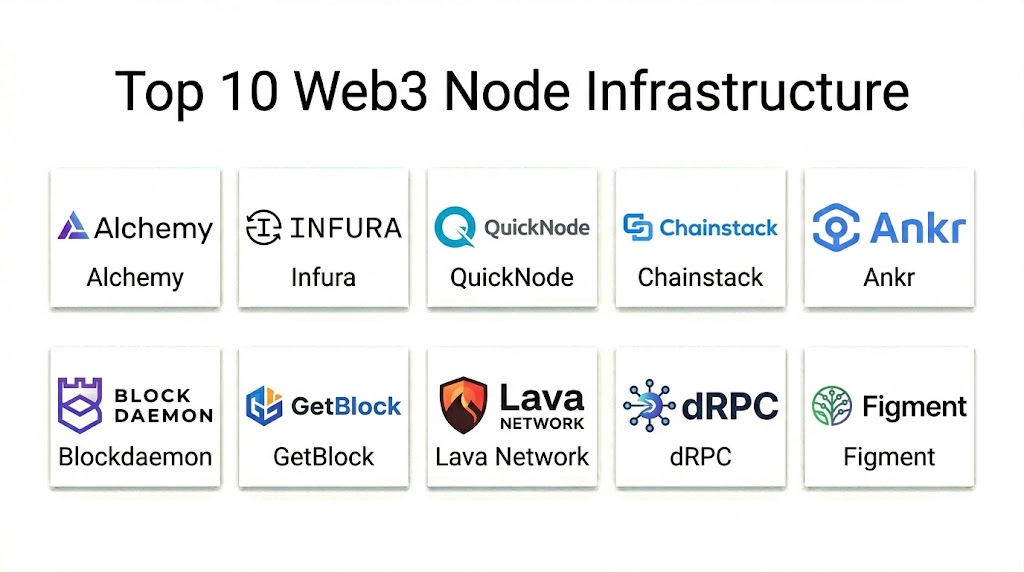
Top 10 Web3 Node Infrastructure Tools
#1 — Alchemy
Short description: Alchemy is a Web3 developer platform that provides blockchain RPC infrastructure, enhanced APIs, monitoring, webhooks, transaction tools, and developer services. It is widely used by dApps, wallets, NFT platforms, DeFi projects, and blockchain startups. Alchemy is especially strong for teams that want more than basic node access and need developer tooling for building and scaling Web3 applications. It is best for teams building production-grade applications across major blockchain ecosystems.
Key Features
- Reliable RPC endpoints for supported blockchain networks.
- Enhanced APIs for tokens, NFTs, transfers, and blockchain data.
- Webhooks and event streaming for real-time application workflows.
- Developer dashboard for usage tracking and debugging.
- Support for archive and historical data use cases depending on plan.
- Tooling for transaction workflows and Web3 app development.
- Strong ecosystem support for Ethereum and EVM-based applications.
Pros
- Strong developer experience and documentation.
- Useful beyond basic RPC because of enhanced APIs and tools.
- Good fit for startups and production dApps.
- Strong ecosystem recognition among Web3 builders.
Cons
- Heavy usage can become expensive depending on workload.
- Chain support may not fit every niche blockchain.
- Teams with highly customized node needs may still need dedicated infrastructure.
- Enterprise-grade requirements may require higher-tier plans.
Platforms / Deployment
Cloud / API / Web dashboard / RPC endpoints / Developer infrastructure.
Security & Compliance
Security features may include API key management, dashboard access controls, usage monitoring, and enterprise controls depending on plan. Specific certifications and compliance claims should be verified directly. If uncertain, write: Not publicly stated.
Integrations & Ecosystem
Alchemy integrates well with Web3 applications, developer frameworks, wallets, indexers, NFT platforms, analytics tools, and blockchain data workflows. It is commonly used as core infrastructure for production dApps.
- Ethereum and EVM development tools
- NFT applications
- DeFi platforms
- Wallet infrastructure
- Webhooks and event-driven apps
- Blockchain analytics workflows
Support & Community
Alchemy provides strong documentation, developer resources, support options, and a large Web3 developer community. Enterprise support may vary by plan and customer needs.
#2 — QuickNode
Short description: QuickNode is a Web3 infrastructure platform that provides fast blockchain RPC endpoints, dedicated nodes, add-ons, analytics, and multi-chain access. It is popular among developers who need reliable performance, broad network support, and flexible infrastructure options. QuickNode supports shared and dedicated node access for different workload sizes. It is best for startups, DeFi teams, gaming apps, analytics platforms, and enterprises needing scalable node infrastructure.
Key Features
- RPC endpoints across many blockchain networks.
- Shared and dedicated node infrastructure options.
- WebSocket support for real-time data workflows.
- Add-ons and marketplace-style extensions for developer needs.
- Analytics and dashboard tools for monitoring usage.
- Archive data support depending on network and plan.
- Regional infrastructure options for performance-sensitive apps.
Pros
- Strong performance-focused Web3 infrastructure.
- Broad chain support for multi-chain development.
- Useful dedicated node options for high-volume teams.
- Flexible for startups, developers, and enterprises.
Cons
- Pricing can vary based on chain, usage, and add-ons.
- Complex workloads may require careful plan selection.
- Advanced features may require paid tiers.
- Teams should validate latency in their target regions.
Platforms / Deployment
Cloud / API / RPC endpoints / Dedicated nodes / Web dashboard.
Security & Compliance
Security features may include API key controls, dashboard access, infrastructure monitoring, and enterprise support options depending on plan. Specific certifications should be verified directly. If uncertain, write: Not publicly stated.
Integrations & Ecosystem
QuickNode fits applications that need fast blockchain access, multi-chain development, and scalable RPC infrastructure. It can integrate with wallets, dApps, analytics platforms, and automation systems.
- Multi-chain dApps
- Wallet applications
- DeFi systems
- NFT platforms
- Analytics dashboards
- WebSocket event workflows
Support & Community
QuickNode provides documentation, technical support, developer guides, and a visible Web3 developer presence. Higher support tiers may be available for larger teams and enterprises.
#3 — Infura
Short description: Infura is one of the most established Web3 node infrastructure providers, known for Ethereum and IPFS-related infrastructure and broad adoption across the blockchain ecosystem. It is commonly used by wallets, dApps, DeFi tools, and developers who need reliable access to Ethereum and related networks. Infura is especially useful for teams building in the Consensys and Ethereum ecosystem. It is best for developers and businesses that want stable, familiar, and widely supported infrastructure.
Key Features
- RPC access for Ethereum and supported blockchain networks.
- API infrastructure for Web3 application development.
- IPFS-related infrastructure support depending on product availability.
- Dashboard and project management for developers.
- Supports archive data and higher-throughput needs depending on plan.
- Strong alignment with Ethereum developer workflows.
- Useful for wallets, dApps, and backend blockchain services.
Pros
- Well-established infrastructure provider.
- Strong Ethereum ecosystem fit.
- Familiar to many Web3 developers.
- Useful for production apps that need stable RPC access.
Cons
- Multi-chain breadth may not match every provider.
- Pricing and limits require careful review for high-volume usage.
- Some teams may want more decentralized infrastructure options.
- Advanced analytics and enhanced APIs may require complementary tools.
Platforms / Deployment
Cloud / API / RPC endpoints / Web dashboard.
Security & Compliance
Security features may include API key management, dashboard controls, account protections, and enterprise options depending on plan. Specific certifications and compliance claims should be verified directly. If uncertain, write: Not publicly stated.
Integrations & Ecosystem
Infura integrates strongly with Ethereum development workflows, wallet infrastructure, and Web3 application stacks. It is widely supported across common blockchain libraries and developer tooling.
- Ethereum dApps
- Wallet infrastructure
- Web3 libraries
- IPFS workflows
- DeFi applications
- Developer backend systems
Support & Community
Infura has extensive documentation, broad developer familiarity, and ecosystem support through Consensys-related Web3 tooling. Paid support options may vary by plan.
#4 — Ankr
Short description: Ankr provides Web3 infrastructure with RPC endpoints, APIs, app development services, and decentralized infrastructure concepts. It is useful for teams that want broad chain coverage, public and premium RPC access, and multi-chain development support. Ankr is especially relevant for developers who need quick access to many blockchain networks without operating their own nodes. It is best for multi-chain builders, dApps, DeFi teams, and teams exploring decentralized RPC infrastructure.
Key Features
- RPC endpoints for many blockchain networks.
- Public and premium endpoint options depending on usage needs.
- Multi-chain infrastructure for developers and apps.
- WebSocket and API access for supported networks.
- Useful for dApps, wallets, analytics, and automation.
- Supports decentralized infrastructure positioning.
- Developer tools and dashboard workflows.
Pros
- Broad multi-chain access.
- Useful for developers needing fast RPC setup.
- Public endpoints can help early-stage testing.
- Good fit for multi-chain dApps and infrastructure experiments.
Cons
- Public endpoints may have rate limits or variable reliability.
- Premium and enterprise needs require careful plan evaluation.
- Latency and performance should be tested for production regions.
- Some enterprise buyers may require additional compliance validation.
Platforms / Deployment
Cloud / API / RPC endpoints / Web dashboard / Decentralized infrastructure model.
Security & Compliance
Security controls may include API key management, access controls, monitoring, and enterprise options depending on plan. Specific certifications and compliance claims should be verified directly. If uncertain, write: Not publicly stated.
Integrations & Ecosystem
Ankr is useful across multi-chain Web3 applications, blockchain data services, and decentralized application workflows. It can support teams that need fast access to many networks.
- Multi-chain dApps
- Wallet backends
- DeFi applications
- Analytics systems
- WebSocket workflows
- Developer APIs
Support & Community
Ankr provides documentation, developer resources, and community support. Enterprise support and service levels may vary by plan and customer requirements.
#5 — Blockdaemon
Short description: Blockdaemon is an institutional blockchain infrastructure provider offering node infrastructure, staking, APIs, and enterprise-grade digital asset services. It is commonly used by financial institutions, custodians, exchanges, fintech companies, and enterprises that need reliable blockchain operations. Blockdaemon is especially useful for teams that need managed nodes, validator infrastructure, and institutional support. It is best for enterprises and institutions that require stronger operational reliability and support.
Key Features
- Managed blockchain node infrastructure.
- Validator and staking infrastructure services.
- API access for blockchain data and operations.
- Supports many blockchain protocols.
- Enterprise-focused infrastructure and support model.
- Useful for exchanges, custodians, institutions, and fintech teams.
- Can support production-grade blockchain operations.
Pros
- Strong fit for institutional and enterprise users.
- Useful for managed nodes and validator operations.
- Broad protocol support.
- Provides professional support and operational expertise.
Cons
- May be more than needed for small developers.
- Pricing may be custom or enterprise-oriented.
- Developer-first experience may differ from self-serve RPC platforms.
- Buyers should validate chain-specific services and SLAs.
Platforms / Deployment
Cloud / Managed nodes / Validator infrastructure / API / Enterprise infrastructure.
Security & Compliance
Enterprise security features may include access controls, monitoring, operational controls, and governance support depending on service. Specific certifications and compliance claims should be verified directly. If uncertain, write: Not publicly stated.
Integrations & Ecosystem
Blockdaemon fits institutional blockchain operations where node reliability, staking, custody-adjacent workflows, and protocol coverage matter.
- Exchanges
- Custodians
- Staking workflows
- Blockchain APIs
- Institutional digital asset systems
- Enterprise infrastructure environments
Support & Community
Blockdaemon provides enterprise support, onboarding, and infrastructure expertise. It is strongest for organizations needing managed blockchain operations rather than only basic self-serve RPC endpoints.
#6 — Chainstack
Short description: Chainstack is a managed blockchain infrastructure platform that helps developers and enterprises deploy, manage, and scale blockchain nodes across multiple protocols and clouds. It supports shared nodes, dedicated nodes, archive nodes, and enterprise infrastructure workflows. Chainstack is useful for teams that want more control over deployment options without fully managing every node component manually. It is best for developers, enterprises, analytics teams, and blockchain businesses needing flexible node deployment.
Key Features
- Managed shared and dedicated blockchain nodes.
- Multi-chain support across major blockchain networks.
- Archive node options for historical data use cases.
- Cloud and region flexibility depending on selected plans.
- Dashboard for node management and monitoring.
- API and RPC access for application development.
- Useful for enterprise and developer infrastructure needs.
Pros
- Flexible node deployment options.
- Good fit for dedicated and archive node workloads.
- Useful for developers and enterprise infrastructure teams.
- Supports multi-chain application development.
Cons
- Requires plan selection based on workload needs.
- Advanced node configurations may increase cost.
- Teams should validate performance in target regions.
- Not all chains or methods may be equal across plans.
Platforms / Deployment
Cloud / Managed nodes / Dedicated nodes / Shared nodes / API / Web dashboard.
Security & Compliance
Security features may include account controls, node access controls, monitoring, and enterprise options depending on plan. Specific certifications should be verified directly. If uncertain, write: Not publicly stated.
Integrations & Ecosystem
Chainstack integrates into Web3 applications, analytics systems, backend services, and enterprise blockchain infrastructure workflows. It is useful where teams need managed nodes with flexible deployment choices.
- Multi-chain dApps
- Archive data systems
- Wallet backends
- Analytics tools
- Enterprise applications
- RPC and WebSocket workflows
Support & Community
Chainstack provides documentation, support resources, and managed infrastructure guidance. Support options may vary by plan and enterprise requirements.
#7 — GetBlock
Short description: GetBlock provides blockchain node infrastructure with shared nodes, dedicated nodes, RPC endpoints, and broad multi-chain support. It is useful for teams that need fast access to many blockchain networks without deploying and maintaining nodes internally. GetBlock is especially relevant for dApps, wallets, exchanges, analytics products, and developers that need flexible access to both shared and dedicated infrastructure. It is best for multi-chain teams that want simple setup and broad network coverage.
Key Features
- Shared node and dedicated node access.
- RPC endpoints for many blockchain networks.
- API access for application and backend workflows.
- Archive node options depending on chain and plan.
- Region-based endpoint options may be available.
- Useful for wallets, dApps, analytics, and exchanges.
- Developer dashboard and documentation support.
Pros
- Broad blockchain network coverage.
- Useful for quick multi-chain infrastructure setup.
- Dedicated node options support higher-control workloads.
- Good fit for developers and Web3 businesses.
Cons
- Performance should be tested by region and chain.
- Advanced enterprise needs may require custom planning.
- Pricing and limits depend on plan and infrastructure type.
- Teams should validate archive and method support before committing.
Platforms / Deployment
Cloud / API / RPC endpoints / Shared nodes / Dedicated nodes.
Security & Compliance
Security controls may include account access, API key management, and infrastructure monitoring depending on plan. Specific certifications and compliance claims should be verified directly. If uncertain, write: Not publicly stated.
Integrations & Ecosystem
GetBlock fits teams that need multi-chain node access for applications, analytics, exchange systems, and blockchain workflows.
- dApp backends
- Wallet infrastructure
- Exchange infrastructure
- Blockchain analytics
- Multi-chain apps
- Dedicated node workflows
Support & Community
GetBlock provides documentation and support resources. Teams should evaluate response times, SLA options, and chain-specific support quality during a pilot.
#8 — Tenderly
Short description: Tenderly is a Web3 development and infrastructure platform known for transaction simulation, smart contract monitoring, debugging, alerting, and RPC services. It is especially useful for teams building, testing, and operating smart contracts and DeFi applications. Tenderly goes beyond simple node access by helping developers understand what transactions do before and after execution. It is best for smart contract teams, DeFi protocols, security-conscious developers, and production dApp operators.
Key Features
- RPC infrastructure for supported blockchain networks.
- Transaction simulation and debugging tools.
- Smart contract monitoring and alerting.
- Useful for DeFi and smart contract development workflows.
- Supports development, testing, and production operations.
- Provides dashboards for contract and transaction visibility.
- Helps improve security review and incident response workflows.
Pros
- Strong developer tooling beyond basic RPC.
- Excellent fit for smart contract debugging and monitoring.
- Useful for DeFi protocols and production Web3 apps.
- Helps teams understand transaction behavior more clearly.
Cons
- Not only a node provider, so teams must evaluate fit carefully.
- Chain coverage may differ from broad RPC-only providers.
- Advanced features may require paid plans.
- Some teams may still need a separate primary node provider.
Platforms / Deployment
Cloud / Web dashboard / API / RPC / Developer tooling.
Security & Compliance
Security features may include access controls, project management, monitoring, alerting, and transaction analysis depending on plan. Specific certifications should be verified directly. If uncertain, write: Not publicly stated.
Integrations & Ecosystem
Tenderly integrates strongly with smart contract development and production monitoring workflows. It is useful for teams that want operational visibility into contract behavior.
- Smart contract development tools
- DeFi applications
- RPC workflows
- Monitoring and alerting systems
- Transaction simulation workflows
- Developer testing environments
Support & Community
Tenderly provides documentation, developer resources, and strong visibility among smart contract developers. Support options may vary by plan and customer size.
#9 — Blast API
Short description: Blast API is a Web3 infrastructure service focused on fast, reliable RPC and API access across supported blockchain networks. It is designed for developers who need scalable endpoints without managing nodes directly. Blast API can be useful for dApps, wallets, analytics systems, and teams that want performant blockchain access with simple setup. It is best for developers and teams looking for RPC infrastructure with multi-chain support and performance focus.
Key Features
- RPC access for supported blockchain networks.
- API endpoints for Web3 application development.
- Performance-focused infrastructure for dApps and services.
- Dashboard and project management workflows.
- Useful for multi-chain blockchain connectivity.
- Supports production and testing environments depending on plan.
- Can be used as a primary or backup RPC provider.
Pros
- Useful for fast blockchain endpoint access.
- Good option for developers needing RPC infrastructure.
- Can support multi-chain applications.
- Practical for dApps, wallets, and analytics workloads.
Cons
- Buyers should validate supported chains and regions.
- Enterprise controls and SLAs should be reviewed directly.
- May require additional tools for analytics or enhanced APIs.
- Support depth may vary by plan.
Platforms / Deployment
Cloud / API / RPC endpoints / Web dashboard.
Security & Compliance
Security features may include API key management, access controls, and monitoring depending on plan. Specific certifications and compliance claims should be verified directly. If uncertain, write: Not publicly stated.
Integrations & Ecosystem
Blast API can support Web3 applications that need blockchain data access, transaction submission, and real-time app connectivity.
- dApp backends
- Wallet applications
- Analytics tools
- DeFi platforms
- Multi-chain applications
- Backup RPC infrastructure
Support & Community
Blast API provides documentation and support resources. Teams should evaluate support responsiveness, chain coverage, and reliability before using it for critical workloads.
#10 — Pocket Network
Short description: Pocket Network is a decentralized RPC infrastructure network designed to connect applications to blockchain data through a distributed network of node operators. It is useful for teams that want to reduce dependency on centralized RPC providers and explore decentralized infrastructure. Pocket Network supports Web3 applications that need blockchain access while aligning with decentralization principles. It is best for teams that value decentralized RPC, redundancy, and infrastructure diversity.
Key Features
- Decentralized RPC infrastructure model.
- Distributed network of node operators.
- Supports application access to blockchain data.
- Useful for reducing reliance on one centralized provider.
- Can support infrastructure redundancy strategies.
- Relevant for decentralization-focused Web3 teams.
- Helps align application infrastructure with Web3 principles.
Pros
- Strong decentralization focus.
- Useful as part of a multi-provider RPC strategy.
- Reduces dependency on a single centralized infrastructure provider.
- Good fit for teams that prioritize infrastructure resilience.
Cons
- Performance and consistency should be tested carefully.
- Developer experience may differ from centralized providers.
- Enterprise support expectations should be validated.
- Teams may still use centralized providers for some workloads.
Platforms / Deployment
Decentralized RPC network / API access / Distributed node infrastructure.
Security & Compliance
Security depends on protocol design, provider selection, application integration, authentication, and operational monitoring. Specific compliance certifications are Not publicly stated.
Integrations & Ecosystem
Pocket Network fits dApps and infrastructure teams that want decentralized RPC access or provider diversity. It is often considered as part of a resilient multi-provider architecture.
- Decentralized applications
- Multi-provider RPC setups
- Wallet backends
- Web3 infrastructure stacks
- Blockchain data workflows
- Redundancy and failover systems
Support & Community
Pocket Network has community-driven support and ecosystem resources. Teams should evaluate documentation, routing performance, supported chains, and operational reliability during testing.
Comparison Table
| Tool Name | Best For | Platform Supported | Deployment | Standout Feature | Public Rating |
|---|---|---|---|---|---|
| Alchemy | Production dApps and developer tooling | Cloud / API / RPC / Web dashboard | Cloud | Enhanced APIs and developer platform | N/A |
| QuickNode | Fast multi-chain RPC and dedicated nodes | Cloud / API / RPC / Dedicated nodes | Cloud | Performance-focused node infrastructure | N/A |
| Infura | Ethereum ecosystem infrastructure | Cloud / API / RPC | Cloud | Established Ethereum and Web3 infrastructure | N/A |
| Ankr | Broad multi-chain RPC access | Cloud / API / RPC | Cloud / Decentralized infrastructure model | Multi-chain RPC with public and premium access | N/A |
| Blockdaemon | Institutional node and validator infrastructure | Managed nodes / APIs / Validators | Cloud / Managed infrastructure | Enterprise-grade blockchain operations | N/A |
| Chainstack | Managed shared and dedicated nodes | Cloud / API / RPC / Web dashboard | Cloud / Managed nodes | Flexible node deployment and archive access | N/A |
| GetBlock | Multi-chain shared and dedicated node access | Cloud / API / RPC | Cloud | Broad network coverage with shared and dedicated nodes | N/A |
| Tenderly | Smart contract debugging and monitoring | Cloud / API / RPC / Web dashboard | Cloud | Transaction simulation and contract observability | N/A |
| Blast API | Fast RPC access for dApps | Cloud / API / RPC | Cloud | Performance-focused blockchain endpoints | N/A |
| Pocket Network | Decentralized RPC infrastructure | Decentralized RPC network / API | Distributed network | Decentralized node operator network | N/A |
Evaluation & Scoring of Web3 Node Infrastructure
| Tool Name | Core 25% | Ease 15% | Integrations 15% | Security 10% | Performance 10% | Support 10% | Value 15% | Weighted Total |
|---|---|---|---|---|---|---|---|---|
| Alchemy | 9 | 9 | 10 | 8 | 9 | 9 | 8 | 8.90 |
| QuickNode | 9 | 8 | 9 | 8 | 9 | 8 | 8 | 8.50 |
| Infura | 8 | 8 | 9 | 8 | 8 | 8 | 8 | 8.15 |
| Ankr | 8 | 8 | 8 | 7 | 8 | 7 | 9 | 7.95 |
| Blockdaemon | 9 | 7 | 8 | 9 | 8 | 9 | 7 | 8.10 |
| Chainstack | 8 | 8 | 8 | 8 | 8 | 8 | 8 | 8.00 |
| GetBlock | 8 | 8 | 8 | 7 | 8 | 8 | 8 | 7.85 |
| Tenderly | 8 | 8 | 9 | 8 | 8 | 8 | 8 | 8.15 |
| Blast API | 8 | 8 | 7 | 7 | 8 | 7 | 8 | 7.55 |
| Pocket Network | 7 | 7 | 7 | 7 | 7 | 7 | 8 | 7.15 |
These scores are comparative and based on Web3 node infrastructure fit, not absolute product quality. A higher score means the provider aligns strongly with RPC reliability, developer tooling, chain coverage, support, and production readiness. Developer platforms score strongly when they provide enhanced APIs and dashboards, while institutional providers score higher for managed operations and enterprise support. Decentralized RPC providers can be valuable for resilience but should be tested carefully for latency and consistency.
Which Web3 Node Infrastructure Tool Is Right for You?
Solo / Freelancer
Solo developers should start with a provider that offers easy setup, good documentation, free or low-cost tiers, and simple API key management. Alchemy, QuickNode, Infura, Ankr, and GetBlock are practical options for early testing and small dApps. If you are building smart contracts, Tenderly is useful because it adds simulation, debugging, and monitoring. Solo developers should avoid complex dedicated nodes unless their project has clear performance or archive data requirements.
SMB
SMBs should choose a provider that balances cost, reliability, and multi-chain support. QuickNode, Alchemy, Chainstack, and GetBlock are good options for production apps that need stable RPC access without heavy infrastructure operations. If the business is Ethereum-focused, Infura may be a familiar choice. SMBs should also consider a backup RPC provider for important applications, especially wallets, DeFi tools, and customer-facing dApps.
Mid-Market
Mid-market teams often need higher rate limits, better monitoring, dedicated endpoints, WebSocket support, archive data, and support SLAs. Alchemy and QuickNode are strong for developer-first production platforms, while Chainstack and GetBlock can support flexible node deployment. Tenderly is valuable for teams operating smart contracts and DeFi systems. Mid-market teams should evaluate failover architecture, usage-based costs, endpoint regions, and observability before scaling.
Enterprise
Enterprises should prioritize SLAs, support, security controls, compliance posture, dedicated infrastructure, and multi-region reliability. Blockdaemon is a strong fit for institutional node and validator infrastructure. Alchemy, QuickNode, Chainstack, and Infura can support enterprise workloads depending on requirements. Tenderly is useful for smart contract monitoring and incident response. Enterprises should run production-like load tests and review legal, security, and support terms before committing.
Budget vs Premium
Budget-conscious teams can start with free or low-cost shared endpoints from providers such as Alchemy, QuickNode, Infura, Ankr, or GetBlock. As usage grows, teams should compare request limits, compute units, rate limits, archive access, WebSocket pricing, and overage costs. Premium plans, dedicated nodes, and enterprise support become valuable when downtime affects users or revenue. For mission-critical applications, cost savings should not come at the expense of reliability.
Feature Depth vs Ease of Use
For ease of use, Alchemy, QuickNode, and Infura are strong starting points because onboarding and documentation are beginner-friendly. For deeper smart contract operations, Tenderly provides simulation and monitoring features that raw RPC providers may not offer. For dedicated node control, Chainstack, GetBlock, and Blockdaemon are worth evaluating. For decentralized infrastructure goals, Pocket Network and Ankr may fit better.
Integrations & Scalability
If you need strong developer integrations, Alchemy, QuickNode, Infura, and Tenderly are practical choices. If you need dedicated nodes, archive data, or flexible deployment, evaluate Chainstack, GetBlock, and Blockdaemon. If you need broad multi-chain support, compare Ankr, QuickNode, GetBlock, and Chainstack. Scalability should be tested using real traffic patterns, including peak loads, WebSocket connections, retries, indexing jobs, and historical queries.
Security & Compliance Needs
Security-sensitive teams should prioritize API key controls, endpoint restrictions, dashboard access management, monitoring, auditability, dedicated infrastructure, and support commitments. Institutions should evaluate Blockdaemon, Chainstack, Alchemy, QuickNode, and Infura for enterprise support and operational reliability. Smart contract teams should add Tenderly for transaction visibility and monitoring. Compliance requirements should be verified directly with providers before production deployment.
Frequently Asked Questions
1. What is Web3 node infrastructure?
Web3 node infrastructure provides blockchain connectivity for applications, wallets, analytics tools, exchanges, and smart contract systems. Instead of running blockchain nodes manually, developers use RPC endpoints and APIs from infrastructure providers. These services help apps read blockchain data, submit transactions, listen to events, and access historical chain information. Reliable node infrastructure is essential for production Web3 applications.
2. What is an RPC endpoint in Web3?
An RPC endpoint is an interface that lets an application communicate with a blockchain node. Apps use RPC calls to read balances, check transactions, estimate gas, submit signed transactions, and fetch smart contract data. Public RPC endpoints are easy to access but may have limits, while private endpoints usually offer better performance and reliability. Production apps should avoid relying only on unstable public endpoints.
3. Should I run my own blockchain node or use a provider?
Running your own node gives more control, but it requires infrastructure, monitoring, updates, storage, security, and operational expertise. Using a provider is faster and easier, especially for startups and developers who need reliable access quickly. Many production teams use providers first and later add self-hosted nodes or dedicated nodes for resilience. The best choice depends on cost, control, performance, and operational capacity.
4. What is the difference between shared nodes and dedicated nodes?
Shared nodes serve traffic from multiple customers and are usually cheaper and easier to start with. Dedicated nodes are reserved for one customer or workload and can provide more predictable performance, custom configuration, and stronger isolation. Shared nodes are good for development and moderate workloads. Dedicated nodes are better for high-volume apps, exchanges, trading systems, and mission-critical infrastructure.
5. What is an archive node?
An archive node stores historical blockchain state, not just recent blocks or current balances. This is useful for analytics, tax tools, compliance systems, DeFi dashboards, historical simulations, and applications that need past contract states. Archive nodes require more storage and infrastructure than standard nodes. Many providers offer archive access as a premium feature or dedicated service.
6. How are Web3 node infrastructure tools priced?
Pricing may be based on requests, compute units, rate limits, endpoint type, chain, archive access, WebSocket usage, dedicated nodes, or enterprise support. Free tiers are useful for testing but may not support production traffic. High-volume apps should calculate monthly usage carefully because costs can increase quickly. Buyers should compare both headline pricing and real workload cost.
7. What are common mistakes when choosing a node provider?
A common mistake is selecting a provider only because it has a free tier. Teams also forget to test latency, error rates, archive support, WebSocket stability, and failover behavior. Another mistake is relying on one provider for all mission-critical traffic. Production teams should test real workloads, set up monitoring, define retry logic, and consider backup providers.
8. Do Web3 node providers support multiple blockchains?
Yes, many providers support multiple blockchains, but coverage varies. Some providers are strongest in Ethereum and EVM ecosystems, while others support a broader set of chains including Solana, Bitcoin, Avalanche, BNB Chain, Polygon, Cosmos-based networks, and more. Buyers should verify not only chain support but also method support, archive access, WebSocket availability, and regional performance for each chain.
9. What integrations should Web3 teams look for?
Important integrations include Web3 libraries, wallets, indexers, monitoring tools, alerting systems, CI/CD workflows, smart contract tools, data warehouses, and analytics platforms. DeFi teams may need transaction simulation and real-time event streams. Wallet teams need reliable transaction submission and balance queries. Analytics teams often need archive nodes, batch APIs, and historical data access.
10. What is the best Web3 node infrastructure provider overall?
There is no single best provider for every team. Alchemy is strong for developer tooling, QuickNode is strong for fast multi-chain infrastructure, Infura is established in Ethereum workflows, Blockdaemon fits institutional infrastructure, Chainstack and GetBlock offer flexible node access, and Tenderly is excellent for smart contract debugging and monitoring. The best choice depends on your chains, traffic, latency needs, archive requirements, budget, and support expectations.
Conclusion
Web3 Node Infrastructure is the backbone of reliable blockchain applications, because every wallet, dApp, DeFi protocol, NFT marketplace, analytics tool, and transaction system depends on stable blockchain connectivity. The right provider depends on your workload: Alchemy is strong for developer tooling, QuickNode is strong for performance-focused RPC, Infura is a familiar Ethereum ecosystem choice, Ankr and GetBlock are useful for broad multi-chain access, and Blockdaemon fits institutional operations. Chainstack supports flexible managed nodes, Tenderly adds smart contract simulation and monitoring, Blast API can support fast endpoint access, and Pocket Network is useful for decentralized RPC strategies. Buyers should avoid choosing only by free tier or chain count and should instead test latency, archive access, WebSocket stability, error rates, support, and real workload cost. Start with two or three providers, run a production-like pilot, design failover early, monitor usage carefully, and scale only after validating reliability, performance, security, and budget fit.

Node performance during network congestion is often overlooked when evaluating providers. Reliability, latency, and failover capabilities can have a major impact on application stability.