Introduction
Runtime Application Self-Protection RASP tools are advanced application security solutions that embed directly inside running applications to detect and block attacks in real time. Unlike external security tools such as WAFs or network firewalls, RASP works from within the application runtime environment, giving it deep visibility into application behavior, user inputs, and execution flows.
RASP matters more than ever in modern cloud-native systems because applications are now highly distributed, API-driven, and continuously deployed through CI/CD pipelines. Traditional perimeter security cannot fully protect against application-layer attacks such as SQL injection, command injection, authentication bypass, or zero-day exploits. RASP helps close this gap by stopping attacks while the application is actively running.
Common use cases include protecting APIs from abuse, blocking injection attacks in production, securing microservices, monitoring application behavior, preventing runtime exploitation, and reducing dependency on external firewalls for application-level security.
When evaluating RASP tools, buyers should consider runtime visibility, detection accuracy, performance overhead, integration with CI/CD pipelines, language and framework support, cloud compatibility, blocking capabilities, false positive handling, reporting depth, scalability, and enterprise governance features.
Best for: DevSecOps teams, application security engineers, platform engineering teams, enterprises running microservices, cloud-native SaaS platforms, and organizations needing real-time application protection.
Not ideal for: static or non-runtime environments, very small applications without security risks, or teams relying only on basic WAF-based protection.
Key Trends in RASP Tools
- Shift from perimeter security to in-application protection, reducing dependency on WAF-only models
- Cloud-native RASP adoption is increasing, especially in Kubernetes and microservices environments
- AI-driven attack detection is emerging, helping identify abnormal runtime behavior patterns
- Integration with DevSecOps pipelines is becoming standard for continuous protection
- Low-overhead RASP agents are improving performance efficiency in high-traffic applications
- API-first security protection is a major focus area as APIs become primary attack surfaces
- Runtime + pre-deployment security convergence, combining RASP with SAST and IAST models
- Automatic attack blocking with context awareness, reducing false positives compared to signature-based systems
- Container and serverless RASP expansion, supporting modern cloud architectures
- Compliance-driven runtime monitoring, especially for regulated industries requiring continuous security enforcement
How We Selected These Tools
- Focused on tools that provide true runtime application protection capabilities
- Included both enterprise platforms and developer-focused solutions
- Prioritized tools with real-time attack detection and blocking
- Considered language and framework coverage (Java, .NET, Node.js, etc.)
- Evaluated integration with DevSecOps and CI/CD workflows
- Included tools with cloud-native and Kubernetes compatibility
- Considered false positive management and detection accuracy
- Reviewed scalability for microservices and distributed systems
- Ensured balance between open ecosystem and enterprise-grade platforms
- Used Not publicly stated for unknown compliance or rating data
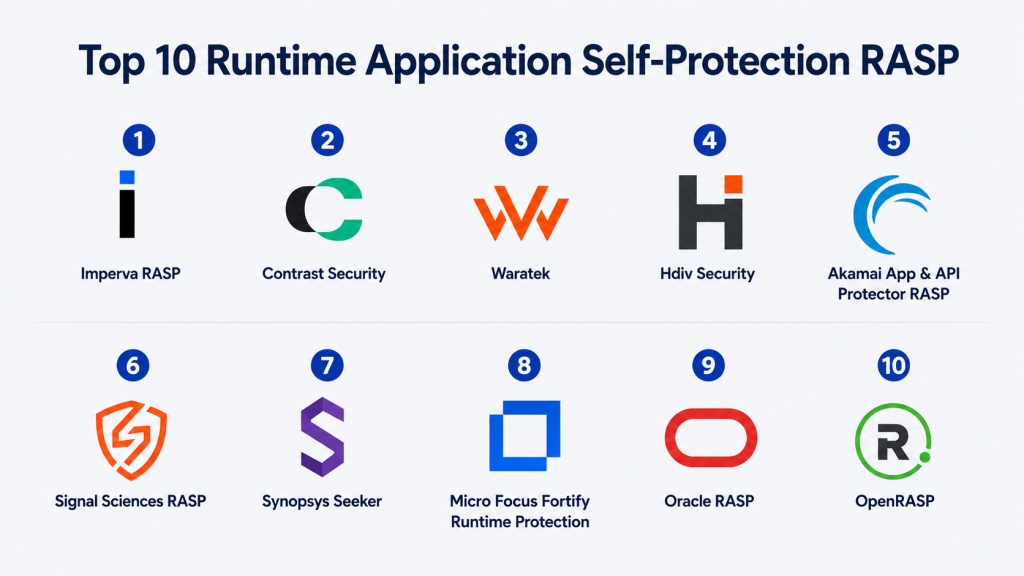
Top 10 Runtime Application Self-Protection RASP Tools
1- Contrast Security RASP
Short description: Contrast Security is one of the most recognized RASP platforms designed to provide continuous application protection by embedding sensors directly into applications. It detects vulnerabilities, monitors runtime behavior, and blocks attacks in real time. It is widely used in enterprise application security programs.
Key Features
- Real-time attack detection and blocking
- In-application instrumentation for deep visibility
- Vulnerability detection during runtime execution
- Protection against injection and authentication attacks
- Continuous monitoring of application behavior
- Integration with DevSecOps pipelines
- API and microservice protection
Pros
- Strong runtime visibility
- High detection accuracy
- Enterprise-grade security coverage
- Good DevSecOps integration
Cons
- Complex setup in large environments
- Requires application instrumentation
- Performance tuning may be required
- Premium pricing model
Platforms / Deployment
Cloud, hybrid, self-hosted, Java, .NET, Node.js environments
Security & Compliance
Supports enterprise-grade security controls including RBAC, audit logs, and encryption. Formal compliance certifications are Not publicly stated.
Integrations & Ecosystem
- CI/CD pipelines
- Application frameworks
- API gateways
- Security monitoring tools
- DevSecOps platforms
Support & Community
Strong enterprise support with structured onboarding and technical assistance. Community engagement is moderate but enterprise-focused.
2- Imperva RASP
Short description: Imperva RASP provides runtime protection by embedding security capabilities inside applications and detecting malicious behavior in real time. It is commonly used in enterprise environments for protecting web applications and APIs.
Key Features
- Real-time application attack detection
- Protection against SQL injection and XSS
- Runtime behavior monitoring
- API security protection
- Threat intelligence integration
- Application-level intrusion prevention
- Security analytics dashboard
Pros
- Strong enterprise security coverage
- Good integration with Imperva ecosystem
- Effective attack blocking
- Mature security platform
Cons
- Complex enterprise deployment
- Limited flexibility outside ecosystem
- Requires tuning for large applications
- Higher operational overhead
Platforms / Deployment
Cloud, hybrid, enterprise application environments
Security & Compliance
Enterprise-grade controls available. Certifications depend on deployment model. Not publicly stated for exact compliance coverage.
Integrations & Ecosystem
- Imperva security suite
- Web application firewalls
- SIEM systems
- API security tools
- Cloud security platforms
Support & Community
Enterprise-level support with structured onboarding and managed services.
3- Veracode RASP
Short description: Veracode RASP provides runtime application protection as part of its broader application security platform. It focuses on detecting and blocking attacks while giving security teams visibility into application behavior.
Key Features
- Runtime attack detection
- Application behavior monitoring
- Protection against injection attacks
- Security telemetry and reporting
- Integration with SDLC workflows
- Vulnerability analysis at runtime
- Enterprise governance support
Pros
- Strong enterprise AppSec integration
- Good visibility into application behavior
- Part of broader security platform
- Useful for compliance-driven teams
Cons
- Platform dependency
- Less standalone flexibility
- Requires enterprise setup
- Learning curve for configuration
Platforms / Deployment
Cloud, hybrid enterprise environments, application runtime systems
Security & Compliance
Supports enterprise security monitoring and governance features. Compliance certifications are Not publicly stated.
Integrations & Ecosystem
- Veracode AppSec platform
- CI/CD pipelines
- Security dashboards
- Developer tools
- Enterprise monitoring systems
Support & Community
Strong enterprise support with structured onboarding and documentation.
4- Hdiv Security RASP
Short description: Hdiv Security provides runtime application self-protection combined with vulnerability detection, focusing on protecting applications from attacks without requiring deep code changes.
Key Features
- Runtime attack prevention
- Vulnerability detection
- Framework-level protection
- API and web application monitoring
- Low-code integration approach
- Real-time security enforcement
- Compliance reporting support
Pros
- Easy integration into applications
- Strong runtime visibility
- Good for legacy systems
- Reduced development overhead
Cons
- Smaller ecosystem compared to major vendors
- Limited public documentation depth
- Enterprise scalability varies
- Less widely adopted
Platforms / Deployment
Java, .NET, web applications, cloud environments
Security & Compliance
Supports runtime security enforcement. Compliance certifications are Not publicly stated.
Integrations & Ecosystem
- Web frameworks
- Application servers
- CI/CD systems
- API monitoring tools
Support & Community
Moderate support with enterprise assistance available.
5- Aikido Security RASP
Short description: Aikido Security provides a unified security platform that includes runtime application protection capabilities alongside code and cloud security features.
Key Features
- Runtime vulnerability detection
- Code and application security integration
- Cloud and API protection
- Developer-focused dashboards
- Continuous monitoring
- Security prioritization engine
- CI/CD integration
Pros
- Unified security platform approach
- Developer-friendly interface
- Easy onboarding
- Good for SMB and mid-market teams
Cons
- RASP depth may vary by use case
- Less specialized than dedicated RASP vendors
- Enterprise controls still evolving
- Requires validation for complex systems
Platforms / Deployment
Cloud-based platform, CI/CD environments, developer tools
Security & Compliance
Security features available through platform controls. Compliance details are Not publicly stated.
Integrations & Ecosystem
- GitHub
- GitLab
- CI/CD pipelines
- Cloud environments
- Developer tools
Support & Community
Growing support ecosystem with focus on developer security workflows.
6- OpenRASP
Short description: OpenRASP is an open-source runtime application self-protection solution designed to embed security directly into applications and provide real-time attack detection.
Key Features
- Open-source RASP engine
- Real-time attack detection
- Application instrumentation
- Injection attack prevention
- Web application protection
- Lightweight deployment model
- Extensible architecture
Pros
- Open-source flexibility
- Customizable deployment
- No vendor lock-in
- Lightweight architecture
Cons
- Requires strong engineering ownership
- Limited enterprise features
- Community-driven support only
- Requires manual tuning
Platforms / Deployment
Self-hosted, Java-based applications, cloud environments
Security & Compliance
Security depends on deployment configuration. Compliance features are Not publicly stated.
Integrations & Ecosystem
- Java applications
- Web frameworks
- CI/CD pipelines
- Security monitoring tools
Support & Community
Community-driven support with documentation available.
7- Fortify RASP
Short description: Fortify RASP is part of the Fortify application security ecosystem, providing runtime protection alongside vulnerability management and code analysis tools.
Key Features
- Runtime application protection
- Vulnerability detection
- Integration with Fortify platform
- Real-time threat blocking
- Application behavior monitoring
- Security analytics
- Enterprise governance
Pros
- Strong enterprise integration
- Good security coverage
- Part of full AppSec suite
- Mature platform ecosystem
Cons
- Requires Fortify ecosystem adoption
- Complex configuration
- Higher cost structure
- Less flexible standalone use
Platforms / Deployment
Enterprise cloud, hybrid, application runtime environments
Security & Compliance
Enterprise-grade security controls available. Compliance certifications are Not publicly stated.
Integrations & Ecosystem
- Fortify AppSec suite
- CI/CD pipelines
- Enterprise security tools
- SIEM systems
Support & Community
Strong enterprise support and documentation within Micro Focus ecosystem.
8- Cloudflare Application RASP Capabilities
Short description: Cloudflare provides runtime application protection capabilities through its edge security platform, focusing on API protection, traffic analysis, and application-layer threat mitigation.
Key Features
- Edge-based runtime protection
- API security monitoring
- Threat detection and blocking
- DDoS protection integration
- Real-time traffic analysis
- Bot mitigation
- Security rules engine
Pros
- Strong edge security integration
- Scalable global protection
- Easy deployment model
- Good API protection
Cons
- Not traditional in-app RASP
- Limited internal application visibility
- Dependency on edge routing
- Advanced features require tuning
Platforms / Deployment
Cloud-based edge platform
Security & Compliance
Strong enterprise security controls. Compliance certifications depend on Cloudflare plan and configuration. Not publicly stated in detail.
Integrations & Ecosystem
- Web applications
- APIs
- CDN and edge services
- Security analytics tools
Support & Community
Strong global support infrastructure and developer community.
9- Signal Sciences RASP Capabilities
Short description: Signal Sciences provides application security with runtime monitoring and attack detection capabilities, especially focused on web applications and APIs.
Key Features
- Real-time application monitoring
- Attack detection and prevention
- API security protection
- Behavioral analysis
- Web application protection
- Security event logging
- Policy-based controls
Pros
- Strong API protection
- Good enterprise adoption
- Easy deployment model
- Strong monitoring capabilities
Cons
- Platform-specific dependency
- Limited customization depth
- Enterprise pricing model
- Requires configuration tuning
Platforms / Deployment
Cloud, hybrid, web application environments
Security & Compliance
Enterprise-grade security features available. Compliance details are Not publicly stated.
Integrations & Ecosystem
- Web applications
- API gateways
- SIEM tools
- CI/CD pipelines
Support & Community
Enterprise support with structured onboarding.
10- Jscrambler RASP (Client-side RASP)
Short description: Jscrambler focuses on client-side RASP, protecting web applications in the browser by preventing tampering, reverse engineering, and script-based attacks.
Key Features
- Client-side runtime protection
- JavaScript protection and obfuscation
- Anti-tampering controls
- Runtime threat detection in browsers
- Protection against code injection
- API request protection
- Web application security hardening
Pros
- Strong client-side protection
- Good for browser-based applications
- Effective against script attacks
- Lightweight integration
Cons
- Limited to frontend security use cases
- Not full backend RASP solution
- Requires tuning for performance
- Specialized scope
Platforms / Deployment
Web browsers, JavaScript applications, frontend frameworks
Security & Compliance
Security controls focused on client-side protection. Compliance certifications are Not publicly stated.
Integrations & Ecosystem
- Web applications
- JavaScript frameworks
- CI/CD pipelines
- API security tools
Support & Community
Enterprise support available with developer documentation.
Comparison Table
| Tool Name | Best For | Platforms Supported | Deployment | Standout Feature | Public Rating |
|---|---|---|---|---|---|
| Contrast Security | Enterprise runtime protection | Java, .NET, Node.js | Cloud / Hybrid | Deep application instrumentation | N/A |
| Imperva RASP | Enterprise security suites | Web apps, APIs | Cloud / Hybrid | Integrated security platform | N/A |
| Veracode RASP | AppSec governance | Enterprise applications | Cloud / Hybrid | Runtime security + compliance | N/A |
| Hdiv Security | Legacy + modern apps | Java, .NET | Hybrid | Low-code integration | N/A |
| Aikido Security | Developer security platforms | CI/CD, cloud apps | Cloud | Unified security approach | N/A |
| OpenRASP | Open-source teams | Java apps | Self-hosted | Lightweight open-source RASP | N/A |
| Fortify RASP | Enterprise AppSec | Enterprise apps | Hybrid | Full Fortify integration | N/A |
| Cloudflare RASP | Edge security use cases | Web apps, APIs | Cloud | Edge-based protection | N/A |
| Signal Sciences | API security teams | Web apps, APIs | Cloud | Real-time API protection | N/A |
| Jscrambler | Frontend security | JavaScript apps | Cloud / Hybrid | Client-side protection | N/A |
Evaluation & Scoring of RASP Tools
| Tool Name | Core 25% | Ease 15% | Integrations 15% | Security 10% | Performance 10% | Support 10% | Value 15% | Weighted Total |
|---|---|---|---|---|---|---|---|---|
| Contrast Security | 9.2 | 8.0 | 9.0 | 9.2 | 8.8 | 9.0 | 8.5 | 8.9 |
| Imperva RASP | 8.8 | 7.8 | 8.8 | 9.0 | 8.5 | 8.8 | 8.0 | 8.5 |
| Veracode RASP | 8.7 | 7.5 | 8.7 | 9.0 | 8.4 | 8.8 | 8.0 | 8.4 |
| Hdiv Security | 8.2 | 8.0 | 8.0 | 8.2 | 8.5 | 8.0 | 8.3 | 8.1 |
| Aikido Security | 8.0 | 8.8 | 8.5 | 8.2 | 8.4 | 8.5 | 8.6 | 8.4 |
| OpenRASP | 7.8 | 8.5 | 7.8 | 7.8 | 8.0 | 7.5 | 9.0 | 8.0 |
| Fortify RASP | 8.6 | 7.5 | 8.6 | 9.0 | 8.5 | 8.8 | 7.8 | 8.4 |
| Cloudflare RASP | 8.4 | 9.0 | 8.5 | 8.5 | 9.2 | 8.8 | 8.7 | 8.7 |
| Signal Sciences | 8.5 | 8.5 | 8.6 | 8.8 | 8.7 | 8.8 | 8.2 | 8.6 |
| Jscrambler | 8.3 | 8.8 | 8.0 | 8.5 | 8.8 | 8.3 | 8.0 | 8.3 |
These scores are comparative and reflect general capability across RASP use cases. The right choice depends on whether your priority is backend protection, API security, edge security, or client-side protection.
Which RASP Tool Is Right for You?
Solo / Freelancer
OpenRASP or lightweight developer-focused tools are more practical. Focus on learning runtime protection concepts rather than enterprise deployment complexity.
SMB
Aikido Security, Cloudflare, or Hdiv Security provide balanced protection without heavy operational overhead.
Mid-Market
Contrast Security, Imperva, and Signal Sciences provide strong runtime protection with better scalability and integrations.
Enterprise
Veracode, Fortify, Imperva, and Contrast Security are strong enterprise-grade RASP solutions with governance and compliance alignment.
Budget vs Premium
Open-source tools reduce cost but require engineering ownership. Enterprise RASP platforms provide automation, monitoring, and compliance support.
Feature Depth vs Ease of Use
Contrast and Imperva provide deep protection but require setup effort. Cloudflare and Aikido are easier to adopt but may offer less granular control.
Integrations & Scalability
Enterprise environments should prioritize CI/CD, API gateways, SIEM integration, and Kubernetes compatibility for scaling RASP effectively.
Security & Compliance Needs
RASP adoption should align with compliance needs, especially in regulated industries requiring runtime monitoring, auditability, and continuous protection.
Frequently Asked Questions
1. What is RASP in cybersecurity?
RASP is a security technology that runs inside an application and detects attacks in real time. It monitors application behavior and blocks malicious activity as it happens. Unlike external tools, it has deep visibility into runtime execution. It helps protect applications from injection attacks, misuse, and exploitation.
2. How is RASP different from a WAF?
A WAF sits outside the application and filters traffic based on patterns. RASP operates inside the application and understands actual execution behavior. This allows RASP to detect attacks that bypass perimeter defenses. RASP provides more context-aware protection than WAFs.
3. Does RASP slow down applications?
RASP can introduce slight overhead because it monitors runtime behavior. However, modern implementations are optimized to minimize performance impact. Most enterprise RASP tools balance security with performance. Proper configuration helps reduce latency.
4. Can RASP replace a WAF?
No, RASP does not fully replace a WAF. They are complementary technologies. WAF protects traffic at the edge while RASP protects the application internally. Using both provides layered security.
5. What types of attacks can RASP detect?
RASP can detect SQL injection, command injection, XSS, authentication bypass attempts, API abuse, and zero-day exploits. It focuses on runtime behavior rather than signatures. This allows it to catch unknown attack patterns. It is especially effective against application-layer attacks.
6. Is RASP suitable for cloud-native applications?
Yes, RASP is widely used in cloud-native environments. It integrates with microservices, APIs, and Kubernetes-based applications. Many modern RASP tools support containerized deployments. It is commonly used in DevSecOps pipelines.
7. What are the limitations of RASP?
RASP requires application instrumentation, which may require integration effort. It can introduce performance overhead if not tuned properly. It is also dependent on runtime environments. It may not cover all edge-level threats.
8. Do all programming languages support RASP?
Most enterprise RASP tools support popular languages like Java, .NET, Node.js, and Python. However, coverage varies by vendor. Some tools focus more on specific ecosystems. Buyers should validate language support before adoption.
9. Is RASP open-source?
Some RASP tools have open-source implementations, but most enterprise-grade RASP solutions are commercial. Open-source options are typically more limited in features. Enterprises often choose commercial RASP for scalability and support.
10. How should companies start with RASP?
Companies should start by deploying RASP in monitoring mode before enabling blocking. This helps understand application behavior and reduce false positives. Gradually, enforcement rules can be introduced. It is best integrated into DevSecOps pipelines.
Conclusion
Runtime Application Self-Protection (RASP) tools are becoming essential in modern application security because they protect applications from inside the runtime environment. Unlike traditional perimeter-based tools, RASP understands application behavior and can stop attacks in real time, making it highly effective for cloud-native, API-driven, and microservice architectures. The best solution depends on your environment: Contrast Security and Imperva offer strong enterprise protection, Cloudflare and Signal Sciences excel in edge and API security, while OpenRASP and Aikido provide lightweight and flexible alternatives. The most effective strategy is to combine RASP with WAF, CI/CD security, and secure development practices to create layered, real-time application protection across the entire software lifecycle.
