Introduction
Crypto custody platforms help organizations securely store, manage, transfer, and govern digital assets such as cryptocurrencies, stablecoins, tokenized assets, NFTs, and institutional blockchain holdings. These platforms provide secure wallet infrastructure, key management, transaction governance, policy enforcement, compliance workflows, and operational security controls for individuals and enterprises handling digital assets at scale.
Crypto custody has become increasingly important because institutional participation in digital assets continues to grow across finance, payments, tokenization, gaming, DeFi, treasury management, and enterprise blockchain ecosystems. Secure custody is critical because compromised private keys, insider threats, phishing attacks, and operational failures can result in irreversible financial losses. Modern custody platforms therefore combine security, governance, compliance, automation, and operational workflows into centralized management systems.
Common use cases include institutional crypto trading, treasury management, digital asset investment funds, NFT custody, exchange infrastructure, tokenized asset management, staking operations, and enterprise blockchain treasury workflows. Buyers should evaluate wallet architecture, MPC support, cold storage, governance controls, insurance availability, compliance workflows, blockchain compatibility, API access, scalability, and operational transparency.
Best for: financial institutions, crypto exchanges, hedge funds, Web3 startups, enterprises managing digital assets, fintech companies, DAO operators, and institutional investors. Not ideal for: casual retail users with minimal holdings, organizations without digital asset operations, or businesses that only require lightweight consumer wallets.
Key Trends in Crypto Custody Platforms
- MPC wallet architectures are becoming dominant because they reduce reliance on single private keys and improve operational resilience.
- Institutional crypto adoption is driving demand for enterprise-grade governance, auditability, and transaction approval workflows.
- Regulatory pressure is increasing around custody controls, reporting, segregation of assets, and operational compliance.
- Tokenized real-world assets are expanding custody requirements beyond cryptocurrencies into securities, funds, and enterprise tokenization.
- Multi-chain asset management is becoming essential as organizations interact with Ethereum, Bitcoin, Solana, Layer 2 networks, and emerging ecosystems.
- Integrated staking and yield workflows are growing within institutional custody platforms.
- Security observability and transaction monitoring are becoming critical for detecting suspicious activity and operational anomalies.
- Self-custody infrastructure is expanding as enterprises seek more direct control over digital assets.
- Cold storage and hybrid custody models remain highly relevant for long-term institutional asset protection.
- AI-assisted risk analysis and transaction monitoring are emerging in enterprise crypto security operations.
How We Selected These Tools
This list was selected using a practical institutional crypto security, blockchain infrastructure, and digital asset operations evaluation approach.
- We prioritized platforms with strong relevance in institutional crypto custody and digital asset management.
- We included both institutional custodians and developer-focused custody infrastructure providers.
- We evaluated security architecture, governance workflows, operational maturity, and multi-chain compatibility.
- We considered MPC support, cold storage capabilities, policy management, and transaction approval systems.
- We reviewed integration support for exchanges, DeFi systems, APIs, treasury systems, and enterprise workflows.
- We prioritized platforms with strong ecosystem adoption and institutional credibility.
- We included solutions for both regulated financial institutions and modern Web3-native organizations.
- We considered scalability, operational automation, and developer accessibility.
- We avoided unsupported claims and invented certifications or ratings.
- We used “Not publicly stated” or “Varies / N/A” where details were uncertain.
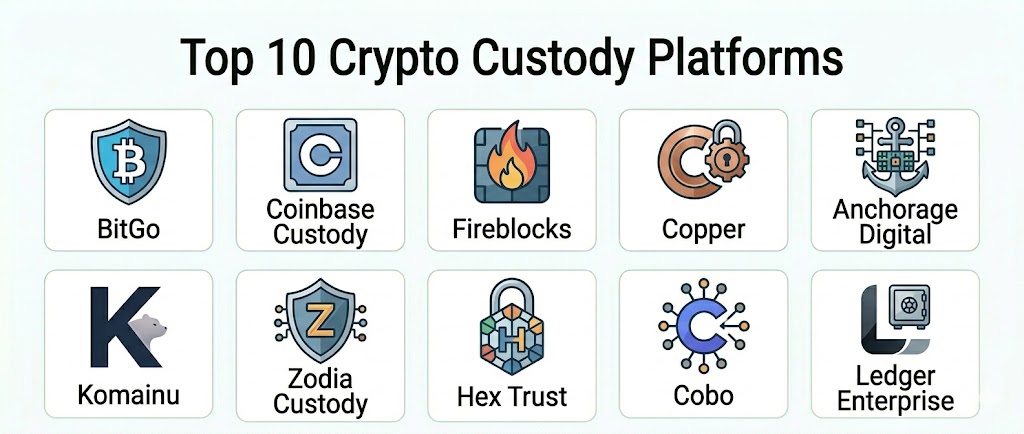
Top 10 Crypto Custody Platforms
#1 — Fireblocks
Short description: Fireblocks is one of the most widely adopted institutional crypto custody and digital asset infrastructure platforms. It provides MPC-based wallet security, transaction governance, treasury management, and secure asset transfer workflows for enterprises and financial institutions. Fireblocks is heavily used by exchanges, trading firms, fintech companies, and institutional investors. It is best suited for organizations requiring scalable institutional-grade digital asset operations.
Key Features
- MPC wallet infrastructure
- Institutional-grade transaction governance
- Secure asset transfer network
- Multi-chain digital asset support
- Treasury management workflows
- API-driven infrastructure
- Operational policy controls
Pros
- Strong institutional adoption
- Mature MPC security architecture
- Excellent operational workflow management
- Broad blockchain ecosystem compatibility
Cons
- Enterprise-focused pricing
- Advanced setup may require onboarding support
- Smaller organizations may not need full platform depth
- Governance workflows can become complex
Platforms / Deployment
Web / Enterprise infrastructure / APIs.
Cloud / Hybrid.
Security & Compliance
Supports MPC security architecture, governance controls, access management, transaction policies, and enterprise operational workflows. Buyers should validate compliance requirements and operational controls directly.
Integrations & Ecosystem
Fireblocks integrates broadly into institutional digital asset ecosystems and enterprise blockchain workflows.
- Exchanges
- DeFi platforms
- Treasury systems
- Trading infrastructure
- APIs and developer workflows
- Blockchain ecosystems
Support & Community
Strong enterprise onboarding, implementation support, and institutional customer ecosystem. Widely recognized in institutional crypto infrastructure environments.
#2 — Coinbase Custody
Short description: Coinbase Custody is an institutional digital asset custody platform designed for secure storage and operational management of cryptocurrencies and tokenized assets. It supports institutional investors, asset managers, enterprises, and regulated organizations seeking enterprise-grade crypto custody workflows. Coinbase Custody is especially useful for organizations prioritizing regulatory alignment and operational simplicity.
Key Features
- Institutional digital asset custody
- Cold storage infrastructure
- Governance and approval workflows
- Multi-asset support
- Integration with Coinbase ecosystem
- Asset segregation workflows
- Institutional reporting support
Pros
- Strong institutional brand recognition
- Good operational simplicity
- Broad digital asset support
- Useful for regulated organizations
Cons
- Dependency on Coinbase ecosystem
- Pricing may not fit smaller organizations
- Advanced customization may be limited
- Some institutions may prefer self-managed custody approaches
Platforms / Deployment
Web platform / institutional infrastructure.
Cloud / Institutional managed custody.
Security & Compliance
Supports institutional security workflows, governance controls, operational segregation, and enterprise-grade custody management. Buyers should validate regional and regulatory alignment directly.
Integrations & Ecosystem
Coinbase Custody integrates naturally into Coinbase institutional and trading ecosystems.
- Coinbase Prime
- Institutional trading workflows
- Treasury operations
- Reporting systems
- Digital asset operations
- Institutional portfolio management
Support & Community
Institutional support and onboarding services are available with operational guidance for enterprise digital asset workflows.
#3 — BitGo
Short description: BitGo is a well-known crypto custody platform focused on institutional wallet security, multi-signature infrastructure, and digital asset management. It supports exchanges, custodians, investment firms, and enterprise crypto operations. BitGo is especially recognized for secure wallet management and operational governance workflows. It is best suited for organizations needing flexible institutional crypto infrastructure.
Key Features
- Multi-signature wallet infrastructure
- Institutional custody services
- Digital asset treasury management
- Multi-chain asset support
- Policy-based transaction controls
- Enterprise wallet APIs
- Operational governance workflows
Pros
- Strong security-focused reputation
- Broad digital asset support
- Flexible enterprise APIs
- Useful governance and approval workflows
Cons
- Enterprise implementation complexity
- Operational setup may require expertise
- Smaller teams may find workflows advanced
- Pricing may vary by deployment model
Platforms / Deployment
Web / APIs / enterprise infrastructure.
Cloud / Hybrid / Self-managed workflows.
Security & Compliance
Supports multi-signature security models, governance controls, transaction policies, and enterprise operational safeguards.
Integrations & Ecosystem
BitGo integrates into exchanges, institutional trading systems, treasury operations, and Web3 infrastructure workflows.
- Exchanges
- Institutional wallets
- APIs
- Treasury management systems
- Blockchain networks
- Trading infrastructure
Support & Community
Strong institutional support and long-standing digital asset infrastructure presence across enterprise crypto ecosystems.
#4 — Anchorage Digital
Short description: Anchorage Digital is a digital asset platform focused on institutional custody, staking, governance, and secure blockchain participation. It provides regulated digital asset infrastructure for institutions interacting with blockchain ecosystems. Anchorage is especially relevant for organizations seeking enterprise-grade operational workflows combined with blockchain participation features.
Key Features
- Institutional crypto custody
- Staking and governance support
- Secure digital asset management
- Enterprise blockchain participation
- Policy and governance controls
- Multi-asset support
- Institutional infrastructure services
Pros
- Strong institutional positioning
- Useful staking and governance workflows
- Enterprise operational focus
- Broad blockchain ecosystem participation
Cons
- Enterprise-oriented onboarding process
- Pricing and deployment may vary
- Smaller organizations may not need full platform scope
- Advanced workflows may require institutional expertise
Platforms / Deployment
Web / institutional infrastructure.
Cloud / Institutional managed services.
Security & Compliance
Supports institutional operational security, governance controls, and enterprise digital asset management workflows. Buyers should validate regulatory alignment and regional support directly.
Integrations & Ecosystem
Anchorage integrates into institutional blockchain operations and enterprise digital asset ecosystems.
- Staking systems
- Governance workflows
- Institutional treasury operations
- Blockchain ecosystems
- Digital asset management systems
- Enterprise APIs
Support & Community
Enterprise onboarding and institutional support services are available for regulated and operationally complex environments.
#5 — Ledger Enterprise
Short description: Ledger Enterprise provides institutional-grade digital asset security infrastructure built around hardware-based key management and secure operational workflows. It extends Ledger’s hardware wallet expertise into enterprise governance, treasury, and custody operations. Ledger Enterprise is useful for organizations seeking strong hardware-backed digital asset protection.
Key Features
- Hardware-backed key protection
- Institutional wallet infrastructure
- Governance and approval workflows
- Enterprise treasury support
- Secure signing operations
- Multi-chain asset support
- Operational policy management
Pros
- Strong hardware security reputation
- Useful for enterprise treasury protection
- Good operational governance capabilities
- Familiar ecosystem for crypto users
Cons
- Hardware-centric workflows may require operational planning
- Enterprise deployment may require specialized onboarding
- Some organizations may prefer cloud-native MPC models
- Workflow customization may vary
Platforms / Deployment
Hardware-integrated enterprise infrastructure.
Hybrid / Self-managed / Enterprise environments.
Security & Compliance
Supports hardware-backed security, secure signing workflows, governance controls, and enterprise operational protections.
Integrations & Ecosystem
Ledger Enterprise integrates into institutional treasury, governance, and blockchain operations.
- Enterprise treasury workflows
- Blockchain ecosystems
- Institutional signing systems
- APIs
- Governance systems
- Secure transaction workflows
Support & Community
Enterprise-focused support and onboarding services are available alongside Ledger’s broader ecosystem familiarity.
#6 — Gemini Custody
Short description: Gemini Custody provides institutional digital asset storage and management services for organizations handling cryptocurrencies and tokenized assets. It focuses on operational security, governance workflows, and institutional asset protection. Gemini Custody is useful for regulated institutions and enterprises prioritizing managed custody services.
Key Features
- Institutional crypto custody
- Governance and operational controls
- Digital asset storage workflows
- Multi-asset support
- Reporting and operational management
- Institutional onboarding
- Secure transaction management
Pros
- Strong institutional focus
- Good fit for managed custody workflows
- Useful operational governance controls
- Recognized digital asset brand
Cons
- Managed custody dependency
- Advanced customization may vary
- Enterprise pricing may not fit smaller teams
- Self-custody flexibility may be limited
Platforms / Deployment
Web / institutional platform.
Cloud / Managed custody infrastructure.
Security & Compliance
Supports institutional operational security workflows and enterprise-grade custody controls. Buyers should validate jurisdictional and regulatory alignment directly.
Integrations & Ecosystem
Gemini Custody integrates into institutional crypto operations and digital asset management workflows.
- Institutional trading
- Treasury systems
- Portfolio management
- Blockchain ecosystems
- Digital asset operations
- Enterprise reporting
Support & Community
Institutional onboarding and support services are available for enterprise digital asset workflows.
#7 — Copper
Short description: Copper is a digital asset custody and settlement platform designed for institutional crypto trading and treasury workflows. It provides secure custody infrastructure combined with trading and settlement capabilities. Copper is especially relevant for institutions seeking operational efficiency across custody and trading activities.
Key Features
- Institutional custody workflows
- Trading and settlement infrastructure
- Multi-chain digital asset support
- Governance and transaction controls
- Treasury management support
- Secure operational workflows
- Institutional blockchain infrastructure
Pros
- Strong institutional trading focus
- Useful settlement and custody integration
- Good operational workflow management
- Multi-asset support
Cons
- Enterprise onboarding complexity
- Pricing may vary by institutional use case
- Smaller organizations may not require integrated settlement features
- Workflow complexity may increase at scale
Platforms / Deployment
Web / APIs / institutional infrastructure.
Cloud / Hybrid.
Security & Compliance
Supports enterprise custody governance, operational security workflows, and institutional transaction management.
Integrations & Ecosystem
Copper integrates into institutional trading, treasury, and blockchain operations.
- Institutional trading systems
- Treasury operations
- Blockchain ecosystems
- APIs
- Settlement workflows
- Digital asset management
Support & Community
Enterprise-focused support and onboarding services are available for institutional digital asset operations.
#8 — Qredo
Short description: Qredo provides decentralized MPC-based custody and digital asset infrastructure focused on secure transaction management and operational governance. It is designed for institutions and Web3-native organizations requiring distributed digital asset security. Qredo is especially useful for organizations seeking decentralized custody architecture.
Key Features
- MPC-based decentralized custody
- Distributed transaction signing
- Institutional governance workflows
- Multi-chain support
- Secure asset transfer infrastructure
- Operational policy management
- Web3-native custody architecture
Pros
- Strong MPC-focused architecture
- Useful for decentralized operational workflows
- Good fit for Web3-native organizations
- Supports distributed governance models
Cons
- Adoption maturity may vary compared to larger custodians
- Advanced deployment workflows may require onboarding
- Buyers should validate operational fit carefully
- Enterprise ecosystem breadth may vary
Platforms / Deployment
Web / APIs / decentralized infrastructure.
Cloud / Hybrid / Decentralized architecture.
Security & Compliance
Supports MPC security architecture, governance controls, and distributed transaction workflows. Buyers should validate operational controls directly.
Integrations & Ecosystem
Qredo integrates into Web3 infrastructure and institutional digital asset workflows.
- Blockchain ecosystems
- Treasury systems
- APIs
- Web3 operational workflows
- Governance systems
- Institutional trading infrastructure
Support & Community
Vendor-led support and onboarding are available with focus on institutional digital asset operations.
#9 — Fordefi
Short description: Fordefi is a Web3 wallet and digital asset management platform focused on institutional security, governance, and operational controls. It combines wallet security with DeFi access and enterprise transaction workflows. Fordefi is especially relevant for organizations operating directly in DeFi ecosystems.
Key Features
- Institutional Web3 wallet infrastructure
- Governance and approval workflows
- DeFi operational support
- MPC wallet architecture
- Policy-based transaction management
- Multi-chain support
- Enterprise operational visibility
Pros
- Strong fit for DeFi-focused institutions
- Useful governance controls
- Good balance of usability and security
- Modern operational workflow design
Cons
- Primarily focused on active Web3 operations
- Smaller organizations may not need advanced governance depth
- Buyers should validate ecosystem compatibility carefully
- Enterprise deployment planning may be required
Platforms / Deployment
Web / APIs / enterprise infrastructure.
Cloud / Hybrid.
Security & Compliance
Supports MPC security models, operational governance workflows, transaction approvals, and enterprise access management.
Integrations & Ecosystem
Fordefi integrates into modern Web3 and DeFi operational environments.
- DeFi protocols
- Treasury systems
- Multi-chain ecosystems
- APIs
- Institutional governance workflows
- Web3 infrastructure
Support & Community
Enterprise onboarding and operational support services are available for institutional Web3 organizations.
#10 — Safe
Short description: Safe is a widely used smart contract wallet platform designed for secure multi-signature digital asset management. Originally known as Gnosis Safe, it has become one of the most trusted wallet infrastructures in Ethereum and EVM ecosystems. Safe is useful for DAOs, treasury management, Web3 organizations, and teams requiring collaborative wallet governance.
Key Features
- Multi-signature wallet management
- Smart contract wallet infrastructure
- Treasury governance workflows
- EVM ecosystem compatibility
- Transaction approval policies
- DAO and organizational wallet support
- Web3-native governance controls
Pros
- Widely trusted in Web3 ecosystems
- Strong DAO and treasury adoption
- Flexible governance workflows
- Broad EVM compatibility
Cons
- Smart contract wallet risks require governance planning
- Advanced operational setups may become complex
- Not a traditional regulated custody platform
- Enterprise support depth may vary by deployment
Platforms / Deployment
Web / EVM blockchain ecosystems.
Self-hosted / Cloud / Hybrid depending on workflow.
Security & Compliance
Supports multi-signature governance, transaction approvals, and operational wallet security. Buyers should validate governance practices and operational setup directly.
Integrations & Ecosystem
Safe integrates broadly into Ethereum and Web3 operational ecosystems.
- Ethereum
- Layer 2 ecosystems
- DAO governance
- Treasury management
- DeFi protocols
- Web3 tooling
Support & Community
Strong Web3 community adoption with broad ecosystem familiarity and integration support.
Comparison Table
| Tool Name | Best For | Platform Supported | Deployment | Standout Feature | Public Rating |
|---|---|---|---|---|---|
| Fireblocks | Institutional digital asset operations | Web / APIs | Cloud / Hybrid | MPC institutional custody infrastructure | N/A |
| Coinbase Custody | Regulated institutional custody | Web platform | Cloud | Managed institutional crypto custody | N/A |
| BitGo | Multi-signature enterprise custody | Web / APIs | Cloud / Hybrid | Institutional multi-signature wallets | N/A |
| Anchorage Digital | Institutional staking and custody | Web platform | Cloud | Custody plus blockchain participation | N/A |
| Ledger Enterprise | Hardware-backed institutional custody | Hardware-integrated systems | Hybrid | Hardware-secured enterprise wallets | N/A |
| Gemini Custody | Managed institutional asset storage | Web platform | Cloud | Enterprise-managed digital asset custody | N/A |
| Copper | Institutional custody and settlement | Web / APIs | Cloud / Hybrid | Integrated trading and custody workflows | N/A |
| Qredo | Decentralized MPC custody | Web / APIs | Cloud / Decentralized | Distributed MPC transaction signing | N/A |
| Fordefi | Institutional DeFi operations | Web / APIs | Cloud / Hybrid | Web3-native operational governance | N/A |
| Safe | DAO and treasury governance | Web / EVM ecosystems | Self-hosted / Hybrid | Multi-signature smart contract wallets | N/A |
Evaluation & Scoring of Crypto Custody Platforms
| Tool Name | Core | Ease | Integrations | Security | Performance | Support | Value | Weighted Total |
|---|---|---|---|---|---|---|---|---|
| Fireblocks | 10 | 8 | 9 | 10 | 9 | 9 | 8 | 9.10 |
| Coinbase Custody | 8 | 9 | 8 | 9 | 8 | 8 | 7 | 8.10 |
| BitGo | 9 | 8 | 8 | 9 | 8 | 8 | 8 | 8.35 |
| Anchorage Digital | 8 | 8 | 8 | 9 | 8 | 8 | 7 | 7.95 |
| Ledger Enterprise | 8 | 7 | 7 | 10 | 8 | 8 | 8 | 8.00 |
| Gemini Custody | 8 | 8 | 7 | 9 | 8 | 8 | 7 | 7.90 |
| Copper | 8 | 8 | 8 | 8 | 8 | 8 | 7 | 7.85 |
| Qredo | 8 | 7 | 8 | 9 | 8 | 7 | 8 | 7.95 |
| Fordefi | 8 | 8 | 8 | 9 | 8 | 8 | 8 | 8.10 |
| Safe | 8 | 8 | 9 | 8 | 8 | 8 | 9 | 8.20 |
These scores are comparative and intended as a practical evaluation guide. Institutional custodians score highly on governance, operational maturity, and compliance-oriented workflows, while Web3-native platforms prioritize flexibility and decentralized governance. Organizations should validate wallet architecture, operational processes, blockchain compatibility, governance workflows, and risk management practices before production adoption.
Which Crypto Custody Platform Is Right for You?
Solo / Freelancer
Most solo users do not need institutional custody platforms. However, Safe can be useful for collaborative treasury management, while Ledger Enterprise-style hardware workflows may inspire operational best practices. Individual users should prioritize secure wallet practices and hardware protection before considering enterprise-grade custody systems.
SMB
SMBs should prioritize operational simplicity, governance controls, and secure transaction workflows. Safe, Fordefi, BitGo, and Coinbase Custody are practical depending on whether the organization prioritizes self-managed workflows or managed institutional services. SMBs should avoid overly complex enterprise infrastructure unless required by scale or compliance.
Mid-Market
Mid-market organizations often require stronger governance, multi-user approvals, and treasury management workflows. Fireblocks, BitGo, Fordefi, Copper, and Anchorage Digital provide strong operational capabilities for scaling digital asset operations. Teams should evaluate integration support and transaction governance carefully.
Enterprise
Enterprises should prioritize operational resilience, MPC security, auditability, compliance alignment, disaster recovery, and transaction governance. Fireblocks, Coinbase Custody, Anchorage Digital, BitGo, and Ledger Enterprise are strong enterprise-focused choices depending on operational preferences. Large organizations should also evaluate insurance options, geographic support, and regulatory requirements.
Budget vs Premium
Open governance solutions such as Safe can reduce infrastructure costs but require stronger internal operational maturity. Premium institutional platforms reduce operational burden and improve support but increase dependency on managed infrastructure providers. The right balance depends on organizational risk tolerance and internal security expertise.
Feature Depth vs Ease of Use
Fireblocks and BitGo provide advanced institutional capabilities with strong operational depth, while Coinbase Custody and Gemini Custody may feel more straightforward for regulated financial organizations. Safe offers excellent flexibility for DAOs and Web3-native governance workflows. Buyers should prioritize usability alongside operational security.
Integrations & Scalability
Organizations interacting with exchanges, DeFi systems, treasury operations, and multi-chain environments should prioritize strong API ecosystems and operational automation. Scalability becomes increasingly important as transaction volume, governance complexity, and blockchain diversity grow.
Security & Compliance Needs
Digital asset custody requires strong operational security beyond wallet technology alone. Organizations should evaluate governance, access controls, transaction approvals, disaster recovery, insider threat protection, monitoring, and incident response capabilities. Custody workflows should also align with legal, regulatory, and audit requirements.
Frequently Asked Questions
1. What is a crypto custody platform?
A crypto custody platform helps organizations securely store and manage digital assets such as cryptocurrencies, NFTs, stablecoins, and tokenized assets. These platforms provide wallet infrastructure, transaction governance, access controls, and operational security workflows. They are especially important for institutions handling large amounts of digital assets. Strong custody systems reduce the risk of theft, operational failure, and insider misuse.
2. What is the difference between custody and self-custody?
Custody platforms usually provide managed or semi-managed infrastructure for digital asset protection and operational governance. Self-custody means the organization directly controls its own private keys and wallet operations. Some platforms combine both approaches with hybrid governance models. The right approach depends on operational maturity, compliance needs, and risk tolerance.
3. What is MPC in crypto custody?
MPC stands for Multi-party Computation. In crypto custody, MPC divides signing authority across multiple parties or systems so that no single private key exists in one place. This improves operational security and reduces single points of failure. MPC has become one of the most important technologies in institutional crypto custody.
4. Why is cold storage important?
Cold storage keeps digital assets offline to reduce exposure to internet-based attacks. It is commonly used for long-term asset protection and treasury management. Many institutions combine cold storage with operational hot wallets for day-to-day transactions. The balance between accessibility and security is critical.
5. Are crypto custody platforms regulated?
Some custody providers operate under regulated financial frameworks depending on the jurisdiction and service model. However, regulation varies significantly across regions and digital asset categories. Organizations should verify licensing, legal structure, and operational governance directly. Regulatory requirements may also differ for tokenized assets, securities, or stablecoins.
6. What are the biggest risks in digital asset custody?
Major risks include private key compromise, insider threats, phishing attacks, governance failures, smart contract vulnerabilities, operational errors, and weak approval workflows. Even strong technology cannot fully compensate for poor operational security. Organizations should implement layered governance, monitoring, and incident response procedures.
7. Can custody platforms support DeFi operations?
Yes, many modern custody platforms now support DeFi interactions, staking, governance voting, and smart contract approvals. Platforms such as Fireblocks, Fordefi, Safe, and Anchorage Digital increasingly support active blockchain participation workflows. Organizations should still validate risk controls and transaction governance carefully before connecting to DeFi protocols.
8. Are hardware wallets enough for institutional custody?
Hardware wallets provide strong key protection but may not be sufficient alone for enterprise governance and operational management. Institutions usually require approval workflows, auditability, disaster recovery, role separation, and policy enforcement. Enterprise custody platforms add these operational layers around digital asset security. Hardware security is only one part of a complete custody strategy.
9. What should organizations evaluate before choosing a custody platform?
Organizations should evaluate wallet architecture, governance controls, multi-chain support, operational workflows, API capabilities, integration support, compliance alignment, disaster recovery, and incident response processes. They should also test usability and transaction approval workflows. A pilot deployment with realistic operational scenarios is highly recommended.
10. How should enterprises build a secure custody strategy?
Enterprises should combine technology, governance, operational procedures, monitoring, and legal oversight into a layered custody program. They should define transaction approval policies, role separation, recovery procedures, and access management standards. Strong auditing and observability are also critical. The safest custody strategy balances operational efficiency with strict security controls.
Conclusion
Crypto custody platforms have become essential infrastructure for institutional digital asset management, treasury operations, Web3 governance, and enterprise blockchain participation. Fireblocks, BitGo, Coinbase Custody, Anchorage Digital, Ledger Enterprise, Gemini Custody, Copper, Qredo, Fordefi, and Safe all address different aspects of institutional custody, governance, and operational security. The best platform depends on whether the organization prioritizes managed custody, self-custody, MPC architecture, DeFi participation, hardware security, or decentralized governance. Strong custody is not only about wallet technology; it also requires governance controls, operational security, transaction monitoring, and incident response planning. Organizations should shortlist two or three suitable platforms, test real transaction workflows, validate governance and recovery procedures, and then scale digital asset custody gradually within broader enterprise security programs.

A critical factor is how custody platforms manage key recovery and operational resilience. Strong security controls must be balanced with practical access and continuity requirements.