Introduction
Infrastructure as Code IaC tools help organizations provision, configure, manage, and automate infrastructure using machine-readable code instead of manual processes. These tools allow teams to define servers, cloud services, Kubernetes clusters, networking, storage, security policies, and deployment environments through reusable templates and configuration files.
IaC matters because modern cloud infrastructure changes rapidly across development, testing, production, AI workloads, containers, edge systems, and multi-cloud environments. Manual provisioning creates inconsistency, security risks, configuration drift, and deployment delays. IaC tools improve automation, repeatability, scalability, governance, and operational reliability across cloud-native infrastructure.
Common real-world use cases include provisioning AWS and Azure environments, managing Kubernetes clusters, automating DevOps pipelines, enforcing infrastructure governance policies, scaling multi-cloud deployments, creating disaster recovery environments, and standardizing infrastructure across teams.
When evaluating Infrastructure as Code IaC tools, buyers should consider cloud compatibility, state management, automation support, policy enforcement, scalability, collaboration workflows, Kubernetes integration, CI/CD compatibility, security controls, community ecosystem, learning curve, and extensibility.
Best for: DevOps teams, platform engineers, cloud architects, infrastructure engineers, SRE teams, enterprises, SaaS companies, cloud-native startups, and organizations managing large-scale infrastructure automation.
Not ideal for: very small teams with minimal infrastructure complexity, companies relying entirely on managed platforms, or organizations without infrastructure automation requirements.
Key Trends in Infrastructure as Code IaC Tools
- AI-assisted infrastructure generation is becoming more common, helping teams generate templates, detect errors, and improve deployment recommendations.
- Policy as Code integration is now central to governance, compliance, and security automation.
- Kubernetes-native IaC workflows are growing rapidly as organizations standardize on container platforms.
- GitOps adoption is increasing because teams want version-controlled infrastructure management and automated reconciliation.
- Multi-cloud infrastructure orchestration is becoming more important as organizations avoid single-provider dependency.
- Infrastructure drift detection is improving with automated remediation and compliance enforcement.
- Developer self-service infrastructure is growing through internal developer platforms and reusable IaC modules.
- Security scanning inside IaC pipelines is becoming standard practice for preventing misconfigurations before deployment.
- Immutable infrastructure approaches are becoming more popular for reliability and consistency.
- Open-source ecosystem growth continues to drive innovation across modules, providers, plugins, and automation frameworks.
How We Selected These Tools
- Tools were selected based on relevance to Infrastructure as Code automation, cloud provisioning, configuration management, and infrastructure orchestration.
- Preference was given to tools with strong multi-cloud support and active ecosystems.
- Enterprise adoption, developer popularity, and production maturity were considered during evaluation.
- Kubernetes support and cloud-native automation capabilities were important selection factors.
- Security, governance, policy management, and automation workflows were reviewed where applicable.
- Integration support for CI/CD pipelines, GitOps workflows, and DevOps tooling was prioritized.
- The list balances declarative IaC tools, configuration management platforms, orchestration tools, and Kubernetes-focused solutions.
- Open-source ecosystem strength and vendor support maturity were considered.
- Unknown compliance and certification details are marked as “Not publicly stated” or “Varies / N/A”.
- The scoring is comparative and should be used as a practical buyer guide rather than a universal ranking.
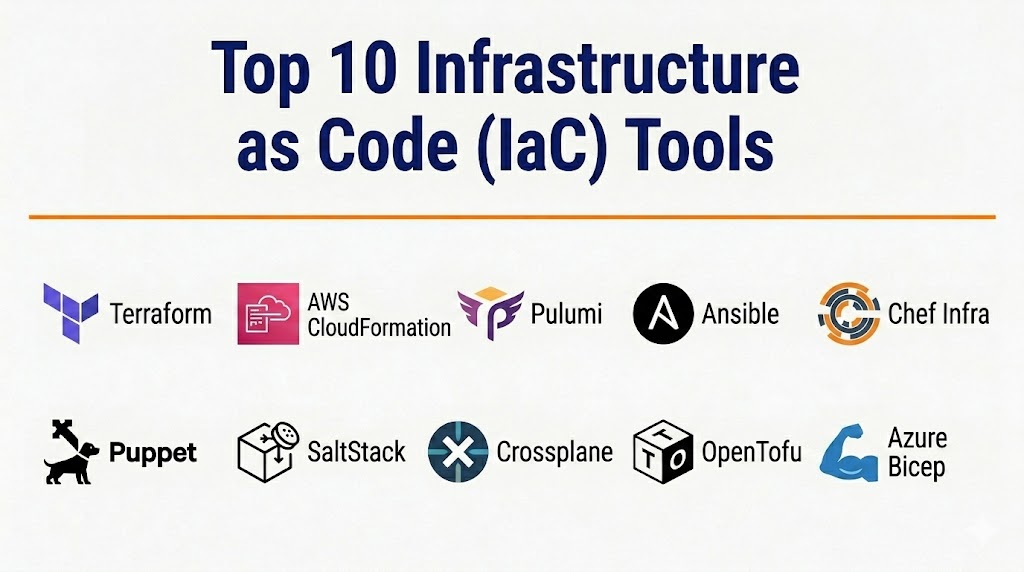
Top 10 Infrastructure as Code IaC Tools
1- Terraform
Short description: Terraform is one of the most widely adopted Infrastructure as Code platforms for provisioning and managing cloud infrastructure. It supports multi-cloud automation through a declarative configuration model and provider ecosystem. Terraform is widely used for infrastructure provisioning, Kubernetes deployment, networking automation, and cloud governance. It is suitable for startups, enterprises, and cloud-native engineering teams.
Key Features
- Multi-cloud infrastructure provisioning.
- Declarative infrastructure configuration language.
- Large provider ecosystem for cloud and SaaS integrations.
- State management for infrastructure tracking.
- Reusable modules and infrastructure templates.
- Policy and governance integrations.
- Strong automation and CI/CD compatibility.
Pros
- Massive ecosystem and community support.
- Strong multi-cloud flexibility.
- Highly reusable infrastructure modules.
- Widely supported across DevOps tooling.
Cons
- State management can become complex at scale.
- Learning curve for advanced workflows.
- Requires governance processes for large teams.
- Drift management needs careful planning.
Platforms / Deployment
Web. Linux. Windows. macOS. Cloud. Self-hosted.
Security & Compliance
Supports RBAC, audit workflows, policy integrations, and infrastructure governance capabilities depending on deployment model. Specific certifications vary by edition and deployment type.
Integrations & Ecosystem
Terraform has one of the largest IaC ecosystems available. Its provider architecture supports infrastructure automation across cloud, SaaS, Kubernetes, networking, and observability platforms.
- AWS
- Microsoft Azure
- Google Cloud
- Kubernetes
- GitHub Actions
- Jenkins
Support & Community
Terraform has a massive open-source ecosystem, extensive documentation, enterprise support offerings, training resources, and one of the strongest communities in the IaC market.
2- Pulumi
Short description: Pulumi is an Infrastructure as Code platform that allows teams to define infrastructure using programming languages instead of only declarative templates. It is especially popular with developer-centric organizations that want infrastructure automation integrated with software engineering workflows. Pulumi supports multi-cloud deployments, Kubernetes automation, and infrastructure testing. It is useful for teams preferring TypeScript, Python, Go, or C# workflows.
Key Features
- Infrastructure automation using modern programming languages.
- Multi-cloud provisioning support.
- Kubernetes infrastructure automation.
- Infrastructure testing and reusable components.
- State management and deployment tracking.
- CI/CD workflow integrations.
- Policy and governance support.
Pros
- Familiar developer experience using real programming languages.
- Strong Kubernetes and cloud-native support.
- Good flexibility for advanced infrastructure logic.
- Useful for engineering-heavy organizations.
Cons
- Smaller ecosystem compared to Terraform.
- Can introduce software engineering complexity into infrastructure.
- Requires developer-oriented skills.
- Enterprise governance may require extra planning.
Platforms / Deployment
Linux. Windows. macOS. Cloud. Self-hosted.
Security & Compliance
Supports RBAC, secrets management, audit capabilities, and policy controls depending on deployment model. Specific compliance certifications should be validated directly.
Integrations & Ecosystem
Pulumi integrates with cloud platforms, Kubernetes, CI/CD tools, and developer workflows. Its language-first model makes it attractive for engineering-focused teams.
- AWS
- Microsoft Azure
- Google Cloud
- Kubernetes
- GitHub
- GitLab CI/CD
Support & Community
Pulumi provides strong documentation, commercial support, developer tutorials, and an active community focused on cloud-native automation.
3- AWS CloudFormation
Short description: AWS CloudFormation is Amazon’s native Infrastructure as Code platform for provisioning and managing AWS infrastructure resources. It enables declarative infrastructure automation tightly integrated with AWS services and governance workflows. It is best suited for organizations heavily invested in AWS. The platform supports templates, stack management, and infrastructure lifecycle automation.
Key Features
- Native AWS infrastructure provisioning.
- Declarative JSON and YAML templates.
- Stack lifecycle management.
- Tight AWS ecosystem integration.
- Infrastructure rollback support.
- IAM and governance integration.
- Automation for AWS networking and services.
Pros
- Deep integration with AWS services.
- Strong fit for AWS-only environments.
- Native governance and IAM support.
- Reliable stack deployment workflows.
Cons
- Primarily limited to AWS ecosystems.
- Less flexible for multi-cloud environments.
- Template complexity can grow quickly.
- Slower innovation compared to open-source ecosystems.
Platforms / Deployment
Web. Cloud.
Security & Compliance
Integrates with AWS IAM, audit logging, encryption, and governance controls. Compliance depends on AWS service configuration.
Integrations & Ecosystem
CloudFormation is deeply integrated with AWS-native infrastructure and automation workflows. It is commonly used alongside AWS DevOps and governance services.
- AWS services
- AWS IAM
- AWS CodePipeline
- AWS Lambda
- Kubernetes on AWS
- AWS Config
Support & Community
AWS provides extensive documentation, enterprise support plans, tutorials, and community resources. The ecosystem is very strong within AWS-focused organizations.
4- Ansible
Short description: Ansible is an open-source automation platform used for configuration management, infrastructure provisioning, orchestration, and application deployment. It is agentless and uses simple YAML playbooks for automation workflows. Ansible is widely used across hybrid infrastructure, cloud automation, networking, and DevOps operations. It is suitable for teams that want flexible automation without complex agents.
Key Features
- Agentless infrastructure automation.
- YAML-based automation playbooks.
- Configuration management workflows.
- Multi-cloud and hybrid infrastructure support.
- Application deployment automation.
- Networking automation support.
- Orchestration across servers and services.
Pros
- Easy to learn compared to many IaC tools.
- Strong automation flexibility.
- Agentless architecture simplifies operations.
- Large open-source ecosystem.
Cons
- Less declarative than Terraform-style tools.
- State management is limited.
- Complex workflows can become difficult to maintain.
- Large-scale orchestration may require careful optimization.
Platforms / Deployment
Linux. Windows. macOS. Cloud. Self-hosted.
Security & Compliance
Supports RBAC, automation controls, secrets management, and audit workflows depending on deployment model and integrations.
Integrations & Ecosystem
Ansible integrates with cloud providers, networking systems, Linux environments, Windows automation, and DevOps workflows.
- AWS
- Microsoft Azure
- Google Cloud
- VMware
- Kubernetes
- Jenkins
Support & Community
Ansible has one of the largest automation communities, extensive documentation, commercial enterprise support, and a large ecosystem of reusable automation roles.
5- Chef
Short description: Chef is a configuration management and infrastructure automation platform designed for large-scale infrastructure consistency and policy enforcement. It is commonly used in enterprise IT environments requiring automation, compliance, and configuration standardization. Chef uses code-driven automation workflows to manage infrastructure state across cloud and on-premises systems. It is useful for mature DevOps and compliance-focused organizations.
Key Features
- Configuration management automation.
- Infrastructure policy enforcement.
- Compliance and audit automation.
- Infrastructure state management.
- Cloud and hybrid infrastructure support.
- Reusable automation cookbooks.
- Enterprise infrastructure consistency workflows.
Pros
- Strong enterprise automation capabilities.
- Good compliance and governance support.
- Useful for large infrastructure environments.
- Mature automation ecosystem.
Cons
- Steeper learning curve for beginners.
- Ruby-based workflows may not suit every team.
- Complex enterprise implementations require planning.
- Smaller modern community compared to Terraform or Ansible.
Platforms / Deployment
Linux. Windows. macOS. Cloud. Self-hosted.
Security & Compliance
Supports compliance automation, RBAC, policy management, audit workflows, and enterprise security integrations depending on deployment.
Integrations & Ecosystem
Chef integrates with cloud infrastructure, operating systems, compliance workflows, and DevOps automation pipelines.
- AWS
- Microsoft Azure
- Google Cloud
- Kubernetes
- Jenkins
- VMware
Support & Community
Chef provides enterprise support, compliance-focused documentation, automation learning resources, and long-standing enterprise adoption.
6- Puppet
Short description: Puppet is an Infrastructure as Code and configuration management platform focused on infrastructure consistency, automation, and compliance. It enables teams to manage large infrastructure environments through declarative automation workflows. Puppet is widely used in enterprises managing hybrid infrastructure and configuration governance. It is useful for organizations prioritizing operational consistency and policy enforcement.
Key Features
- Declarative configuration management.
- Infrastructure automation and orchestration.
- Policy-based infrastructure governance.
- Compliance and audit workflows.
- Hybrid infrastructure management.
- Automated drift detection.
- Reusable infrastructure modules.
Pros
- Strong infrastructure consistency management.
- Useful for enterprise compliance workflows.
- Mature automation ecosystem.
- Good for large-scale infrastructure management.
Cons
- Learning curve for new users.
- Requires operational expertise for scaling.
- Less cloud-native than newer IaC tools.
- Configuration complexity can increase over time.
Platforms / Deployment
Linux. Windows. macOS. Cloud. Self-hosted.
Security & Compliance
Supports RBAC, compliance reporting, audit workflows, and enterprise governance capabilities depending on deployment configuration.
Integrations & Ecosystem
Puppet integrates with cloud environments, operating systems, automation pipelines, and infrastructure governance workflows.
- AWS
- Microsoft Azure
- Google Cloud
- VMware
- Kubernetes
- Jenkins
Support & Community
Puppet offers enterprise support, training resources, documentation, and a mature automation community.
7- Crossplane
Short description: Crossplane is a Kubernetes-native Infrastructure as Code platform that enables infrastructure management through Kubernetes APIs. It allows teams to provision cloud infrastructure using Kubernetes-style workflows and GitOps automation. Crossplane is especially useful for platform engineering teams standardizing on Kubernetes-native operations. It is strong for cloud-native infrastructure platforms and internal developer portals.
Key Features
- Kubernetes-native infrastructure management.
- Multi-cloud infrastructure provisioning.
- GitOps-friendly workflows.
- Infrastructure APIs inside Kubernetes.
- Reusable infrastructure compositions.
- Self-service platform engineering workflows.
- Declarative cloud infrastructure automation.
Pros
- Strong Kubernetes-native architecture.
- Good fit for platform engineering teams.
- Useful for GitOps-driven infrastructure.
- Supports self-service infrastructure platforms.
Cons
- Requires Kubernetes expertise.
- Smaller ecosystem than Terraform.
- Platform engineering maturity is needed.
- Can be complex for smaller teams.
Platforms / Deployment
Kubernetes. Linux. Cloud. Self-hosted.
Security & Compliance
Supports Kubernetes RBAC, policy enforcement, and cloud-native governance capabilities depending on deployment.
Integrations & Ecosystem
Crossplane integrates closely with Kubernetes, cloud providers, GitOps workflows, and platform engineering environments.
- Kubernetes
- AWS
- Microsoft Azure
- Google Cloud
- Argo CD
- Flux
Support & Community
Crossplane has an active cloud-native community, growing enterprise adoption, and strong platform engineering interest.
8- SaltStack
Short description: SaltStack is an infrastructure automation and configuration management platform focused on event-driven automation and large-scale orchestration. It helps organizations automate servers, cloud infrastructure, applications, and operational workflows. SaltStack is useful for infrastructure teams needing high-speed automation and centralized management. It supports both configuration management and orchestration use cases.
Key Features
- Event-driven automation workflows.
- Infrastructure configuration management.
- Remote execution and orchestration.
- Large-scale infrastructure automation.
- Cloud and hybrid environment support.
- Automated remediation capabilities.
- Infrastructure monitoring integrations.
Pros
- Fast infrastructure orchestration capabilities.
- Useful for large-scale operations.
- Flexible automation workflows.
- Good event-driven automation support.
Cons
- Complexity can increase at scale.
- Smaller ecosystem than Terraform or Ansible.
- Requires operational expertise.
- Documentation quality may vary across workflows.
Platforms / Deployment
Linux. Windows. macOS. Cloud. Self-hosted.
Security & Compliance
Supports RBAC, automation governance, and operational security workflows depending on deployment configuration.
Integrations & Ecosystem
SaltStack integrates with cloud providers, operating systems, monitoring platforms, and automation environments.
- AWS
- Microsoft Azure
- Google Cloud
- VMware
- Kubernetes
- Jenkins
Support & Community
SaltStack provides documentation, enterprise support options, and a long-standing infrastructure automation community.
9- OpenTofu
Short description: OpenTofu is an open-source Infrastructure as Code platform created as a community-driven alternative compatible with Terraform workflows. It supports declarative infrastructure automation, provider ecosystems, and multi-cloud provisioning. OpenTofu is attractive for organizations wanting open governance and open-source infrastructure tooling. It is useful for teams seeking Terraform-compatible workflows without vendor lock-in concerns.
Key Features
- Terraform-compatible infrastructure automation.
- Multi-cloud provisioning support.
- Open-source governance model.
- Declarative infrastructure workflows.
- Reusable modules and providers.
- Infrastructure state management.
- CI/CD integration support.
Pros
- Open-source and community-driven.
- Familiar Terraform-style workflows.
- Strong flexibility for infrastructure automation.
- Useful for organizations prioritizing open ecosystems.
Cons
- Ecosystem is newer than Terraform.
- Enterprise support maturity is still evolving.
- Long-term ecosystem growth remains developing.
- Migration planning may be needed for some organizations.
Platforms / Deployment
Linux. Windows. macOS. Cloud. Self-hosted.
Security & Compliance
Supports infrastructure governance and policy workflows depending on deployment configuration and integrations.
Integrations & Ecosystem
OpenTofu supports Terraform-compatible providers and workflows, making it useful for teams already using declarative infrastructure automation.
- AWS
- Microsoft Azure
- Google Cloud
- Kubernetes
- GitHub Actions
- Jenkins
Support & Community
OpenTofu has a growing open-source community, increasing ecosystem support, and active interest among infrastructure automation practitioners.
10- Azure Bicep
Short description: Azure Bicep is Microsoft’s Infrastructure as Code language for deploying Azure resources using simplified declarative syntax. It is designed to improve Azure infrastructure automation compared to traditional ARM templates. Azure Bicep is useful for organizations heavily invested in Microsoft Azure environments. It provides strong native Azure integration and governance support.
Key Features
- Native Azure infrastructure automation.
- Simplified declarative syntax.
- Modular infrastructure templates.
- ARM integration and compatibility.
- Azure governance and policy support.
- Deployment automation workflows.
- Resource dependency management.
Pros
- Strong native Azure integration.
- Easier syntax compared to ARM templates.
- Good governance support inside Azure ecosystems.
- Useful for Azure-focused organizations.
Cons
- Primarily Azure-focused.
- Limited multi-cloud flexibility.
- Less suitable for heterogeneous environments.
- Smaller ecosystem than Terraform.
Platforms / Deployment
Windows. Linux. macOS. Cloud.
Security & Compliance
Integrates with Azure RBAC, Azure Policy, audit logging, and governance controls depending on deployment architecture.
Integrations & Ecosystem
Azure Bicep integrates deeply with Azure infrastructure services, governance workflows, and deployment automation environments.
- Microsoft Azure
- Azure DevOps
- GitHub Actions
- Kubernetes on Azure
- Azure Policy
- Azure Resource Manager
Support & Community
Microsoft provides strong documentation, tutorials, enterprise support, and an active Azure-focused developer ecosystem.
Comparison Table
| Tool Name | Best For | Platforms Supported | Deployment | Standout Feature | Public Rating |
|---|---|---|---|---|---|
| Terraform | Multi-cloud infrastructure automation | Linux, Windows, macOS | Cloud, Self-hosted | Massive provider ecosystem | N/A |
| Pulumi | Developer-centric infrastructure automation | Linux, Windows, macOS | Cloud, Self-hosted | Infrastructure using programming languages | N/A |
| AWS CloudFormation | AWS-native infrastructure automation | Web | Cloud | Deep AWS integration | N/A |
| Ansible | Agentless automation and orchestration | Linux, Windows, macOS | Cloud, Self-hosted | Agentless automation workflows | N/A |
| Chef | Enterprise configuration management | Linux, Windows, macOS | Cloud, Self-hosted | Compliance-focused automation | N/A |
| Puppet | Infrastructure consistency and governance | Linux, Windows, macOS | Cloud, Self-hosted | Declarative infrastructure governance | N/A |
| Crossplane | Kubernetes-native infrastructure platforms | Kubernetes, Linux | Cloud, Self-hosted | Kubernetes-native infrastructure APIs | N/A |
| SaltStack | Event-driven infrastructure automation | Linux, Windows, macOS | Cloud, Self-hosted | High-speed orchestration workflows | N/A |
| OpenTofu | Open-source Terraform-compatible IaC | Linux, Windows, macOS | Cloud, Self-hosted | Community-driven Terraform alternative | N/A |
| Azure Bicep | Azure infrastructure automation | Linux, Windows, macOS | Cloud | Simplified Azure-native IaC | N/A |
Evaluation and Scoring of Infrastructure as Code IaC Tools
| Tool Name | Core 25% | Ease 15% | Integrations 15% | Security 10% | Performance 10% | Support 10% | Value 15% | Weighted Total |
|---|---|---|---|---|---|---|---|---|
| Terraform | 10 | 8 | 10 | 8 | 9 | 10 | 9 | 9.25 |
| Pulumi | 8 | 8 | 8 | 8 | 8 | 8 | 8 | 8.00 |
| AWS CloudFormation | 8 | 7 | 8 | 9 | 8 | 9 | 8 | 8.05 |
| Ansible | 9 | 9 | 9 | 7 | 8 | 9 | 9 | 8.70 |
| Chef | 8 | 6 | 8 | 8 | 8 | 8 | 7 | 7.55 |
| Puppet | 8 | 6 | 8 | 8 | 8 | 8 | 7 | 7.55 |
| Crossplane | 8 | 6 | 8 | 8 | 8 | 7 | 8 | 7.65 |
| SaltStack | 7 | 7 | 7 | 7 | 8 | 7 | 8 | 7.30 |
| OpenTofu | 8 | 8 | 8 | 7 | 8 | 7 | 9 | 8.00 |
| Azure Bicep | 8 | 8 | 7 | 8 | 8 | 8 | 8 | 7.90 |
These scores are comparative and based on infrastructure automation capability, ecosystem strength, integrations, scalability, governance, and operational practicality. Terraform scores highest because of its broad ecosystem and multi-cloud maturity, while Ansible performs strongly for operational automation flexibility. Kubernetes-native teams may prefer Crossplane, while Azure-focused organizations may benefit most from Azure Bicep. Buyers should shortlist tools based on cloud strategy, automation maturity, governance needs, and team expertise.
Which Infrastructure as Code IaC Tool Is Right for You
Solo / Freelancer
Solo engineers and freelancers usually benefit from simpler automation workflows and lower operational overhead. Terraform and Ansible are strong choices because they have large ecosystems and reusable templates. OpenTofu can also be attractive for open-source-focused users. If the environment is AWS-only or Azure-only, native tools like CloudFormation or Azure Bicep may be sufficient.
SMB
SMBs should prioritize ease of use, fast deployment, reusable templates, and community support. Terraform and Ansible are often the strongest choices for growing businesses because they balance flexibility with ecosystem maturity. Pulumi is useful for developer-heavy organizations. SMBs running Kubernetes platforms should also evaluate Crossplane.
Mid-Market
Mid-market organizations usually need stronger governance, reusable infrastructure modules, CI/CD integration, and cloud scalability. Terraform, Pulumi, Ansible, and Crossplane are strong choices depending on cloud strategy and engineering maturity. Teams with strong compliance requirements may also evaluate Chef or Puppet.
Enterprise
Enterprises should focus on governance, policy enforcement, auditability, scalability, RBAC, compliance workflows, and multi-team collaboration. Terraform, Ansible, Chef, Puppet, and Crossplane are strong enterprise candidates depending on infrastructure architecture. Organizations deeply invested in AWS or Azure may also benefit from CloudFormation or Azure Bicep for native governance integration.
Budget vs Premium
Open-source tools like Terraform, OpenTofu, Ansible, and Crossplane provide strong value for teams wanting infrastructure automation without heavy licensing costs. Premium enterprise platforms often provide governance workflows, support, policy enforcement, and compliance features that large organizations require. Buyers should compare operational complexity along with subscription pricing.
Feature Depth vs Ease of Use
Terraform provides strong infrastructure depth but may require governance planning at scale. Ansible is easier for operational automation workflows. Pulumi is attractive for developers preferring programming languages over declarative templates. Crossplane is powerful for Kubernetes-native environments but requires higher platform engineering maturity.
Integrations and Scalability
Terraform, Ansible, and Pulumi provide some of the strongest integration ecosystems across cloud providers, Kubernetes, CI/CD pipelines, and observability tools. Crossplane is highly scalable for Kubernetes-native platform engineering. CloudFormation and Azure Bicep scale well inside their native cloud ecosystems but are less flexible across heterogeneous environments.
Security and Compliance Needs
Enterprises should validate RBAC, audit logging, secrets management, policy enforcement, compliance integrations, and infrastructure governance controls before choosing a platform. IaC tools can directly impact production infrastructure, so change management and access control are critical. Teams should also integrate security scanning into CI/CD pipelines to detect misconfigurations before deployment.
Frequently Asked Questions FAQs
1. What is Infrastructure as Code IaC?
Infrastructure as Code IaC is the practice of managing infrastructure using code instead of manual configuration. Teams define servers, networks, cloud resources, and infrastructure settings through templates or scripts. This improves consistency, automation, scalability, and deployment reliability. IaC is widely used in DevOps and cloud-native environments.
2. Why are IaC tools important?
IaC tools reduce manual errors, improve deployment speed, and make infrastructure repeatable across environments. They help teams automate provisioning, enforce governance, and scale infrastructure consistently. Without IaC, infrastructure management becomes difficult as environments grow. These tools also improve disaster recovery and operational reliability.
3. What is the difference between Terraform and Ansible?
Terraform focuses mainly on infrastructure provisioning using declarative configurations. Ansible is more focused on configuration management and orchestration using agentless automation workflows. Many organizations actually use both tools together. Terraform provisions infrastructure, while Ansible configures operating systems and applications.
4. Are IaC tools only for cloud environments?
No, IaC tools can manage cloud, on-premises, hybrid infrastructure, networking devices, Kubernetes clusters, and virtual machines. Many enterprises use IaC across mixed environments. Some tools are cloud-native, while others support hybrid infrastructure automation. The right choice depends on architecture and operational goals.
5. Which IaC tool is easiest for beginners?
Ansible is often considered easier for beginners because of its simple YAML syntax and agentless architecture. Terraform is also beginner-friendly for cloud provisioning because of its large ecosystem and documentation. Pulumi may appeal more to developers already comfortable with programming languages. The easiest tool depends on the team’s background.
6. Are Infrastructure as Code tools secure?
IaC tools can improve security when used correctly because they support repeatable, auditable infrastructure deployments. However, insecure templates or weak access controls can create risk. Teams should integrate secrets management, RBAC, audit logging, and security scanning into their workflows. Governance and review processes are very important.
7. What is infrastructure drift?
Infrastructure drift happens when deployed infrastructure changes outside the IaC workflow, causing differences between the code and the real environment. Drift can create inconsistencies, security risks, and deployment failures. Many IaC tools include drift detection or reconciliation workflows. Good governance practices help reduce drift.
8. Can IaC tools work with Kubernetes?
Yes, many IaC tools support Kubernetes infrastructure automation. Terraform, Pulumi, Crossplane, Ansible, and Azure Bicep all provide Kubernetes-related capabilities in different ways. Crossplane is especially focused on Kubernetes-native infrastructure management. Kubernetes support is now a major evaluation factor for many organizations.
9. What are the biggest challenges with IaC adoption?
Common challenges include learning curve, state management complexity, governance planning, module reuse, security enforcement, and operational standardization. Large organizations may also struggle with collaboration and infrastructure ownership models. Strong documentation, training, and version control practices help reduce adoption problems.
10. Should organizations use open-source or enterprise IaC tools?
Open-source IaC tools are often enough for startups and engineering-focused teams with strong internal expertise. Enterprise editions may provide governance, compliance, policy enforcement, audit capabilities, and vendor support needed by large organizations. The best choice depends on infrastructure complexity, compliance needs, and operational maturity.
Conclusion
Infrastructure as Code IaC tools are now essential for organizations managing cloud-native, hybrid, and scalable infrastructure environments. The best tool depends on cloud strategy, operational maturity, governance requirements, engineering expertise, and automation goals. Terraform remains the strongest all-around option for multi-cloud automation, while Ansible excels in operational orchestration and Pulumi appeals to developer-centric teams. Organizations heavily invested in AWS or Azure may benefit from CloudFormation or Azure Bicep, while Kubernetes-native environments may prefer Crossplane. The most successful IaC strategies combine automation, governance, security, version control, and reusable infrastructure standards. Teams should shortlist two or three tools, test them with real deployment workflows, validate governance and CI/CD integration, and choose the platform that best aligns with long-term infrastructure operations.

This article clearly explains infrastructure as code tools and how they help organizations automate infrastructure deployment, improve consistency, and simplify system management.
This article gives a very clear comparison of Infrastructure as Code tools with practical insights and easy explanations. The structured format made the topic simple and useful to understand.
One often-overlooked aspect of IaC adoption is infrastructure testing and drift remediation at scale. The real challenge is not provisioning resources, but ensuring infrastructure changes remain compliant, reproducible, and free from manual modifications over time.