Introduction
Vector search tooling platforms help organizations store, index, retrieve, and analyze high-dimensional vector embeddings used in AI, semantic search, recommendation engines, retrieval-augmented generation, and machine learning systems. Instead of relying only on keyword-based matching, vector search platforms identify semantic similarity between embeddings generated from text, images, audio, video, and other unstructured data sources.
As enterprises rapidly adopt generative AI, retrieval-augmented generation workflows, AI assistants, semantic recommendation systems, and multimodal search applications, vector search tooling has become foundational infrastructure for modern AI architectures. These platforms improve semantic retrieval accuracy, reduce hallucinations in AI systems, and enable faster contextual search across massive datasets.
Common use cases include:
- Retrieval-augmented generation systems
- Semantic enterprise search
- AI assistants and copilots
- Recommendation engines
- Similarity search applications
- Multimodal AI retrieval workflows
Key evaluation criteria include:
- Vector indexing performance
- Query latency and scalability
- Hybrid search capabilities
- Metadata filtering support
- Embedding model compatibility
- Cloud and hybrid deployment support
- API and SDK ecosystem
- Security and governance controls
- Real-time ingestion support
- Cost efficiency at scale
Best for: AI engineering teams, ML platforms, enterprise search initiatives, recommendation systems, RAG architectures, analytics teams, and businesses building semantic AI applications.
Not ideal for: Small organizations without AI or semantic search workloads, traditional keyword-only search systems, or businesses that do not manage embedding-based data retrieval.
Key Trends in Vector Search Tooling Platforms
- Hybrid search combining keyword and vector retrieval is becoming a standard requirement.
- Retrieval-augmented generation architectures are driving rapid vector database adoption.
- Multimodal search support for image, audio, and video embeddings is expanding.
- AI observability and retrieval quality monitoring are becoming important features.
- Real-time streaming ingestion is increasingly required for AI applications.
- GPU acceleration is improving high-scale vector indexing performance.
- Open-source vector search ecosystems are growing rapidly.
- Metadata-aware filtering is becoming critical for enterprise governance.
- Integration with LLM orchestration frameworks is expanding quickly.
- Distributed vector indexing is becoming essential for enterprise-scale AI deployments.
How We Selected These Tools
The platforms in this list were selected using a balanced evaluation framework focused on AI retrieval performance and enterprise usability.
- Market adoption and developer popularity
- Retrieval accuracy and indexing performance
- Scalability for large vector workloads
- Hybrid search and metadata filtering support
- Cloud-native and hybrid deployment flexibility
- API ecosystem and SDK quality
- AI and LLM framework integrations
- Security and governance capabilities
- Community and enterprise support maturity
- Cost efficiency and operational simplicity
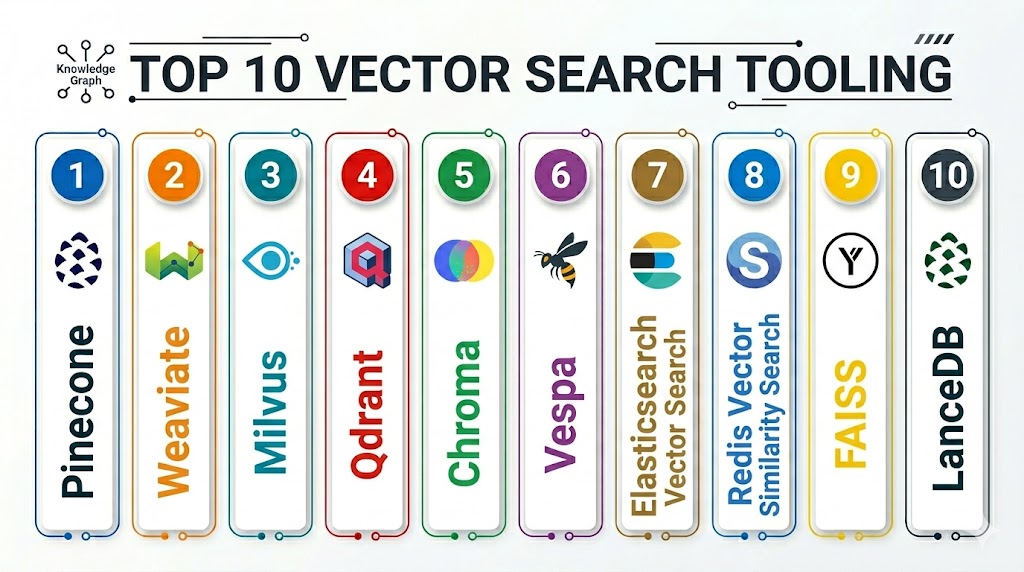
Top 10 Vector Search Tooling Platforms
1- Pinecone
Short description: Pinecone is one of the most widely used managed vector database platforms designed for semantic search, retrieval-augmented generation, and AI retrieval applications. It provides scalable vector indexing, real-time search, filtering, and serverless infrastructure for AI workloads. Pinecone is especially popular among teams building production-grade generative AI applications and enterprise semantic search systems.
Key Features
- Managed vector database
- Real-time vector indexing
- Hybrid search support
- Metadata filtering
- Serverless architecture
- Distributed vector retrieval
- AI application scalability
Pros
- Easy cloud deployment
- Strong scalability for AI workloads
- Good developer experience
- Fast semantic retrieval performance
Cons
- Managed-only approach may limit control
- Usage costs can increase at scale
- Requires embedding management externally
- Limited offline deployment flexibility
Platforms / Deployment
Web
Cloud
Security & Compliance
RBAC, encryption support, API authentication, governance controls.
Formal compliance details vary by deployment tier.
Integrations & Ecosystem
Pinecone integrates with LLM frameworks, AI orchestration systems, embedding providers, and analytics platforms.
- LangChain integration
- LlamaIndex support
- OpenAI compatibility
- Hugging Face integration
- Python SDK
- Metadata filtering APIs
Support & Community
Strong developer adoption with extensive AI documentation and active community support.
2- Weaviate
Short description: Weaviate is an open-source vector database and semantic search platform designed for AI-native applications and knowledge retrieval systems. It supports vector search, hybrid search, multimodal embeddings, and graph-style semantic relationships. Weaviate is widely used for AI assistants, enterprise semantic search, and retrieval-augmented generation systems.
Key Features
- Open-source vector database
- Hybrid vector and keyword search
- Multimodal embedding support
- Semantic graph relationships
- Real-time vector indexing
- Metadata-aware retrieval
- AI-native APIs
Pros
- Strong open-source ecosystem
- Flexible deployment options
- Good hybrid retrieval capabilities
- Useful multimodal support
Cons
- Requires operational expertise for self-hosting
- Large-scale tuning may be complex
- Enterprise support requires premium plans
- Advanced optimization needs expertise
Platforms / Deployment
Web / Linux / macOS / Windows
Cloud / Self-hosted / Hybrid
Security & Compliance
RBAC, authentication controls, encryption support.
Formal compliance details are not publicly stated.
Integrations & Ecosystem
Weaviate integrates with AI frameworks, vector pipelines, embedding providers, and semantic workflows.
- OpenAI integration
- Cohere support
- Hugging Face compatibility
- LangChain integration
- LlamaIndex support
- REST and GraphQL APIs
Support & Community
Strong open-source AI community with active ecosystem growth and enterprise support options.
3- Milvus
Short description: Milvus is an open-source vector database designed for high-scale similarity search and AI retrieval workloads. It supports distributed indexing, GPU acceleration, and large-scale embedding search across billions of vectors. Milvus is commonly used in recommendation systems, AI search platforms, computer vision, and enterprise AI environments.
Key Features
- Distributed vector indexing
- GPU acceleration support
- Real-time vector ingestion
- Similarity search optimization
- Hybrid deployment support
- Scalable cluster architecture
- Multiple indexing algorithms
Pros
- Excellent scalability
- Strong performance for large workloads
- Flexible deployment models
- Good GPU optimization support
Cons
- Operational complexity for beginners
- Requires infrastructure expertise
- Advanced tuning can be difficult
- Self-hosted management overhead
Platforms / Deployment
Linux / macOS / Windows
Cloud / Self-hosted / Hybrid
Security & Compliance
Authentication support, encryption controls, RBAC capabilities.
Integrations & Ecosystem
Milvus integrates with AI frameworks, analytics systems, cloud infrastructure, and machine learning environments.
- PyTorch integration
- TensorFlow compatibility
- LangChain support
- Kubernetes deployment
- Python SDK
- GPU infrastructure support
Support & Community
Large open-source vector database community with strong AI infrastructure adoption.
4- Qdrant
Short description: Qdrant is an open-source vector database and semantic search platform focused on high-performance similarity search and metadata filtering. It provides efficient indexing, scalable retrieval, and developer-friendly APIs for modern AI retrieval systems. Qdrant is increasingly popular for retrieval-augmented generation and semantic AI applications.
Key Features
- High-performance vector indexing
- Metadata-aware filtering
- Real-time vector search
- Distributed deployment support
- REST and gRPC APIs
- Hybrid search capabilities
- Snapshot and backup management
Pros
- Strong filtering performance
- Developer-friendly architecture
- Flexible deployment options
- Good retrieval performance
Cons
- Requires infrastructure management for self-hosting
- Smaller ecosystem than older databases
- Advanced scaling requires tuning
- Enterprise support may require premium plans
Platforms / Deployment
Linux / macOS / Windows
Cloud / Self-hosted / Hybrid
Security & Compliance
RBAC support, authentication controls, encryption capabilities.
Integrations & Ecosystem
Qdrant integrates with modern AI frameworks, orchestration tools, and cloud infrastructure systems.
- LangChain integration
- LlamaIndex support
- OpenAI compatibility
- FastAPI integration
- Python SDK
- Kubernetes deployment
Support & Community
Growing open-source community with active developer ecosystem and enterprise offerings.
5- Chroma
Short description: Chroma is an open-source embedding database designed for AI-native applications, retrieval systems, and lightweight semantic search workflows. It focuses on simplicity, developer experience, and easy integration with LLM applications. Chroma is commonly used in prototyping and lightweight production AI retrieval systems.
Key Features
- Lightweight vector storage
- Embedding management
- Semantic retrieval APIs
- Developer-friendly SDKs
- AI application support
- Local and cloud workflows
- Metadata filtering
Pros
- Simple developer experience
- Good for rapid prototyping
- Easy LLM integration
- Lightweight deployment model
Cons
- Enterprise scalability may vary
- Limited advanced governance features
- Smaller ecosystem than larger databases
- Not ideal for massive workloads
Platforms / Deployment
Linux / macOS / Windows
Cloud / Self-hosted
Security & Compliance
Authentication capabilities vary by deployment configuration.
Integrations & Ecosystem
Chroma integrates with AI orchestration tools, Python ecosystems, and embedding providers.
- LangChain support
- OpenAI integration
- Python SDK
- LlamaIndex compatibility
- Hugging Face integration
- Local AI workflows
Support & Community
Strong adoption among AI developers and experimental generative AI projects.
6- Elasticsearch Vector Search
Short description: Elasticsearch provides vector search capabilities alongside traditional keyword search and analytics features. It enables organizations to combine semantic retrieval with structured search and observability workflows. Elasticsearch is especially useful for enterprises already using Elastic for search and analytics infrastructure.
Key Features
- Vector similarity search
- Hybrid keyword and semantic retrieval
- Distributed indexing
- Analytics integration
- Real-time ingestion
- Observability tooling
- Scalable enterprise architecture
Pros
- Strong hybrid search support
- Mature enterprise ecosystem
- Good scalability
- Broad operational tooling
Cons
- Vector-first workflows require tuning
- Operational complexity at scale
- Resource-intensive deployments
- Advanced vector optimization needed
Platforms / Deployment
Linux / Windows / macOS
Cloud / Self-hosted / Hybrid
Security & Compliance
RBAC, encryption support, SSO integration, audit logging capabilities.
Integrations & Ecosystem
Elasticsearch integrates with analytics, observability, AI frameworks, and enterprise infrastructure systems.
- Kibana integration
- LangChain support
- API ecosystem
- Cloud platform support
- Real-time analytics integration
- Log and observability workflows
Support & Community
Large enterprise search ecosystem with extensive documentation and operational maturity.
7- Vespa
Short description: Vespa is an open-source serving engine designed for large-scale vector search, recommendation systems, and real-time AI retrieval applications. It supports vector retrieval, machine learning inference, and low-latency serving for enterprise AI workloads.
Key Features
- Real-time vector retrieval
- Recommendation engine support
- Distributed search architecture
- Machine learning inference
- Low-latency serving
- Streaming ingestion
- Hybrid ranking support
Pros
- Excellent large-scale performance
- Strong recommendation system support
- Good low-latency architecture
- Scalable AI retrieval capabilities
Cons
- Requires advanced operational expertise
- Complex deployment architecture
- Steeper learning curve
- Smaller ecosystem than mainstream databases
Platforms / Deployment
Linux
Cloud / Self-hosted / Hybrid
Security & Compliance
Authentication support, encryption controls, access management features.
Integrations & Ecosystem
Vespa integrates with machine learning systems, AI retrieval pipelines, and distributed serving architectures.
- TensorFlow integration
- PyTorch compatibility
- API support
- Kubernetes deployment
- Recommendation workflows
- Streaming data support
Support & Community
Strong technical community with enterprise-scale AI serving focus.
8- Redis Vector Similarity Search
Short description: Redis Vector Similarity Search extends Redis with vector indexing and semantic retrieval capabilities for real-time AI applications. It combines low-latency data access with vector similarity operations, making it useful for AI assistants, recommendation systems, and real-time semantic retrieval.
Key Features
- Real-time vector search
- In-memory retrieval performance
- Metadata filtering
- Hybrid query support
- Streaming ingestion
- Scalable caching integration
- Low-latency AI retrieval
Pros
- Very fast retrieval performance
- Strong real-time capabilities
- Broad Redis ecosystem support
- Flexible deployment options
Cons
- Large-scale memory usage can increase costs
- Advanced vector optimization may require tuning
- Not specialized solely for vector workflows
- Enterprise scaling requires planning
Platforms / Deployment
Linux / macOS / Windows
Cloud / Self-hosted / Hybrid
Security & Compliance
RBAC, encryption support, authentication controls.
Integrations & Ecosystem
Redis integrates with application stacks, AI pipelines, APIs, and real-time infrastructure systems.
- LangChain support
- OpenAI compatibility
- Python SDK
- Kubernetes integration
- Streaming workflows
- API support
Support & Community
Large Redis developer ecosystem with strong enterprise support availability.
9- pgvector
Short description: pgvector is an open-source PostgreSQL extension that adds vector similarity search capabilities directly into PostgreSQL databases. It enables organizations to combine structured relational data with semantic vector retrieval in a single database environment.
Key Features
- PostgreSQL vector extension
- Similarity search support
- SQL-based vector querying
- Relational and vector data support
- Lightweight deployment
- Open-source architecture
- Metadata filtering support
Pros
- Easy PostgreSQL integration
- Familiar SQL workflows
- Good for existing PostgreSQL environments
- Lower operational complexity
Cons
- Limited ultra-large-scale optimization
- Advanced retrieval performance may vary
- Less specialized than dedicated vector databases
- Scaling requires PostgreSQL expertise
Platforms / Deployment
Linux / macOS / Windows
Cloud / Self-hosted / Hybrid
Security & Compliance
Inherits PostgreSQL security controls including RBAC, authentication, and encryption support.
Integrations & Ecosystem
pgvector integrates naturally with PostgreSQL ecosystems, analytics systems, and AI workflows.
- PostgreSQL integration
- LangChain support
- Python SDK support
- OpenAI integration
- SQL-based workflows
- ORM compatibility
Support & Community
Rapidly growing open-source adoption with strong developer interest.
10- LanceDB
Short description: LanceDB is an open-source vector database focused on AI-native retrieval workflows, multimodal search, and analytics-oriented vector storage. It is designed for modern AI pipelines requiring efficient vector management and local-first deployment flexibility.
Key Features
- AI-native vector storage
- Multimodal retrieval support
- Local and cloud workflows
- Analytics-oriented architecture
- Metadata filtering
- Fast vector indexing
- Developer-focused APIs
Pros
- Good developer experience
- Strong local AI workflow support
- Efficient vector analytics
- Open-source flexibility
Cons
- Smaller ecosystem than mature competitors
- Enterprise governance features still evolving
- Large-scale deployments require testing
- Operational tooling is still maturing
Platforms / Deployment
Linux / macOS / Windows
Cloud / Self-hosted
Security & Compliance
Authentication and governance capabilities vary by deployment configuration.
Integrations & Ecosystem
LanceDB integrates with AI pipelines, embedding frameworks, analytics workflows, and local AI environments.
- Python SDK
- LangChain support
- LlamaIndex compatibility
- Hugging Face integration
- Local AI workflows
- Analytics integrations
Support & Community
Growing AI developer community with increasing adoption in retrieval-focused applications.
Comparison Table
| Tool Name | Best For | Platform(s) Supported | Deployment | Standout Feature | Public Rating |
|---|---|---|---|---|---|
| Pinecone | Managed enterprise vector search | Web | Cloud | Serverless vector infrastructure | N/A |
| Weaviate | Open-source semantic retrieval | Linux, Windows, macOS | Hybrid | Multimodal semantic search | N/A |
| Milvus | Large-scale vector workloads | Linux, Windows, macOS | Hybrid | Distributed GPU indexing | N/A |
| Qdrant | Metadata-aware vector retrieval | Linux, Windows, macOS | Hybrid | Fast filtering performance | N/A |
| Chroma | Lightweight AI retrieval apps | Linux, Windows, macOS | Cloud, Self-hosted | Simple developer experience | N/A |
| Elasticsearch Vector Search | Hybrid semantic and keyword search | Linux, Windows, macOS | Hybrid | Combined search and analytics | N/A |
| Vespa | Real-time AI serving | Linux | Hybrid | Recommendation system support | N/A |
| Redis Vector Similarity Search | Real-time semantic retrieval | Linux, Windows, macOS | Hybrid | Low-latency vector search | N/A |
| pgvector | PostgreSQL vector workflows | Linux, Windows, macOS | Hybrid | SQL-native vector search | N/A |
| LanceDB | AI-native local retrieval | Linux, Windows, macOS | Cloud, Self-hosted | Local-first vector workflows | N/A |
Evaluation & Scoring of Vector Search Tooling Platforms
| Tool Name | Core 25% | Ease 15% | Integrations 15% | Security 10% | Performance 10% | Support 10% | Value 15% | Weighted Total |
|---|---|---|---|---|---|---|---|---|
| Pinecone | 9.5 | 8.8 | 9.2 | 8.8 | 9.3 | 8.8 | 7.8 | 8.9 |
| Weaviate | 9.0 | 8.2 | 9.0 | 8.5 | 8.8 | 8.5 | 8.7 | 8.7 |
| Milvus | 9.3 | 7.5 | 8.8 | 8.2 | 9.5 | 8.5 | 8.8 | 8.8 |
| Qdrant | 8.8 | 8.5 | 8.7 | 8.3 | 8.8 | 8.3 | 8.8 | 8.6 |
| Chroma | 8.0 | 9.0 | 8.2 | 7.5 | 7.8 | 8.0 | 9.0 | 8.3 |
| Elasticsearch Vector Search | 8.8 | 7.5 | 9.2 | 9.0 | 8.8 | 9.0 | 8.0 | 8.6 |
| Vespa | 9.0 | 7.0 | 8.5 | 8.2 | 9.5 | 8.2 | 8.0 | 8.5 |
| Redis Vector Similarity Search | 8.7 | 8.5 | 8.8 | 8.8 | 9.2 | 8.7 | 8.2 | 8.7 |
| pgvector | 8.2 | 8.8 | 8.5 | 8.5 | 8.0 | 8.2 | 9.2 | 8.5 |
| LanceDB | 8.0 | 8.7 | 8.0 | 7.5 | 8.0 | 7.8 | 8.8 | 8.1 |
These scores are comparative and should be evaluated based on your AI architecture, operational model, and retrieval requirements. Enterprise managed services generally provide easier scalability and operational simplicity, while open-source platforms provide greater flexibility and deployment control. Some tools prioritize retrieval speed, while others focus on developer simplicity, metadata filtering, or hybrid search. Organizations should validate performance using real embeddings, real retrieval pipelines, and production-like workloads before choosing a long-term platform.
Which Vector Search Tooling Platform Is Right for You?
Solo / Freelancer
Solo AI developers and experimental projects often benefit from Chroma, pgvector, or LanceDB because they provide lightweight deployment and simpler operational management. These tools are useful for rapid prototyping and local retrieval workflows. Cost efficiency and developer simplicity are usually more important than enterprise governance at this stage. Local-first AI workflows can also reduce infrastructure complexity.
SMB
SMBs should prioritize ease of deployment, retrieval quality, and manageable operational overhead. Pinecone, Qdrant, Weaviate, and Redis Vector Similarity Search are strong options depending on whether the organization prefers managed infrastructure or open-source flexibility. SMBs should focus on integration simplicity and scalable pricing models. Hybrid search support can also improve practical retrieval quality.
Mid-Market
Mid-market organizations typically need stronger scalability, governance, and metadata filtering capabilities. Pinecone, Weaviate, Milvus, Elasticsearch Vector Search, and Qdrant are strong candidates depending on operational expertise and infrastructure preferences. Teams building production AI copilots or recommendation systems should prioritize indexing performance and orchestration integrations. Scalability testing becomes increasingly important at this stage.
Enterprise
Enterprises should prioritize governance, scalability, hybrid deployment flexibility, metadata filtering, security, and operational reliability. Pinecone, Milvus, Elasticsearch Vector Search, Weaviate, and Vespa are strong options for large-scale AI retrieval systems. Enterprises should also evaluate monitoring, observability, and operational tooling carefully. Long-term infrastructure cost planning is critical for enterprise vector workloads.
Budget vs Premium
Open-source vector platforms such as Weaviate, Milvus, Qdrant, Chroma, and pgvector provide strong flexibility and lower entry costs. Managed enterprise services reduce operational complexity but may increase long-term infrastructure expenses. Buyers should compare operational staffing requirements alongside licensing or usage pricing. Lower infrastructure overhead can sometimes justify higher managed-service costs.
Feature Depth vs Ease of Use
Managed vector databases usually provide easier onboarding and operational simplicity, while open-source platforms offer deeper infrastructure control and customization. Teams should decide whether they prioritize rapid deployment or architectural flexibility. Developer productivity is important, but so is long-term scalability and retrieval quality. Pilot testing helps reveal operational trade-offs early.
Integrations & Scalability
Vector search platforms should integrate with embedding providers, orchestration frameworks, graph workflows, APIs, and cloud infrastructure systems. Scalability testing should include retrieval latency, ingestion speed, filtering complexity, and concurrent query workloads. AI applications often grow faster than expected, making scalability planning important from the beginning. Distributed indexing support may become essential at enterprise scale.
Security & Compliance Needs
Organizations handling sensitive enterprise data should prioritize RBAC, encryption, authentication, audit logging, and metadata governance. AI retrieval systems may expose sensitive content through semantic search workflows if governance is weak. Security reviews should include embedding pipelines, API exposure, and access management. Compliance requirements should be validated before production rollout.
Frequently Asked Questions
1. What is a vector search tooling platform?
A vector search tooling platform stores and retrieves high-dimensional embeddings generated from AI models. Instead of matching exact keywords, these platforms search for semantic similarity between vectors. They are commonly used in AI assistants, recommendation engines, retrieval-augmented generation systems, and semantic search applications. Vector search improves contextual retrieval across unstructured datasets.
2. Why is vector search important for AI applications?
Vector search helps AI systems retrieve semantically relevant information rather than relying only on exact keyword matching. This improves the quality of AI responses, recommendations, and contextual understanding. In retrieval-augmented generation systems, vector search reduces hallucinations by providing grounded context. It is becoming foundational for modern enterprise AI architectures.
3. What is the difference between vector search and keyword search?
Keyword search looks for exact or partial text matches, while vector search identifies semantic similarity between embeddings. Keyword search is useful for structured queries, but vector search is better for contextual meaning and natural language understanding. Many modern systems combine both approaches using hybrid retrieval. Hybrid search often produces better enterprise retrieval quality.
4. What are embeddings in vector databases?
Embeddings are numerical vector representations generated by machine learning models from text, images, audio, or other data types. These vectors capture semantic meaning and relationships between concepts. Vector search platforms index and compare these embeddings to find similar content. Embeddings are central to semantic retrieval workflows.
5. Are vector databases only for generative AI?
No. Vector search is also widely used in recommendation systems, fraud detection, image similarity search, semantic analytics, cybersecurity, and multimodal retrieval applications. Generative AI has accelerated adoption, but vector search has broader applications beyond LLMs. Many enterprises use vector retrieval in traditional machine learning systems as well.
6. What are hybrid search capabilities?
Hybrid search combines vector similarity retrieval with traditional keyword or structured search. This approach improves search precision because semantic meaning and exact matching work together. Hybrid retrieval is increasingly important for enterprise AI systems handling structured and unstructured content together. Many leading vector platforms now support hybrid search natively.
7. How do organizations choose the right vector search platform?
Organizations should evaluate scalability, retrieval quality, operational complexity, metadata filtering, deployment flexibility, integrations, and security controls. Some platforms prioritize developer simplicity, while others focus on large-scale distributed indexing. Pilot testing with real embeddings and production-like workloads is essential. Infrastructure cost planning should also be part of evaluation.
8. Are open-source vector databases production-ready?
Yes. Open-source platforms such as Weaviate, Milvus, Qdrant, pgvector, and Chroma are widely used in production AI systems. However, organizations may need operational expertise for scaling, monitoring, backups, and governance. Managed services simplify operations but may increase long-term costs. The right choice depends on internal infrastructure capabilities.
9. What security features should enterprises evaluate?
Enterprises should evaluate RBAC, authentication, encryption, audit logging, metadata filtering, API governance, and network isolation capabilities. AI retrieval systems can expose sensitive information if governance is weak. Security teams should review how embeddings are stored, accessed, and filtered. Compliance requirements should also be validated before deployment.
10. Can vector search platforms scale to billions of embeddings?
Yes, many enterprise-grade vector databases support distributed indexing and large-scale retrieval architectures capable of handling billions of embeddings. Platforms such as Milvus, Pinecone, Vespa, and Weaviate are designed for high-scale AI retrieval workloads. Scalability depends on infrastructure design, indexing strategy, and workload optimization. Real-world testing is important before large-scale rollout.
Conclusion
Vector search tooling platforms are becoming foundational infrastructure for modern AI systems, semantic search, recommendation engines, and retrieval-augmented generation architectures. The best platform depends on operational preferences, scalability requirements, governance needs, and AI workload complexity. Pinecone provides strong managed infrastructure for production AI systems, while Weaviate, Milvus, and Qdrant offer flexible open-source alternatives with strong retrieval performance. Elasticsearch Vector Search and Redis Vector Similarity Search are excellent for organizations already invested in those ecosystems, while pgvector and Chroma provide lightweight options for simpler deployments and developer-focused workflows. Vespa is especially powerful for large-scale recommendation and serving systems, while LanceDB is gaining attention for AI-native local retrieval workflows. Organizations should shortlist a few platforms, validate retrieval quality with real embeddings, benchmark latency and scalability, and confirm governance and infrastructure requirements before selecting a long-term vector search architecture.

This article provides a very clear and well-structured overview of vector search tooling platforms with practical comparisons and useful insights. The simple explanations made a complex topic much easier to understand and compare.
This article clearly explains vector search tooling platforms and how they help improve semantic search accuracy and faster retrieval of large-scale data.
What often determines the success of a vector search platform is not retrieval speed alone but how effectively embeddings are managed throughout their lifecycle. As data changes, embeddings can become stale, leading to degraded search quality even when infrastructure performance remains strong. Teams operating these systems at scale need clear strategies for re-embedding, version control, and quality validation to ensure search relevance remains consistent as models and datasets evolve.