Introduction
API Security Platforms are specialized tools designed to discover, monitor, test, and protect APIs across their entire lifecycle. They secure REST, GraphQL, and internal APIs by detecting vulnerabilities, stopping abuse, and providing real-time protection against attacks like authentication bypass, injection, data exposure, and business logic abuse.
In 2026 and beyond, API security has become critical because APIs now power microservices, mobile apps, SaaS platforms, AI systems, and cloud-native architectures. As API traffic continues to dominate modern applications, attackers increasingly target APIs instead of traditional web apps.
Common use cases include API discovery, shadow API detection, runtime threat protection, API penetration testing, authentication abuse detection, schema validation, and continuous security monitoring across distributed environments.
Buyers should evaluate API discovery accuracy, runtime protection strength, CI/CD integration, behavioral analytics, false positive rate, scalability, compliance support, API inventory management, and developer experience.
Best for: DevSecOps teams, API-first SaaS companies, enterprise security teams, cloud-native platforms, fintech organizations, and organizations with large API ecosystems.
Not ideal for: static websites, non-API-driven applications, or very small systems with minimal external integrations.
Key Trends in API Security Platforms
- Continuous API discovery is replacing periodic scanning due to rapid API sprawl
- Runtime API protection (RASP-like behavior) is becoming standard in enterprise platforms
- AI-driven behavioral anomaly detection is improving detection of business logic attacks
- Shift-left API security in CI/CD pipelines is now a default DevSecOps practice
- GraphQL and gRPC security support is expanding beyond traditional REST APIs
- Unified API + WAAP platforms are merging API security with web application protection
- Shadow and zombie API detection is becoming a core requirement for visibility
- API posture management (APIM + security convergence) is increasing adoption
- Zero-trust API security models are being implemented for internal microservices
- Automated remediation and policy enforcement is reducing manual security overhead
How We Selected These Tools
- Focused on platforms providing end-to-end API security lifecycle coverage
- Included tools for discovery, testing, and runtime protection
- Prioritized behavioral analytics and anomaly detection capabilities
- Considered integration with CI/CD pipelines and DevSecOps workflows
- Evaluated support for REST, GraphQL, and modern API protocols
- Included both enterprise and developer-focused platforms
- Reviewed scalability for microservices and distributed APIs
- Considered alert quality and false positive management
- Ensured inclusion of platforms with strong industry adoption
- Used Not publicly stated where compliance or rating data is not confirmed
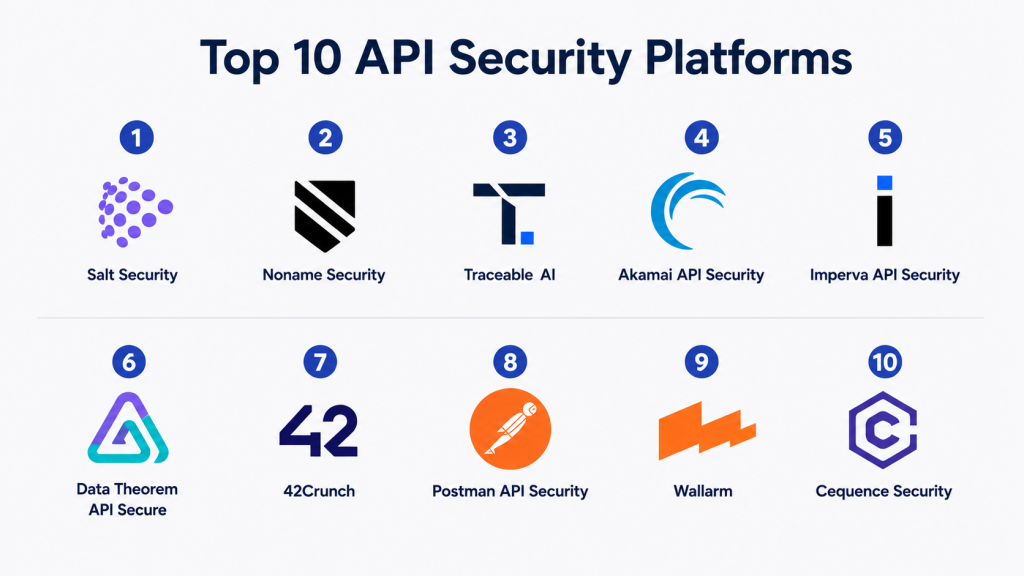
Top 10 API Security Platforms
1- Salt Security
Short description: Salt Security is a leading API security platform focused on behavioral analysis and runtime protection. It uses AI-driven analytics to discover APIs, detect anomalies, and prevent API abuse in real time. It is widely used in enterprise environments for protecting large-scale API ecosystems.
Key Features
- Continuous API discovery and inventory
- Behavioral AI-based anomaly detection
- Runtime API attack prevention
- Shadow and zombie API detection
- API traffic analysis and monitoring
- Threat intelligence integration
- API risk scoring and prioritization
Pros
- Strong behavioral detection model
- Excellent API visibility
- Effective against business logic attacks
- Enterprise-grade scalability
Cons
- Enterprise-focused pricing
- Requires time for behavioral learning
- Less suitable for small teams
- Complex deployment in large environments
Platforms / Deployment
Cloud-native SaaS platform, hybrid API environments
Security & Compliance
Supports enterprise security controls including encryption, RBAC, and audit logs. Compliance certifications are Not publicly stated.
Integrations & Ecosystem
- API gateways
- SIEM systems
- Cloud environments
- DevSecOps pipelines
- Security orchestration tools
Support & Community
Strong enterprise support with onboarding and technical assistance.
2- Akamai API Security
Short description: Akamai API Security provides deep visibility, discovery, and protection for APIs across cloud and hybrid environments. It integrates with Akamai’s edge platform for large-scale traffic protection and API monitoring.
Key Features
- API discovery and inventory
- Real-time threat detection
- Edge-based API protection
- Bot and abuse prevention
- Traffic anomaly detection
- API schema validation
- DDoS and API security integration
Pros
- Massive global scalability
- Strong edge protection
- Good integration with WAAP
- High-performance architecture
Cons
- Complex enterprise setup
- Best value within Akamai ecosystem
- Requires tuning for precision
- Higher operational cost
Platforms / Deployment
Cloud, edge-based deployment, hybrid environments
Security & Compliance
Enterprise-grade security features available. Compliance details are Not publicly stated.
Integrations & Ecosystem
- Akamai WAAP
- CDN services
- SIEM platforms
- API gateways
- Security analytics tools
Support & Community
Enterprise-level global support with managed services options.
3- Traceable AI
Short description: Traceable AI focuses on API observability and runtime security, helping organizations detect threats and understand API behavior across distributed systems.
Key Features
- API discovery and mapping
- Runtime threat detection
- Behavioral analytics engine
- API lineage tracking
- Attack path visualization
- Anomaly detection for APIs
- Continuous API monitoring
Pros
- Strong API observability
- Good behavioral analytics
- Useful for microservices
- Detailed attack visualization
Cons
- Requires learning curve
- Enterprise pricing model
- Setup complexity in large systems
- Limited offline usage
Platforms / Deployment
Cloud-native environments, Kubernetes, hybrid deployments
Security & Compliance
Security controls include RBAC and encryption. Compliance certifications are Not publicly stated.
Integrations & Ecosystem
- Kubernetes
- API gateways
- SIEM tools
- Cloud platforms
- DevSecOps pipelines
Support & Community
Enterprise support with onboarding assistance.
4- Noname Security
Short description: Noname Security provides full lifecycle API protection including discovery, posture management, testing, and runtime security.
Key Features
- API inventory and discovery
- Security posture management
- Runtime threat detection
- API vulnerability testing
- Schema validation
- Shadow API detection
- Risk scoring engine
Pros
- End-to-end API security coverage
- Strong enterprise adoption
- Good posture management
- Comprehensive visibility
Cons
- Complex configuration
- Enterprise-only focus
- Requires onboarding effort
- Higher operational overhead
Platforms / Deployment
Cloud, hybrid, enterprise environments
Security & Compliance
Enterprise-grade controls available. Compliance details are Not publicly stated.
Integrations & Ecosystem
- API gateways
- SIEM systems
- Cloud providers
- Security platforms
- DevOps tools
Support & Community
Strong enterprise support and consulting services.
5- Imperva API Security
Short description: Imperva API Security protects APIs through traffic monitoring, threat detection, and integration with its WAAP platform for web and API protection.
Key Features
- API discovery and classification
- Runtime attack detection
- API traffic monitoring
- Injection and abuse protection
- Schema validation
- Security analytics dashboard
- Integration with WAAP
Pros
- Strong enterprise protection
- Good WAAP integration
- Mature security platform
- Reliable threat detection
Cons
- Complex deployment model
- Best within Imperva ecosystem
- Requires tuning for accuracy
- Enterprise pricing
Platforms / Deployment
Cloud, hybrid enterprise environments
Security & Compliance
Enterprise compliance support available depending on configuration. Not publicly stated for certifications.
Integrations & Ecosystem
- WAAP platform
- SIEM tools
- API gateways
- Cloud environments
- Security operations systems
Support & Community
Enterprise-grade support with global coverage.
6- Wallarm
Short description: Wallarm provides API security with strong runtime protection, API discovery, and anomaly detection for cloud-native applications.
Key Features
- API discovery and monitoring
- Runtime attack prevention
- Anomaly detection engine
- API traffic filtering
- Kubernetes integration
- CI/CD security scanning
- Threat intelligence feeds
Pros
- Strong cloud-native support
- Good runtime protection
- Easy Kubernetes integration
- Developer-friendly workflows
Cons
- Enterprise features require tuning
- Limited offline capabilities
- Smaller ecosystem than top vendors
- Requires setup effort
Platforms / Deployment
Cloud, Kubernetes, hybrid environments
Security & Compliance
Security features include encryption and access control. Compliance is Not publicly stated.
Integrations & Ecosystem
- Kubernetes
- API gateways
- CI/CD pipelines
- SIEM tools
- Cloud platforms
Support & Community
Good enterprise and developer support.
7- Akto
Short description: Akto is a developer-focused API security platform that specializes in API discovery, testing, and continuous security monitoring.
Key Features
- Continuous API discovery
- API security testing
- CI/CD integration
- Shadow API detection
- API inventory management
- Schema validation
- Automated vulnerability detection
Pros
- Strong developer experience
- Easy CI/CD integration
- Good for modern SaaS teams
- Lightweight setup
Cons
- Limited enterprise depth
- Smaller feature set than large platforms
- Requires configuration tuning
- Evolving enterprise capabilities
Platforms / Deployment
Cloud-native platform, CI/CD environments
Security & Compliance
Security features depend on deployment setup. Not publicly stated for certifications.
Integrations & Ecosystem
- GitHub
- GitLab
- CI/CD tools
- API gateways
- Developer workflows
Support & Community
Strong developer adoption and documentation.
8- StackHawk
Short description: StackHawk focuses on API security testing integrated into CI/CD pipelines, helping developers detect vulnerabilities early in the development lifecycle.
Key Features
- API vulnerability scanning
- CI/CD pipeline integration
- OpenAPI-based testing
- Automated security testing
- Developer-focused reports
- Continuous security validation
- Shift-left security workflows
Pros
- Strong shift-left security approach
- Easy developer adoption
- CI/CD native integration
- Fast scanning cycles
Cons
- Focused on testing, not full runtime protection
- Limited behavioral analytics
- Requires pipeline setup
- Not a full API security suite
Platforms / Deployment
Cloud, CI/CD pipelines, developer environments
Security & Compliance
Security features depend on pipeline integration. Compliance details are Not publicly stated.
Integrations & Ecosystem
- GitHub Actions
- GitLab CI
- Jenkins
- API frameworks
- DevSecOps tools
Support & Community
Strong developer-focused support and documentation.
9- Pynt
Short description: Pynt is a developer-centric API security testing platform focused on automated API attack simulation and continuous testing.
Key Features
- Automated API penetration testing
- CI/CD integration
- API attack simulation
- Schema-based testing
- Vulnerability detection
- Continuous testing workflows
- Developer remediation guidance
Pros
- Strong automated testing approach
- Easy CI/CD integration
- Developer-friendly interface
- Good for modern APIs
Cons
- Limited runtime protection
- Smaller enterprise footprint
- Focused more on testing than monitoring
- Requires CI/CD maturity
Platforms / Deployment
Cloud, CI/CD pipelines, API environments
Security & Compliance
Security controls depend on deployment model. Not publicly stated for compliance certifications.
Integrations & Ecosystem
- CI/CD pipelines
- Git platforms
- API gateways
- Developer tools
- Testing frameworks
Support & Community
Developer-focused support and growing ecosystem.
10- F5 Distributed Cloud API Security
Short description: F5 provides API security as part of its distributed cloud platform, focusing on API discovery, protection, and enforcement across hybrid environments.
Key Features
- API discovery and mapping
- Runtime API protection
- Traffic inspection and filtering
- Bot mitigation
- Schema enforcement
- API gateway integration
- Threat intelligence
Pros
- Strong enterprise scalability
- Good hybrid cloud support
- Mature security platform
- High-performance architecture
Cons
- Complex enterprise deployment
- Requires F5 ecosystem alignment
- Higher cost structure
- Steeper learning curve
Platforms / Deployment
Cloud, hybrid enterprise environments, distributed systems
Security & Compliance
Enterprise security controls available. Compliance certifications are Not publicly stated.
Integrations & Ecosystem
- API gateways
- Cloud platforms
- SIEM systems
- WAAP solutions
- Security operations tools
Support & Community
Strong enterprise support and global services.
Comparison Table
| Tool Name | Best For | Platforms Supported | Deployment | Standout Feature | Public Rating |
|---|---|---|---|---|---|
| Salt Security | Behavioral API protection | Cloud, hybrid | SaaS | AI behavioral detection | N/A |
| Akamai API Security | Large-scale enterprises | Cloud, edge | Cloud/Edge | Global edge protection | N/A |
| Traceable AI | API observability | Cloud, Kubernetes | Cloud | API lineage tracking | N/A |
| Noname Security | Full lifecycle API security | Cloud, hybrid | Cloud/Hybrid | End-to-end API protection | N/A |
| Imperva API Security | Enterprise WAAP users | Cloud, hybrid | Cloud/Hybrid | WAAP integration | N/A |
| Wallarm | Cloud-native security | Kubernetes, cloud | Cloud | Runtime protection engine | N/A |
| Akto | Developer-first teams | CI/CD, APIs | Cloud | Continuous API discovery | N/A |
| StackHawk | API testing in CI/CD | CI/CD pipelines | Cloud | Shift-left API testing | N/A |
| Pynt | Automated API testing | CI/CD, APIs | Cloud | API attack simulation | N/A |
| F5 API Security | Hybrid enterprise systems | Cloud, hybrid | Cloud/Hybrid | Distributed API protection | N/A |
Evaluation & Scoring of API Security Platforms
| Tool Name | Core 25% | Ease 15% | Integrations 15% | Security 10% | Performance 10% | Support 10% | Value 15% | Weighted Total |
|---|---|---|---|---|---|---|---|---|
| Salt Security | 9.3 | 8.5 | 9.0 | 9.2 | 8.8 | 9.0 | 8.5 | 8.9 |
| Akamai API Security | 9.0 | 8.0 | 9.2 | 9.2 | 9.3 | 9.0 | 8.2 | 8.8 |
| Traceable AI | 8.8 | 8.3 | 8.8 | 8.8 | 8.7 | 8.5 | 8.4 | 8.6 |
| Noname Security | 9.0 | 7.8 | 9.0 | 9.0 | 8.8 | 8.8 | 8.0 | 8.6 |
| Imperva API Security | 8.8 | 7.8 | 8.8 | 9.0 | 8.7 | 8.8 | 8.0 | 8.5 |
| Wallarm | 8.5 | 8.5 | 8.6 | 8.6 | 8.7 | 8.5 | 8.5 | 8.5 |
| Akto | 8.2 | 8.8 | 8.5 | 8.0 | 8.3 | 8.2 | 8.7 | 8.4 |
| StackHawk | 8.0 | 9.0 | 8.5 | 8.0 | 8.5 | 8.3 | 8.8 | 8.4 |
| Pynt | 8.1 | 8.8 | 8.4 | 8.0 | 8.4 | 8.2 | 8.6 | 8.3 |
| F5 API Security | 8.8 | 7.8 | 8.8 | 9.0 | 9.0 | 8.8 | 8.0 | 8.6 |
Which API Security Platform Is Right for You?
Solo / Freelancer
StackHawk, Akto, or Pynt are practical for learning and lightweight API testing workflows.
SMB
Wallarm, Akto, and StackHawk provide balanced protection without heavy enterprise complexity.
Mid-Market
Traceable AI, Noname Security, and Wallarm offer strong visibility and runtime protection.
Enterprise
Salt Security, Akamai, Imperva, and F5 provide scalable enterprise-grade API protection.
Budget vs Premium
Open and developer-first tools are cheaper but limited in runtime depth. Enterprise platforms provide behavioral analytics and governance.
Feature Depth vs Ease of Use
StackHawk and Akto are easier. Salt Security and Noname offer deeper protection but require more setup.
Integrations & Scalability
Enterprise environments should prioritize API gateway integration, CI/CD support, SIEM connectivity, and Kubernetes compatibility.
Security & Compliance Needs
Compliance-heavy industries should prioritize audit logs, policy enforcement, and continuous monitoring capabilities.
Frequently Asked Questions
1. What is an API security platform?
An API security platform is a tool that protects APIs from attacks by discovering, monitoring, testing, and securing them across their lifecycle. It detects vulnerabilities and prevents abuse in real time. It helps secure REST, GraphQL, and internal APIs. It is essential for modern cloud-native applications.
2. Why is API security important?
APIs are now the main way applications communicate, making them a primary attack target. Attackers exploit APIs for data theft, authentication bypass, and business logic abuse. API security platforms help detect and prevent these threats. They protect sensitive data and services.
3. What types of attacks do API security platforms detect?
They detect authentication bypass, injection attacks, data exposure, shadow APIs, and business logic abuse. They also identify anomalous traffic patterns. Some tools detect zero-day API vulnerabilities. They help prevent misuse of API endpoints.
4. How do API security platforms work?
They analyze API traffic, discover endpoints, build API inventories, and monitor runtime behavior. They use rules and AI-based detection to identify threats. Some tools also simulate attacks. They integrate into CI/CD pipelines and production environments.
5. What is API discovery?
API discovery is the process of automatically identifying all APIs in an environment, including undocumented or shadow APIs. It helps create a full inventory of API endpoints. This improves security visibility. It is a core feature in API security platforms.
6. What is runtime API protection?
Runtime protection monitors API behavior in real time and blocks malicious requests. It detects abnormal patterns during live traffic. It helps stop attacks as they happen. It is similar to RASP but for APIs.
7. Are API security platforms necessary for small businesses?
Small businesses with minimal API usage may not need full platforms. However, SaaS and cloud-based companies benefit from basic API security tools. Lightweight tools can provide sufficient protection. The need depends on API complexity.
8. Do API security tools slow down applications?
Most modern API security platforms are optimized for low latency. They use asynchronous processing and edge-based architectures. Some minimal overhead may exist depending on configuration. Proper tuning ensures performance impact is low.
9. Can API security platforms replace WAFs?
No, API security platforms complement WAFs rather than replace them. WAFs protect web traffic at the perimeter. API security platforms provide deep API-specific visibility. Together they provide layered security.
10. How should companies start API security implementation?
Companies should start by discovering all APIs, then enabling monitoring and runtime protection. Next, integrate API security into CI/CD pipelines. Finally, implement governance and compliance controls. A phased approach reduces risk and improves adoption.
Conclusion
API security platforms are essential for protecting modern applications built on APIs, microservices, and cloud-native architectures. They provide deep visibility, continuous monitoring, and real-time protection against evolving threats. The right platform depends on your scale and maturity—developer-focused tools like StackHawk and Akto are ideal for shift-left testing, while enterprise platforms like Salt Security, Akamai, and Imperva provide advanced behavioral detection and runtime protection. Mid-market tools like Wallarm and Traceable AI balance visibility and ease of use. The best strategy is to combine API discovery, runtime protection, and CI/CD security testing into a unified API security program to ensure end-to-end protection.
