Introduction
Enterprise Data Fabric platforms help organizations unify, manage, govern, and deliver data across cloud, on-premise, hybrid, and multi-cloud environments through a connected architectural layer. Instead of moving all data into one centralized system, a data fabric creates intelligent connectivity between distributed systems while improving accessibility, governance, metadata management, lineage, integration, and analytics delivery.
Modern enterprises operate with fragmented data spread across SaaS applications, cloud warehouses, data lakes, APIs, streaming systems, operational databases, and legacy enterprise software. Enterprise Data Fabric platforms simplify this complexity by enabling real-time data access, automation, governance, observability, and trusted analytics across the organization.
Common use cases include:
- Unified enterprise data governance
- Hybrid and multi-cloud analytics
- Data cataloging and lineage management
- AI and machine learning data preparation
- Self-service analytics enablement
- Enterprise-wide metadata management
Key evaluation criteria include:
- Data integration and connectivity
- Metadata and catalog capabilities
- Governance and policy management
- Data lineage and observability
- Hybrid and multi-cloud support
- AI-assisted automation
- Security and access controls
- Scalability and query performance
- Ease of deployment and administration
- Ecosystem integrations
Best for: Large enterprises, data governance teams, analytics organizations, regulated industries, hybrid cloud environments, and businesses managing distributed data architectures.
Not ideal for: Small businesses with limited analytics complexity, organizations using only a single centralized database, or teams needing only lightweight ETL functionality.
Key Trends in Enterprise Data Fabric Platforms
- AI-assisted metadata classification and governance automation are becoming major differentiators.
- Active metadata management is improving automation and data observability workflows.
- Data fabric and data mesh architectures are increasingly being combined together.
- Real-time and event-driven data access is replacing purely batch-driven integration approaches.
- Multi-cloud interoperability is becoming mandatory for enterprise deployments.
- Data quality and observability features are increasingly embedded into data fabric platforms.
- Lakehouse integration support is rapidly expanding across vendors.
- Governance-first architectures are becoming more important due to compliance requirements.
- API-first and low-code management experiences are improving enterprise adoption.
- AI readiness and trusted analytics are becoming primary business drivers for data fabric investments.
How We Selected These Tools
The platforms in this list were selected using a balanced enterprise data management evaluation methodology.
- Market adoption and enterprise reputation
- Breadth of integration capabilities
- Metadata and governance depth
- Data lineage and observability features
- Hybrid and cloud-native deployment flexibility
- Security and compliance capabilities
- AI and automation functionality
- Scalability for enterprise workloads
- Ecosystem maturity and integrations
- Vendor support quality and implementation maturity
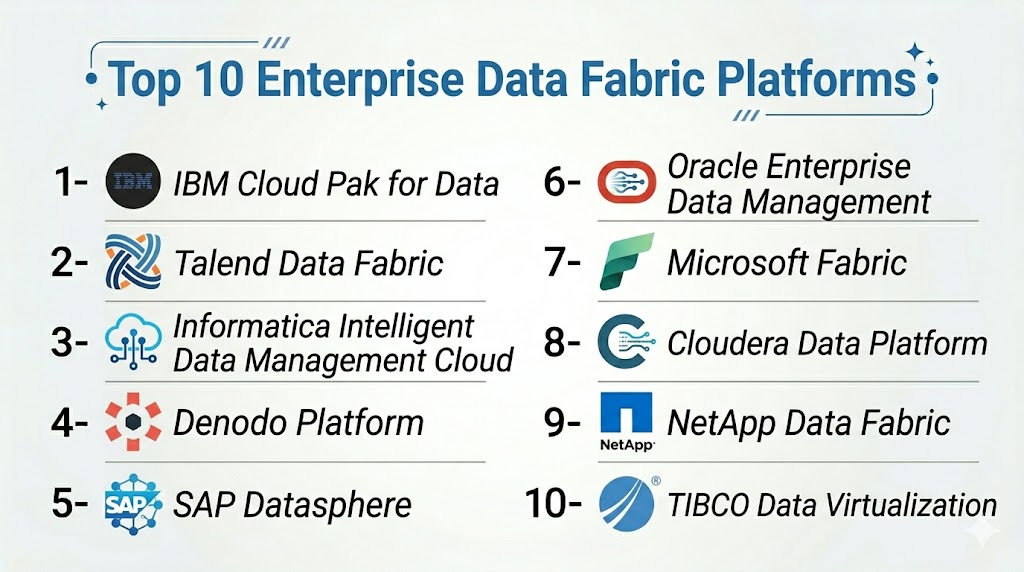
Top 10 Enterprise Data Fabric Platforms
1- Informatica Intelligent Data Management Cloud
Short description: Informatica Intelligent Data Management Cloud is one of the most comprehensive enterprise data fabric platforms available for integration, governance, quality, metadata, and master data management. It enables enterprises to manage complex distributed data environments across cloud and hybrid infrastructures. The platform is widely adopted by organizations requiring strong governance, automation, and large-scale enterprise integration.
Key Features
- Cloud-native data integration
- Enterprise data catalog
- AI-assisted metadata management
- Data governance and privacy controls
- Data quality monitoring
- Master data management
- Multi-cloud integration support
Pros
- Broad enterprise feature coverage
- Strong governance and compliance support
- Mature ecosystem integrations
- Scalable hybrid-cloud capabilities
Cons
- Enterprise pricing can be expensive
- Complex implementation for beginners
- Advanced features require training
- Administration overhead for large deployments
Platforms / Deployment
Web
Cloud / Hybrid
Security & Compliance
RBAC, SSO/SAML, encryption support, audit logging, governance controls.
Integrations & Ecosystem
Informatica supports a broad ecosystem across cloud warehouses, SaaS platforms, APIs, databases, and analytics systems.
- Snowflake integration
- Databricks support
- AWS integration
- Azure integration
- Salesforce connectivity
- Google Cloud support
Support & Community
Strong enterprise support ecosystem with certifications, consulting services, and large implementation partner networks.
2- IBM Cloud Pak for Data
Short description: IBM Cloud Pak for Data combines data fabric architecture, governance, analytics, AI, and virtualization into a unified enterprise platform. It is designed for organizations operating complex hybrid-cloud environments requiring governed data access and AI-ready data pipelines. The platform is commonly used in regulated enterprise environments.
Key Features
- Enterprise data fabric architecture
- Data virtualization capabilities
- AI-assisted governance
- Unified metadata management
- Data catalog support
- Hybrid cloud deployment
- Integrated analytics and AI workflows
Pros
- Excellent hybrid cloud support
- Strong governance capabilities
- Broad AI and analytics integration
- Enterprise-grade scalability
Cons
- Complex deployment process
- Premium enterprise pricing
- Requires skilled administrators
- Large platform footprint
Platforms / Deployment
Web / Linux
Cloud / Hybrid
Security & Compliance
RBAC, encryption support, audit logging, SSO integration, governance controls.
Integrations & Ecosystem
IBM Cloud Pak integrates with enterprise databases, AI platforms, cloud environments, and analytics systems.
- Db2 integration
- Red Hat OpenShift support
- Watson AI integration
- Hadoop connectivity
- Cloud storage support
- Data virtualization services
Support & Community
Enterprise-focused support backed by IBM consulting and professional services.
3- Denodo Platform
Short description: Denodo Platform is a leading logical data fabric and data virtualization solution designed for real-time enterprise data access and federation. It helps organizations unify distributed data without excessive replication while improving analytics agility and governance. Denodo is widely used for hybrid and multi-cloud analytics strategies.
Key Features
- Logical data layer creation
- Data virtualization engine
- Real-time federation
- Query optimization
- Metadata management
- API data services
- Enterprise governance controls
Pros
- Excellent virtualization capabilities
- Reduces data duplication
- Strong enterprise scalability
- Good hybrid-cloud support
Cons
- Advanced optimization requires expertise
- Enterprise licensing costs
- Complex architecture planning
- Requires careful governance design
Platforms / Deployment
Web / Windows / Linux
Cloud / Self-hosted / Hybrid
Security & Compliance
RBAC, SSO/SAML support, encryption, audit logging, governance controls.
Integrations & Ecosystem
Denodo connects enterprise databases, warehouses, BI platforms, APIs, and cloud services into a unified virtual layer.
- Snowflake integration
- Tableau connectivity
- Power BI support
- AWS integration
- Azure support
- Google Cloud support
Support & Community
Strong enterprise services ecosystem with training, documentation, and implementation support.
4- Talend Data Fabric
Short description: Talend Data Fabric combines data integration, governance, quality, APIs, and metadata management within a unified enterprise data platform. It helps organizations modernize analytics operations and improve trust in distributed data environments. Talend is especially useful for enterprises seeking scalable integration with built-in quality controls.
Key Features
- Data integration pipelines
- Data quality management
- Governance and metadata tools
- API integration support
- Hybrid-cloud connectivity
- Reusable transformation components
- Cloud-native deployment options
Pros
- Strong integration ecosystem
- Good data quality capabilities
- Flexible deployment support
- Useful for analytics modernization
Cons
- Advanced deployments can be complex
- Enterprise licensing may be expensive
- Requires experienced implementation teams
- UI complexity for some workflows
Platforms / Deployment
Web / Windows / Linux
Cloud / Self-hosted / Hybrid
Security & Compliance
RBAC, SSO integration, encryption support, audit logging capabilities.
Integrations & Ecosystem
Talend integrates with cloud warehouses, SaaS systems, APIs, and modern analytics stacks.
- Snowflake support
- AWS integration
- Azure integration
- Salesforce connectivity
- REST API support
- Google Cloud integration
Support & Community
Strong vendor documentation, enterprise onboarding services, and broad enterprise adoption.
5- Microsoft Fabric
Short description: Microsoft Fabric is a unified analytics and enterprise data platform that combines data engineering, integration, analytics, governance, warehousing, and BI workflows into one environment. It supports enterprise data fabric strategies by connecting cloud analytics operations into a centralized Microsoft ecosystem.
Key Features
- Unified analytics environment
- Data lake and warehouse support
- Integrated governance features
- Power BI connectivity
- Data engineering workflows
- Real-time analytics
- AI and notebook integration
Pros
- Strong Microsoft ecosystem integration
- Unified analytics experience
- Good self-service capabilities
- Scalable cloud-native architecture
Cons
- Best for Microsoft-centric organizations
- Usage-based pricing requires monitoring
- Some features still evolving
- Complex enterprise rollout planning
Platforms / Deployment
Web
Cloud
Security & Compliance
RBAC, Microsoft Entra ID integration, encryption support, audit logging.
Integrations & Ecosystem
Microsoft Fabric integrates deeply with Microsoft analytics, productivity, and cloud services.
- Power BI integration
- Azure Data Lake support
- Synapse connectivity
- Microsoft 365 ecosystem
- Data science notebooks
- Data pipeline support
Support & Community
Strong Microsoft support ecosystem with broad enterprise community resources.
6- SAP Datasphere
Short description: SAP Datasphere is an enterprise data fabric and semantic data management platform designed primarily for SAP-centric organizations. It enables unified analytics and governed data access while preserving business context across enterprise systems and cloud environments.
Key Features
- Business data fabric architecture
- SAP ecosystem integration
- Semantic data modeling
- Data federation support
- Governance controls
- Cloud analytics support
- Metadata management
Pros
- Excellent SAP integration
- Strong business context modeling
- Good governance support
- Enterprise analytics capabilities
Cons
- Less flexible outside SAP ecosystems
- Enterprise implementation complexity
- Premium pricing structure
- Requires SAP expertise for optimization
Platforms / Deployment
Web
Cloud / Hybrid
Security & Compliance
RBAC, SSO integration, encryption support, governance controls.
Integrations & Ecosystem
SAP Datasphere integrates deeply with SAP enterprise applications and analytics environments.
- SAP S/4HANA integration
- SAP Analytics Cloud support
- Data warehouse connectivity
- API integration support
- Cloud platform integration
- Business semantic layer support
Support & Community
Strong SAP consulting, documentation, and enterprise support services.
7- Oracle Cloud Infrastructure Data Integration
Short description: Oracle Cloud Infrastructure Data Integration helps enterprises build governed data pipelines and integration workflows across Oracle and hybrid enterprise environments. It supports enterprise data modernization and centralized analytics management within Oracle cloud ecosystems.
Key Features
- Cloud-native data integration
- ETL and ELT workflows
- Metadata-driven pipeline management
- Scheduling and monitoring
- Oracle ecosystem integration
- Hybrid deployment support
- Data pipeline automation
Pros
- Strong Oracle integration
- Good enterprise scalability
- Managed cloud infrastructure
- Useful hybrid modernization capabilities
Cons
- Best for Oracle-centric organizations
- Less neutral than independent platforms
- Requires Oracle expertise
- Multi-cloud flexibility may vary
Platforms / Deployment
Web
Cloud / Hybrid
Security & Compliance
RBAC, encryption support, IAM integration, audit logging capabilities.
Integrations & Ecosystem
Oracle Data Integration supports Oracle databases, cloud services, and enterprise analytics systems.
- Oracle Database integration
- Autonomous Database support
- SaaS application connectivity
- Object storage integration
- API support
- Data warehouse connectivity
Support & Community
Enterprise support ecosystem through Oracle cloud services and partner programs.
8- Cloudera Data Platform
Short description: Cloudera Data Platform provides enterprise-scale data management, analytics, governance, and machine learning support across hybrid and multi-cloud environments. It is designed for large-scale data lake operations and regulated enterprise workloads.
Key Features
- Hybrid data platform
- Enterprise governance controls
- Data engineering workflows
- Data lake management
- Metadata and lineage support
- Machine learning integration
- Multi-cloud analytics support
Pros
- Strong hybrid deployment flexibility
- Enterprise-scale analytics support
- Good governance capabilities
- Suitable for regulated industries
Cons
- Complex administration requirements
- Requires experienced technical teams
- Heavy platform footprint
- Enterprise rollout can be time-consuming
Platforms / Deployment
Web / Linux
Cloud / Self-hosted / Hybrid
Security & Compliance
RBAC, encryption support, audit logging, governance controls.
Integrations & Ecosystem
Cloudera integrates with big data frameworks, analytics systems, and cloud storage environments.
- Hadoop ecosystem support
- Spark integration
- Kafka connectivity
- Cloud storage support
- BI platform integration
- ML workflow support
Support & Community
Strong enterprise support backed by large-scale big data ecosystem maturity.
9- Qlik Talend Cloud
Short description: Qlik Talend Cloud combines integration, quality, transformation, governance, and analytics-oriented delivery into a unified enterprise platform. It supports organizations seeking trusted analytics pipelines and cloud-native data management workflows.
Key Features
- Data integration workflows
- Data quality controls
- Governance-oriented delivery
- Metadata-driven management
- API integration support
- Cloud-native analytics workflows
- SaaS connectivity
Pros
- Good balance of integration and quality
- Strong cloud analytics support
- Flexible deployment options
- Useful trusted data workflows
Cons
- Enterprise licensing can vary
- Complex enterprise deployments
- Broad platform requires planning
- Feature packaging may require evaluation
Platforms / Deployment
Web
Cloud / Hybrid
Security & Compliance
RBAC, SSO support, encryption, audit logging capabilities.
Integrations & Ecosystem
Qlik Talend Cloud supports modern warehouses, analytics tools, APIs, and cloud environments.
- Snowflake support
- Databricks integration
- AWS connectivity
- Azure integration
- Google Cloud support
- Qlik analytics integration
Support & Community
Strong enterprise support and growing cloud analytics ecosystem resources.
10- Atlan
Short description: Atlan is a modern active metadata platform supporting enterprise data fabric initiatives through cataloging, lineage, governance, collaboration, and metadata-driven workflows. It helps organizations improve trust, discoverability, and operational governance across distributed data environments.
Key Features
- Active metadata management
- Enterprise data catalog
- Data lineage tracking
- Governance workflows
- Collaboration capabilities
- Ownership and policy context
- Modern data stack integration
Pros
- Strong user-friendly experience
- Excellent collaboration features
- Modern metadata architecture
- Helpful governance adoption support
Cons
- Not a complete integration engine
- Requires complementary data tools
- Enterprise pricing varies
- Metadata maturity impacts value
Platforms / Deployment
Web
Cloud
Security & Compliance
RBAC, SSO/SAML support, encryption, audit logging capabilities.
Integrations & Ecosystem
Atlan integrates with cloud warehouses, BI systems, transformation tools, and observability platforms.
- Snowflake integration
- dbt support
- Databricks connectivity
- Tableau integration
- Power BI support
- Slack integration
Support & Community
Strong onboarding resources and growing modern data community adoption.
Comparison Table
| Tool Name | Best For | Platform(s) Supported | Deployment | Standout Feature | Public Rating |
|---|---|---|---|---|---|
| Informatica Intelligent Data Management Cloud | Enterprise data management | Web | Cloud, Hybrid | AI-assisted governance | N/A |
| IBM Cloud Pak for Data | Hybrid enterprise analytics | Web, Linux | Cloud, Hybrid | Unified data and AI platform | N/A |
| Denodo Platform | Logical data fabric | Web, Windows, Linux | Cloud, Hybrid | Real-time virtualization | N/A |
| Talend Data Fabric | Integration and data quality | Web, Windows, Linux | Cloud, Hybrid | Unified integration platform | N/A |
| Microsoft Fabric | Microsoft analytics environments | Web | Cloud | Unified analytics workspace | N/A |
| SAP Datasphere | SAP enterprise ecosystems | Web | Cloud, Hybrid | Business semantic layer | N/A |
| Oracle Cloud Infrastructure Data Integration | Oracle enterprise modernization | Web | Cloud, Hybrid | Oracle-native integration | N/A |
| Cloudera Data Platform | Hybrid enterprise data lakes | Web, Linux | Cloud, Hybrid | Large-scale hybrid analytics | N/A |
| Qlik Talend Cloud | Trusted analytics delivery | Web | Cloud, Hybrid | Integration and quality workflows | N/A |
| Atlan | Active metadata management | Web | Cloud | Metadata collaboration | N/A |
Evaluation & Scoring of Enterprise Data Fabric Platforms
| Tool Name | Core 25% | Ease 15% | Integrations 15% | Security 10% | Performance 10% | Support 10% | Value 15% | Weighted Total |
|---|---|---|---|---|---|---|---|---|
| Informatica Intelligent Data Management Cloud | 9.5 | 7.8 | 9.5 | 9.2 | 9.0 | 9.0 | 7.6 | 8.8 |
| IBM Cloud Pak for Data | 9.2 | 7.5 | 9.0 | 9.2 | 8.8 | 9.0 | 7.5 | 8.6 |
| Denodo Platform | 9.0 | 7.8 | 9.2 | 8.8 | 9.0 | 8.8 | 7.8 | 8.6 |
| Talend Data Fabric | 8.7 | 8.0 | 8.8 | 8.5 | 8.5 | 8.5 | 8.0 | 8.5 |
| Microsoft Fabric | 8.8 | 8.5 | 8.8 | 9.0 | 8.7 | 8.8 | 8.2 | 8.6 |
| SAP Datasphere | 8.5 | 7.8 | 8.5 | 8.8 | 8.5 | 8.7 | 7.6 | 8.3 |
| Oracle Cloud Infrastructure Data Integration | 8.3 | 7.8 | 8.4 | 8.7 | 8.5 | 8.5 | 7.8 | 8.3 |
| Cloudera Data Platform | 8.8 | 7.2 | 8.5 | 9.0 | 8.8 | 8.7 | 7.5 | 8.3 |
| Qlik Talend Cloud | 8.7 | 8.1 | 8.7 | 8.5 | 8.5 | 8.4 | 8.0 | 8.5 |
| Atlan | 8.0 | 9.0 | 8.7 | 8.7 | 8.0 | 8.5 | 8.2 | 8.4 |
These scores are comparative and should be interpreted based on organizational priorities rather than treated as absolute rankings. Some platforms focus heavily on metadata and governance, while others prioritize integration, virtualization, analytics, or hybrid infrastructure support. Enterprises should evaluate platforms using real governance workflows, integration requirements, scalability tests, and operational scenarios. A pilot deployment with production-like workloads is usually the best way to validate long-term fit.
Which Enterprise Data Fabric Platform Is Right for You?
Solo / Freelancer
Independent consultants and smaller technical teams usually do not need full enterprise data fabric suites. Lightweight metadata platforms or targeted integration tools are often more practical. Atlan can be useful for governance and cataloging projects, while larger enterprise suites may be too expensive and operationally complex for solo use. Simplicity and operational efficiency should be prioritized.
SMB
SMBs should focus on platforms that balance usability, governance, and manageable pricing. Microsoft Fabric, Qlik Talend Cloud, and Talend Data Fabric are often easier to adopt for growing analytics teams. Smaller organizations should avoid overinvesting in very large enterprise suites before governance maturity justifies the complexity. A modular approach is usually more sustainable.
Mid-Market
Mid-market organizations typically need stronger governance, metadata management, and cloud integration capabilities. Denodo, Talend Data Fabric, Microsoft Fabric, and Atlan can provide a balanced mix of scalability and usability. These organizations should prioritize platforms that integrate well with existing warehouses, BI tools, and analytics environments. Scalability and metadata automation become increasingly important at this stage.
Enterprise
Large enterprises should prioritize governance depth, hybrid deployment support, scalability, lineage, and security controls. Informatica, IBM Cloud Pak for Data, Denodo, SAP Datasphere, and Cloudera are strong options depending on existing infrastructure and compliance requirements. Enterprises should also evaluate implementation complexity, operating models, and long-term vendor ecosystem alignment.
Budget vs Premium
Open and modular platforms may provide lower entry costs, while premium enterprise suites deliver broader governance, support, and operational coverage. Buyers should compare not only licensing costs but also implementation effort, infrastructure requirements, support fees, and staffing needs. Lower licensing costs do not always result in lower total ownership costs if extensive custom engineering is required.
Feature Depth vs Ease of Use
Enterprise-grade platforms usually provide deeper governance and integration functionality but may require more specialized administration and training. Simpler platforms can improve adoption and productivity but may not cover every advanced governance requirement. Organizations should balance operational complexity against business usability and time-to-value.
Integrations & Scalability
Integration breadth is one of the most critical evaluation factors. Buyers should confirm compatibility with cloud warehouses, BI tools, lakehouses, APIs, streaming systems, SaaS applications, and governance workflows. Scalability testing should include metadata growth, user concurrency, lineage processing, and distributed analytics workloads.
Security & Compliance Needs
Regulated industries should prioritize RBAC, encryption, audit logging, policy enforcement, identity integration, and sensitive data governance. Security teams should be involved early during evaluation to validate compliance alignment and governance workflows. Enterprise data fabric platforms should support both centralized oversight and distributed access controls across business domains.
Frequently Asked Questions
1. What is an enterprise data fabric platform?
An enterprise data fabric platform creates a unified management layer across distributed data systems, cloud environments, warehouses, lakes, applications, and APIs. It helps organizations improve governance, metadata management, lineage, integration, and analytics delivery. Instead of managing isolated data silos, enterprises can create more connected and trusted data operations. These platforms are becoming foundational for modern analytics and AI readiness.
2. How is data fabric different from data integration?
Data integration mainly focuses on moving and transforming data between systems. Data fabric is broader because it includes governance, metadata, lineage, quality, security, automation, and real-time access capabilities. A data fabric platform may contain integration features, but it also creates a more intelligent and governed data architecture. It is designed to improve enterprise-wide data management rather than only pipelines.
3. Why are enterprises investing in data fabric platforms?
Enterprises are dealing with increasingly fragmented data environments across clouds, warehouses, SaaS platforms, APIs, and operational systems. Data fabric platforms help reduce silos, improve governance, accelerate analytics delivery, and support AI initiatives. They also improve data trust and collaboration across departments. These benefits are especially important in regulated and large-scale organizations.
4. Are data fabric and data mesh the same thing?
No. Data mesh is primarily an organizational and operating model where business domains own and manage data products. Data fabric is a technology architecture focused on integration, governance, metadata, and automation. Many organizations combine both approaches together. The fabric provides the technical foundation while the mesh shapes data ownership and operational processes.
5. What are the biggest benefits of enterprise data fabric?
Key benefits include improved data accessibility, stronger governance, better lineage visibility, faster analytics delivery, improved collaboration, and reduced data duplication. Enterprise data fabric also helps organizations build AI-ready data foundations. By improving metadata and governance, businesses can increase trust in analytics and reporting. It also helps simplify hybrid and multi-cloud operations.
6. Do data fabric platforms replace data warehouses?
No. Data fabric platforms typically work alongside warehouses, lakes, and lakehouses rather than replacing them. The fabric improves how data is governed, connected, discovered, and accessed across systems. Warehouses still play a major role in centralized analytics storage and performance optimization. The two approaches are complementary rather than competitive.
7. What security features should buyers prioritize?
Organizations should evaluate RBAC, SSO/SAML, encryption, audit logs, governance workflows, policy enforcement, and sensitive data management capabilities. Compliance support is especially important for regulated industries. Buyers should also validate how the platform handles identity integration and distributed access control. Security should be tested using real governance scenarios during evaluation.
8. Can SMBs benefit from enterprise data fabric platforms?
Yes, but SMBs should focus on practical needs and avoid overbuying large enterprise suites too early. Smaller organizations may benefit from metadata management, integration simplification, or self-service analytics capabilities. Platforms with simpler deployment models are usually more appropriate for SMBs. Governance maturity should guide investment decisions.
9. How difficult is implementation?
Implementation complexity depends on the size of the data environment, governance maturity, integrations, and organizational structure. Metadata and catalog projects may be relatively fast, while full enterprise-wide fabric deployments can take longer. Most successful implementations start with a focused business use case rather than attempting everything at once. Pilot programs are strongly recommended.
10. How should organizations choose the right platform?
Organizations should first identify their most urgent problems such as fragmented governance, poor lineage visibility, weak integration, or slow analytics delivery. Then they should evaluate platforms based on connectivity, governance depth, scalability, security, metadata automation, and ecosystem alignment. Real-world testing with existing systems is critical before long-term adoption. The best platform is the one that aligns with both current needs and future architecture plans.
Conclusion
Enterprise Data Fabric platforms are becoming critical infrastructure for organizations managing distributed analytics, hybrid cloud architectures, governance complexity, and AI-driven data operations. These platforms help unify fragmented environments by improving integration, metadata management, lineage, governance, and trusted access across enterprise systems. Large organizations may prioritize broad enterprise suites such as Informatica, IBM Cloud Pak for Data, Denodo, SAP Datasphere, or Cloudera for governance depth and scalability, while Microsoft-centric enterprises may find Microsoft Fabric especially compelling. Metadata-driven platforms such as Atlan are also becoming important components of modern data fabric strategies because they improve collaboration, discovery, and operational governance. No single platform is universally best because each organization has different priorities around analytics, compliance, cloud strategy, and operational maturity. Enterprises should shortlist several platforms, validate integrations and governance workflows through a pilot deployment, and assess long-term scalability before committing to a full enterprise rollout.

This article clearly explains enterprise data fabric platforms and how they help unify, manage, and access data efficiently across complex business environments.
A key gap in most enterprise data fabric discussions is the operational challenge of metadata governance at scale. Building a unified data layer is only the beginning; the real difficulty comes when hundreds of pipelines, data products, and business domains start evolving independently. Without strong metadata ownership, lineage validation, and automated policy enforcement, a data fabric can quickly become another layer of complexity rather than a simplification. Teams should also evaluate how platforms handle schema evolution, data contracts, CI/CD integration, and cost observability, since these factors often determine long-term success more than the initial integration capabilities. Enterprise adoption experiences frequently show that governance maturity and operational reliability become more important than feature richness once the platform moves into production.
Successful data fabric implementations usually face their biggest challenges in organizational alignment rather than technology selection. When data ownership spans multiple business units, inconsistent governance policies and conflicting data definitions can quickly undermine the value of a unified fabric architecture. Exploring strategies for metadata stewardship, cross-domain accountability, and policy enforcement would provide useful insight for teams planning enterprise-wide adoption rather than isolated pilot projects.