Introduction
DNS Filtering Platforms help organizations block unsafe, unwanted, or non-compliant websites before users connect to them. In simple terms, when a user tries to visit a website, DNS filtering checks the domain against security and policy rules. If the site is malicious, phishing-related, adult, gambling, malware-hosting, newly registered, suspicious, or against company policy, access can be blocked automatically.
DNS filtering matters because many cyberattacks begin with users clicking links, visiting fake login pages, downloading malware, or connecting to command-and-control domains. It is also useful for enforcing acceptable internet usage, protecting remote workers, securing schools, reducing shadow IT risk, and preventing access to dangerous web destinations. Common use cases include phishing protection, malware domain blocking, content filtering, remote workforce protection, school web safety, guest Wi-Fi filtering, compliance policy enforcement, and threat intelligence-based domain blocking.
Buyers should evaluate threat intelligence quality, category accuracy, policy flexibility, roaming user protection, reporting, deployment options, identity integration, cloud app visibility, bypass controls, DNS over HTTPS handling, MSP support, pricing, and admin usability.
Best for: IT teams, security teams, MSPs, schools, universities, healthcare organizations, financial services, retail chains, SMBs, enterprises, and remote-first companies that need lightweight internet protection. Not ideal for: teams that only need basic browser-level controls, organizations requiring full secure web gateway inspection, or businesses that need deep file inspection, CASB controls, and advanced data loss prevention beyond DNS-level filtering.
Key Trends in DNS Filtering Platforms
- Remote worker protection is a major priority: DNS filtering is no longer only for office networks. Businesses need protection for laptops, mobile users, home networks, and roaming employees.
- Phishing defense is becoming the main use case: DNS filtering helps block fake login pages, lookalike domains, suspicious redirects, and malicious links before users reach them.
- Threat intelligence quality is a major differentiator: Platforms with faster detection of malicious domains, newly registered domains, malware infrastructure, and command-and-control activity provide stronger protection.
- Content filtering is still important: Schools, libraries, healthcare organizations, and workplaces use DNS filtering to block adult content, gambling, hate, violence, social media, streaming, and other categories.
- DNS filtering is becoming part of zero trust security: Organizations use DNS-layer controls alongside identity, endpoint security, secure web gateways, and cloud access controls.
- Identity-based policies are gaining adoption: Admins increasingly want filtering rules based on user, group, department, device type, location, or network.
- MSP-friendly platforms are growing: Managed service providers need multi-tenant dashboards, customer-level policies, reporting, alerts, and easy deployment.
- Encrypted DNS creates new management challenges: DNS over HTTPS and DNS over TLS can bypass basic network controls, so platforms need ways to handle encrypted DNS traffic.
- Security reporting is becoming more actionable: Teams want dashboards showing blocked threats, risky users, top categories, policy violations, malware domains, and phishing attempts.
- DNS filtering is being combined with SWG and SASE: Some vendors now package DNS filtering with secure web gateway, firewall-as-a-service, CASB, ZTNA, and broader cloud security services.
How We Selected These Tools
The platforms below were selected based on practical relevance to DNS security, web filtering, threat intelligence, content control, remote user protection, enterprise security, and MSP use cases.
- Feature completeness: Tools were evaluated for malware blocking, phishing protection, category filtering, policy control, reporting, identity rules, and roaming protection.
- Market adoption and mindshare: Preference was given to platforms widely recognized by IT teams, MSPs, schools, SMBs, enterprises, and security teams.
- Threat intelligence depth: Domain reputation, malicious infrastructure detection, suspicious domain categories, newly registered domain controls, and threat feeds were considered.
- Deployment flexibility: Cloud DNS, network-level deployment, endpoint agents, roaming clients, secure web gateway integration, and firewall integration were reviewed.
- Admin usability: Dashboards, policy creation, reporting, alerts, user management, and troubleshooting tools were considered.
- Identity and ecosystem integration: Directory sync, SSO, endpoint security, SIEM, firewall, and MSP management integrations were considered.
- Security and compliance fit: Logging, audit trails, role-based access, data handling, reporting, and policy enforcement options were reviewed where clearly known.
- Buyer fit: The list includes enterprise platforms, SMB tools, education-focused tools, MSP-friendly tools, and broader cloud security platforms.
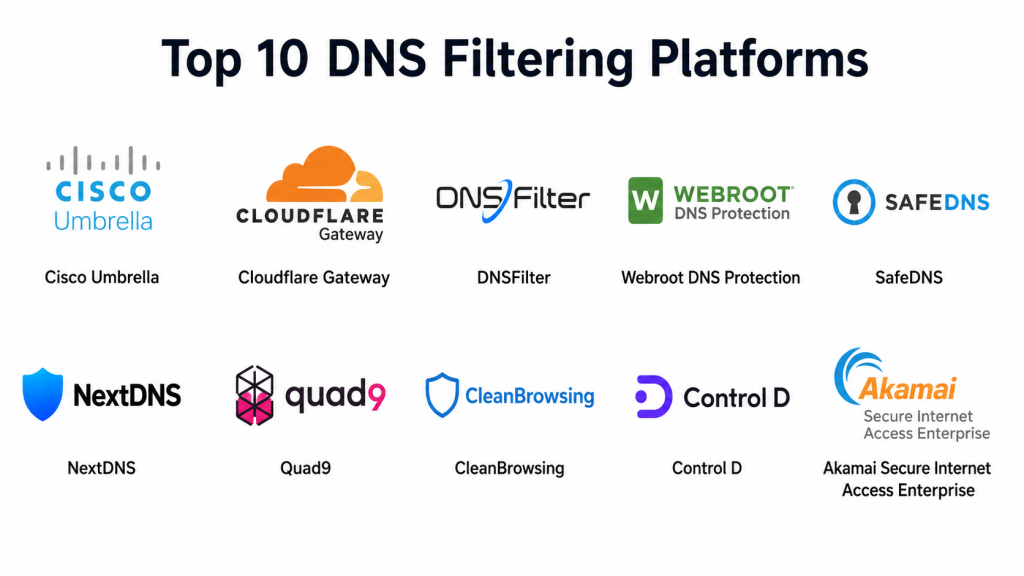
Top 10 DNS Filtering Platforms
#1 — Cisco Umbrella
Short description: Cisco Umbrella is a cloud-delivered DNS security and secure internet gateway platform that helps organizations block malicious domains, phishing sites, malware, command-and-control activity, and unwanted web content. It is widely used by enterprises, schools, MSPs, and security teams that want protection at the DNS layer before connections are established. Umbrella can protect office networks, roaming users, branch offices, and cloud-connected environments. It is best for organizations that want DNS-layer security connected to a broader Cisco security ecosystem.
Key Features
- DNS-layer security for malicious domain blocking.
- Phishing, malware, ransomware, and command-and-control protection.
- Content category filtering and acceptable-use policies.
- Roaming user protection through endpoint deployment options.
- Cloud security features depending on package.
- Reporting, threat visibility, and security activity dashboards.
- Integration with broader Cisco security tools.
Pros
- Strong enterprise DNS security reputation.
- Good fit for distributed and remote workforces.
- Useful threat intelligence and policy controls.
- Can scale from SMB to enterprise environments.
Cons
- Advanced packages may increase cost.
- Best value comes with Cisco ecosystem alignment.
- Policy tuning may require security team involvement.
- Some use cases may require secure web gateway features beyond DNS.
Platforms / Deployment
Cloud / DNS forwarding / Roaming client / Network deployment / Hybrid environments.
Security & Compliance
Security capabilities may include DNS-layer protection, threat intelligence, content filtering, roaming protection, reporting, policy control, and admin access controls depending on plan. Specific certifications should be verified directly. If uncertain, write: Not publicly stated.
Integrations & Ecosystem
Cisco Umbrella fits security stacks where DNS filtering needs to connect with network security, endpoint protection, SIEM, and broader threat intelligence workflows.
- Cisco security ecosystem
- SIEM tools
- Identity providers
- Endpoint protection workflows
- Network appliances
- MSP and enterprise dashboards
Support & Community
Cisco provides documentation, enterprise support, partner services, training, and a large security administrator community. It is strongest for teams that need scalable DNS protection and mature security operations.
#2 — Cloudflare Gateway
Short description: Cloudflare Gateway is a DNS filtering and secure web gateway service that helps organizations block threats, control web access, and enforce internet policies for users, offices, and remote teams. It is part of Cloudflare’s broader zero trust platform and can protect DNS, HTTP, and network traffic depending on configuration. Gateway is useful for teams that want fast DNS resolution, threat blocking, content filtering, and identity-aware policy control. It is best for organizations adopting zero trust and cloud-delivered security.
Key Features
- DNS filtering for malware, phishing, and risky domains.
- Content category blocking and policy enforcement.
- Identity-aware policies for users and groups.
- Roaming user protection through endpoint client options.
- Secure web gateway capabilities depending on plan.
- Logging, analytics, and security dashboards.
- Integration with Cloudflare Zero Trust services.
Pros
- Strong fit for zero trust and SASE-style programs.
- Fast global DNS and security infrastructure.
- Useful for remote teams and cloud-first organizations.
- Can combine DNS filtering with broader web controls.
Cons
- Full value may require broader Cloudflare adoption.
- Policy design can become complex in larger environments.
- Some advanced web controls may require paid tiers.
- Organizations should test compatibility with existing network tools.
Platforms / Deployment
Cloud / DNS filtering / Endpoint client / Secure web gateway / Zero trust platform.
Security & Compliance
Security capabilities may include DNS filtering, web policies, identity-aware access, logs, admin controls, role-based access, and zero trust controls depending on plan. Specific certifications should be verified directly. If uncertain, write: Not publicly stated.
Integrations & Ecosystem
Cloudflare Gateway fits organizations that want DNS filtering as part of a broader cloud security platform.
- Identity providers
- Endpoint client deployments
- SIEM and logging workflows
- Cloudflare Zero Trust
- Secure web gateway workflows
- Network security policies
Support & Community
Cloudflare provides documentation, community resources, support plans, and enterprise services. It is strongest for cloud-first organizations that want DNS filtering plus broader zero trust security.
#3 — DNSFilter
Short description: DNSFilter is a cloud-based DNS filtering platform focused on threat protection, content filtering, reporting, and MSP-friendly management. It uses AI-driven domain categorization and threat detection to help block phishing, malware, botnets, and inappropriate content. DNSFilter is popular with MSPs, SMBs, schools, and distributed businesses because it is easy to deploy and manage. It is best for organizations that want simple, effective DNS filtering with strong usability.
Key Features
- DNS filtering for malware, phishing, botnets, and unwanted content.
- AI-based domain categorization.
- Content category policies for users and networks.
- Roaming client support for remote users.
- Multi-tenant management for MSPs.
- Reporting and dashboard visibility.
- Policy-based blocking and allowlisting.
Pros
- Easy to deploy and manage.
- Strong fit for MSPs and SMBs.
- Good content filtering and security controls.
- User-friendly dashboards and reporting.
Cons
- Enterprise teams may need broader SASE or SWG capabilities.
- Advanced integrations may vary by plan.
- Larger environments may require careful policy structure.
- DNS-level filtering may not inspect full webpage content.
Platforms / Deployment
Cloud / DNS forwarding / Roaming client / MSP multi-tenant dashboard.
Security & Compliance
Security capabilities may include DNS-layer threat blocking, category filtering, roaming protection, reporting, admin roles, and policy controls depending on plan. Specific certifications should be verified directly. If uncertain, write: Not publicly stated.
Integrations & Ecosystem
DNSFilter fits MSP, SMB, education, and distributed business environments where DNS filtering needs to be simple and manageable.
- MSP management workflows
- Directory integrations
- Roaming user deployments
- Network-level filtering
- Reporting dashboards
- Security alert workflows
Support & Community
DNSFilter provides documentation, support resources, MSP enablement, and onboarding guidance. It is a strong choice for service providers and teams that need quick deployment.
#4 — Webroot DNS Protection
Short description: Webroot DNS Protection helps businesses and MSPs block malicious domains, phishing sites, malware, botnets, and unwanted web categories at the DNS layer. It is often used alongside endpoint protection to create lightweight internet security for office and remote users. Webroot DNS Protection is especially useful for MSPs and SMBs that want centralized policy control and reporting. It is best for organizations that need easy DNS filtering connected to endpoint security workflows.
Key Features
- DNS-layer protection against malicious domains.
- Phishing, malware, and botnet domain blocking.
- Web content category filtering.
- Policy controls for users, groups, and networks.
- Roaming user protection depending on deployment.
- Reporting and visibility into blocked activity.
- MSP-friendly management options.
Pros
- Strong fit for MSP and SMB environments.
- Useful alongside endpoint security.
- Straightforward content filtering and threat blocking.
- Easy to manage for smaller IT teams.
Cons
- Large enterprises may need deeper analytics and integrations.
- Advanced SASE features are limited compared with broader platforms.
- Policy granularity depends on deployment and package.
- Buyers should validate reporting depth before purchase.
Platforms / Deployment
Cloud / DNS forwarding / Roaming endpoint options / MSP-friendly management.
Security & Compliance
Security capabilities may include DNS threat blocking, content filtering, reporting, policy management, and admin controls depending on plan. Specific certifications should be verified directly. If uncertain, write: Not publicly stated.
Integrations & Ecosystem
Webroot DNS Protection fits organizations that want DNS filtering connected with endpoint protection and MSP management.
- Endpoint protection workflows
- MSP dashboards
- SMB networks
- Remote worker protection
- Reporting systems
- Web access policies
Support & Community
Webroot provides documentation, partner support, and MSP-focused resources. It is best for organizations that want straightforward DNS protection without heavy enterprise complexity.
#5 — Quad9
Short description: Quad9 is a free public recursive DNS service focused on blocking known malicious domains using threat intelligence. It is useful for individuals, small teams, nonprofits, and organizations that want basic DNS-layer protection without deploying a commercial filtering platform. Quad9 blocks domains associated with malware, phishing, botnets, and other known threats. It is best for simple security-focused DNS protection where advanced policy control, user reporting, and enterprise dashboards are not required.
Key Features
- Security-focused recursive DNS service.
- Blocks known malicious domains.
- Uses threat intelligence from multiple sources.
- Simple network-level DNS configuration.
- Privacy-conscious DNS resolution positioning.
- No complex admin dashboard required for basic use.
- Useful for small teams and simple deployments.
Pros
- Free and easy to use.
- Good option for basic malware and phishing domain blocking.
- Simple setup for routers, devices, or networks.
- Useful for personal and small organization protection.
Cons
- Not a full enterprise DNS filtering platform.
- Limited policy customization compared with paid tools.
- No rich user-based reporting or MSP controls.
- Not ideal for organizations needing content category filtering.
Platforms / Deployment
Public DNS / Network DNS configuration / Device-level DNS configuration.
Security & Compliance
Security capabilities include malicious domain blocking based on threat intelligence. Enterprise compliance controls, RBAC, audit logs, and custom policy management are Varies / N/A.
Integrations & Ecosystem
Quad9 is best used as a basic secure DNS resolver rather than an enterprise filtering platform.
- Router DNS configuration
- Device DNS settings
- Small network protection
- Basic malware domain blocking
- Privacy-focused DNS workflows
- Lightweight security setups
Support & Community
Quad9 provides public documentation and community-oriented resources. Support is not the same as a paid enterprise platform, so organizations needing SLAs should consider commercial options.
#6 — NextDNS
Short description: NextDNS is a customizable cloud DNS filtering platform for individuals, families, small teams, and businesses that want security, privacy, content control, and detailed DNS logs. It can block malware, phishing, trackers, ads, adult content, gambling, social media, and custom blocklists depending on configuration. NextDNS is flexible and developer-friendly, making it useful for users who want more control than a basic public DNS resolver. It is best for small teams, technical users, and privacy-conscious organizations.
Key Features
- Custom DNS filtering policies.
- Malware, phishing, tracker, and unwanted domain blocking.
- Content filtering categories and custom blocklists.
- Device-level and network-level configuration.
- Logs, analytics, and query visibility.
- Profiles for different users or devices.
- Privacy-focused configuration options.
Pros
- Highly customizable for technical users.
- Strong fit for small teams and personal use.
- Good balance of security, privacy, and content filtering.
- Easy to test without major infrastructure changes.
Cons
- Not a full enterprise secure web gateway.
- Larger organizations may need stronger identity and admin controls.
- Support model may not match enterprise vendors.
- Policy management can become complex if many profiles are used.
Platforms / Deployment
Cloud DNS / Device configuration / Router configuration / Mobile and desktop setup options.
Security & Compliance
Security capabilities may include malware and phishing blocking, content policies, logs, analytics, and privacy settings depending on configuration. Enterprise compliance controls are Varies / N/A.
Integrations & Ecosystem
NextDNS fits technical users and small teams that want customizable DNS filtering across devices and networks.
- Device DNS configuration
- Router DNS setup
- Mobile and desktop profiles
- Custom blocklists
- Privacy filtering
- Home and small office networks
Support & Community
NextDNS provides documentation and community support. It is best for users who are comfortable configuring DNS profiles and reviewing logs themselves.
#7 — SafeDNS
Short description: SafeDNS is a cloud-based DNS filtering platform for businesses, schools, libraries, MSPs, and families that need web content filtering and threat protection. It helps block malicious domains, adult content, gambling, violence, social media, and other categories based on policy settings. SafeDNS is especially useful for education, public Wi-Fi, and organizations that need easy content control. It is best for teams that prioritize web filtering and acceptable-use enforcement.
Key Features
- DNS-based web content filtering.
- Malware and phishing domain blocking.
- Category-based controls for websites.
- Policies for users, groups, or networks depending on plan.
- Reporting and usage visibility.
- Cloud-based deployment.
- Useful for schools, public networks, and businesses.
Pros
- Strong fit for content filtering needs.
- Useful for schools, libraries, and family-safe networks.
- Easy to deploy using DNS configuration.
- Affordable option for basic filtering.
Cons
- May not match enterprise threat intelligence depth.
- Advanced security operations features may be limited.
- DNS-level filtering cannot inspect full webpage content.
- Buyers should validate reporting and policy granularity.
Platforms / Deployment
Cloud DNS / Network-level filtering / Device-level configuration / Business and education deployments.
Security & Compliance
Security capabilities may include category filtering, malware domain blocking, phishing domain blocking, reporting, and policy management depending on plan. Specific certifications should be verified directly. If uncertain, write: Not publicly stated.
Integrations & Ecosystem
SafeDNS fits environments where safe browsing and category filtering are primary needs.
- School networks
- Business Wi-Fi
- Public access networks
- Family-safe browsing
- MSP-managed filtering
- Guest network policies
Support & Community
SafeDNS provides documentation and support resources. It is a practical option for organizations that need simple content filtering and DNS-level web control.
#8 — ScoutDNS
Short description: ScoutDNS is a DNS filtering platform designed for businesses, schools, and MSPs that need security filtering, content controls, reporting, and simple deployment. It focuses on giving administrators control over allowed and blocked categories, threat protection, and visibility into DNS activity. ScoutDNS is especially useful for MSPs and smaller organizations that want practical DNS filtering without enterprise complexity. It is best for teams that want clear policies and manageable DNS protection.
Key Features
- DNS security filtering for malicious domains.
- Category-based content filtering.
- Reporting and activity logs.
- Policy controls for networks and users depending on setup.
- MSP-friendly management capabilities.
- Simple cloud deployment.
- Useful for SMB and education environments.
Pros
- Practical for SMBs, schools, and MSPs.
- Easy DNS-based deployment.
- Useful category filtering and reporting.
- Clear fit for managed web protection.
Cons
- Less known than larger enterprise DNS security vendors.
- Advanced integrations may be limited.
- Large enterprises may require deeper security features.
- Buyers should validate support and reporting depth.
Platforms / Deployment
Cloud DNS / Network DNS forwarding / MSP and business deployments.
Security & Compliance
Security capabilities may include malware domain blocking, content filtering, reporting, admin controls, and policy management depending on plan. Specific certifications should be verified directly. If uncertain, write: Not publicly stated.
Integrations & Ecosystem
ScoutDNS fits organizations that need DNS filtering managed through simple policies and reporting.
- SMB networks
- School networks
- MSP customer environments
- Guest Wi-Fi filtering
- Category blocking policies
- DNS reporting workflows
Support & Community
ScoutDNS provides documentation and support resources. It is strongest for organizations that need straightforward DNS filtering and manageable administration.
#9 — Zscaler Internet Access
Short description: Zscaler Internet Access is a cloud security platform that includes DNS security, secure web gateway, cloud firewall, sandboxing, data protection, and broader internet security controls. It is much broader than basic DNS filtering and is designed for enterprises adopting zero trust and cloud-delivered security. Zscaler helps organizations protect users across locations without backhauling traffic through legacy appliances. It is best for enterprises needing DNS filtering as part of a full secure internet access platform.
Key Features
- DNS security and malicious domain blocking.
- Secure web gateway and URL filtering.
- Cloud firewall and advanced threat protection.
- Sandboxing and malware analysis depending on package.
- Data protection and policy enforcement.
- Identity-aware internet access controls.
- Cloud-delivered security for remote and branch users.
Pros
- Strong enterprise SASE and secure internet access platform.
- Goes beyond DNS filtering with SWG and cloud firewall features.
- Good fit for large distributed organizations.
- Useful for zero trust network transformation.
Cons
- More complex and expensive than standalone DNS filtering.
- Implementation requires network and security planning.
- Smaller teams may not need the full platform.
- Buyers should evaluate licensing and module fit carefully.
Platforms / Deployment
Cloud / Secure internet access platform / Endpoint client / Branch and remote user security.
Security & Compliance
Security capabilities may include DNS security, URL filtering, sandboxing, firewall controls, identity policies, logging, data protection, admin controls, and reporting depending on plan. Specific certifications should be verified directly. If uncertain, write: Not publicly stated.
Integrations & Ecosystem
Zscaler fits enterprise environments where DNS filtering is part of a broader internet security and zero trust strategy.
- Identity providers
- Endpoint clients
- SIEM tools
- Cloud security workflows
- Secure web gateway policies
- Enterprise network security
Support & Community
Zscaler provides enterprise support, documentation, partner services, training, and security architecture resources. It is strongest for large organizations modernizing internet security.
#10 — Forcepoint Web Security
Short description: Forcepoint Web Security provides web filtering, threat protection, policy enforcement, user behavior visibility, and secure web access controls. It includes DNS and URL filtering capabilities as part of broader web security. Forcepoint is especially relevant for organizations that need content control, compliance policies, data protection, and user-aware web security. It is best for enterprises and regulated organizations that need web filtering beyond basic DNS blocking.
Key Features
- URL and DNS-based web filtering.
- Malware, phishing, and risky site protection.
- Content category controls and acceptable-use policies.
- User-aware web access controls.
- Reporting and policy visibility.
- Data protection features depending on package.
- Cloud and hybrid deployment options depending on product.
Pros
- Strong web filtering and policy enforcement heritage.
- Useful for regulated and compliance-sensitive organizations.
- Goes beyond basic DNS filtering.
- Good fit where web usage control and data protection matter.
Cons
- May be more complex than simple DNS filtering tools.
- Best suited to organizations with web security requirements.
- Licensing and deployment model should be reviewed carefully.
- Buyers should validate cloud, endpoint, and identity integration needs.
Platforms / Deployment
Cloud / Web security platform / Hybrid deployment options / Endpoint and network integrations.
Security & Compliance
Security capabilities may include URL filtering, DNS filtering, malware protection, content controls, reporting, identity-aware policies, and data protection features depending on configuration. Specific certifications should be verified directly. If uncertain, write: Not publicly stated.
Integrations & Ecosystem
Forcepoint Web Security fits organizations that want web security policies connected with identity, compliance, and data protection.
- Identity providers
- SIEM tools
- Endpoint environments
- Web security policies
- DLP workflows
- Compliance reporting
Support & Community
Forcepoint provides enterprise documentation, support, partner services, and security resources. It is best for organizations needing mature web filtering and policy enforcement.
Comparison Table
| Tool Name | Best For | Platform Supported | Deployment | Standout Feature | Public Rating |
|---|---|---|---|---|---|
| Cisco Umbrella | Enterprise DNS-layer security | Cloud / Roaming client / Network DNS | Cloud / Hybrid | DNS security with Cisco threat intelligence | N/A |
| Cloudflare Gateway | Zero trust DNS and web filtering | Cloud / Endpoint client / DNS | Cloud | DNS filtering inside Cloudflare Zero Trust | N/A |
| DNSFilter | MSP and SMB DNS filtering | Cloud / Roaming client / MSP dashboard | Cloud | AI-based categorization and easy management | N/A |
| Webroot DNS Protection | SMB and MSP endpoint-aligned filtering | Cloud / DNS / Roaming options | Cloud | DNS filtering connected to endpoint security workflows | N/A |
| Quad9 | Free secure DNS protection | Public DNS / Device / Network | Public DNS | Free malicious domain blocking | N/A |
| NextDNS | Custom DNS filtering for small teams | Cloud DNS / Device / Router | Cloud | Highly customizable DNS profiles and logs | N/A |
| SafeDNS | Schools and content filtering | Cloud DNS / Network filtering | Cloud | Category-based safe browsing controls | N/A |
| ScoutDNS | SMB, school, and MSP filtering | Cloud DNS / Business networks | Cloud | Simple DNS filtering and reporting | N/A |
| Zscaler Internet Access | Enterprise SASE and secure internet access | Cloud / Endpoint / Branch | Cloud | DNS filtering inside full SWG and SASE platform | N/A |
| Forcepoint Web Security | Enterprise web filtering and compliance | Cloud / Hybrid / Endpoint | Cloud / Hybrid | User-aware web filtering and policy enforcement | N/A |
Evaluation & Scoring of DNS Filtering Platforms
| Tool Name | Core 25% | Ease 15% | Integrations 15% | Security 10% | Performance 10% | Support 10% | Value 15% | Weighted Total |
|---|---|---|---|---|---|---|---|---|
| Cisco Umbrella | 9 | 8 | 9 | 9 | 9 | 9 | 8 | 8.75 |
| Cloudflare Gateway | 9 | 8 | 9 | 9 | 9 | 8 | 8 | 8.65 |
| DNSFilter | 8 | 9 | 8 | 8 | 8 | 8 | 9 | 8.35 |
| Webroot DNS Protection | 8 | 8 | 8 | 8 | 8 | 8 | 8 | 8.00 |
| Quad9 | 6 | 9 | 5 | 7 | 8 | 6 | 10 | 7.15 |
| NextDNS | 7 | 8 | 6 | 7 | 8 | 7 | 9 | 7.45 |
| SafeDNS | 7 | 8 | 6 | 7 | 8 | 7 | 8 | 7.25 |
| ScoutDNS | 7 | 8 | 7 | 7 | 8 | 7 | 8 | 7.40 |
| Zscaler Internet Access | 10 | 7 | 9 | 10 | 9 | 9 | 7 | 8.75 |
| Forcepoint Web Security | 8 | 7 | 8 | 9 | 8 | 8 | 7 | 7.85 |
These scores are comparative and based on DNS filtering platform fit, not absolute product quality. A higher score means the tool aligns strongly with threat blocking, category filtering, policy control, roaming protection, integrations, reporting, and enterprise readiness. Standalone DNS filtering platforms score well for simplicity and value, while SASE and secure web gateway platforms score higher for security depth but may require more planning. Buyers should adjust the weights based on whether they need basic filtering, MSP management, school safety, remote user protection, or enterprise zero trust security.
Which DNS Filtering Platform Is Right for You?
Solo / Freelancer
Solo users usually do not need a full enterprise DNS filtering platform. Quad9 and NextDNS are practical options for personal devices, home offices, or small technical setups. Quad9 is simple for basic malicious domain blocking, while NextDNS offers more customization and logs. Freelancers managing client data should also use MFA, endpoint protection, secure browsers, and phishing awareness because DNS filtering is only one security layer.
SMB
SMBs should prioritize easy deployment, clear reports, roaming user protection, and low admin overhead. DNSFilter, Webroot DNS Protection, SafeDNS, ScoutDNS, and Cloudflare Gateway can be practical depending on budget and security needs. Businesses already using Cisco may evaluate Cisco Umbrella. SMBs should start with malware and phishing blocking, then add content categories carefully to avoid productivity issues.
Mid-Market
Mid-market organizations often need identity-based policies, remote user protection, SIEM integration, reporting, and better threat intelligence. Cisco Umbrella, Cloudflare Gateway, DNSFilter, Webroot DNS Protection, and Forcepoint Web Security are strong candidates. If the company is moving toward secure web gateway or zero trust, Cloudflare Gateway or Zscaler Internet Access may provide a broader path. Mid-market buyers should test policy behavior across office, remote, and mobile users.
Enterprise
Enterprises should prioritize scalability, identity integration, threat intelligence quality, reporting, admin roles, SIEM integration, and broader security platform fit. Cisco Umbrella, Cloudflare Gateway, Zscaler Internet Access, and Forcepoint Web Security are strong options depending on architecture. Enterprises with existing Cisco, Cloudflare, Zscaler, or Forcepoint investments may benefit from ecosystem alignment. Large teams should evaluate encrypted DNS handling, roaming clients, branch deployment, and incident response workflows.
Budget vs Premium
Budget-conscious users can start with Quad9 or NextDNS for basic protection. SMBs and MSPs may get better business controls from DNSFilter, Webroot DNS Protection, SafeDNS, or ScoutDNS. Premium options such as Cisco Umbrella, Cloudflare Gateway, Zscaler Internet Access, and Forcepoint Web Security are better when organizations need identity rules, remote user coverage, reporting, compliance controls, and broader security integrations.
Feature Depth vs Ease of Use
For ease of use, DNSFilter, Webroot DNS Protection, SafeDNS, and ScoutDNS are practical choices. For technical customization, NextDNS is useful for smaller teams and advanced users. For enterprise depth, Cisco Umbrella, Cloudflare Gateway, Zscaler Internet Access, and Forcepoint Web Security provide stronger security capabilities. The right choice depends on whether you need simple DNS blocking or broader secure internet access controls.
Integrations & Scalability
Integration needs depend on environment size. MSPs should look for multi-tenant dashboards and customer-level policies. Enterprises should look for identity provider integration, SIEM exports, endpoint client support, policy groups, audit logs, and API options. Schools should prioritize category controls, safe search, reporting, and bypass management. Remote-first companies should prioritize roaming clients and encrypted DNS handling.
Security & Compliance Needs
Security-sensitive buyers should prioritize malicious domain blocking, phishing protection, newly registered domain controls, command-and-control detection, reporting, audit logs, admin roles, and identity-based enforcement. Compliance-focused organizations should also evaluate retention, reporting exports, policy evidence, and user activity visibility. DNS filtering should be combined with endpoint security, MFA, email security, secure web gateway, and incident response processes for stronger protection.
Frequently Asked Questions
1. What is DNS filtering?
DNS filtering is a security method that blocks access to unsafe or unwanted domains before a connection is completed. When a user tries to visit a website, the DNS filtering platform checks the domain against threat intelligence and policy rules. If the domain is malicious or blocked by policy, the request is denied. It is commonly used to stop phishing, malware, adult content, gambling, and other risky sites.
2. How does DNS filtering protect users?
DNS filtering protects users by blocking access to dangerous domains used for phishing, malware delivery, command-and-control traffic, scams, and suspicious redirects. It works early in the connection process, often before a web page loads. This makes it lightweight and effective for many common threats. However, it should be used with other controls such as email security, endpoint protection, and MFA.
3. Is DNS filtering the same as a secure web gateway?
No, DNS filtering and secure web gateways are related but not the same. DNS filtering blocks or allows domains based on DNS requests, while a secure web gateway can inspect web traffic, URLs, files, applications, and content more deeply. DNS filtering is simpler and lightweight, but it cannot inspect every page element or file download. Many enterprises use DNS filtering as part of a broader secure web gateway or SASE platform.
4. Can DNS filtering stop phishing attacks?
DNS filtering can block many phishing domains, fake login pages, and malicious redirects, especially when the platform has strong threat intelligence. However, it cannot stop every phishing attempt because attackers constantly create new domains and use compromised legitimate sites. DNS filtering works best when combined with email security, user training, browser protection, MFA, and incident response. It is a strong layer, not a complete solution by itself.
5. What is roaming DNS protection?
Roaming DNS protection applies filtering rules to users when they are outside the office network. This usually requires an endpoint agent, mobile profile, or device configuration. It is important for remote workers, traveling employees, students, and hybrid teams. Without roaming protection, users may only be protected while connected to the corporate network or VPN.
6. How are DNS filtering platforms priced?
Pricing varies by vendor and use case. Some platforms charge per user, device, network, site, customer tenant, or feature package. MSP platforms may use tenant-based or endpoint-based pricing. Free DNS services exist, but they usually offer limited customization, reporting, and support. Buyers should compare total cost based on users, locations, roaming clients, reporting needs, and support requirements.
7. What are common DNS filtering implementation mistakes?
A common mistake is blocking too many categories too quickly, which can disrupt business workflows. Another mistake is forgetting remote users, guest networks, mobile devices, or DNS over HTTPS bypass. Some teams also fail to review reports and tune policies after deployment. A good rollout starts with threat blocking, then gradually adds content categories, user groups, and exception workflows.
8. What integrations should buyers look for?
Important integrations include identity providers, directory services, endpoint agents, SIEM tools, firewall systems, MSP dashboards, reporting exports, and alerting workflows. Enterprises should also evaluate role-based admin access and API support. Schools should look for user group policies and safe search controls. Remote-first businesses should prioritize roaming clients and device-level enforcement.
9. Can users bypass DNS filtering?
Users may bypass DNS filtering if they use unauthorized DNS servers, VPNs, proxies, encrypted DNS, mobile hotspots, or unmanaged devices. Stronger deployments enforce DNS settings through endpoint agents, firewalls, network policies, and device management tools. Organizations should also monitor for bypass attempts. DNS filtering is most effective when combined with endpoint management and network controls.
10. What is the best DNS filtering platform overall?
There is no single best DNS filtering platform for every organization. Cisco Umbrella is strong for enterprise DNS security, Cloudflare Gateway fits zero trust and cloud-first teams, DNSFilter is excellent for MSPs and SMBs, Webroot DNS Protection is practical for endpoint-aligned SMB security, and Zscaler Internet Access is strong for enterprise SASE programs. The best choice depends on your size, budget, remote workforce needs, content filtering requirements, security stack, and reporting expectations.
Conclusion
DNS Filtering Platforms provide a lightweight but powerful layer of protection against phishing, malware, command-and-control domains, unsafe websites, and unwanted content. The right platform depends on your needs: Cisco Umbrella and Cloudflare Gateway are strong for enterprise and zero trust programs, DNSFilter and Webroot DNS Protection are practical for SMBs and MSPs, Quad9 and NextDNS are useful for simple or customizable DNS protection, and SafeDNS or ScoutDNS fit education and content filtering use cases. Zscaler Internet Access and Forcepoint Web Security are better when DNS filtering must be part of a broader secure web gateway or SASE strategy. Buyers should not choose only by price or brand; they should test threat blocking, category accuracy, roaming protection, encrypted DNS handling, reporting, support, and policy usability. Start with phishing and malware blocking, pilot with a few users or networks, review false positives, then expand policies gradually across remote users, offices, guest networks, and high-risk groups.

This article clearly explains DNS filtering platforms and how they help organizations strengthen network security and control harmful online traffic more effectively.
This article clearly explains DNS filtering platforms and how they help organizations improve network security by blocking harmful and unwanted online traffic.
DNS filtering is most effective when combined with broader security monitoring. Visibility into blocked requests can help identify emerging threats before they escalate.