Introduction
Cloud spend governance tools help organizations control, monitor, allocate, and optimize cloud costs across teams, projects, products, and business units. In simple words, these tools make sure cloud spending does not grow without visibility, ownership, budget control, or accountability.
Cloud spend governance matters because modern companies use cloud services across engineering, AI, data, security, DevOps, product, and business operations. Without governance, teams can overprovision resources, forget idle workloads, miss budget limits, or create untagged infrastructure that finance teams cannot track. These tools help businesses connect cloud usage with financial responsibility.
Common real-world use cases include enforcing cloud budgets, identifying waste, improving tagging hygiene, allocating spend to teams, detecting cost anomalies, forecasting future cloud bills, managing Kubernetes costs, and creating leadership-ready cost reports.
When evaluating cloud spend governance tools, buyers should consider multi-cloud support, budget controls, policy automation, tagging governance, cost allocation, anomaly detection, Kubernetes visibility, reporting flexibility, access controls, security posture, finance integrations, ease of use, and pricing transparency.
Best for: FinOps teams, cloud operations leaders, IT finance teams, DevOps managers, platform teams, engineering leaders, enterprises, SaaS companies, and fast-growing businesses that need stronger cloud cost control.
Not ideal for: very small teams with simple cloud usage, companies without cloud ownership processes, or teams that only need basic billing reports from a single cloud provider.
Key Trends in Cloud Spend Governance Tools
- AI-assisted FinOps analysis is becoming more useful for cost anomaly detection, waste identification, forecasting, and recommendation summaries.
- Policy-based cloud governance is now a major requirement, especially for teams that need budget limits, approval workflows, and automated guardrails.
- Tagging and metadata hygiene are becoming central because poor tags make cost allocation, chargeback, and reporting unreliable.
- Kubernetes cost governance is now important because shared clusters can hide real workload-level spend from finance and engineering teams.
- Multi-cloud visibility is expected as companies use AWS, Microsoft Azure, Google Cloud, SaaS platforms, data tools, and container platforms together.
- Engineering-first cost ownership is growing, with cloud cost insights moving into developer dashboards, alerts, service catalogs, and DevOps workflows.
- Unit economics reporting is becoming more common for SaaS companies that need to track cost per customer, cost per feature, and cost per transaction.
- Automated budget alerts are replacing manual monthly reviews so teams can catch overspending before it becomes a finance issue.
- Governance workflows are becoming more collaborative, connecting finance, engineering, procurement, operations, and business leadership.
- Optimization is shifting left, meaning teams now consider cost during architecture, deployment, and product planning instead of only after the bill arrives.
How We Selected These Tools
- Tools were selected based on relevance to cloud spend governance, FinOps, cloud cost visibility, optimization, allocation, policy control, and reporting.
- Preference was given to platforms that support budget ownership, tagging governance, cost allocation, anomaly detection, and cloud optimization workflows.
- Multi-cloud coverage was considered important because many organizations operate across more than one cloud provider.
- Kubernetes and container cost visibility were considered because shared clusters are common in modern cloud environments.
- Enterprise readiness was reviewed through access controls, reporting flexibility, governance depth, and support posture where known.
- Tools with strong integrations, APIs, cloud billing ingestion, and automation capabilities were prioritized.
- The list includes enterprise platforms, engineering-focused tools, Kubernetes-focused tools, and cloud cost intelligence platforms.
- Public ratings were not included because ratings vary across review sites and should not be guessed.
- Unknown details are written as “Not publicly stated” or “Varies / N/A” to avoid invented claims.
- The scoring is comparative and should be used as a shortlist guide, not a universal ranking.
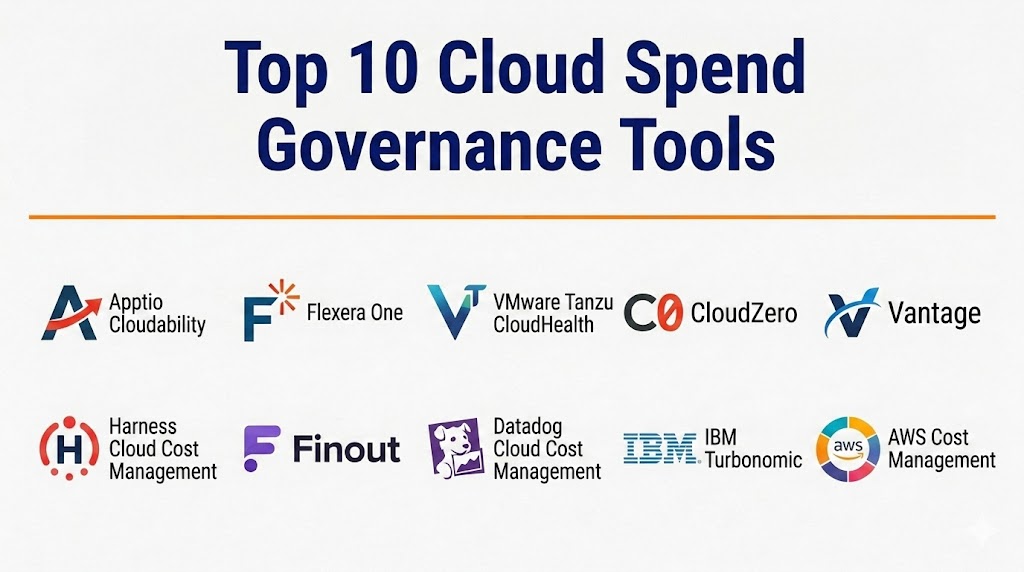
Top 10 Cloud Spend Governance Tools
1- IBM Cloudability
Short description: IBM Cloudability is a mature FinOps and cloud cost management platform built for enterprises that need strong visibility, allocation, forecasting, optimization, and governance. It helps organizations connect cloud spend with teams, applications, business units, and financial ownership. It is especially useful for companies with formal FinOps practices and complex multi-cloud environments. The platform is best suited for finance, engineering, and leadership teams that need consistent cloud cost accountability.
Key Features
- Multi-cloud cost visibility across major cloud environments.
- Budgeting, forecasting, and cloud spend tracking.
- Cost allocation by team, business unit, application, and custom dimensions.
- Governance workflows for enterprise FinOps programs.
- Optimization insights for waste, commitments, and usage patterns.
- Executive dashboards and finance-ready reporting.
- Unit economics and cost efficiency analysis.
Pros
- Strong fit for enterprise FinOps and IT finance teams.
- Useful for mature cloud cost governance programs.
- Supports detailed allocation and executive reporting.
- Good for organizations with complex multi-cloud spend.
Cons
- May be too advanced for small teams.
- Requires clean tagging and ownership mapping.
- Implementation may require stakeholder alignment.
- Pricing is usually enterprise-oriented.
Platforms / Deployment
Web. Cloud.
Security & Compliance
Enterprise security controls such as SSO, RBAC, audit capabilities, and access management may be available depending on plan and configuration. Specific certifications should be verified directly. Not publicly stated for all details.
Integrations & Ecosystem
IBM Cloudability integrates cloud billing data with financial and operational reporting workflows. It is commonly used with enterprise FinOps processes, budgeting systems, and cloud operations teams.
- AWS
- Microsoft Azure
- Google Cloud
- Kubernetes cost inputs where configured
- Finance reporting workflows
- Enterprise governance processes
Support & Community
IBM Cloudability offers enterprise-focused documentation, onboarding, implementation guidance, and customer support. Community strength is mainly FinOps practitioner and enterprise customer focused.
2- VMware Tanzu CloudHealth
Short description: VMware Tanzu CloudHealth is a cloud cost management and governance platform designed for enterprises and managed service providers. It helps organizations manage cloud visibility, policy control, optimization, and financial accountability. For cloud spend governance, it is useful when companies need structured reporting, budget tracking, and policy-based controls. It is a strong choice for organizations with large cloud estates and governance-heavy operating models.
Key Features
- Cloud cost visibility across major cloud providers.
- Policy-based governance and cost control.
- Budget management and financial reporting.
- Cost allocation by accounts, tags, groups, and custom structures.
- Optimization recommendations for waste and commitments.
- Role-based reporting for finance and operations.
- Support for managed service provider cost models.
Pros
- Strong governance features for large cloud programs.
- Useful for internal showback and chargeback reporting.
- Good for organizations with many accounts and business units.
- Mature cloud management and cost control capabilities.
Cons
- Can feel complex for small or fast-moving teams.
- Requires disciplined account structure and tagging.
- User experience depends on setup quality.
- Pricing and packaging should be confirmed directly.
Platforms / Deployment
Web. Cloud.
Security & Compliance
Enterprise identity, access, and governance controls are generally expected for enterprise deployments. Specific compliance certifications, encryption details, and audit capabilities should be verified with the vendor. Not publicly stated for all details.
Integrations & Ecosystem
CloudHealth integrates with cloud providers and enterprise governance workflows. It works best when account structures, cloud tags, and business ownership models are already defined.
- AWS
- Microsoft Azure
- Google Cloud
- Enterprise cloud accounts
- Business unit mapping
- Governance and reporting workflows
Support & Community
Support is typically enterprise-oriented, with product documentation, onboarding support, and account assistance. Community strength is stronger among enterprise cloud management users than open-source communities.
3- Flexera One FinOps
Short description: Flexera One FinOps helps organizations manage cloud spend, optimize usage, allocate costs, and connect cloud finance with broader technology governance. It is especially useful for large companies that need visibility across cloud services, software assets, procurement, and IT financial management. For cloud spend governance, it supports cost accountability, optimization policies, and reporting for finance and technology leaders. It is a strong choice for enterprises with complex IT estates.
Key Features
- Cloud cost visibility across multiple providers and accounts.
- Cost allocation and ownership reporting.
- Optimization recommendations and policy automation.
- Budgeting and forecasting support.
- Commitment planning and efficiency insights.
- Governance across cloud and broader IT spend.
- Reporting for finance, procurement, and IT operations.
Pros
- Strong fit for large enterprises with complex IT spend.
- Useful for aligning cloud governance with asset and software management.
- Supports mature FinOps and IT financial management workflows.
- Good for organizations that need policy-driven optimization.
Cons
- Can be complex for cloud-only teams.
- Requires careful setup and ownership mapping.
- May be more than smaller teams need.
- Pricing and implementation effort can vary.
Platforms / Deployment
Web. Cloud.
Security & Compliance
Enterprise access controls and governance capabilities are commonly expected, but exact security and compliance details should be validated with Flexera. Not publicly stated for all details.
Integrations & Ecosystem
Flexera One FinOps connects cloud cost data with wider IT management and finance workflows. It is useful when cloud governance needs to align with procurement, software assets, and financial operations.
- AWS
- Microsoft Azure
- Google Cloud
- IT asset management workflows
- Software asset management processes
- Finance and procurement reporting
Support & Community
Flexera provides enterprise documentation, professional services, onboarding, and customer support. Community strength is more enterprise and vendor-led than developer-led.
4- CloudZero
Short description: CloudZero is a cloud cost intelligence platform built to help teams understand cloud spend by product, feature, customer, team, and business dimension. It is strong for SaaS companies and product-led organizations that need more than basic billing reports. For cloud spend governance, CloudZero helps teams create accountability even when tags are incomplete or inconsistent. It is especially useful for connecting engineering decisions with business cost outcomes.
Key Features
- Cost allocation by product, team, feature, customer, and service.
- Shared cost allocation and custom business dimensions.
- Unit economics reporting for SaaS and product teams.
- Anomaly detection and cost intelligence workflows.
- Flexible allocation models beyond basic tagging.
- Engineering-focused cost ownership.
- Multi-source cost data normalization.
Pros
- Strong for product and engineering cost accountability.
- Helpful when cloud tags are incomplete or inconsistent.
- Good fit for SaaS teams tracking unit economics.
- Business-friendly cost views for finance and leadership.
Cons
- Requires thoughtful business dimension modeling.
- May be more advanced than basic cost reporting needs.
- Pricing is typically vendor-led.
- Finance integrations should be validated during evaluation.
Platforms / Deployment
Web. Cloud.
Security & Compliance
CloudZero provides enterprise-oriented security features, but buyers should verify specific access controls, audit logs, encryption, and compliance requirements directly. Not publicly stated for all details.
Integrations & Ecosystem
CloudZero connects cloud spend with business context. It helps teams map technical costs into product, service, feature, customer, and team-level reporting.
- AWS
- Microsoft Azure
- Google Cloud
- Kubernetes and container cost contexts
- Custom cost data sources
- BI and finance workflows where configured
Support & Community
CloudZero offers customer success, onboarding, documentation, and FinOps guidance. Its support model is well aligned with product, engineering, and finance teams building cost accountability.
5- Harness Cloud Cost Management
Short description: Harness Cloud Cost Management is an engineering-first cloud cost governance tool that helps teams control, allocate, and optimize cloud and Kubernetes costs. It brings spend visibility closer to DevOps and platform workflows. It supports cost perspectives, budget alerts, anomaly detection, automation, and optimization recommendations. It is especially useful for teams already using modern software delivery workflows.
Key Features
- Cloud and Kubernetes cost visibility.
- Cost perspectives by team, application, service, and environment.
- Budget alerts and anomaly detection.
- Automation for idle resource reduction and optimization.
- Showback and chargeback reporting views.
- AI-assisted cost insights and recommendations.
- Integration with DevOps and delivery workflows.
Pros
- Strong fit for engineering-led FinOps.
- Useful for Kubernetes and cloud cost governance together.
- Good alignment with DevOps workflows.
- Automation can reduce manual cost analysis work.
Cons
- Best value may come when used with broader Harness workflows.
- Finance teams may need additional reporting exports.
- Requires accurate mapping between resources and teams.
- Automation should be carefully tested before full rollout.
Platforms / Deployment
Web. Cloud.
Security & Compliance
Harness generally supports enterprise identity and access control capabilities, but exact compliance details for Cloud Cost Management should be verified directly. Not publicly stated for all details.
Integrations & Ecosystem
Harness Cloud Cost Management integrates cloud cost governance with engineering and delivery workflows. It helps teams move cost visibility into the same place where infrastructure and applications are managed.
- AWS
- Microsoft Azure
- Google Cloud
- Kubernetes
- CI/CD workflows
- Ticketing and automation workflows where configured
Support & Community
Harness provides documentation, enterprise support, onboarding resources, and developer-focused education. Community strength is stronger among DevOps and platform engineering users.
6- Vantage
Short description: Vantage is a cloud cost platform focused on cost visibility, governance, allocation, forecasting, and reporting. It is useful for startups, scaleups, and mid-market organizations that need clear cloud spend control without heavy enterprise complexity. For governance, Vantage helps teams organize spend with cost reports, virtual tags, budgets, and shared cost allocation. It is strong for teams that want fast adoption and practical cost visibility.
Key Features
- Cost reports by team, service, project, tag, and custom segment.
- Virtual tags to normalize inconsistent metadata.
- Budgeting, forecasting, and anomaly detection.
- Cost allocation segments for ownership reporting.
- Shared cost allocation using rules and weights.
- Multi-cloud and usage-based vendor cost visibility.
- APIs and reporting workflows for automation.
Pros
- Easier to adopt than many enterprise-heavy platforms.
- Strong allocation features for messy tag environments.
- Useful for finance and engineering collaboration.
- Good fit for startups, scaleups, and mid-market teams.
Cons
- May not cover every enterprise governance workflow.
- Advanced finance integration may require extra work.
- Security details should be verified by buyers.
- Still requires a clear internal cost ownership model.
Platforms / Deployment
Web. Cloud.
Security & Compliance
Access controls and enterprise features may be available depending on plan. Specific compliance certifications, audit controls, and data handling details should be validated directly. Not publicly stated for all details.
Integrations & Ecosystem
Vantage integrates with cloud providers and usage-based cost sources. It helps teams normalize cloud spend across accounts, providers, services, and business structures.
- AWS
- Microsoft Azure
- Google Cloud
- Kubernetes cost sources where configured
- SaaS and usage-based vendor costs
- APIs and custom reports
Support & Community
Vantage provides documentation, product support, and onboarding resources. It is popular with teams that want practical reporting and cost governance without heavy implementation effort.
7- nOps
Short description: nOps is a cloud cost optimization and FinOps platform focused on cost visibility, governance, allocation, and AWS savings workflows. It helps teams understand unallocated spend, improve tagging, monitor budgets, and act on optimization opportunities. For cloud spend governance, nOps is useful when companies need allocation rules, showback reporting, and cost control automation. It is especially relevant for AWS-focused teams.
Key Features
- Cloud cost visibility and showback reporting.
- Cost allocation rules for unallocated and shared spend.
- Budget management and spend monitoring.
- Tag-based reporting and cost allocation keys.
- Optimization recommendations and automation.
- AWS commitment and savings workflows.
- Finance and cloud operations reporting views.
Pros
- Practical governance workflows for AWS-heavy teams.
- Helps reduce unallocated and poorly categorized spend.
- Combines visibility with optimization actions.
- Useful for teams building FinOps discipline.
Cons
- Best fit is usually AWS-focused environments.
- Requires tagging and allocation discipline.
- Enterprise finance integrations may need validation.
- Pricing and packaging should be confirmed directly.
Platforms / Deployment
Web. Cloud.
Security & Compliance
Security and access controls should be validated during vendor review. Not publicly stated for all details.
Integrations & Ecosystem
nOps connects AWS cost data with allocation, optimization, and governance workflows. It is useful for teams that want to clean up spend ownership and create practical cloud cost controls.
- AWS
- Cloud billing data
- Tagging workflows
- Budget workflows
- Optimization automation
- Reporting exports where configured
Support & Community
nOps provides documentation, onboarding, and customer support. Its community strength is mostly AWS FinOps and cloud cost optimization focused.
8- Datadog Cloud Cost Management
Short description: Datadog Cloud Cost Management adds cloud cost visibility to Datadog’s observability platform. It helps engineering, DevOps, and SRE teams connect spend with services, infrastructure, containers, and performance data. For cloud spend governance, it is useful when organizations want cost insights inside operational dashboards. It is best for teams already using Datadog for monitoring and service ownership.
Key Features
- Cloud and container cost visibility.
- Cost allocation by service, team, product, and custom tags.
- Kubernetes and container cost attribution.
- Cost anomaly monitoring and alerts.
- Dashboards connecting cost, performance, and reliability.
- Shared and untagged cost allocation workflows.
- Integration with service catalogs and observability data.
Pros
- Strong fit for engineering and SRE teams.
- Useful when cost needs context from observability data.
- Good for service-level cost ownership.
- Reduces tool switching for Datadog users.
Cons
- Best value is strongest for existing Datadog customers.
- Finance teams may still need customized reporting.
- Cost can depend on broader Datadog usage.
- Requires tag and service ownership discipline.
Platforms / Deployment
Web. Cloud.
Security & Compliance
Datadog offers enterprise security controls, but buyers should verify SSO, RBAC, audit logs, encryption, compliance, and data access details for their plan and region. Not publicly stated for all details.
Integrations & Ecosystem
Datadog Cloud Cost Management connects cost data with metrics, traces, logs, services, and infrastructure metadata. This makes it useful for engineering teams that want cost governance inside operational workflows.
- AWS
- Microsoft Azure
- Google Cloud
- Kubernetes
- Datadog observability stack
- Service catalog workflows
Support & Community
Datadog provides strong documentation, customer support, training resources, and a large practitioner ecosystem. Community engagement is active among DevOps, SRE, and observability users.
9- Kubecost
Short description: Kubecost is a Kubernetes cost monitoring and governance platform designed for teams running containerized workloads at scale. It helps platform teams allocate cluster costs by namespace, workload, label, service, and team. For cloud spend governance, Kubecost is especially useful when Kubernetes is a major cost driver. It makes shared cluster costs more transparent for engineering and finance teams.
Key Features
- Kubernetes cost allocation by namespace, label, deployment, and workload.
- Visibility into CPU, memory, storage, network, and cluster costs.
- Budget alerts and cost monitoring for teams.
- Shared cluster cost reporting.
- Savings recommendations for underutilized resources.
- Support for cloud and custom pricing models.
- Cloud-native cost allocation workflows.
Pros
- Strong Kubernetes-specific cost governance.
- Useful for shared cluster environments.
- Helps platform teams improve workload cost accountability.
- More detailed for Kubernetes than generic billing tools.
Cons
- Focused mainly on Kubernetes rather than total enterprise spend.
- Requires cluster access and labeling discipline.
- Finance-ready reports may need additional setup.
- May need pairing with a broader FinOps platform.
Platforms / Deployment
Web. Kubernetes. Cloud. Self-hosted. Hybrid.
Security & Compliance
Security features vary by edition and deployment model. Buyers should validate SSO, RBAC, audit logging, encryption, and compliance requirements directly. Not publicly stated for all details.
Integrations & Ecosystem
Kubecost integrates with Kubernetes environments and cloud billing data. It is often used by platform teams to make Kubernetes costs visible and accountable.
- Kubernetes
- AWS
- Microsoft Azure
- Google Cloud
- Prometheus
- OpenCost ecosystem
Support & Community
Kubecost has documentation, commercial support options, and strong recognition in Kubernetes cost management. Community strength is supported by its connection to cloud-native cost allocation practices.
10- Finout
Short description: Finout is a cloud cost management and FinOps platform focused on cost visibility, allocation, and business-level cloud spend reporting. It helps teams understand spend across cloud, Kubernetes, data platforms, and usage-based services. For governance, Finout is useful when companies need to map infrastructure costs to customers, products, teams, or business units. It is especially relevant for SaaS and cloud-native companies with complex cost structures.
Key Features
- Cloud cost visibility across multiple cost sources.
- Cost allocation by customer, product, team, and service.
- Kubernetes and container cost visibility.
- Support for unit economics and business cost reporting.
- Shared cost allocation and custom views.
- Budgeting, anomaly detection, and forecasting workflows.
- Dashboards for engineering, finance, and leadership teams.
Pros
- Strong for SaaS and cloud-native cost allocation.
- Useful for unit economics and business-level reporting.
- Supports multiple cloud and infrastructure cost sources.
- Helps connect technical spend with business ownership.
Cons
- Requires cost model planning for best results.
- May be more advanced than basic cloud billing needs.
- Pricing and packaging should be verified directly.
- Some compliance details may not be publicly stated.
Platforms / Deployment
Web. Cloud.
Security & Compliance
Security controls should be verified directly with the vendor, including access management, audit logs, encryption, and compliance requirements. Not publicly stated for all details.
Integrations & Ecosystem
Finout connects infrastructure, cloud, Kubernetes, and usage-based platform costs into business-friendly reporting. It works well when companies need cost governance across several technical and financial dimensions.
- AWS
- Microsoft Azure
- Google Cloud
- Kubernetes
- Data platforms and usage-based tools
- BI and finance workflows where configured
Support & Community
Finout provides documentation, onboarding, and customer support for FinOps and cloud finance teams. Community strength is more product-led and practitioner-focused than open-source driven.
Comparison Table
| Tool Name | Best For | Platforms Supported | Deployment | Standout Feature | Public Rating |
|---|---|---|---|---|---|
| IBM Cloudability | Enterprise FinOps and IT finance | Web | Cloud | Mature enterprise cost governance and reporting | N/A |
| VMware Tanzu CloudHealth | Large cloud governance programs | Web | Cloud | Policy-based cloud cost governance | N/A |
| Flexera One FinOps | Enterprises with complex IT spend | Web | Cloud | Cloud cost governance aligned with IT finance | N/A |
| CloudZero | SaaS and product engineering teams | Web | Cloud | Cost visibility by product, customer, feature, and team | N/A |
| Harness Cloud Cost Management | DevOps and platform engineering teams | Web | Cloud | Engineering-first cloud and Kubernetes cost governance | N/A |
| Vantage | Startups, scaleups, and mid-market teams | Web | Cloud | Virtual tags and flexible cost allocation | N/A |
| nOps | AWS-focused FinOps teams | Web | Cloud | Cost allocation and optimization workflows for AWS | N/A |
| Datadog Cloud Cost Management | Engineering and SRE teams | Web | Cloud | Cost governance connected with observability | N/A |
| Kubecost | Kubernetes platform teams | Web, Kubernetes | Cloud, Self-hosted, Hybrid | Kubernetes workload-level cost governance | N/A |
| Finout | SaaS and cloud-native companies | Web | Cloud | Business-level cloud cost allocation and unit economics | N/A |
Evaluation and Scoring of Cloud Spend Governance Tools
| Tool Name | Core 25% | Ease 15% | Integrations 15% | Security 10% | Performance 10% | Support 10% | Value 15% | Weighted Total |
|---|---|---|---|---|---|---|---|---|
| IBM Cloudability | 9 | 7 | 9 | 8 | 8 | 9 | 7 | 8.20 |
| VMware Tanzu CloudHealth | 8 | 7 | 8 | 8 | 8 | 8 | 7 | 7.70 |
| Flexera One FinOps | 8 | 7 | 8 | 8 | 8 | 8 | 7 | 7.70 |
| CloudZero | 9 | 8 | 8 | 8 | 8 | 8 | 8 | 8.25 |
| Harness Cloud Cost Management | 8 | 8 | 8 | 8 | 8 | 8 | 8 | 8.00 |
| Vantage | 8 | 9 | 8 | 7 | 8 | 8 | 8 | 8.10 |
| nOps | 7 | 8 | 7 | 7 | 8 | 8 | 8 | 7.55 |
| Datadog Cloud Cost Management | 8 | 8 | 9 | 8 | 9 | 8 | 6 | 8.00 |
| Kubecost | 8 | 7 | 8 | 7 | 8 | 7 | 8 | 7.65 |
| Finout | 8 | 8 | 8 | 7 | 8 | 8 | 8 | 7.95 |
These scores are comparative and based on feature depth, governance usefulness, integrations, buyer fit, and practical cloud cost control. A higher score does not mean one tool is best for every organization. A Kubernetes-heavy company may get more value from Kubecost, while an enterprise finance team may prefer IBM Cloudability or Flexera One FinOps. Buyers should use this table to shortlist tools, then validate pricing, integrations, security controls, reporting needs, and implementation effort through a pilot.
Which Cloud Spend Governance Tool Is Right for You
Solo / Freelancer
Solo users usually do not need a full cloud spend governance platform unless they manage client cloud environments. Native cloud billing tools, basic budgets, and simple alerts may be enough. If Kubernetes cost tracking is needed, Kubecost or open-source cost tooling can be useful. Vantage may also work well for consultants who need simple client-facing cost reports.
SMB
SMBs should prioritize ease of setup, simple reporting, budget alerts, and practical cost allocation. Vantage, nOps, and Harness Cloud Cost Management are strong options depending on the cloud stack. If the team is AWS-heavy, nOps can be a practical choice. If the team runs Kubernetes, Kubecost should be evaluated early.
Mid-Market
Mid-market organizations usually need stronger cost allocation, tagging governance, dashboards, shared cost rules, and finance-friendly reporting. CloudZero, Vantage, Harness Cloud Cost Management, Finout, Datadog Cloud Cost Management, and Kubecost can be strong options depending on whether the buyer is finance-led, engineering-led, or Kubernetes-heavy. The best choice depends on how the company defines ownership and accountability.
Enterprise
Enterprises should prioritize governance depth, access controls, auditability, finance alignment, multi-cloud coverage, executive reporting, and scalable policy workflows. IBM Cloudability, VMware Tanzu CloudHealth, Flexera One FinOps, and CloudZero are strong enterprise candidates. Datadog Cloud Cost Management can also work well for engineering-led enterprises already using Datadog widely.
Budget vs Premium
Budget-conscious teams should begin with native cloud tools, focused cost platforms, or Kubernetes-specific solutions if their environment is narrow. Premium buyers should evaluate IBM Cloudability, Flexera One FinOps, CloudHealth, CloudZero, and Datadog based on governance depth and enterprise reporting requirements. The real cost includes subscription, setup time, stakeholder training, and ongoing process maintenance.
Feature Depth vs Ease of Use
IBM Cloudability, Flexera One FinOps, and CloudHealth offer deeper enterprise governance but may require more configuration. Vantage and CloudZero are easier for teams that want practical cost allocation and business-friendly reporting. Harness and Datadog fit engineering-first teams. Kubecost is highly practical for Kubernetes but may not replace a full enterprise FinOps platform.
Integrations and Scalability
For multi-cloud governance, IBM Cloudability, Flexera One FinOps, CloudHealth, CloudZero, Vantage, Datadog, and Finout should be evaluated closely. For Kubernetes-heavy environments, Kubecost is highly relevant. For AWS-focused cost governance, nOps is a strong option. Buyers should test billing ingestion, tag normalization, APIs, finance exports, data retention, and dashboard performance using real data.
Security and Compliance Needs
Security-focused buyers should validate SSO, SAML, MFA, RBAC, audit logs, encryption, data residency, access controls, and compliance requirements directly with each vendor. Cloud spend data can reveal business activity, product priorities, customer growth, and infrastructure patterns, so access should be limited by role. Enterprises should also check whether governance actions are auditable and whether reports can be restricted by team or business unit.
Frequently Asked Questions FAQs
1. What is a cloud spend governance tool?
A cloud spend governance tool helps organizations control cloud costs through visibility, budgets, policies, allocation, reporting, and optimization. It gives finance, engineering, and leadership a shared view of cloud usage and spending. These tools help prevent waste, improve accountability, and support better planning. They are especially useful when many teams use cloud services independently.
2. How is cloud spend governance different from cloud cost optimization?
Cloud cost optimization focuses on reducing waste and improving resource efficiency. Cloud spend governance is broader because it includes ownership, policy, budget control, reporting, allocation, and accountability. Optimization is one part of governance, but governance also defines who owns costs and how spending decisions are controlled. Strong governance helps optimization become repeatable instead of reactive.
3. Do small businesses need cloud spend governance tools?
Small businesses may not need a full platform if their cloud usage is simple and limited. Basic cloud budgets, alerts, and billing dashboards may be enough at the beginning. However, once multiple teams, environments, or products use cloud resources, governance becomes more important. A lightweight tool can help prevent confusion before cloud bills become difficult to manage.
4. What features should buyers look for first?
Buyers should start with cost visibility, budget alerts, allocation rules, tagging support, anomaly detection, and reporting. Multi-cloud support is important if the company uses more than one cloud provider. Kubernetes cost visibility matters if the company runs shared clusters. Security, integrations, and ease of adoption should also be reviewed before making a final decision.
5. How do these tools help with budgeting?
Cloud spend governance tools help teams set budgets by project, department, service, account, environment, or business unit. They can alert owners when spending approaches or exceeds limits. Some tools also provide forecasting to estimate future spend based on usage trends. This helps finance teams plan better and helps engineering teams take action earlier.
6. Can cloud spend governance tools reduce cloud waste?
Yes, many tools identify idle resources, oversized workloads, unused storage, poor commitment coverage, and cost anomalies. Some tools also recommend or automate cleanup actions. However, savings depend on whether teams act on the recommendations. Governance tools work best when ownership, accountability, and approval processes are clearly defined.
7. Are these tools useful for Kubernetes environments?
Yes, but not every tool handles Kubernetes costs equally well. Kubecost is especially strong for Kubernetes cost visibility and workload-level allocation. Harness, Datadog, CloudZero, Vantage, and Finout may also support Kubernetes cost analysis in different ways. Buyers should test namespace, label, workload, and shared cluster cost allocation before choosing a tool.
8. What are the most common mistakes in cloud spend governance?
Common mistakes include poor tagging, unclear ownership, relying only on monthly reports, and buying tools before defining governance rules. Another mistake is making reports too complex for teams to understand. Finance and engineering teams should agree on practical cost allocation methods. A consistent model is often better than a technically perfect but confusing model.
9. Do cloud spend governance tools integrate with finance systems?
Some tools support exports, APIs, reports, or workflows that can connect with finance and budgeting systems. Direct integration varies by vendor, plan, and customer requirements. Many companies start with dashboards and spreadsheet exports before automating finance workflows. Buyers should verify whether the tool supports their cost center structure and reporting format.
10. What are alternatives to cloud spend governance tools?
Alternatives include native cloud billing dashboards, spreadsheets, BI reports, internal scripts, open-source tools, and manual finance reporting. These may work for simple environments but become difficult as cloud usage grows. Native tools are useful for provider-specific visibility but may struggle with multi-cloud, Kubernetes, SaaS costs, and shared cost allocation. A dedicated governance platform becomes valuable when manual reporting creates delays, confusion, or disputes.
Conclusion
Cloud spend governance tools help organizations control cloud costs, improve accountability, and connect technical usage with business value. The best tool depends on cloud maturity, team structure, budget ownership, engineering workflows, and finance reporting needs. Enterprises may prefer IBM Cloudability, VMware Tanzu CloudHealth, or Flexera One FinOps for broad governance, while CloudZero, Vantage, Harness, nOps, Datadog, Kubecost, and Finout serve more specific engineering, product, Kubernetes, or mid-market needs. The most important success factor is not only the tool, but also the governance model behind it. Teams need clear ownership rules, reliable tagging, practical budgets, strong reporting, and trusted cost allocation methods. The best next step is to shortlist two or three tools, test them with real cloud billing data, validate security and integrations, and choose the platform that best fits your operating model.

This article clearly explains cloud spend governance tools and how they help organizations control cloud costs, improve budgeting, and optimize resource usage efficiently.
Cost visibility is useful, but real savings come from automated governance and resource ownership. Without enforcement, cloud waste often continues despite clear reporting.