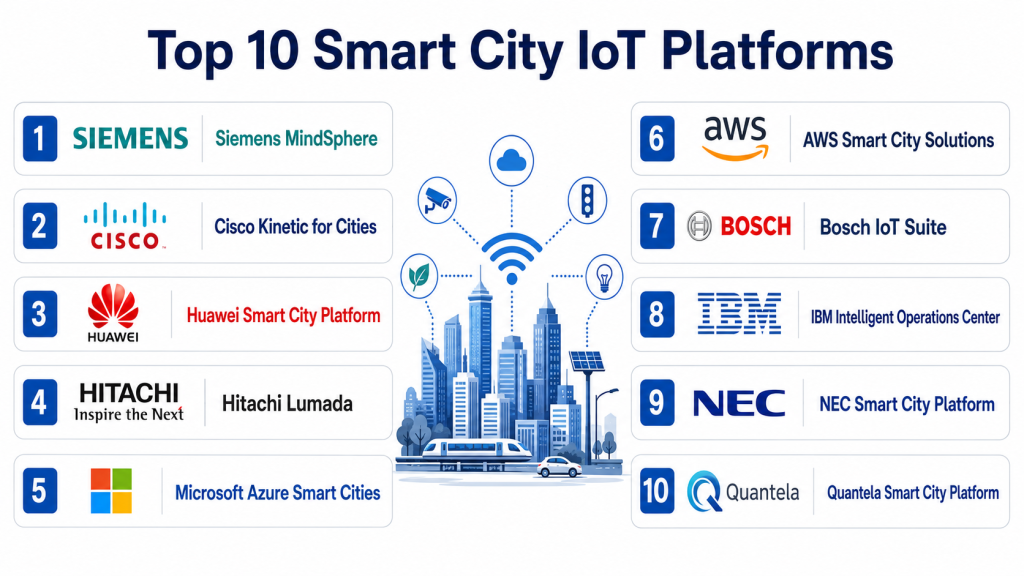
Introduction
Smart City IoT Platforms help governments, municipalities, utilities, and urban infrastructure providers connect, monitor, automate, and optimize city operations using connected devices, sensors, analytics, and cloud platforms. These platforms collect and process real-time data from transportation systems, street lighting, water infrastructure, traffic systems, public safety networks, waste management systems, environmental sensors, and energy infrastructure.
Modern cities increasingly rely on IoT-driven automation to improve operational efficiency, sustainability, citizen services, and infrastructure reliability. Real-world use cases include intelligent traffic management, smart parking, connected street lighting, environmental monitoring, smart utility metering, emergency response coordination, public safety monitoring, and predictive maintenance of city assets. Buyers should evaluate scalability, interoperability, device management, analytics, security, integration support, edge computing capabilities, AI automation, deployment flexibility, and compliance readiness.
Best for: Municipal governments, smart infrastructure providers, transportation authorities, utility operators, urban planners, telecom providers, and public-sector technology teams.
Not ideal for: Small towns with limited digital infrastructure, organizations without IoT operational expertise, or projects that only require isolated monitoring without large-scale connected infrastructure.
Key Trends in Smart City IoT Platforms
- AI-powered traffic optimization and predictive analytics
- Edge computing for low-latency city operations
- Digital twin technology for urban planning and monitoring
- Integration of smart lighting, parking, and utility systems
- Real-time environmental and pollution monitoring
- 5G-enabled smart infrastructure deployments
- Unified dashboards for city-wide operational visibility
- Increased focus on cybersecurity and citizen data privacy
- IoT interoperability across multiple vendors and protocols
- Sustainability-driven energy and resource optimization initiatives
How We Selected These Tools
- Evaluated adoption in smart city and public-sector projects
- Assessed IoT scalability and multi-device management capabilities
- Reviewed analytics, AI, and automation features
- Verified integration flexibility with sensors, utilities, and city systems
- Assessed security and compliance support where publicly stated
- Reviewed edge computing and cloud deployment flexibility
- Evaluated reporting, dashboards, and operational visibility
- Considered support for transportation, utilities, and infrastructure use cases
- Reviewed ecosystem maturity and developer tools
- Assessed documentation, support, and implementation capabilities
Top 10 Smart City IoT Platforms
#1 — Cisco Kinetic for Cities
Short description: Cisco Kinetic for Cities helps municipalities connect, manage, and optimize urban infrastructure through centralized IoT data integration, analytics, and automation. It supports smart transportation, utilities, public safety, and connected infrastructure projects. The platform focuses on operational visibility, edge intelligence, and scalable city-wide deployments. It is widely used in enterprise-grade smart city environments.
Key Features
- Centralized IoT data management
- Smart transportation and parking support
- Real-time analytics and dashboards
- Edge computing integration
- Public safety and utility monitoring
- Device and sensor interoperability
- AI-assisted operational insights
Pros
- Enterprise-grade scalability
- Strong networking and IoT integration
- Advanced analytics capabilities
- Good edge computing support
Cons
- Complex implementation requirements
- Premium enterprise pricing
- Requires experienced IT teams
- Best suited for large-scale deployments
Platforms / Deployment
Cloud / Edge / Hybrid
IoT Devices / Sensors / Smart Infrastructure
Security & Compliance
- Encryption, RBAC, secure networking
- Supports enterprise-grade security architecture
Integrations & Ecosystem
Cisco Kinetic integrates with networking infrastructure, city sensors, transportation systems, and operational analytics environments.
- Cisco networking ecosystem
- Smart traffic systems
- Utility monitoring systems
- Video surveillance systems
- APIs and IoT integrations
- Edge infrastructure
Support & Community
Enterprise support, implementation services, partner ecosystem, and extensive technical documentation.
#2 — Siemens MindSphere
Short description: Siemens MindSphere is an industrial IoT and smart infrastructure platform used for urban utilities, transportation systems, energy optimization, and infrastructure monitoring. It combines analytics, device connectivity, automation, and operational intelligence. MindSphere is especially strong in industrial and utility-focused smart city projects where reliability and operational technology integration are critical.
Key Features
- Industrial IoT and smart infrastructure management
- Real-time analytics and dashboards
- Energy and utility optimization
- Edge and cloud deployment support
- Asset monitoring and predictive maintenance
- AI-powered operational insights
- Device connectivity and automation workflows
Pros
- Strong industrial infrastructure expertise
- Excellent utility and energy integrations
- Scalable enterprise architecture
- Good predictive maintenance capabilities
Cons
- Complex deployment for smaller municipalities
- Requires industrial IoT expertise
- Enterprise-focused pricing
- Implementation timelines can be long
Platforms / Deployment
Cloud / Edge / Hybrid
Industrial IoT / Smart Infrastructure
Security & Compliance
- Encryption, secure industrial connectivity, RBAC
- Compliance support depends on deployment model
Integrations & Ecosystem
MindSphere connects industrial systems, smart grids, utilities, and infrastructure management environments.
- Siemens industrial ecosystem
- Utility systems
- Energy management systems
- Industrial automation platforms
- APIs and analytics tools
- Edge gateways
Support & Community
Enterprise support, engineering services, documentation, and industrial integration expertise.
#3 — AWS IoT
Short description: AWS IoT provides scalable cloud infrastructure for smart city deployments, enabling device management, analytics, automation, and integration across connected urban systems. It is highly flexible and suitable for transportation, utilities, environmental monitoring, and infrastructure automation projects. AWS IoT works best for organizations already invested in AWS cloud infrastructure.
Key Features
- Massive IoT device scalability
- Real-time analytics and event processing
- AI and machine learning integrations
- Device management and monitoring
- Serverless automation workflows
- Edge computing support
- Cloud-native operational dashboards
Pros
- Extremely scalable cloud infrastructure
- Strong AI and analytics ecosystem
- Flexible integration architecture
- Broad IoT service portfolio
Cons
- Requires cloud engineering expertise
- Complex pricing structure
- Smart city workflows require configuration
- Governance must be carefully managed
Platforms / Deployment
Cloud / Edge
IoT Devices / Sensors / Smart Infrastructure
Security & Compliance
- IAM, encryption, logging, secure certificates
- Broad cloud compliance ecosystem
Integrations & Ecosystem
AWS IoT integrates with analytics, AI, edge computing, and infrastructure automation workflows.
- AWS analytics services
- AI and machine learning tools
- IoT Core and edge services
- Monitoring and alerting systems
- APIs and automation pipelines
- Smart infrastructure applications
Support & Community
Large cloud ecosystem, enterprise support, training resources, and extensive documentation.
#4 — Microsoft Azure IoT
Short description: Azure IoT enables smart city organizations to connect infrastructure, utilities, transportation systems, and public services through cloud-native IoT management and analytics. It supports digital twins, AI automation, edge computing, and operational dashboards. Azure IoT is especially useful for municipalities already using Microsoft enterprise services.
Key Features
- IoT device and infrastructure management
- Digital twin support
- AI-driven analytics and automation
- Edge and hybrid cloud deployment
- Smart utility and transportation integrations
- Real-time monitoring dashboards
- Security and identity management
Pros
- Strong Microsoft ecosystem integration
- Good digital twin capabilities
- Scalable cloud infrastructure
- Flexible AI and analytics support
Cons
- Requires Azure cloud expertise
- Enterprise implementation complexity
- Pricing varies by scale and services
- Device integration planning required
Platforms / Deployment
Cloud / Edge / Hybrid
IoT Devices / Smart Infrastructure
Security & Compliance
- Identity management, encryption, RBAC
- Enterprise compliance ecosystem support
Integrations & Ecosystem
Azure IoT integrates with analytics, AI, identity management, and operational monitoring systems.
- Azure Digital Twins
- Power BI
- AI and machine learning tools
- Edge gateways
- APIs and automation services
- Enterprise identity systems
Support & Community
Enterprise support, Microsoft partner ecosystem, technical documentation, and cloud training resources.
#5 — Hitachi Lumada
Short description: Hitachi Lumada is an IoT and analytics platform focused on infrastructure optimization, smart transportation, utilities, and industrial operations. It combines operational technology, AI analytics, and connected infrastructure management. Lumada is widely used in transportation, energy, and public infrastructure modernization projects.
Key Features
- Smart infrastructure analytics
- Predictive maintenance capabilities
- Transportation and mobility monitoring
- Utility optimization and automation
- AI-powered operational insights
- Industrial IoT integration
- Real-time infrastructure dashboards
Pros
- Strong operational technology expertise
- Good transportation and utility capabilities
- AI-driven analytics support
- Suitable for infrastructure-heavy deployments
Cons
- Enterprise-focused platform
- Complex implementation requirements
- Requires industrial integration expertise
- Limited SMB relevance
Platforms / Deployment
Cloud / Edge / Hybrid
Industrial IoT / Smart Infrastructure
Security & Compliance
- Encryption, access management, industrial security controls
- Compliance support depends on deployment architecture
Integrations & Ecosystem
Lumada integrates with industrial systems, transportation infrastructure, and smart utility environments.
- Transportation systems
- Utility infrastructure
- AI analytics tools
- Edge gateways
- Industrial automation platforms
- APIs and monitoring tools
Support & Community
Enterprise consulting, implementation services, technical documentation, and support resources.
#6 — Bosch IoT Suite
Short description: Bosch IoT Suite provides connected infrastructure management for transportation, utilities, smart buildings, and urban automation projects. It focuses on interoperability, secure connectivity, and IoT device management. Bosch IoT Suite is useful for organizations deploying mixed-vendor smart city environments.
Key Features
- IoT device and sensor management
- Smart building and utility integration
- Real-time monitoring dashboards
- Rule-based automation
- Edge and cloud deployment support
- Secure connectivity management
- API-driven integration framework
Pros
- Strong interoperability support
- Flexible deployment architecture
- Good smart building integration
- Useful for mixed infrastructure environments
Cons
- Advanced analytics may require external tools
- Complex configuration for large deployments
- Enterprise-focused licensing
- Learning curve for new users
Platforms / Deployment
Cloud / Edge / Hybrid
IoT Devices / Smart Infrastructure
Security & Compliance
- Secure device communication, encryption, RBAC
- Compliance support depends on deployment model
Integrations & Ecosystem
Bosch IoT Suite integrates with smart infrastructure, automation systems, and IoT analytics environments.
- Smart buildings
- Utility systems
- Edge gateways
- APIs and automation workflows
- Sensor networks
- Cloud infrastructure tools
Support & Community
Technical documentation, partner support, onboarding services, and enterprise support resources.
#7 — Huawei OceanConnect IoT
Short description: Huawei OceanConnect IoT supports smart city deployments through large-scale device connectivity, analytics, automation, and infrastructure management. It is designed for telecom-scale IoT environments and supports transportation, utility, and public infrastructure use cases. OceanConnect is often used in large connected infrastructure projects.
Key Features
- Massive device connectivity support
- Smart transportation and utility monitoring
- AI-driven analytics and automation
- Edge and cloud deployment capabilities
- Real-time infrastructure monitoring
- IoT device lifecycle management
- Telecom-grade scalability
Pros
- Telecom-scale infrastructure support
- Strong device connectivity capabilities
- Good for large deployments
- Supports hybrid infrastructure models
Cons
- Regional adoption varies
- Requires advanced IoT expertise
- Complex implementation workflows
- Governance considerations may apply
Platforms / Deployment
Cloud / Edge / Hybrid
IoT Devices / Telecom Infrastructure
Security & Compliance
- Secure connectivity and identity management
- Compliance support varies by deployment and region
Integrations & Ecosystem
OceanConnect integrates with telecom, utility, transportation, and smart infrastructure systems.
- Telecom infrastructure
- Smart transportation systems
- Utility platforms
- AI analytics tools
- APIs and automation workflows
- Edge computing environments
Support & Community
Enterprise support, implementation consulting, technical resources, and ecosystem partnerships.
#8 — Oracle Smart City Platform
Short description: Oracle Smart City Platform combines IoT, analytics, cloud infrastructure, and operational intelligence for urban infrastructure and public services. It helps municipalities manage utilities, traffic, environmental monitoring, and public operations through centralized dashboards and AI-driven analytics. Oracle’s strength lies in enterprise data management and analytics integration.
Key Features
- Centralized city operations dashboards
- Smart utility and traffic management
- AI-powered analytics and reporting
- Real-time event monitoring
- IoT device connectivity
- Data integration and governance
- Cloud infrastructure management
Pros
- Strong enterprise analytics capabilities
- Good operational visibility
- Scalable cloud infrastructure
- Robust data management support
Cons
- Enterprise implementation complexity
- Requires Oracle ecosystem expertise
- Higher operational costs possible
- Less developer-friendly than some alternatives
Platforms / Deployment
Cloud / Hybrid
IoT Devices / Smart Infrastructure
Security & Compliance
- Encryption, identity management, access controls
- Enterprise-grade cloud governance capabilities
Integrations & Ecosystem
Oracle integrates analytics, databases, IoT infrastructure, and operational dashboards into centralized city operations.
- Oracle Cloud
- Analytics and BI tools
- Utility and transportation systems
- APIs and middleware
- AI services
- Monitoring platforms
Support & Community
Enterprise support, consulting services, technical documentation, and cloud ecosystem resources.
#9 — PTC ThingWorx
Short description: PTC ThingWorx is an industrial IoT platform supporting smart infrastructure, utilities, transportation systems, and connected city operations. It combines IoT connectivity, analytics, AR capabilities, and operational monitoring. ThingWorx is especially useful for organizations integrating industrial systems into broader smart city projects.
Key Features
- Industrial IoT connectivity
- Real-time infrastructure monitoring
- Predictive analytics and automation
- AR-assisted operational workflows
- Device and asset management
- Integration with industrial systems
- Dashboard and reporting tools
Pros
- Strong industrial IoT capabilities
- Good analytics and visualization
- Useful AR integration features
- Flexible infrastructure support
Cons
- Complex deployment workflows
- Requires technical expertise
- Premium enterprise pricing
- SMB adoption may be limited
Platforms / Deployment
Cloud / Edge / Hybrid
Industrial IoT / Smart Infrastructure
Security & Compliance
- Secure device communication, encryption, RBAC
- Compliance support depends on deployment configuration
Integrations & Ecosystem
ThingWorx integrates industrial automation, analytics, and connected infrastructure systems.
- Industrial automation platforms
- Utility infrastructure
- AR tools
- Analytics and dashboards
- APIs and cloud integrations
- Smart infrastructure systems
Support & Community
Technical documentation, enterprise onboarding, support resources, and industrial IoT ecosystem support.
#10 — FIWARE
Short description: FIWARE is an open-source smart city platform framework that supports interoperability, IoT data management, and urban service integration. It is widely used in public-sector and smart city innovation projects because of its open architecture and standards-based approach. FIWARE is especially useful for municipalities seeking flexibility and vendor neutrality.
Key Features
- Open-source smart city framework
- IoT data context management
- Interoperability and standards support
- Real-time data processing
- Smart infrastructure integration
- APIs and open ecosystem support
- Multi-domain urban service support
Pros
- Open-source flexibility
- Strong interoperability model
- Vendor-neutral architecture
- Useful for innovation-focused projects
Cons
- Requires engineering and integration expertise
- Support quality depends on implementation partner
- Enterprise governance must be planned carefully
- Advanced analytics may require external tools
Platforms / Deployment
Cloud / Edge / Hybrid
IoT Devices / Smart Infrastructure
Security & Compliance
- Security depends on deployment architecture and implementation choices
- Compliance support varies by deployment model
Integrations & Ecosystem
FIWARE integrates with open IoT standards, APIs, and smart infrastructure services.
- Open APIs
- IoT gateways
- Smart transportation systems
- Environmental sensors
- Utility systems
- Open-source analytics tools
Support & Community
Large open-source community, implementation partners, documentation, and smart city collaboration ecosystem.
Comparison Table
| Tool Name | Best For | Platform Supported | Deployment | Standout Feature | Public Rating |
|---|---|---|---|---|---|
| Cisco Kinetic for Cities | Large smart cities | IoT / Smart Infrastructure | Cloud / Edge / Hybrid | City-wide operational visibility | N/A |
| Siemens MindSphere | Industrial smart infrastructure | Industrial IoT | Cloud / Hybrid | Utility and industrial optimization | N/A |
| AWS IoT | Scalable IoT deployments | IoT / Sensors | Cloud / Edge | Massive cloud scalability | N/A |
| Azure IoT | Microsoft-based smart cities | IoT / Smart Infrastructure | Cloud / Hybrid | Digital twin integration | N/A |
| Hitachi Lumada | Transportation and utilities | Industrial IoT | Cloud / Hybrid | Predictive infrastructure analytics | N/A |
| Bosch IoT Suite | Mixed smart infrastructure | IoT / Buildings | Cloud / Edge | Interoperability support | N/A |
| Huawei OceanConnect | Telecom-scale deployments | Telecom / IoT | Cloud / Hybrid | Large-scale connectivity | N/A |
| Oracle Smart City Platform | Data-driven city operations | Smart Infrastructure | Cloud / Hybrid | Enterprise analytics integration | N/A |
| PTC ThingWorx | Industrial smart city operations | Industrial IoT | Cloud / Edge | Industrial analytics and AR | N/A |
| FIWARE | Open smart city ecosystems | IoT / Smart Infrastructure | Cloud / Hybrid | Open-source interoperability | N/A |
Evaluation & Scoring
| Tool Name | Core 25% | Ease 15% | Integrations 15% | Security 10% | Performance 10% | Support 10% | Value 15% | Weighted Total |
|---|---|---|---|---|---|---|---|---|
| Cisco Kinetic for Cities | 9 | 7.5 | 9 | 8.5 | 8.5 | 8 | 7 | 8.2 |
| Siemens MindSphere | 8.5 | 7 | 8.5 | 8.5 | 8.5 | 8 | 7 | 8.0 |
| AWS IoT | 9 | 7 | 9 | 9 | 9 | 8 | 7.5 | 8.4 |
| Azure IoT | 8.5 | 7.5 | 9 | 9 | 8.5 | 8 | 7.5 | 8.3 |
| Hitachi Lumada | 8.5 | 7 | 8 | 8 | 8 | 7.5 | 7 | 7.8 |
| Bosch IoT Suite | 8 | 7.5 | 8 | 8 | 7.5 | 7.5 | 7.5 | 7.8 |
| Huawei OceanConnect | 8 | 7 | 8 | 8 | 8 | 7 | 7 | 7.6 |
| Oracle Smart City Platform | 8 | 7 | 8.5 | 8.5 | 8 | 7.5 | 7 | 7.8 |
| PTC ThingWorx | 8.5 | 7 | 8 | 8 | 8 | 7.5 | 7 | 7.8 |
| FIWARE | 7.5 | 6.5 | 8.5 | 7 | 7.5 | 7 | 8.5 | 7.5 |
The scoring above is comparative and should be interpreted based on project requirements, infrastructure complexity, and operational maturity. Large enterprise cloud platforms often score highly in scalability and integrations, while open-source frameworks may offer stronger flexibility and cost efficiency for municipalities with in-house engineering capabilities.
Which Smart City IoT Platform Is Right for You?
Solo / Freelancer
Most smart city platforms are designed for enterprise or municipal deployments rather than individual users. Developers and researchers may experiment with FIWARE or cloud IoT platforms for proof-of-concept projects and pilot environments.
SMB
Smaller municipalities or regional infrastructure projects may benefit from Bosch IoT Suite or FIWARE because of flexibility and interoperability. Teams with limited resources should prioritize deployment simplicity, cloud management, and managed support services.
Mid-Market
Mid-sized city initiatives often require centralized dashboards, analytics, utility integration, and transportation visibility. Azure IoT, AWS IoT, and Oracle Smart City Platform provide balanced scalability, analytics, and integration capabilities for expanding infrastructure projects.
Enterprise
Large smart city deployments should evaluate Cisco Kinetic for Cities, Siemens MindSphere, AWS IoT, Azure IoT, and Hitachi Lumada for enterprise-grade scalability, operational intelligence, and infrastructure integration. These platforms are suitable for transportation authorities, utilities, and national-scale urban modernization projects.
Budget vs Premium
Open-source and interoperability-focused platforms such as FIWARE may reduce licensing costs but require stronger engineering resources. Premium enterprise platforms provide managed support, advanced analytics, automation, and stronger operational tooling, but implementation costs can be significant.
Feature Depth vs Ease of Use
Cloud hyperscale platforms offer deep analytics and AI capabilities but require technical cloud expertise. Open-source platforms provide flexibility but demand more integration effort. Simpler managed platforms may accelerate deployment for municipalities with smaller technical teams.
Integrations & Scalability
Smart city platforms must integrate with sensors, transportation systems, utility infrastructure, GIS systems, analytics platforms, and operational dashboards. Scalability should be validated using real deployment conditions, especially for large populations and distributed infrastructure environments.
Security & Compliance Needs
Cities should prioritize encryption, identity management, secure APIs, audit logs, role-based access controls, and operational governance. Public-sector deployments must also consider citizen privacy, infrastructure resilience, and compliance with regional security regulations.
Frequently Asked Questions
1. What is a Smart City IoT Platform?
A Smart City IoT Platform helps cities connect and manage infrastructure, devices, sensors, utilities, transportation systems, and public services through centralized software and analytics tools. These platforms support automation, monitoring, and operational intelligence across urban environments.
2. Why are Smart City IoT Platforms important?
They improve operational efficiency, reduce infrastructure costs, optimize energy usage, enhance public safety, and support better citizen services. Smart city platforms also help cities use real-time data for planning and decision-making.
3. What industries benefit most from these platforms?
Municipal governments, transportation authorities, utilities, telecom providers, public safety agencies, and urban infrastructure operators benefit significantly from smart city IoT platforms.
4. Are cloud platforms necessary for smart city projects?
Cloud platforms are commonly used because they provide scalability, analytics, and centralized management. However, many smart city projects also use edge computing and hybrid infrastructure for low-latency operations and local data processing.
5. What role does AI play in smart city platforms?
AI helps analyze traffic patterns, predict infrastructure failures, optimize energy usage, automate alerts, and improve operational efficiency across city services.
6. How important is interoperability in smart city deployments?
Interoperability is critical because cities often use devices and systems from multiple vendors. Platforms must support open standards, APIs, and integration frameworks to avoid vendor lock-in.
7. What are the biggest deployment challenges?
Common challenges include integration complexity, cybersecurity risks, data governance, infrastructure modernization, scalability, and long implementation timelines.
8. Are these platforms secure?
Most enterprise-grade platforms provide encryption, identity management, access controls, and monitoring capabilities. Security still depends heavily on deployment architecture, governance policies, and operational practices.
9. What should buyers prioritize first?
Cities should first define operational goals, infrastructure priorities, integration requirements, and governance policies before selecting a platform. Scalability and interoperability are especially important for long-term success.
10. Can smaller municipalities use these platforms?
Yes, smaller municipalities can start with focused use cases such as smart lighting, environmental monitoring, or traffic optimization before expanding into broader smart city initiatives.
Conclusion
Smart City IoT Platforms are becoming foundational technologies for modern urban infrastructure, enabling cities to optimize transportation, utilities, public safety, environmental monitoring, and citizen services through connected systems and real-time analytics. Large enterprise platforms such as AWS IoT, Azure IoT, Cisco Kinetic for Cities, and Siemens MindSphere provide scalability and advanced operational intelligence for major urban deployments, while FIWARE and Bosch IoT Suite offer interoperability and flexibility for municipalities seeking more open architectures. The best platform depends on infrastructure complexity, operational goals, technical expertise, integration requirements, and governance priorities. Cities should begin with targeted pilot projects, validate interoperability and security controls, measure operational impact, and then scale deployments strategically across broader urban systems.

This article provides a clear overview of smart city IoT platforms and explains how they help improve urban services through connected technologies and real-time data management. It also highlights how these platforms support smarter infrastructure, sustainability, and better city operations.
One challenge that is often underestimated in smart city deployments is cross-department data ownership and governance. Most platforms can ingest data from traffic, utilities, public safety, and environmental systems, but long-term success depends on establishing common data models, privacy controls, and inter-agency operating procedures. Without strong governance, cities risk creating isolated data silos that limit the value of analytics and increase operational complexity as new services are added. Additionally, the article could explore how these platforms handle citizen privacy, AI transparency, and data residency requirements, which are becoming critical procurement criteria for modern municipalities.
Smart city platforms are expected to integrate data from transportation, utilities, public safety, and environmental systems, which makes interoperability a major long-term challenge. Even with strong platform capabilities, inconsistent standards and siloed data ownership can limit the effectiveness of city-wide initiatives. Discussing open data strategies, cross-agency governance, and vendor lock-in mitigation would provide valuable insight for municipalities planning sustainable digital infrastructure.
Smart city IoT platforms are most successful when they enable collaboration across departments rather than operating as isolated technology solutions. Transportation, utilities, public safety, environmental monitoring, and emergency services often generate valuable data that can improve one another’s operations. Including insights on cross-domain data sharing, open standards, digital twin integration, and citizen privacy governance would provide readers with a more comprehensive understanding of how smart city platforms create long-term value for both municipalities and residents.