Introduction
Security Posture Management CNAPP suites are unified cloud security platforms that combine Cloud Security Posture Management CSPM, Cloud Workload Protection Platform CWPP, Cloud Infrastructure Entitlement Management CIEM, and often application and data security into a single system. These platforms continuously assess, monitor, and protect cloud-native environments across infrastructure, workloads, identities, and applications.
In simple terms, CNAPP suites give organizations a single “security control plane” to understand and reduce risk across the entire cloud stack—from misconfigurations in cloud accounts to vulnerabilities in running workloads and exposed identities.
This matters more in 2026 because cloud environments are no longer simple. Organizations now run multi-cloud infrastructure, Kubernetes clusters, serverless workloads, APIs, and AI-driven applications. This complexity creates blind spots when using separate security tools. CNAPP solves this by unifying visibility, context, and enforcement into one platform.
Common real-world use cases include detecting cloud misconfigurations, identifying risky IAM permissions, scanning containers and Kubernetes clusters, monitoring cloud workloads in real time, preventing data exposure, enforcing compliance policies, and prioritizing risks based on exploitability.
When evaluating CNAPP Security Posture Management tools, buyers should consider cloud coverage, workload protection depth, identity security, runtime visibility, policy automation, integration ecosystem, CI CD support, AI-driven risk prioritization, compliance mapping, scalability, and remediation automation.
Best for: Cloud security teams, DevSecOps engineers, platform engineering teams, enterprise security architects, SOC teams, and organizations running multi-cloud or Kubernetes-heavy environments.
Not ideal for: very small cloud setups, basic hosting environments, or teams without cloud-native infrastructure.
Key Trends in Security Posture Management CNAPP Suites
- Convergence of CSPM, CWPP, CIEM, and DSPM into unified platforms
- Shift toward agentless-first architecture for faster cloud visibility
- AI-driven risk prioritization and attack path analysis
- Real-time runtime protection across containers and serverless workloads
- Strong focus on Kubernetes and container security posture management
- Increased adoption of graph-based security models for attack path mapping
- Integration of DevSecOps workflows into CI CD pipelines
- Continuous compliance automation replacing manual audits
- Identity-centric cloud security becoming a core CNAPP pillar
- Expansion into AI workload and API security protection layers
CNAPP platforms are increasingly expected to provide unified visibility across infrastructure, identities, applications, and data to reduce tool sprawl and improve risk prioritization.
How We Selected These Tools
- Focused on platforms recognized as CNAPP leaders or widely adopted in cloud security programs
- Included tools combining CSPM, CWPP, CIEM, and posture management capabilities
- Prioritized multi-cloud and Kubernetes support
- Evaluated real-time detection and runtime protection capabilities
- Considered DevSecOps and CI CD integration strength
- Included both enterprise-grade and developer-friendly CNAPP platforms
- Assessed AI-driven risk analysis and automation features where available
- Reviewed scalability across large enterprise cloud environments
- Focused on platforms actively used in production CNAPP deployments
- Avoided tools without meaningful CNAPP consolidation capabilities
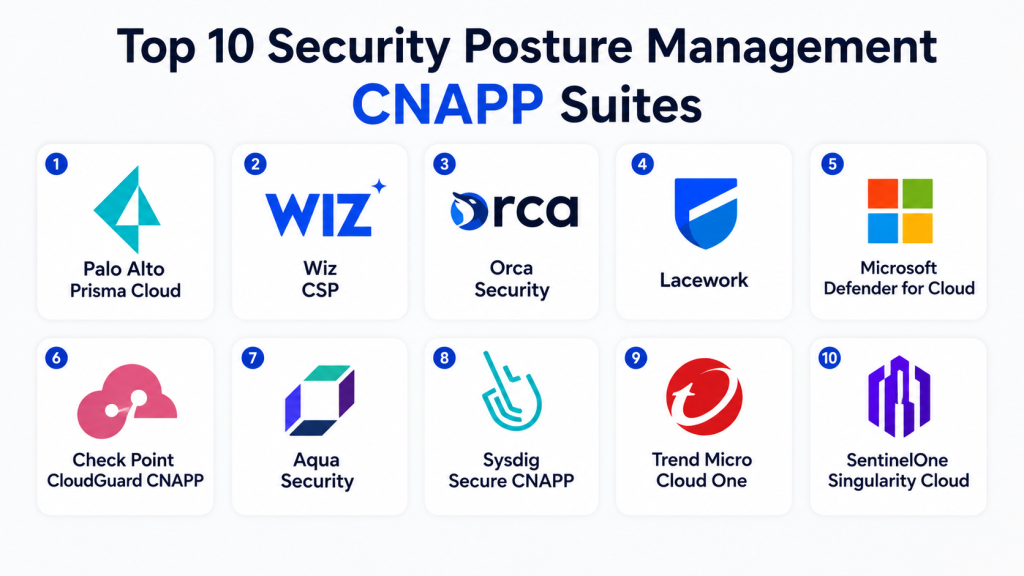
Top 10 Security Posture Management CNAPP Suites
1- Wiz
Short description: Wiz is a leading agentless CNAPP platform that provides full cloud visibility across infrastructure, workloads, identities, and data. It uses graph-based analysis to detect attack paths and prioritize critical risks. Wiz is widely used for multi-cloud environments requiring fast deployment and deep security context.
Key Features
- Agentless cloud security posture management
- Attack path analysis using security graph model
- CSPM, CWPP, CIEM, and DSPM capabilities
- Kubernetes and container security visibility
- Identity and permission risk analysis
- Continuous cloud environment scanning
- Real-time risk prioritization engine
Pros
- Very fast deployment due to agentless architecture
- Strong visibility across multi-cloud environments
- Excellent attack path correlation
- Low operational overhead
Cons
- Limited agent-based deep runtime control
- Enterprise pricing model
- Requires tuning for large-scale environments
- Advanced customization may be complex
Platforms / Deployment
Web. Cloud SaaS.
Security & Compliance
Supports enterprise security controls including RBAC, audit logs, and compliance mapping. Not publicly stated for certifications.
Integrations & Ecosystem
Wiz integrates deeply into cloud ecosystems and DevSecOps workflows.
- AWS
- Microsoft Azure
- Google Cloud
- Kubernetes
- CI CD pipelines
- SIEM tools
Support & Community
Strong enterprise support and rapidly growing cloud security community adoption.
2- Palo Alto Prisma Cloud
Short description: Prisma Cloud is a comprehensive CNAPP platform that provides CSPM, CWPP, CIEM, and application security capabilities. It is designed for large enterprises requiring end-to-end cloud security and compliance enforcement across hybrid and multi-cloud environments.
Key Features
- Full CNAPP coverage CSPM CWPP CIEM
- Cloud workload protection for containers and VMs
- Identity and entitlement security management
- Kubernetes security posture management
- Compliance and policy enforcement dashboards
- Runtime threat detection and response
- Infrastructure as code security scanning
Pros
- Extremely broad enterprise security coverage
- Strong compliance and governance capabilities
- Deep integration with cloud ecosystems
- Suitable for large scale hybrid environments
Cons
- Complex deployment and configuration
- High operational overhead
- Enterprise pricing model
- Requires skilled security teams
Platforms / Deployment
Cloud. Hybrid. Self-hosted components available.
Security & Compliance
Supports enterprise-grade compliance frameworks, audit logs, RBAC, and policy enforcement. Not publicly stated for exact certifications.
Integrations & Ecosystem
- AWS
- Azure
- Google Cloud
- Kubernetes
- DevOps pipelines
- SIEM platforms
Support & Community
Enterprise support with global security operations and professional services.
3- Orca Security
Short description: Orca Security is an agentless CNAPP platform that provides deep cloud visibility, vulnerability detection, and compliance monitoring across cloud environments. It is known for its SideScanning technology that enables fast and lightweight security coverage.
Key Features
- Agentless cloud security posture management
- SideScanning workload analysis
- CSPM, CWPP, CIEM capabilities
- Kubernetes and container security
- Vulnerability and malware detection
- Cloud identity risk analysis
- Continuous compliance monitoring
Pros
- No agents required for deployment
- Strong vulnerability visibility
- Fast time to value
- Good multi-cloud support
Cons
- Less granular runtime control than agent-based tools
- Enterprise pricing model
- Advanced features may require tuning
- Limited customization in some workflows
Platforms / Deployment
Cloud SaaS.
Security & Compliance
Provides compliance dashboards and audit reporting. Not publicly stated for certifications.
Integrations & Ecosystem
- AWS
- Azure
- Google Cloud
- Kubernetes
- SIEM tools
- DevSecOps pipelines
Support & Community
Strong enterprise support and growing adoption in cloud-native security teams.
4- CrowdStrike Falcon Cloud Security
Short description: CrowdStrike Falcon Cloud Security is an AI-powered CNAPP platform that provides unified cloud workload protection, posture management, and identity security. It extends CrowdStrike’s endpoint security leadership into cloud-native environments.
Key Features
- Cloud workload protection CWPP
- CSPM and CIEM capabilities
- AI-driven threat detection
- Container and Kubernetes security
- Identity-based cloud risk analysis
- Real-time runtime protection
- Integrated threat intelligence
Pros
- Strong AI-driven threat detection
- Unified endpoint and cloud security ecosystem
- High performance runtime protection
- Strong threat intelligence integration
Cons
- Complex enterprise ecosystem
- Requires CrowdStrike platform adoption
- Pricing may be high
- Learning curve for full capabilities
Platforms / Deployment
Cloud SaaS.
Security & Compliance
Enterprise-grade security controls, RBAC, audit logging, and compliance workflows. Not publicly stated for certifications.
Integrations & Ecosystem
- AWS
- Azure
- Google Cloud
- Kubernetes
- SIEM platforms
- Security operations tools
Support & Community
Strong enterprise SOC integration and global support infrastructure.
5- Microsoft Defender for Cloud
Short description: Microsoft Defender for Cloud is a CNAPP solution that provides security posture management, workload protection, and compliance monitoring for Azure and multi-cloud environments. It is tightly integrated with Microsoft security and identity ecosystem.
Key Features
- CSPM for Azure and multi-cloud environments
- CWPP for servers, containers, and workloads
- CIEM identity and access security
- Security posture recommendations
- Kubernetes and container protection
- Compliance dashboards
- Threat detection and response
Pros
- Strong Azure native integration
- Good enterprise compliance coverage
- Unified Microsoft security ecosystem
- Easy adoption for Azure users
Cons
- Best features optimized for Azure
- Complex for multi-cloud beyond Microsoft stack
- Requires Microsoft ecosystem dependency
- Advanced features may require configuration
Platforms / Deployment
Cloud SaaS.
Security & Compliance
Supports enterprise compliance frameworks and audit reporting. Not publicly stated for full certification details.
Integrations & Ecosystem
- Azure
- Microsoft 365
- GitHub
- Kubernetes
- SIEM tools
- DevOps pipelines
Support & Community
Strong Microsoft enterprise support and documentation ecosystem.
6- Sysdig Secure CNAPP
Short description: Sysdig Secure CNAPP provides cloud security posture management and runtime protection focused on containers and Kubernetes environments. It is widely used in cloud-native and DevSecOps-heavy organizations.
Key Features
- Kubernetes security posture management
- Runtime threat detection for containers
- CSPM and vulnerability management
- Cloud workload protection
- Compliance monitoring
- Container visibility and forensics
- DevSecOps pipeline integration
Pros
- Strong Kubernetes focus
- Excellent runtime visibility
- Good DevSecOps integration
- Deep container security capabilities
Cons
- Less focus on non-container workloads
- Requires Kubernetes expertise
- Enterprise features may require tuning
- Not fully agentless
Platforms / Deployment
Cloud SaaS. Hybrid options.
Security & Compliance
Supports compliance reporting and runtime security controls. Not publicly stated for certifications.
Integrations & Ecosystem
- Kubernetes
- AWS
- Azure
- Google Cloud
- CI CD pipelines
- DevSecOps tools
Support & Community
Strong cloud-native community and enterprise support offerings.
7- Aqua Security CNAPP
Short description: Aqua Security provides CNAPP capabilities focused on container security, workload protection, and cloud posture management. It is widely used for securing Kubernetes and containerized environments.
Key Features
- Container security and scanning
- Kubernetes workload protection
- CSPM capabilities
- CIEM identity security
- Runtime protection for cloud workloads
- DevSecOps pipeline integration
- Compliance enforcement
Pros
- Strong container and Kubernetes security
- Good DevSecOps integration
- Mature cloud-native security platform
- Flexible deployment options
Cons
- Complex configuration in large environments
- Less strong in agentless models
- Requires Kubernetes maturity
- Enterprise pricing structure
Platforms / Deployment
Cloud SaaS. On-premise. Hybrid.
Security & Compliance
Supports compliance frameworks and runtime security policies. Not publicly stated for certifications.
Integrations & Ecosystem
- Kubernetes
- AWS
- Azure
- Google Cloud
- CI CD pipelines
- DevOps tools
Support & Community
Strong enterprise support and cloud-native security community.
8- Sysdig Secure CNAPP Alternative Views
(Sysdig also overlaps CNAPP and runtime security)
Key Features
- Cloud security posture visibility
- Kubernetes runtime protection
- Threat detection and forensics
- Policy-based compliance enforcement
- Container vulnerability scanning
Pros
- Deep container observability
- Strong runtime security focus
- Good Kubernetes insights
- Strong DevSecOps alignment
Cons
- Limited traditional enterprise CSPM depth
- Requires Kubernetes expertise
- Not fully agentless
- Complex for beginners
Platforms / Deployment
Cloud SaaS.
Security & Compliance
Supports security monitoring and compliance tracking. Not publicly stated.
Integrations & Ecosystem
- Kubernetes
- Cloud platforms
- CI CD systems
- Security tools
Support & Community
Strong DevSecOps and Kubernetes community adoption.
9- SentinelOne Singularity Cloud
Short description: SentinelOne Singularity Cloud is an AI-driven CNAPP platform that provides cloud workload protection, posture management, and identity security across multi-cloud environments.
Key Features
- AI-powered cloud threat detection
- CSPM and CWPP capabilities
- Identity security management
- Kubernetes protection
- Automated incident response
- Cloud workload monitoring
- DevSecOps integration
Pros
- Strong AI-driven security engine
- Unified endpoint and cloud protection ecosystem
- Good runtime protection
- High automation capabilities
Cons
- Enterprise complexity
- Requires platform adoption
- Pricing may be high
- Learning curve for full features
Platforms / Deployment
Cloud SaaS.
Security & Compliance
Enterprise-grade compliance controls and audit logging. Not publicly stated for certifications.
Integrations & Ecosystem
- AWS
- Azure
- Google Cloud
- Kubernetes
- SIEM platforms
- Security operations tools
Support & Community
Strong enterprise SOC and security operations support.
10- Trend Micro Cloud One CNAPP
Short description: Trend Micro Cloud One provides CNAPP capabilities including cloud security posture management, workload protection, and container security. It is widely used in hybrid and enterprise cloud environments.
Key Features
- CSPM for cloud environments
- CWPP workload protection
- Container and Kubernetes security
- File integrity monitoring
- Vulnerability scanning
- Compliance management
- DevSecOps integration
Pros
- Strong enterprise security coverage
- Good hybrid cloud support
- Mature security platform
- Broad workload protection
Cons
- Less modern architecture compared to newer CNAPPs
- Complex configuration
- Enterprise licensing model
- UI complexity in large environments
Platforms / Deployment
Cloud SaaS. Hybrid. On-premise components.
Security & Compliance
Supports enterprise compliance frameworks and security controls. Not publicly stated for certifications.
Integrations & Ecosystem
- AWS
- Azure
- Google Cloud
- Kubernetes
- DevOps pipelines
- Security tools
Support & Community
Strong enterprise support and long-standing security vendor ecosystem.
Comparison Table
| Tool Name | Best For | Platforms Supported | Deployment | Standout Feature | Public Rating |
|---|---|---|---|---|---|
| Wiz | Agentless cloud visibility | AWS Azure GCP | SaaS | Graph-based attack path analysis | N/A |
| Prisma Cloud | Enterprise CNAPP | Multi-cloud | Hybrid | Full CNAPP coverage | N/A |
| Orca Security | Agentless CNAPP | Multi-cloud | SaaS | SideScanning technology | N/A |
| CrowdStrike | AI-driven cloud security | Multi-cloud | SaaS | Threat intelligence integration | N/A |
| Microsoft Defender | Azure-native CNAPP | Azure multi-cloud | SaaS | Azure ecosystem integration | N/A |
| Sysdig Secure | Kubernetes security | Kubernetes cloud | SaaS hybrid | Runtime container protection | N/A |
| Aqua Security | Container security CNAPP | Kubernetes cloud | Hybrid | Kubernetes-native protection | N/A |
| SentinelOne | AI CNAPP platform | Multi-cloud | SaaS | Autonomous threat detection | N/A |
| Trend Micro | Hybrid cloud CNAPP | Multi-cloud | Hybrid | Enterprise workload protection | N/A |
| N/A | CNAPP ecosystem mix | Multi-cloud | Mixed | Combined posture + runtime security | N/A |
Evaluation and Scoring of CNAPP Security Posture Tools
| Tool Name | Core 25% | Ease 15% | Integrations 15% | Security 10% | Performance 10% | Support 10% | Value 15% | Weighted Total |
|---|---|---|---|---|---|---|---|---|
| Wiz | 10 | 9 | 10 | 9 | 9 | 9 | 8 | 9.25 |
| Prisma Cloud | 10 | 7 | 10 | 10 | 9 | 10 | 8 | 9.05 |
| Orca Security | 9 | 9 | 9 | 9 | 9 | 9 | 8 | 8.90 |
| CrowdStrike | 9 | 8 | 9 | 10 | 9 | 9 | 8 | 8.85 |
| Microsoft Defender | 9 | 8 | 9 | 9 | 9 | 10 | 9 | 8.90 |
| Sysdig | 8 | 8 | 9 | 9 | 9 | 8 | 8 | 8.40 |
| Aqua Security | 8 | 7 | 8 | 9 | 8 | 8 | 8 | 8.10 |
| SentinelOne | 9 | 8 | 9 | 9 | 9 | 9 | 8 | 8.70 |
| Trend Micro | 8 | 7 | 8 | 9 | 8 | 9 | 8 | 8.00 |
These scores reflect CNAPP depth, cloud coverage, runtime security, identity protection, integration strength, and enterprise readiness. Wiz and Prisma Cloud lead due to full-stack CNAPP maturity, while Orca excels in agentless visibility. Microsoft Defender is strongest for Azure-centric organizations, and Sysdig dominates Kubernetes-native environments.
Which CNAPP Security Posture Tool Is Right for You
Solo / Freelancer
Solo engineers rarely need full CNAPP platforms. Lightweight cloud security tools or limited CSPM features are more practical. Basic posture monitoring may be sufficient.
SMB
SMBs should prioritize simplicity and fast deployment. Wiz, Orca Security, and Microsoft Defender for Cloud are strong options due to ease of use and cloud-native visibility.
Mid-Market
Mid-market organizations need multi-cloud visibility, CIEM, and workload protection. Wiz, Sysdig, SentinelOne, and Orca Security are strong choices.
Enterprise
Enterprises require full CNAPP coverage including CSPM, CWPP, CIEM, compliance, and runtime protection. Prisma Cloud, Wiz, CrowdStrike, Microsoft Defender, and Trend Micro are leading options.
Budget vs Premium
Open-source CNAPP equivalents are limited. Most CNAPP tools are premium SaaS platforms due to infrastructure complexity. SMBs may start with cloud-native tools like Microsoft Defender or Orca.
Feature Depth vs Ease of Use
Wiz and Orca are easiest to deploy due to agentless architecture. Prisma Cloud offers deepest enterprise features but is more complex. Sysdig and Aqua require Kubernetes expertise.
Integrations & Scalability
Prisma Cloud and Wiz offer the strongest integrations across cloud providers. Microsoft Defender is best for Azure ecosystems. Sysdig and Aqua scale well for Kubernetes-heavy environments.
Security & Compliance Needs
Enterprises in regulated industries should prioritize Prisma Cloud, Wiz, Microsoft Defender, and CrowdStrike due to compliance reporting, audit logs, and governance controls.
Frequently Asked Questions FAQs
1. What is a CNAPP?
A CNAPP is a Cloud Native Application Protection Platform that combines CSPM, CWPP, CIEM, and other security capabilities into a unified system. It helps secure cloud-native applications from development to runtime. It provides centralized visibility and risk management. CNAPP reduces complexity by replacing multiple security tools.
2. Why is CNAPP important?
CNAPP is important because modern cloud environments are complex and distributed. Traditional security tools create silos and blind spots. CNAPP unifies visibility and improves risk prioritization. It helps organizations manage cloud security at scale.
3. What is CSPM in CNAPP?
CSPM stands for Cloud Security Posture Management. It identifies misconfigurations in cloud infrastructure. It ensures compliance with security best practices. It is a core component of CNAPP platforms.
4. What is CWPP in CNAPP?
CWPP stands for Cloud Workload Protection Platform. It secures workloads like virtual machines, containers, and serverless functions. It provides runtime protection against threats. It is a key part of CNAPP architecture.
5. What is CIEM in CNAPP?
CIEM stands for Cloud Infrastructure Entitlement Management. It manages identities and permissions across cloud environments. It reduces excessive privileges and access risks. It is essential for identity security.
6. Are CNAPP tools cloud-only?
Most CNAPP tools are cloud-based SaaS platforms. However, some support hybrid and on-premise deployments. They are designed for cloud-native environments. Cloud-first architecture is standard.
7. Do CNAPP tools replace all security tools?
CNAPP reduces the need for multiple standalone tools but does not replace everything. Organizations may still use SIEM, endpoint security, and specialized tools. CNAPP acts as a unified cloud security layer.
8. What are the biggest CNAPP challenges?
Common challenges include complexity, cost, integration effort, and skill requirements. Large environments may require tuning for accuracy. Adoption requires alignment between security and DevOps teams. Proper configuration is essential.
9. Which CNAPP tool is easiest to use?
Wiz and Orca Security are among the easiest due to agentless deployment. Microsoft Defender is also easy for Azure users. These tools require minimal setup. They provide fast visibility into cloud risks.
10. What is the future of CNAPP?
The future of CNAPP includes AI-driven security, automated remediation, deeper runtime protection, and unified data models. CNAPP will increasingly integrate with DevSecOps workflows. Identity and API security will become even more important. AI workloads will also become a key focus area.
Conclusion
Security Posture Management CNAPP suites are becoming the backbone of modern cloud security strategies. They unify fragmented tools into a single platform that provides visibility across infrastructure, identities, workloads, and applications. Wiz and Prisma Cloud lead the market in full-stack CNAPP capabilities, while Orca excels in agentless visibility and Microsoft Defender is strongest in Azure ecosystems. CrowdStrike and SentinelOne bring AI-driven threat intelligence, while Sysdig and Aqua dominate Kubernetes-native security. The best CNAPP choice depends on cloud strategy, scale, compliance needs, and operational maturity. Organizations should evaluate at least two to three platforms, run pilot deployments, and validate integration with CI CD pipelines before full adoption.

This article clearly explains CNAPP suites and how they help organizations strengthen cloud security through unified visibility, threat detection, and risk management.
Helpful comparison article showing how CNAPP and security posture management suites improve cloud visibility, risk detection, and overall security governance.