Introduction
Data masking and tokenization tools help organizations protect sensitive information such as customer records, payment data, healthcare data, employee information, financial records, and confidential business data. These tools either replace sensitive values with fictional but realistic substitutes or tokenize the original values so the real data stays protected. In simple terms, they reduce the risk of exposing sensitive information while still allowing applications, analytics systems, developers, testers, and AI platforms to work with usable datasets.
These tools matter because organizations now move massive volumes of sensitive data across cloud platforms, AI systems, analytics pipelines, development environments, and third-party integrations. Regulations and internal governance policies also require stronger protection for personal and regulated information. Common use cases include securing non-production environments, protecting payment card information, enabling safe analytics, securing AI training datasets, supporting compliance audits, and reducing insider risk exposure.
Buyers should evaluate masking accuracy, tokenization strength, cloud compatibility, deployment flexibility, performance impact, integration ecosystem, compliance alignment, scalability, automation, and developer usability.
Best for: enterprises, financial institutions, healthcare organizations, SaaS providers, cloud-native companies, security teams, compliance teams, data engineering teams, and AI-driven businesses handling sensitive data. Not ideal for: organizations with very limited sensitive data exposure, extremely small environments without compliance needs, or teams only requiring simple encryption instead of masking and tokenization workflows.
Key Trends in Data Masking & Tokenization Tools
- AI and analytics workloads are driving masking demand because organizations need safe datasets for AI training, testing, and analytics workflows.
- Cloud-native tokenization platforms are growing rapidly as businesses move applications and sensitive workloads into hybrid and multi-cloud environments.
- Dynamic masking is becoming more common so organizations can protect sensitive data in real-time without changing the underlying database.
- Zero trust data security models are increasing adoption of tokenization and masking as part of broader security architecture.
- API-based tokenization services are replacing legacy systems in modern SaaS and cloud-native applications.
- Privacy regulations are influencing product design including stronger audit logging, data residency controls, and granular policy management.
- DevSecOps integration is becoming important so masking workflows can support CI/CD pipelines and automated test data provisioning.
- Format-preserving tokenization is gaining popularity for applications that require realistic data structures without exposing real values.
- Ransomware and insider threats are increasing investment in minimizing exposure of sensitive records across enterprise systems.
- Data security platforms are combining DSPM, masking, tokenization, and monitoring into unified data protection ecosystems.
How We Selected These Tools
This list was selected using a practical enterprise data security and SaaS evaluation approach. The focus is on tools that provide strong masking, tokenization, and sensitive data protection capabilities across modern enterprise environments.
- We prioritized vendors and platforms with strong relevance in data masking, tokenization, privacy protection, and data security.
- We included a mix of enterprise-grade platforms, cloud-native services, and developer-friendly solutions.
- We considered support for structured, semi-structured, and cloud-based data environments.
- We evaluated masking flexibility, tokenization depth, automation capabilities, and scalability.
- We reviewed integration support for databases, cloud platforms, analytics systems, APIs, and enterprise applications.
- We considered deployment flexibility including cloud, self-hosted, hybrid, and multi-cloud support.
- We prioritized tools that align well with modern compliance and governance requirements.
- We avoided guessing certifications, public ratings, or unsupported claims.
- We considered usability for security teams, compliance teams, developers, and data engineering groups.
- We used “Not publicly stated” or “Varies / N/A” when details were uncertain.
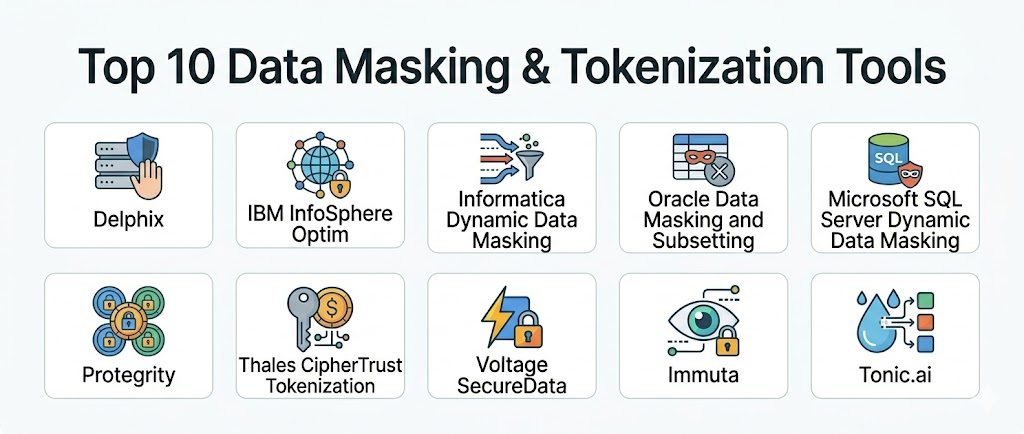
Top 10 Data Masking & Tokenization Tools
#1 — Protegrity
Short description: Protegrity is an enterprise data protection platform focused on tokenization, masking, encryption, and privacy controls across cloud, analytics, and enterprise environments. It is widely used in financial services, healthcare, retail, and regulated industries that require strong protection for sensitive data. Protegrity supports large-scale enterprise deployments and hybrid architectures. It is best suited for organizations with strict governance and compliance requirements.
Key Features
- Enterprise-grade tokenization and masking
- Format-preserving tokenization support
- Dynamic and static data masking capabilities
- Protection for cloud, analytics, and AI workloads
- Centralized policy management
- Broad database and enterprise application support
- Large-scale enterprise deployment capabilities
Pros
- Strong enterprise security focus
- Good fit for regulated industries
- Supports large hybrid and multi-cloud environments
- Mature tokenization capabilities
Cons
- May be complex for smaller organizations
- Enterprise deployment can require planning and expertise
- Pricing may be premium-focused
- Smaller teams may not need full platform depth
Platforms / Deployment
Windows / Linux / Enterprise environments.
Cloud / Self-hosted / Hybrid.
Security & Compliance
Supports enterprise security workflows including encryption, RBAC, logging, and access controls. Buyers should verify compliance requirements and deployment-specific controls directly.
Integrations & Ecosystem
Protegrity integrates into enterprise data ecosystems where sensitive information moves across databases, analytics systems, cloud workloads, and enterprise applications.
- Databases
- Cloud platforms
- Analytics environments
- Enterprise applications
- API integrations
- AI and data governance workflows
Support & Community
Enterprise-focused support with implementation guidance, onboarding, and professional services. Documentation and enterprise customer support are strong for large deployments.
#2 — Voltage SecureData
Short description: Voltage SecureData provides enterprise tokenization, masking, and privacy protection for structured and unstructured data. It is widely used by organizations that need scalable protection for payment data, customer records, and regulated information. The platform supports format-preserving encryption and secure data usage across applications and analytics systems. It is best for enterprises prioritizing compliance and operational scalability.
Key Features
- Data tokenization and masking
- Format-preserving encryption support
- Structured and unstructured data protection
- Enterprise privacy controls
- Real-time and batch data protection workflows
- Hybrid and cloud deployment support
- Scalable enterprise architecture
Pros
- Strong fit for enterprise compliance use cases
- Useful for payment and customer data protection
- Supports large-scale deployments
- Good integration flexibility
Cons
- Enterprise-focused pricing may not fit smaller teams
- Advanced deployment may require expert setup
- Some workflows may require customization
- Smaller organizations may find it complex
Platforms / Deployment
Windows / Linux / Enterprise infrastructure.
Cloud / Self-hosted / Hybrid.
Security & Compliance
Supports enterprise-grade security controls including encryption, access controls, and auditing. Buyers should validate specific compliance certifications and deployment requirements.
Integrations & Ecosystem
Voltage SecureData integrates into enterprise data security architectures where sensitive information must remain protected across applications and databases.
- Databases
- Enterprise applications
- Cloud infrastructure
- Data pipelines
- Payment systems
- Analytics platforms
Support & Community
Enterprise support and onboarding services are available. Best suited for organizations with dedicated security and infrastructure teams.
#3 — IBM Guardium Data Protection
Short description: IBM Guardium Data Protection combines database security, monitoring, masking, and data protection capabilities into a centralized enterprise platform. It helps organizations protect sensitive information across databases, cloud systems, and enterprise workloads. Guardium is especially useful for enterprises with large compliance and governance requirements. It is best for organizations needing centralized visibility and data protection controls.
Key Features
- Data masking and monitoring capabilities
- Sensitive data discovery
- Database activity monitoring
- Centralized policy management
- Cloud and hybrid support
- Compliance reporting workflows
- Enterprise-scale deployment support
Pros
- Strong enterprise governance capabilities
- Good fit for large database environments
- Centralized visibility into sensitive data
- Broad IBM ecosystem integration
Cons
- Can be complex to deploy and manage
- May require experienced administrators
- Enterprise pricing may be high
- Smaller teams may find it heavyweight
Platforms / Deployment
Windows / Linux / Enterprise systems.
Cloud / Self-hosted / Hybrid.
Security & Compliance
Supports auditing, logging, RBAC, encryption workflows, and governance-related controls. Buyers should verify compliance alignment for their regulatory environment.
Integrations & Ecosystem
IBM Guardium integrates into enterprise security, governance, and database ecosystems.
- Databases
- SIEM systems
- Cloud environments
- IBM enterprise ecosystem
- Governance workflows
- Compliance reporting systems
Support & Community
Enterprise support, documentation, and implementation guidance are available through IBM enterprise services and support programs.
#4 — Delphix
Short description: Delphix focuses on data masking and test data management for development, DevOps, and cloud-native environments. It helps organizations safely provision realistic but protected datasets for developers, testers, and analytics teams. Delphix is especially useful for enterprises needing automated masking workflows inside CI/CD and development pipelines. It is best for organizations focused on non-production data security.
Key Features
- Static data masking
- Test data management
- DevOps and CI/CD integration
- Automated data provisioning
- Cloud and hybrid support
- Developer-friendly workflows
- Realistic masked datasets for testing
Pros
- Strong fit for DevOps and development teams
- Useful for test data security
- Helps accelerate development workflows safely
- Good automation support
Cons
- More focused on masking than enterprise tokenization
- May require integration planning
- Enterprise licensing may vary
- Not designed primarily for payment tokenization
Platforms / Deployment
Windows / Linux / Enterprise infrastructure.
Cloud / Self-hosted / Hybrid.
Security & Compliance
Supports enterprise security workflows including access controls, auditing, and governance-oriented masking operations.
Integrations & Ecosystem
Delphix integrates well into development, DevOps, and enterprise testing environments.
- CI/CD pipelines
- Databases
- Cloud platforms
- Development environments
- DevOps workflows
- Enterprise applications
Support & Community
Enterprise-oriented support with documentation, onboarding, and implementation assistance. Popular among organizations modernizing development workflows.
#5 — Thales CipherTrust Data Security Platform
Short description: Thales CipherTrust Data Security Platform provides enterprise data protection capabilities including tokenization, encryption, masking, and centralized key management. It is designed for organizations handling regulated and highly sensitive data across cloud and hybrid environments. CipherTrust is especially useful for enterprises requiring centralized control over data protection policies. It is best suited for large organizations with broad compliance needs.
Key Features
- Tokenization and masking capabilities
- Centralized key management
- Enterprise data protection controls
- Cloud and hybrid environment support
- Data discovery and classification support
- Access policy enforcement
- Broad enterprise integration capabilities
Pros
- Strong enterprise security positioning
- Good fit for regulated industries
- Centralized management workflows
- Broad data protection coverage
Cons
- Enterprise deployment complexity
- Premium-focused pricing
- Smaller organizations may not need full platform scope
- Advanced setup may require professional services
Platforms / Deployment
Windows / Linux / Enterprise environments.
Cloud / Self-hosted / Hybrid.
Security & Compliance
Supports encryption, RBAC, auditing, centralized policy controls, and enterprise security management workflows. Buyers should verify compliance alignment directly.
Integrations & Ecosystem
CipherTrust integrates into enterprise security and data governance ecosystems where centralized protection and policy management are required.
- Databases
- Cloud providers
- Enterprise applications
- Security systems
- Governance workflows
- Data security platforms
Support & Community
Enterprise-focused support and onboarding services are available. Best suited for organizations with dedicated security and compliance teams.
#6 — Informatica Dynamic Data Masking
Short description: Informatica Dynamic Data Masking helps organizations protect sensitive data in real-time by masking information based on user roles, permissions, and policies. It is especially useful for enterprises managing large analytics, BI, and database environments. Informatica integrates well into data governance and enterprise data management ecosystems. It is best for organizations already using Informatica products.
Key Features
- Dynamic masking capabilities
- Real-time policy-based masking
- Role-based data visibility
- Enterprise data governance integration
- Database protection workflows
- Analytics and BI support
- Broad enterprise ecosystem compatibility
Pros
- Strong enterprise governance integration
- Useful for large database environments
- Good fit for analytics workflows
- Real-time masking support
Cons
- Best suited for enterprise deployments
- Informatica ecosystem knowledge may help implementation
- Smaller teams may find it expensive
- Tokenization depth may vary by use case
Platforms / Deployment
Windows / Linux / Enterprise environments.
Cloud / Self-hosted / Hybrid.
Security & Compliance
Supports policy-based security workflows, RBAC, auditing, and enterprise governance controls.
Integrations & Ecosystem
Informatica integrates into enterprise data management, analytics, and governance workflows.
- Databases
- BI systems
- Analytics platforms
- Informatica ecosystem
- Governance workflows
- Cloud data platforms
Support & Community
Strong enterprise documentation and support. Popular in organizations already using Informatica for data governance and integration.
#7 — Oracle Data Safe
Short description: Oracle Data Safe provides masking, activity auditing, and security assessment capabilities for Oracle databases and cloud environments. It helps organizations reduce sensitive data exposure while supporting compliance and governance requirements. Oracle Data Safe is especially useful for enterprises heavily invested in Oracle infrastructure. It is best suited for Oracle-centric environments.
Key Features
- Data masking for Oracle environments
- Database activity auditing
- Security assessments
- Sensitive data discovery
- Cloud-native Oracle integration
- Compliance-oriented workflows
- Centralized security visibility
Pros
- Strong fit for Oracle database environments
- Good integration with Oracle cloud ecosystem
- Useful for compliance and governance workflows
- Simplifies Oracle-specific masking tasks
Cons
- Best suited for Oracle-centric organizations
- Limited relevance for highly diverse database environments
- Enterprise deployment planning may be needed
- Broader tokenization workflows may require additional tools
Platforms / Deployment
Oracle Cloud / Enterprise database environments.
Cloud / Hybrid.
Security & Compliance
Supports auditing, access monitoring, and database security workflows within Oracle environments.
Integrations & Ecosystem
Oracle Data Safe integrates naturally into Oracle cloud and enterprise database ecosystems.
- Oracle databases
- Oracle Cloud Infrastructure
- Governance workflows
- Database auditing
- Security monitoring
- Enterprise Oracle applications
Support & Community
Oracle enterprise support and documentation are available. Best suited for teams already managing Oracle infrastructure.
#8 — BigID
Short description: BigID is a data intelligence and privacy platform that includes data discovery, classification, masking, and privacy management capabilities. It helps organizations identify and protect sensitive data across cloud, SaaS, and enterprise environments. BigID is especially useful for organizations prioritizing privacy governance and data visibility. It is best for enterprises managing large distributed data environments.
Key Features
- Sensitive data discovery
- Data classification and privacy workflows
- Masking and privacy management support
- Multi-cloud and SaaS visibility
- Governance and compliance workflows
- Risk-based data management
- Enterprise-scale data intelligence
Pros
- Strong visibility into enterprise data environments
- Useful for privacy governance initiatives
- Broad cloud and SaaS support
- Helps reduce unknown data exposure
Cons
- Broader governance focus beyond masking alone
- Enterprise complexity may require planning
- Pricing may vary by deployment scope
- Smaller organizations may not need full platform depth
Platforms / Deployment
Web / Enterprise infrastructure.
Cloud / Self-hosted / Hybrid.
Security & Compliance
Supports governance, auditing, access visibility, and enterprise privacy management workflows.
Integrations & Ecosystem
BigID integrates into governance, compliance, cloud, and enterprise data ecosystems.
- Cloud platforms
- SaaS applications
- Databases
- Governance systems
- Compliance workflows
- Enterprise analytics environments
Support & Community
Enterprise support, onboarding, and implementation services are available. Strong fit for privacy and governance teams.
#9 — Immuta
Short description: Immuta provides data access control, masking, and privacy enforcement for cloud analytics and data platforms. It helps organizations manage who can see sensitive information based on policies, roles, and context. Immuta is especially useful for cloud-native analytics and AI-driven data environments. It is best suited for organizations adopting modern data lake and analytics architectures.
Key Features
- Dynamic data masking
- Policy-based access control
- Cloud analytics security
- Data privacy automation
- Data lake and warehouse integration
- Governance-oriented workflows
- AI and analytics environment support
Pros
- Strong fit for cloud analytics environments
- Useful for modern data platform security
- Policy automation improves governance workflows
- Good integration with analytics ecosystems
Cons
- Focused more on analytics access control
- Traditional tokenization workflows may require additional tools
- Enterprise deployment planning may be needed
- Pricing may vary by scale and usage
Platforms / Deployment
Web / Cloud data environments.
Cloud / Hybrid.
Security & Compliance
Supports policy enforcement, RBAC, auditing, and governance workflows for analytics environments.
Integrations & Ecosystem
Immuta integrates well into cloud-native analytics and modern data platform architectures.
- Snowflake
- Databricks
- Cloud data warehouses
- Analytics platforms
- Governance systems
- AI and ML workflows
Support & Community
Enterprise support and onboarding services are available. Popular among organizations modernizing cloud analytics security.
#10 — TokenEx
Short description: TokenEx is a cloud-based tokenization platform designed to reduce exposure of sensitive payment and personal data. It is especially useful for organizations needing PCI-related tokenization workflows without building large internal tokenization systems. TokenEx focuses on simplifying tokenization deployment across applications, APIs, and payment workflows. It is best suited for organizations prioritizing fast implementation and cloud-native tokenization.
Key Features
- Cloud-based tokenization services
- PCI-oriented tokenization workflows
- API-first architecture
- Sensitive data protection for applications
- Payment and personal data tokenization
- Scalable cloud deployment
- Reduced exposure of regulated data
Pros
- Easier implementation compared with some enterprise platforms
- Good fit for payment and customer data protection
- API-based workflows simplify integration
- Cloud-native deployment model
Cons
- Less focused on broad enterprise masking ecosystems
- May not match the depth of large enterprise platforms
- Deployment scope depends on use case requirements
- Advanced governance workflows may vary
Platforms / Deployment
Web / API / Cloud environments.
Cloud.
Security & Compliance
Supports tokenization-focused security workflows and enterprise data protection controls. Buyers should validate compliance documentation directly.
Integrations & Ecosystem
TokenEx integrates into cloud-native applications, payment systems, and API-driven architectures.
- Payment platforms
- APIs
- SaaS applications
- Customer data systems
- Cloud applications
- Enterprise workflows
Support & Community
Vendor-led support and onboarding are available. Best suited for organizations prioritizing fast cloud-based tokenization deployment.
Comparison Table
| Tool Name | Best For | Platform Supported | Deployment | Standout Feature | Public Rating |
|---|---|---|---|---|---|
| Protegrity | Enterprise tokenization and privacy protection | Windows, Linux | Cloud / Self-hosted / Hybrid | Large-scale enterprise tokenization | N/A |
| Voltage SecureData | Regulated enterprise data protection | Windows, Linux | Cloud / Self-hosted / Hybrid | Format-preserving encryption and masking | N/A |
| IBM Guardium Data Protection | Enterprise database governance | Windows, Linux | Cloud / Self-hosted / Hybrid | Database monitoring with masking workflows | N/A |
| Delphix | DevOps and test data masking | Windows, Linux | Cloud / Self-hosted / Hybrid | Automated masked test data provisioning | N/A |
| Thales CipherTrust | Enterprise centralized data protection | Windows, Linux | Cloud / Self-hosted / Hybrid | Combined masking, tokenization, and key management | N/A |
| Informatica Dynamic Data Masking | Enterprise analytics masking | Windows, Linux | Cloud / Self-hosted / Hybrid | Real-time policy-based masking | N/A |
| Oracle Data Safe | Oracle database masking and auditing | Oracle environments | Cloud / Hybrid | Oracle-native masking workflows | N/A |
| BigID | Data discovery and privacy governance | Web / Enterprise infrastructure | Cloud / Self-hosted / Hybrid | Sensitive data discovery and governance | N/A |
| Immuta | Cloud analytics masking and policy control | Web / Cloud data platforms | Cloud / Hybrid | Dynamic analytics data masking | N/A |
| TokenEx | Cloud-native tokenization | Web / API | Cloud | API-first tokenization platform | N/A |
Evaluation & Scoring of Data Masking & Tokenization Tools
| Tool Name | Core | Ease | Integrations | Security | Performance | Support | Value | Weighted Total |
|---|---|---|---|---|---|---|---|---|
| Protegrity | 9 | 7 | 8 | 9 | 8 | 8 | 7 | 8.10 |
| Voltage SecureData | 8 | 7 | 8 | 9 | 8 | 8 | 7 | 7.95 |
| IBM Guardium Data Protection | 8 | 6 | 8 | 9 | 8 | 8 | 7 | 7.75 |
| Delphix | 8 | 8 | 8 | 7 | 8 | 8 | 8 | 8.00 |
| Thales CipherTrust | 9 | 7 | 8 | 9 | 8 | 8 | 7 | 8.10 |
| Informatica Dynamic Data Masking | 8 | 7 | 8 | 8 | 8 | 8 | 7 | 7.75 |
| Oracle Data Safe | 7 | 8 | 7 | 8 | 8 | 8 | 8 | 7.70 |
| BigID | 8 | 7 | 8 | 8 | 8 | 8 | 7 | 7.75 |
| Immuta | 8 | 8 | 9 | 8 | 8 | 8 | 8 | 8.15 |
| TokenEx | 7 | 8 | 8 | 8 | 8 | 8 | 9 | 7.95 |
These scores are comparative rather than absolute. Enterprise-focused platforms may score highly on security, governance, and scalability but require larger budgets and implementation effort. Developer-friendly or cloud-native solutions may score better on ease of use and agility. Buyers should validate performance, compliance alignment, and integration depth using their own data environments and workflows.
Which Data Masking & Tokenization Tool Is Right for You?
Solo / Freelancer
Solo users rarely need enterprise-grade tokenization platforms. Smaller teams experimenting with data security or compliance may prefer lightweight cloud-native services or database-native masking capabilities instead of large enterprise deployments.
SMB
SMBs should prioritize easier deployment, manageable pricing, and cloud-native compatibility. TokenEx, Delphix, and Oracle Data Safe can be practical depending on the database and application environment. SMBs should avoid overly complex enterprise platforms unless regulatory requirements demand them.
Mid-Market
Mid-market organizations often need a balance of governance, cloud compatibility, and operational simplicity. Immuta, Delphix, BigID, and Informatica Dynamic Data Masking are strong choices depending on whether the focus is analytics, governance, or DevOps workflows. Integration flexibility is critical at this stage.
Enterprise
Enterprises should evaluate Protegrity, Thales CipherTrust, IBM Guardium, Voltage SecureData, BigID, and Immuta for broader governance and security requirements. Large organizations usually need centralized policy controls, auditability, hybrid deployment support, and integration with existing governance ecosystems.
Budget vs Premium
Budget-focused organizations may prefer cloud-native or workload-specific solutions such as TokenEx or Oracle Data Safe. Premium enterprise platforms provide stronger governance, scalability, and centralized controls but often require higher investment and implementation effort.
Feature Depth vs Ease of Use
Enterprise platforms like Protegrity and Thales provide deeper security and policy management capabilities but can require specialized expertise. Delphix and TokenEx are easier to operationalize for focused use cases. Buyers should balance flexibility with operational simplicity.
Integrations & Scalability
Organizations with complex enterprise ecosystems should prioritize platforms with strong database, analytics, cloud, and API integrations. Multi-cloud scalability, centralized policy enforcement, and governance integration are important for larger environments.
Security & Compliance Needs
Regulated industries should prioritize auditing, RBAC, encryption support, policy management, and deployment flexibility. Buyers should verify compliance alignment, data residency controls, and operational governance directly with vendors.
Frequently Asked Questions
1. What are data masking and tokenization tools?
Data masking and tokenization tools protect sensitive information by replacing real values with safe alternatives. Masking usually creates fictional but realistic-looking data, while tokenization replaces sensitive values with tokens that reference protected originals. These tools help organizations reduce exposure of regulated and confidential data. They are commonly used in analytics, development, testing, AI, and compliance workflows.
2. What is the difference between masking and tokenization?
Masking changes data so it looks realistic but is not reversible in most cases. Tokenization replaces data with tokens that can sometimes be mapped back to the original value through a secure system. Masking is often used for testing and analytics, while tokenization is common in payment and regulated workflows. Many enterprises use both together depending on the use case.
3. Why are these tools important for AI and analytics?
AI systems and analytics platforms often process large volumes of sensitive information. Without masking or tokenization, organizations risk exposing personal, financial, or regulated data. These tools help organizations safely use data for training, analytics, and testing while reducing privacy risks. They also help support governance and compliance initiatives.
4. Are these tools only for large enterprises?
No, although large enterprises are major users because of regulatory and scale requirements. Mid-market companies and cloud-native startups also use masking and tokenization to reduce security and privacy risks. The right solution depends on the amount of sensitive data and the complexity of the environment. Cloud-native services have also made adoption easier for smaller organizations.
5. How difficult is implementation?
Implementation complexity depends on deployment size, integration needs, and governance requirements. Cloud-native tokenization services can sometimes be implemented quickly, while enterprise platforms may require planning, architecture design, and policy development. Organizations should start with a high-risk workflow or dataset first. Pilot projects are useful before large-scale rollout.
6. What are the most common mistakes organizations make?
A common mistake is protecting only production environments while leaving development, testing, analytics, and AI workflows exposed. Another mistake is focusing only on encryption without considering masking or tokenization. Organizations also fail when they underestimate integration complexity and governance planning. Successful deployments require both technical controls and operational processes.
7. Can tokenization reduce compliance scope?
Yes, tokenization can help reduce exposure of sensitive data in some regulatory environments, especially payment-related workflows. However, compliance outcomes depend on architecture, implementation quality, and governance controls. Organizations should work with security and compliance teams when designing tokenization strategies. Tokenization alone does not automatically guarantee compliance.
8. Do these tools work in cloud and hybrid environments?
Most modern platforms support cloud, hybrid, and multi-cloud environments. Enterprises increasingly need masking and tokenization across SaaS platforms, cloud analytics systems, AI workflows, and on-premise databases. Buyers should validate cloud provider support and deployment flexibility before selecting a platform. Hybrid compatibility is especially important for large enterprises.
9. Are open-source masking tools enough for production?
Open-source tools can be useful for smaller or highly technical environments, but enterprises often require broader governance, scalability, and compliance workflows. Production deployments usually require auditing, access controls, monitoring, and centralized management. Open-source solutions may work well for focused use cases but can require more operational effort. The right choice depends on risk level and organizational maturity.
10. How should organizations choose the right platform?
Organizations should start by identifying where sensitive data exists and which workflows create the most risk. They should evaluate masking depth, tokenization strength, integration compatibility, scalability, and governance features. Cloud strategy, compliance requirements, AI usage, and operational maturity are also important factors. Running a pilot with real datasets and workflows is usually the best next step.
Conclusion
Data masking and tokenization tools are becoming critical components of modern enterprise security, privacy, analytics, and AI architectures. As organizations move sensitive workloads into cloud, AI, and distributed data environments, reducing direct exposure of regulated information is more important than ever. Enterprise-focused platforms such as Protegrity, Thales CipherTrust, IBM Guardium, and Voltage SecureData provide strong governance and large-scale protection, while platforms like Delphix, Immuta, TokenEx, and BigID address specialized cloud, analytics, and development use cases. The best solution depends on your compliance obligations, cloud strategy, operational maturity, and data architecture. Organizations should shortlist two or three platforms, test them against real workflows, validate integration and governance requirements, and then scale the chosen approach gradually across production environments.

Practical comparison article showing how data masking and tokenization tools help organizations safeguard sensitive information while maintaining usability for business operations.