Introduction
Email Spam Filtering Tools help organizations block unwanted, suspicious, malicious, or deceptive emails before they reach users’ inboxes. In simple terms, these tools inspect incoming and outgoing messages for spam, phishing, malware, spoofing, malicious URLs, risky attachments, impersonation attempts, and business email compromise signals. They protect email systems such as Microsoft 365, Google Workspace, hybrid mail environments, and enterprise mail gateways.
Email spam filtering matters because email remains one of the most common paths for cyberattacks, user compromise, credential theft, payment fraud, and malware delivery. Modern spam is not only junk marketing; it can include phishing links, QR code attacks, spoofed senders, fake invoices, social engineering, malicious attachments, and AI-generated lures. Microsoft describes email as a major entry point for cyberattacks, while Mimecast describes spam filtering as protection against spam, malware, zero-day attacks, and advanced threats.
Common use cases include inbound spam filtering, phishing protection, malware scanning, URL rewriting, attachment sandboxing, spoofing defense, email quarantine, outbound data protection, user reporting, and post-delivery remediation. Buyers should evaluate detection accuracy, false positives, Microsoft 365 or Google Workspace fit, policy control, AI-based detection, user quarantine, reporting, admin usability, integration depth, incident response, pricing, and support quality.
Best for: IT teams, security teams, MSPs, schools, healthcare organizations, law firms, finance teams, SaaS companies, enterprises, and SMBs that need better email protection. Not ideal for: personal users with basic email needs, very small teams relying only on built-in mailbox filtering, or organizations that cannot manage allowlists, quarantines, DNS records, user training, and policy tuning.
Key Trends in Email Spam Filtering Tools
- AI-based detection is becoming standard: Spam filtering is moving beyond static rules toward machine learning, behavioral signals, natural language analysis, sender reputation, and campaign detection.
- Phishing protection is now as important as spam blocking: Attackers use realistic invoices, fake login pages, payroll scams, QR codes, impersonation, and conversation hijacking, so tools must detect more than bulk spam.
- Post-delivery remediation is critical: Some threats are identified after delivery, so modern platforms need mailbox search, message recall, automated removal, and incident investigation.
- Microsoft 365 and Google Workspace protection is a major buying driver: Many buyers want tools that improve native cloud email security without disrupting existing mail flows.
- User-reported phishing workflows are becoming common: Tools increasingly include report buttons, user feedback loops, admin review queues, and security awareness integrations.
- Business email compromise requires identity and behavior analysis: Traditional spam rules often miss socially engineered emails, so vendors use relationship graphs, writing patterns, and sender behavior.
- Outbound filtering matters more: Organizations are not only blocking inbound spam; they also need to prevent outbound spam, compromised account abuse, data leakage, and misdirected emails.
- Email authentication remains foundational: SPF, DKIM, DMARC, domain reputation, sender alignment, and anti-spoofing policies are still essential for reducing forged email.
- Quarantine experience affects productivity: Admins and users need clear quarantine controls, safe previews, release workflows, and policy transparency to avoid help desk overload.
- Layered email security is common: Many organizations use native Microsoft or Google filtering plus a secure email gateway, API-based email security, or AI-focused anti-phishing tool.
How We Selected These Tools
The tools below were selected based on practical relevance to spam filtering, phishing protection, cloud email security, secure email gateways, API-based email defense, and enterprise email threat protection.
- Feature completeness: Tools were evaluated for spam filtering, phishing protection, malware scanning, URL protection, attachment analysis, impersonation defense, and quarantine management.
- Market adoption and mindshare: Preference was given to platforms widely recognized by IT admins, security teams, MSPs, enterprises, and cloud email customers.
- Microsoft 365 and Google Workspace fit: Tools with strong cloud email integration and modern mail flow support were prioritized.
- Threat detection depth: AI-based analysis, sender behavior, domain reputation, sandboxing, spoof detection, and post-delivery remediation were considered.
- Admin experience: Policy control, dashboards, reporting, alerting, search, investigation workflows, and quarantine management were reviewed.
- Security posture: Email authentication support, DLP, encryption, audit logs, RBAC, user awareness, and incident response workflows were considered where clearly known.
- Deployment flexibility: Gateway, cloud API, integrated cloud-native, hybrid, and MSP-friendly models were included.
- Buyer fit: The list includes options for SMBs, MSPs, mid-market teams, enterprises, regulated industries, and cloud-first organizations.
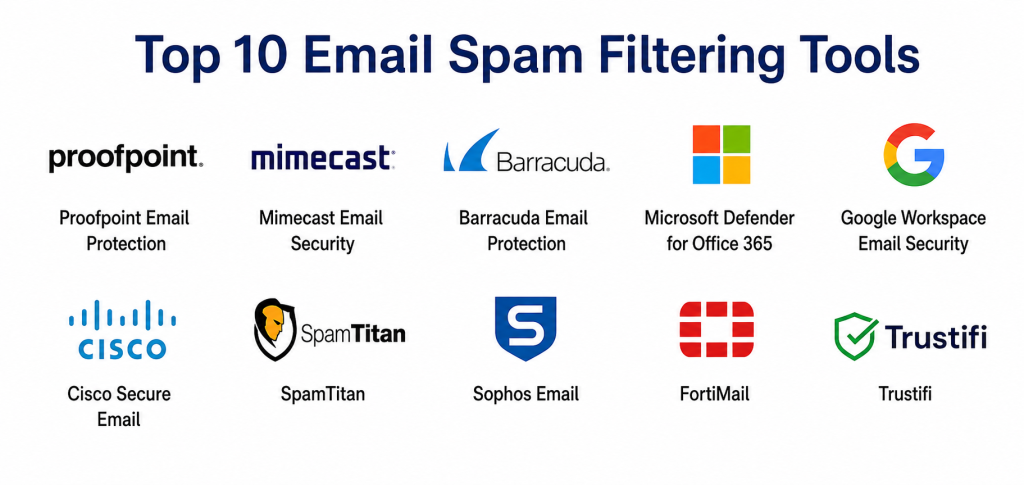
Top 10 Email Spam Filtering Tools
#1 — Microsoft Defender for Office 365
Short description: Microsoft Defender for Office 365 protects Microsoft 365 email and collaboration environments from spam, phishing, malicious links, QR code attacks, malware, spoofing, and business email compromise. It is especially useful for organizations already using Exchange Online, Microsoft 365, Teams, SharePoint, and OneDrive. The platform includes policies, reporting, threat investigation, automated response, and user protection features depending on plan. It is best for Microsoft-first organizations that want native email security tightly integrated with Microsoft security tools.
Key Features
- Anti-spam, anti-phishing, and anti-malware protection for Microsoft 365.
- Safe Links and attachment protection depending on plan.
- Impersonation, spoofing, and mailbox intelligence controls.
- Real-time detections, reporting, and investigation workflows.
- Automated investigation and response capabilities depending on plan.
- Protection across email and collaboration tools.
- Integration with Microsoft Defender XDR and security operations workflows.
Pros
- Strong native fit for Microsoft 365 environments.
- Good visibility across email and collaboration tools.
- Useful for organizations already using Microsoft security stack.
- Reduces need for separate mail routing in some deployments.
Cons
- Best value depends on Microsoft licensing and configuration.
- Policy tuning can be complex for large environments.
- Organizations using third-party gateways must avoid policy conflicts.
- Some advanced features require higher-tier plans.
Platforms / Deployment
Cloud / Microsoft 365 / Exchange Online / Web admin portal / API and security ecosystem integrations.
Security & Compliance
Security capabilities may include anti-phishing policies, anti-spoofing, Safe Links, Safe Attachments, reporting, audit logs, RBAC, automated investigation, and Microsoft security integration depending on plan. Specific certifications should be verified directly. If uncertain, write: Not publicly stated.
Integrations & Ecosystem
Microsoft Defender for Office 365 works best inside the Microsoft ecosystem and connects email protection with broader security operations.
- Microsoft 365
- Exchange Online
- Microsoft Defender XDR
- Microsoft Sentinel workflows
- Teams and collaboration security
- Security investigation dashboards
Support & Community
Microsoft provides extensive documentation, admin guidance, support options, partner services, and a large administrator community. Success depends heavily on correct configuration, policy tuning, and ongoing review.
#2 — Proofpoint Email Protection
Short description: Proofpoint Email Protection helps organizations block spam, phishing, malware, credential theft, impostor messages, and other email-based attacks. It is widely used by enterprises and regulated organizations that need advanced email threat detection, policy control, and visibility. Proofpoint’s email security products include URL defense, attachment analysis, DLP-related features, encryption options, and reporting depending on package. It is best for enterprises that need strong protection against email fraud, phishing, and targeted attacks.
Key Features
- Spam, phishing, malware, and credential theft protection.
- URL defense and link rewriting capabilities.
- Attachment analysis and threat detection workflows.
- Email fraud and impersonation protection depending on package.
- DLP and encryption capabilities depending on licensing.
- Reporting and visibility into threat types and attack frequency.
- Enterprise policy control and investigation workflows.
Pros
- Strong enterprise email security reputation.
- Useful for phishing, malware, and credential attacks.
- Good fit for regulated and high-risk organizations.
- Strong reporting and threat visibility capabilities.
Cons
- Pricing may be enterprise-oriented.
- Implementation and tuning may require security expertise.
- Package selection can affect available capabilities.
- Smaller teams may find it more complex than SMB-focused tools.
Platforms / Deployment
Cloud / Secure email gateway / API and cloud email integrations / Enterprise admin portal.
Security & Compliance
Security capabilities may include URL protection, anti-malware, anti-phishing, DLP, email encryption, reporting, policy control, and admin visibility depending on package. Specific certifications should be verified directly. If uncertain, write: Not publicly stated.
Integrations & Ecosystem
Proofpoint fits enterprise mail environments where email security must connect with compliance, DLP, security awareness, and incident response workflows.
- Microsoft 365
- Google Workspace
- SIEM systems
- Security awareness workflows
- DLP and encryption workflows
- Threat investigation processes
Support & Community
Proofpoint provides enterprise documentation, customer support, training, and security expertise. It is well suited for organizations with dedicated IT and security teams.
#3 — Mimecast Email Security
Short description: Mimecast Email Security helps organizations block spam, phishing, malware, malicious URLs, risky attachments, spoofing, and advanced email threats. It is commonly used by mid-market and enterprise organizations that need a cloud-based secure email gateway with continuity, archiving, and email security options. Mimecast combines spam filtering, threat intelligence, targeted threat protection, quarantine controls, and user tools. It is best for organizations that want email security, continuity, and management features in a unified cloud platform.
Key Features
- Spam filtering and malware protection.
- URL and attachment protection through targeted threat controls.
- Secure email gateway protection for inbound and outbound mail.
- Quarantine management and user-managed permit or block lists.
- Email continuity and archiving options depending on product bundle.
- Support for email authentication technologies such as DKIM and DMARC.
- Cloud-based admin controls and reporting.
Pros
- Strong fit for gateway-based email security.
- Useful for spam filtering, continuity, and archiving needs.
- Gives users some control over allow and block lists.
- Good option for organizations wanting a unified email risk platform.
Cons
- Mail routing and policy setup require careful configuration.
- User experience depends on quarantine and release workflows.
- Advanced protection may require additional modules.
- Organizations should test false positives and missed phishing carefully.
Platforms / Deployment
Cloud / Secure email gateway / Microsoft 365 and Google Workspace mail flow integrations / Web admin portal.
Security & Compliance
Security capabilities may include spam filtering, malware protection, URL scanning, attachment controls, DKIM and DMARC support, admin controls, reporting, continuity, and archiving depending on package. Specific certifications should be verified directly. If uncertain, write: Not publicly stated.
Integrations & Ecosystem
Mimecast integrates with cloud email systems and security workflows where organizations need gateway-style email filtering, continuity, and archiving.
- Microsoft 365
- Google Workspace
- Secure email gateway routing
- Email continuity workflows
- Archiving and search workflows
- User quarantine management
Support & Community
Mimecast provides documentation, support options, customer success resources, and admin training. It is commonly used by IT teams and MSPs managing business email security.
#4 — Google Workspace Gmail Security
Short description: Google Workspace Gmail Security provides built-in spam, phishing, malware, spoofing, and suspicious message protection for organizations using Gmail. It is useful for teams that want native protection without routing email through a separate gateway. Google Workspace admins can configure spam controls, quarantine settings, allowlists, denylists, routing, attachment rules, and authentication-related protections. It is best for Google-first organizations that want integrated email protection within their existing workspace environment.
Key Features
- Built-in spam, phishing, and malware filtering for Gmail.
- Admin controls for quarantine, allowlists, denylists, and routing.
- Attachment and content compliance rules.
- Support for SPF, DKIM, and DMARC-related authentication workflows.
- Suspicious message warnings for users.
- Integration with Google Workspace admin controls.
- Reporting and investigation capabilities depending on edition.
Pros
- Native fit for Google Workspace.
- No separate gateway required for basic protection.
- Simple admin experience for Google-first teams.
- Good option for organizations that want integrated email controls.
Cons
- Advanced enterprise needs may require additional tools.
- Visibility and investigation depth depend on edition and configuration.
- Some organizations may want extra phishing or BEC protection.
- Admins still need strong DNS, authentication, and policy setup.
Platforms / Deployment
Cloud / Google Workspace / Gmail / Admin console.
Security & Compliance
Security capabilities may include spam filtering, phishing protection, malware detection, quarantine controls, authentication settings, admin policies, and reporting depending on Google Workspace edition. Specific certifications should be verified directly. If uncertain, write: Not publicly stated.
Integrations & Ecosystem
Google Workspace Gmail Security fits businesses that rely on Gmail and Google Workspace for productivity, collaboration, and mail administration.
- Gmail
- Google Workspace Admin
- Google Drive and collaboration workflows
- Security center features depending on edition
- Email routing and compliance rules
- User reporting workflows
Support & Community
Google provides documentation, admin training resources, support plans, and a large Workspace administrator community. Organizations should test policy settings and user reporting workflows before rollout.
#5 — Barracuda Email Protection
Short description: Barracuda Email Protection provides spam filtering, malware protection, phishing defense, URL protection, backup, archiving, encryption, and email security features depending on package. It is commonly used by SMBs, mid-market companies, MSPs, and organizations that need a practical email security suite. Barracuda emphasizes protection against spam, ransomware, zero-day attacks, malicious URLs, and attachments. It is best for organizations that want bundled email protection, backup, and security controls.
Key Features
- Spam, malware, and phishing protection.
- URL and attachment analysis.
- Email backup and recovery options depending on plan.
- Data leak prevention and email encryption options.
- AI-powered email gateway capabilities.
- Inbound and outbound email security controls.
- MSP-friendly and SMB-friendly deployment options.
Pros
- Practical suite for SMB and mid-market email security.
- Combines spam filtering with backup and encryption options.
- Good fit for organizations needing layered email protection.
- Useful for MSP-managed environments.
Cons
- Buyers should test detection quality against real threats.
- Some advanced features require specific packages.
- Policy tuning and mail flow setup are important.
- Large enterprises may compare it with more advanced SEG or API-based tools.
Platforms / Deployment
Cloud / Secure email gateway / Microsoft 365 and Google Workspace integrations / Web admin portal.
Security & Compliance
Security capabilities may include spam filtering, malware protection, URL analysis, attachment protection, DLP, encryption, backup, and admin controls depending on plan. Specific certifications should be verified directly. If uncertain, write: Not publicly stated.
Integrations & Ecosystem
Barracuda fits organizations that need email protection connected with backup, recovery, encryption, and administrative workflows.
- Microsoft 365
- Google Workspace
- MSP management workflows
- Email backup and recovery
- DLP and encryption workflows
- Secure gateway routing
Support & Community
Barracuda provides documentation, support, partner resources, and MSP ecosystem support. Buyers should evaluate support response, policy usability, and quarantine workflows during pilots.
#6 — Cisco Secure Email Threat Defense
Short description: Cisco Secure Email Threat Defense protects organizations from spam, phishing, malware, ransomware, and email-based threats using gateway and cloud email security capabilities. It is useful for enterprises that want email protection connected to broader Cisco security telemetry and threat intelligence. Cisco’s email security tools support URL protection, attachment scanning, outbreak filtering, impersonation protection, and reporting depending on product and deployment. It is best for organizations already using Cisco security infrastructure or needing enterprise-grade email defense.
Key Features
- Spam, phishing, and malware protection.
- URL filtering and attachment analysis.
- Threat intelligence from Cisco security ecosystem.
- Protection against business email compromise and impersonation patterns.
- Email threat investigation and reporting workflows.
- Gateway and cloud email security options depending on product.
- Integration with broader Cisco security tools.
Pros
- Strong fit for Cisco security customers.
- Useful enterprise email threat protection.
- Benefits from broader threat intelligence ecosystem.
- Good option for organizations needing gateway and cloud email defense.
Cons
- Product selection and deployment model require careful planning.
- Admin experience may be complex for smaller teams.
- Advanced features may require additional licensing.
- Buyers should validate integration with their mail platform.
Platforms / Deployment
Cloud / Secure email gateway / API-based cloud email protection depending on product / Web admin portal.
Security & Compliance
Security capabilities may include spam filtering, anti-malware, URL filtering, attachment analysis, impersonation protection, reporting, and integration with Cisco security tools depending on configuration. Specific certifications should be verified directly. If uncertain, write: Not publicly stated.
Integrations & Ecosystem
Cisco Secure Email fits organizations that want email protection tied to a broader security stack.
- Microsoft 365
- Google Workspace
- Cisco SecureX-style workflows
- SIEM and security operations tools
- Threat intelligence workflows
- Email gateway deployments
Support & Community
Cisco provides enterprise support, documentation, partners, and security operations expertise. It is strongest for larger organizations and security teams already invested in Cisco infrastructure.
#7 — Cloudflare Area 1 Email Security
Short description: Cloudflare Area 1 Email Security helps organizations detect and stop phishing, business email compromise, malware, and other email threats before users are compromised. It focuses strongly on phishing campaign discovery, attacker infrastructure detection, and cloud email protection. Area 1 is useful for organizations that want API-based or integrated protection for Microsoft 365 and Google Workspace environments. It is best for security teams that prioritize phishing prevention and modern cloud email defense.
Key Features
- Phishing and BEC detection.
- Email threat intelligence and campaign analysis.
- Protection for Microsoft 365 and Google Workspace environments.
- API-based and cloud email security deployment options.
- Pre-delivery and post-delivery threat workflows depending on configuration.
- Malicious link and attacker infrastructure detection.
- Integration with Cloudflare security ecosystem.
Pros
- Strong focus on phishing and attacker infrastructure.
- Good fit for cloud-first email environments.
- Useful for security teams already using Cloudflare.
- Can complement native Microsoft or Google filtering.
Cons
- Less traditional SEG-focused than some legacy gateways.
- Buyers should validate spam filtering depth for non-phishing use cases.
- Best value depends on cloud email and Cloudflare ecosystem fit.
- Advanced workflows may require security team involvement.
Platforms / Deployment
Cloud / API / Microsoft 365 and Google Workspace integrations / Security dashboard.
Security & Compliance
Security capabilities may include phishing detection, threat intelligence, email scanning, post-delivery workflows, dashboard controls, and cloud security integrations depending on configuration. Specific certifications should be verified directly. If uncertain, write: Not publicly stated.
Integrations & Ecosystem
Cloudflare Area 1 fits organizations that need phishing-focused email security connected with broader web, DNS, network, and cloud security controls.
- Microsoft 365
- Google Workspace
- Cloudflare security stack
- Security operations workflows
- Phishing investigation workflows
- API-based email protection
Support & Community
Cloudflare provides documentation, support, and security resources. It is especially relevant for teams that want email security as part of a broader Cloudflare security program.
#8 — Abnormal Security
Short description: Abnormal Security uses behavioral AI to detect socially engineered email attacks, business email compromise, vendor fraud, phishing, account takeover, and suspicious communication patterns. It is designed for cloud email environments and focuses on understanding normal business communication behavior to detect abnormal messages. Abnormal is especially useful for organizations that struggle with targeted phishing and BEC that bypass traditional spam filters. It is best for cloud-first enterprises that want AI-based email behavior analysis.
Key Features
- Behavioral AI for email threat detection.
- Business email compromise and vendor fraud protection.
- Account takeover detection and suspicious mailbox activity analysis.
- Cloud-native integration with Microsoft 365 and Google Workspace.
- Detection of socially engineered and low-payload attacks.
- Automated remediation and investigation workflows.
- Executive, vendor, and relationship-based risk analysis.
Pros
- Strong fit for BEC and social engineering detection.
- Useful for cloud email environments.
- Helps detect attacks that lack obvious malware or links.
- Good option for executive and vendor impersonation protection.
Cons
- May be more expensive than basic spam filtering tools.
- Best value appears in organizations with targeted email risk.
- Not a traditional gateway for all mail hygiene use cases.
- Buyers should test false positives and workflow fit.
Platforms / Deployment
Cloud / API-based email security / Microsoft 365 and Google Workspace integrations.
Security & Compliance
Security capabilities may include behavior-based detection, account takeover monitoring, automated remediation, admin controls, and reporting depending on package. Specific certifications should be verified directly. If uncertain, write: Not publicly stated.
Integrations & Ecosystem
Abnormal Security fits cloud email environments where relationship-based, behavior-based, and AI-driven analysis is needed.
- Microsoft 365
- Google Workspace
- Security operations workflows
- User reporting systems
- Vendor risk workflows
- Incident response processes
Support & Community
Abnormal provides enterprise support, documentation, security resources, and customer success assistance. It is best suited for organizations with targeted phishing, BEC, and cloud email compromise concerns.
#9 — SpamTitan
Short description: SpamTitan is an email security and spam filtering solution commonly used by SMBs, MSPs, schools, and organizations that need practical protection against spam, malware, phishing, and unwanted email. It provides cloud-based email filtering, quarantine management, policy controls, and reporting. SpamTitan is especially popular with MSPs and budget-conscious organizations looking for reliable spam filtering without overly complex enterprise suites. It is best for SMB and MSP environments that need straightforward email protection.
Key Features
- Spam filtering and malware protection.
- Phishing and malicious email detection.
- Quarantine management and user controls.
- Policy-based filtering and admin controls.
- Reporting and mail flow visibility.
- MSP-friendly management options.
- Cloud-based deployment for business email protection.
Pros
- Practical fit for SMBs and MSPs.
- Straightforward spam filtering and quarantine workflows.
- Good value for organizations needing core email protection.
- Easier to manage than some enterprise-heavy tools.
Cons
- Advanced BEC and behavioral AI features may be more limited.
- Large enterprises may need deeper investigation workflows.
- Buyers should validate Microsoft 365 or Google Workspace integration needs.
- Detection tuning is still important.
Platforms / Deployment
Cloud / Email filtering service / Web admin portal / MSP management options.
Security & Compliance
Security capabilities may include spam filtering, malware detection, phishing controls, quarantine, reporting, and admin policies depending on plan. Specific certifications should be verified directly. If uncertain, write: Not publicly stated.
Integrations & Ecosystem
SpamTitan fits organizations that need practical spam filtering layered into cloud or business email systems.
- Microsoft 365
- Google Workspace
- MSP-managed email environments
- Quarantine workflows
- SMB email security programs
- Admin reporting systems
Support & Community
SpamTitan provides documentation, support options, and MSP-focused resources. It is strongest for teams looking for simple email security administration and cost-conscious deployment.
#10 — Sophos Email
Short description: Sophos Email protects organizations from spam, phishing, malware, ransomware, impersonation, and email-based threats. It is especially useful for organizations already using Sophos security products and wanting email security connected to broader endpoint, network, and cloud security workflows. Sophos Email includes policy control, scanning, quarantine, link protection, attachment analysis, and encryption options depending on package. It is best for SMBs and mid-market companies that want email protection as part of a broader security stack.
Key Features
- Spam, phishing, malware, and ransomware protection.
- Impersonation and spoofing defense.
- URL protection and attachment scanning.
- Email encryption and data protection options depending on plan.
- Quarantine and policy management.
- Integration with Sophos security ecosystem.
- Cloud-based email security administration.
Pros
- Strong fit for existing Sophos customers.
- Practical email security for SMB and mid-market teams.
- Combines spam filtering with phishing and malware protection.
- Useful as part of a broader security stack.
Cons
- Large enterprises may compare it with deeper SEG or API-based tools.
- Advanced capabilities depend on package selection.
- Policy tuning and user training remain important.
- Buyers should test detection quality against real mail flow.
Platforms / Deployment
Cloud / Email security service / Microsoft 365 and Google Workspace integrations / Web admin portal.
Security & Compliance
Security capabilities may include spam filtering, anti-phishing, anti-malware, URL protection, attachment scanning, encryption, quarantine, and admin controls depending on plan. Specific certifications should be verified directly. If uncertain, write: Not publicly stated.
Integrations & Ecosystem
Sophos Email fits organizations that want email security connected to endpoint, network, firewall, and cloud security workflows.
- Microsoft 365
- Google Workspace
- Sophos Central
- Endpoint and network security workflows
- Quarantine and reporting systems
- Email encryption workflows
Support & Community
Sophos provides documentation, support, partner resources, and a broad SMB and mid-market security community. It is a practical option for organizations already invested in Sophos Central.
Comparison Table
| Tool Name | Best For | Platform Supported | Deployment | Standout Feature | Public Rating |
|---|---|---|---|---|---|
| Microsoft Defender for Office 365 | Microsoft 365 email security | Microsoft 365 / Exchange Online / Web | Cloud | Native Microsoft email and collaboration protection | N/A |
| Proofpoint Email Protection | Enterprise phishing and malware defense | Microsoft 365 / Google Workspace / Gateway | Cloud / Gateway | Advanced URL, attachment, and email fraud protection | N/A |
| Mimecast Email Security | Secure email gateway and continuity | Microsoft 365 / Google Workspace / Gateway | Cloud / Gateway | Spam filtering with continuity and archiving options | N/A |
| Google Workspace Gmail Security | Native Gmail spam and phishing protection | Gmail / Google Workspace / Admin console | Cloud | Built-in Google Workspace mail protection | N/A |
| Barracuda Email Protection | SMB and mid-market email security | Microsoft 365 / Google Workspace / Gateway | Cloud / Gateway | Email protection with backup and encryption options | N/A |
| Cisco Secure Email Threat Defense | Enterprise email threat defense | Cloud email / Gateway / Security integrations | Cloud / Gateway | Cisco threat intelligence and email defense | N/A |
| Cloudflare Area 1 Email Security | Phishing-focused cloud email protection | Microsoft 365 / Google Workspace / API | Cloud / API | Phishing campaign and attacker infrastructure detection | N/A |
| Abnormal Security | AI-based BEC and social engineering defense | Microsoft 365 / Google Workspace / API | Cloud / API | Behavioral AI for abnormal email detection | N/A |
| SpamTitan | SMB and MSP spam filtering | Business email / Cloud mail systems | Cloud | Simple spam filtering and quarantine management | N/A |
| Sophos Email | SMB and mid-market email protection | Microsoft 365 / Google Workspace / Sophos Central | Cloud | Email security inside Sophos ecosystem | N/A |
Evaluation & Scoring of Email Spam Filtering Tools
| Tool Name | Core 25% | Ease 15% | Integrations 15% | Security 10% | Performance 10% | Support 10% | Value 15% | Weighted Total |
|---|---|---|---|---|---|---|---|---|
| Microsoft Defender for Office 365 | 9 | 8 | 10 | 9 | 9 | 9 | 8 | 8.85 |
| Proofpoint Email Protection | 10 | 7 | 9 | 9 | 9 | 9 | 7 | 8.65 |
| Mimecast Email Security | 9 | 8 | 9 | 8 | 8 | 8 | 8 | 8.40 |
| Google Workspace Gmail Security | 8 | 9 | 9 | 8 | 8 | 8 | 9 | 8.45 |
| Barracuda Email Protection | 8 | 8 | 8 | 8 | 8 | 8 | 8 | 8.00 |
| Cisco Secure Email Threat Defense | 9 | 7 | 8 | 9 | 8 | 9 | 7 | 8.10 |
| Cloudflare Area 1 Email Security | 8 | 8 | 8 | 8 | 8 | 8 | 8 | 8.00 |
| Abnormal Security | 9 | 8 | 8 | 9 | 8 | 8 | 7 | 8.15 |
| SpamTitan | 7 | 8 | 7 | 7 | 8 | 8 | 9 | 7.65 |
| Sophos Email | 8 | 8 | 8 | 8 | 8 | 8 | 8 | 8.00 |
These scores are comparative and based on email spam filtering fit, not absolute product quality. A higher score means the tool aligns strongly with spam filtering, phishing defense, malware protection, integrations, reporting, support, and value. Enterprise tools score well for advanced protection and investigation, while SMB-focused tools score well for simplicity and cost-effectiveness. Buyers should adjust the weights based on whether they need gateway filtering, cloud-native protection, API-based phishing defense, MSP management, or Microsoft and Google integration depth.
Which Email Spam Filtering Tool Is Right for You?
Solo / Freelancer
Solo users usually do not need enterprise spam filtering tools unless they manage a business domain or client email environment. Built-in Gmail or Outlook filtering may be enough for personal accounts. If you manage a custom business domain, focus first on SPF, DKIM, DMARC, strong passwords, MFA, and built-in spam controls. For freelancer businesses using Microsoft 365 or Google Workspace, native security controls can be a practical starting point.
SMB
SMBs should prioritize ease of deployment, low admin overhead, good quarantine controls, and strong phishing protection. Microsoft Defender for Office 365 is practical for Microsoft 365 users, while Google Workspace Gmail Security fits Gmail-first teams. SpamTitan, Barracuda Email Protection, Sophos Email, and Mimecast can be good options when SMBs want an additional layer or MSP-managed filtering. SMBs should avoid overcomplicated tools unless they have IT staff to manage policies.
Mid-Market
Mid-market organizations often need better reporting, policy flexibility, phishing defense, URL protection, user reporting, and post-delivery remediation. Mimecast, Proofpoint, Microsoft Defender for Office 365, Barracuda, Sophos Email, and Cloudflare Area 1 are strong candidates depending on environment. If business email compromise is a major concern, Abnormal Security deserves evaluation. Mid-market buyers should test detection quality, false positives, quarantine workflows, and integration with existing mail systems.
Enterprise
Enterprises should prioritize advanced phishing protection, reporting, incident response, DLP, policy control, integration with SIEM and XDR, admin roles, and support. Proofpoint, Microsoft Defender for Office 365, Mimecast, Cisco Secure Email Threat Defense, Cloudflare Area 1, and Abnormal Security are strong options depending on architecture. Enterprises may use layered protection, combining native Microsoft or Google controls with API-based or gateway-based tools. Security teams should run pilots with real mail traffic and attack simulations.
Budget vs Premium
Budget-conscious teams should start with built-in protection from Microsoft 365 or Google Workspace and ensure SPF, DKIM, DMARC, MFA, and user reporting are configured correctly. SMB-focused tools like SpamTitan, Sophos Email, and Barracuda can add value without enterprise-level complexity. Premium tools such as Proofpoint, Mimecast, Cisco, Abnormal, and Cloudflare Area 1 are worth evaluating when phishing, BEC, compliance, or incident response needs justify the cost.
Feature Depth vs Ease of Use
For ease of use, native tools like Microsoft Defender for Office 365 and Google Workspace Gmail Security are convenient because they sit inside existing admin environments. For feature depth, Proofpoint, Mimecast, and Cisco Secure Email Threat Defense provide stronger enterprise email security capabilities. For AI-driven BEC detection, Abnormal Security is more specialized. For simple spam filtering and MSP-friendly management, SpamTitan and Barracuda can be practical.
Integrations & Scalability
Integration fit is critical. Microsoft-heavy organizations should evaluate Microsoft Defender for Office 365, while Gmail-heavy organizations should begin with Google Workspace Gmail Security and then test third-party layers if needed. Enterprises needing SIEM and XDR workflows should evaluate Proofpoint, Cisco, Microsoft, Mimecast, and Cloudflare Area 1. MSPs should consider tools with multi-tenant management, clear reporting, and easy quarantine handling.
Security & Compliance Needs
Security-sensitive organizations should prioritize anti-phishing, anti-spoofing, attachment sandboxing, URL rewriting, post-delivery removal, DLP, encryption, audit logs, reporting, and user awareness workflows. Regulated industries should also evaluate retention, archiving, legal hold, encryption, admin permissions, and evidence trails. No spam filter should be treated as perfect; layered controls, user training, incident response, and email authentication remain essential.
Frequently Asked Questions
1. What are email spam filtering tools?
Email spam filtering tools inspect incoming and outgoing email to block unwanted, suspicious, or malicious messages. They can detect spam, phishing, malware, spoofing, malicious links, risky attachments, and business email compromise attempts. Some tools work as secure email gateways, while others integrate directly with Microsoft 365 or Google Workspace. The goal is to reduce inbox risk and protect users from email-based attacks.
2. How do spam filters detect unwanted email?
Spam filters use a mix of sender reputation, domain authentication, content analysis, URL scanning, attachment inspection, threat intelligence, machine learning, and policy rules. Modern tools also analyze user behavior, communication patterns, and impersonation signals. Some tools rewrite links or sandbox attachments before delivery. Better platforms combine multiple signals instead of relying only on keywords or blocklists.
3. Are built-in Microsoft and Google spam filters enough?
Built-in filtering may be enough for some small organizations, especially when configured well. However, businesses with high phishing risk, regulated data, executive impersonation threats, or compliance needs may require additional protection. Microsoft Defender for Office 365 and Google Workspace security controls can be strong starting points. Many organizations add third-party tools for deeper phishing defense, BEC detection, reporting, and incident response.
4. What is the difference between a secure email gateway and API-based email security?
A secure email gateway usually routes email through a filtering service before messages reach the mailbox. API-based email security connects directly to cloud mailboxes such as Microsoft 365 or Google Workspace without changing MX routing in the same way. Gateways are strong for pre-delivery filtering, while API-based tools can be strong for post-delivery scanning, behavioral analysis, and cloud-native remediation. Some organizations use both approaches.
5. What is business email compromise protection?
Business email compromise protection focuses on detecting messages that impersonate executives, vendors, finance teams, or trusted partners. These attacks may not contain malware or obvious spam signals, so they can bypass basic filters. Tools use sender identity, domain similarity, relationship analysis, writing patterns, and payment request context to detect risk. BEC protection is especially important for finance, HR, legal, and executive teams.
6. How are email spam filtering tools priced?
Pricing varies by vendor, user count, mailbox count, features, retention, archiving, encryption, support tier, and deployment model. SMB tools may charge per user or mailbox, while enterprise tools may use custom pricing. Advanced features such as sandboxing, DLP, archiving, BEC protection, and automated remediation may cost extra. Buyers should compare total cost, not only base spam filtering price.
7. What are common mistakes when implementing spam filtering?
A common mistake is turning on strict filtering without monitoring false positives and user impact. Another mistake is ignoring SPF, DKIM, DMARC, and domain reputation. Some teams also forget outbound filtering, compromised account detection, and user reporting workflows. Successful implementation includes pilot testing, quarantine review, policy tuning, admin training, and regular threat reporting.
8. What integrations should buyers look for?
Important integrations include Microsoft 365, Google Workspace, SIEM tools, XDR platforms, security awareness training, user reporting buttons, identity platforms, DLP tools, encryption systems, archiving platforms, and ticketing systems. MSPs should look for multi-tenant management. Enterprises should prioritize APIs, audit logs, automated remediation, and incident response workflows. Integration quality can affect both security and admin workload.
9. Can spam filters stop all phishing attacks?
No spam filter can stop every phishing attack. Attackers constantly change domains, wording, attachments, QR codes, sender identities, and social engineering tactics. Good tools reduce risk significantly, but users still need training, reporting options, MFA, passwordless authentication, and incident response. Organizations should treat spam filtering as one layer in a broader email security program.
10. What is the best email spam filtering tool overall?
There is no single best tool for every organization. Microsoft Defender for Office 365 is strong for Microsoft-first teams, Google Workspace Gmail Security fits Gmail-first organizations, Proofpoint and Mimecast are strong enterprise options, Barracuda, SpamTitan, and Sophos Email are practical for SMB and MSP environments, while Abnormal Security and Cloudflare Area 1 are strong for AI-driven and phishing-focused cloud email protection. The best choice depends on your email platform, threat profile, budget, admin capacity, and compliance needs.
Conclusion
Email Spam Filtering Tools are essential for protecting users from unwanted mail, phishing, malware, impersonation, malicious links, and business email compromise. The right tool depends on your environment: Microsoft Defender for Office 365 is strong for Microsoft 365, Google Workspace Gmail Security is practical for Gmail-first teams, Proofpoint and Mimecast fit enterprises needing advanced protection, and Barracuda, SpamTitan, and Sophos Email are useful for SMBs and MSPs. Cisco Secure Email Threat Defense fits larger security ecosystems, Cloudflare Area 1 is strong for phishing-focused cloud email defense, and Abnormal Security is valuable for AI-based BEC and behavior-driven detection. Buyers should not choose only by brand name; they should test detection quality, false positives, quarantine workflows, reporting, user experience, Microsoft or Google integration, and support. Start with your current email platform, shortlist two or three tools, run a real mail-flow pilot, tune policies carefully, and scale after validating security, productivity, and admin workload.

This article clearly explains email spam filtering tools and how they help organizations improve email security and reduce unwanted or harmful messages.
This article clearly explains email spam filtering tools and how they help organizations improve email security by blocking unwanted and potentially harmful messages.
Reducing false positives is just as important as blocking spam effectively. Over-filtering can impact business communication and create hidden productivity costs.