Introduction
Multi-party Computation MPC toolkits help two or more parties compute a shared result without revealing their private inputs to each other. In simple terms, MPC allows organizations to collaborate on sensitive data without directly sharing the raw data. Instead of sending private records to one central place, each participant keeps control of its own input while the computation produces only the agreed output.
MPC is important for privacy-preserving analytics, secure AI collaboration, financial risk analysis, healthcare research, identity verification, fraud detection, blockchain custody, digital asset security, and cross-organization data sharing. It is especially useful when parties do not fully trust each other but still need to compute a joint result.
Common use cases include private set intersection, secure statistics, privacy-preserving machine learning, confidential benchmarking, joint fraud detection, secure key management, and regulated data collaboration. Buyers should evaluate protocol support, performance, security model, developer experience, deployment complexity, scalability, integration options, documentation quality, governance support, and production readiness.
Best for: cryptography teams, privacy engineers, AI researchers, data scientists, financial institutions, healthcare organizations, regulated enterprises, blockchain teams, and companies that need secure collaboration across sensitive datasets. Not ideal for: simple internal analytics, low-risk datasets, teams without cryptography or engineering expertise, or organizations that only need basic encryption, masking, or access control.
Key Trends in Multi-party Computation MPC Toolkits
- Privacy-preserving AI is increasing MPC adoption because organizations want to train, evaluate, and run analytics across sensitive datasets without centralizing raw data.
- Private set intersection is becoming a practical business use case for fraud detection, customer matching, identity workflows, and partner analytics.
- Blockchain and digital asset custody continue to use MPC for distributed key management and transaction signing without exposing a full private key.
- Regulated industries are exploring MPC to enable data collaboration across finance, healthcare, insurance, government, and research environments.
- Open-source MPC frameworks remain important because transparency, protocol review, and academic validation are critical in cryptographic systems.
- Performance optimization is a major focus because MPC can require more communication and computation than normal plaintext analytics.
- MPC is being combined with confidential computing and differential privacy to create stronger privacy-preserving data collaboration workflows.
- Developer experience is improving with Python interfaces, higher-level languages, APIs, and easier experimentation environments.
- Enterprise adoption still requires careful governance because output leakage, participant permissions, auditability, and key management must be designed correctly.
- Specialized MPC platforms are emerging for identity verification, data clean rooms, secure collaboration, and privacy-preserving business workflows.
How We Selected These Tools
This list was selected using a practical privacy engineering, cryptography, and enterprise data collaboration evaluation approach. The focus is on credible MPC toolkits and platforms that support secure computation, privacy-preserving analytics, or real-world MPC workflows.
- We prioritized tools with strong relevance to secure multi-party computation, secret sharing, garbled circuits, secure analytics, or privacy-preserving collaboration.
- We included a mix of open-source research frameworks, developer toolkits, enterprise platforms, and business-focused MPC products.
- We considered support for different security models, including semi-honest, malicious, honest-majority, and dishonest-majority scenarios where applicable.
- We evaluated developer usability, documentation quality, language support, setup complexity, and extensibility.
- We considered practical use cases such as private set intersection, secure machine learning, blockchain custody, identity verification, and multi-party analytics.
- We reviewed whether each tool is better for research, prototyping, production, or enterprise collaboration.
- We avoided guessing certifications, ratings, or unsupported compliance claims.
- We considered performance, scalability, and ecosystem maturity.
- We included tools suitable for cryptography experts, developers, researchers, and enterprise security teams.
- We used “Not publicly stated” or “Varies / N/A” where details are uncertain.
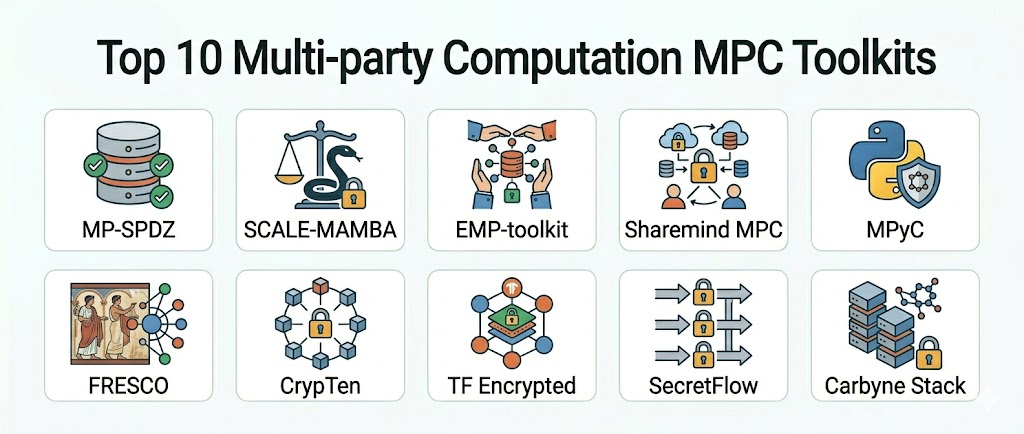
Top 10 Multi-party Computation MPC Toolkits
#1 — MP-SPDZ
Short description: MP-SPDZ is a versatile open-source MPC framework designed for benchmarking and implementing many secure computation protocols. It is widely used in cryptography research and advanced privacy engineering environments. The framework supports multiple security models, protocol families, and computation types, making it one of the most flexible MPC toolkits available. It is best suited for researchers, cryptographers, and advanced engineering teams that need deep protocol control.
Key Features
- Supports many MPC protocol variants
- Works with arithmetic and binary circuits
- Supports honest-majority and dishonest-majority settings
- Supports semi-honest and malicious adversary models
- High-level programming interface for secure computation
- Useful for benchmarking MPC protocol performance
- Strong fit for research and advanced prototyping
Pros
- Very flexible and protocol-rich
- Strong academic and technical credibility
- Good for comparing different MPC approaches
- Open-source transparency supports review and customization
Cons
- Requires strong cryptography and systems knowledge
- Not designed as a simple enterprise SaaS platform
- Production deployment may require significant engineering work
- Business reporting and governance features are not the main focus
Platforms / Deployment
Linux / developer environments.
Self-hosted / local / cloud-based research environments.
Security & Compliance
Not publicly stated as a standalone compliance-certified enterprise product. Security depends on protocol selection, deployment architecture, participant setup, access controls, and operational governance.
Integrations & Ecosystem
MP-SPDZ is commonly used in research, benchmarking, and advanced engineering workflows where cryptographic flexibility matters more than plug-and-play deployment.
- Secure computation research workflows
- Python-like secure programming interface
- Cryptographic benchmarking
- Custom MPC protocol experiments
- Academic and enterprise research labs
- Privacy-preserving computation prototypes
Support & Community
Support is primarily community and research-driven. Documentation and academic references are useful, but teams should expect to provide their own cryptography and engineering expertise.
#2 — SCALE-MAMBA
Short description: SCALE-MAMBA is an MPC system designed for secure computation using secret sharing and related protocol techniques. It has been important in MPC research and education, especially for teams studying actively secure computation. SCALE-MAMBA is useful for cryptographers and advanced researchers who want to understand secure computation internals. It is best suited for academic, research, and specialized prototyping environments.
Key Features
- Secret-sharing-based MPC system
- Supports secure computation program development
- Useful for studying actively secure MPC
- Designed for research and experimentation
- Supports secure arithmetic computation workflows
- Helpful for learning MPC system design
- Strong historical relevance in MPC research
Pros
- Valuable for cryptography research and education
- Good for understanding MPC protocol mechanics
- Open-source availability supports experimentation
- Useful for advanced secure computation prototyping
Cons
- Not ideal for modern enterprise production deployment
- Requires strong technical and cryptographic expertise
- Maintenance and ecosystem maturity should be carefully evaluated
- Less beginner-friendly than higher-level frameworks
Platforms / Deployment
Linux / developer environments.
Self-hosted / local / research environments.
Security & Compliance
Not publicly stated as an enterprise compliance product. Security depends on deployment, configuration, protocol use, and operational practices.
Integrations & Ecosystem
SCALE-MAMBA is most relevant for research, learning, and specialized secure computation experiments rather than broad enterprise workflow integration.
- Secure computation research
- Academic environments
- Protocol experimentation
- Secret-sharing-based computation
- Cryptography education
- Custom proof-of-concept workflows
Support & Community
Support is primarily through documentation, academic materials, and community knowledge. Organizations should validate maintenance status and technical fit before using it in serious production workflows.
#3 — EMP Toolkit
Short description: EMP Toolkit is a collection of efficient secure computation libraries focused heavily on two-party computation and garbled circuit-based workflows. It is useful for researchers and developers building high-performance cryptographic applications. EMP is especially relevant when teams need lower-level building blocks for secure computation protocols. It is best for technical users who want fine-grained control and performance-oriented implementation.
Key Features
- Secure computation libraries for two-party computation
- Garbled circuit support
- Performance-oriented cryptographic building blocks
- Useful for protocol implementation and research
- Supports custom secure computation workflows
- Developer-focused C++ ecosystem
- Suitable for advanced experimentation
Pros
- Strong performance-oriented design
- Useful for secure computation researchers
- Good fit for custom protocol development
- Open-source flexibility and transparency
Cons
- Requires strong C++ and cryptography expertise
- Not a plug-and-play enterprise platform
- More suitable for advanced users than business teams
- Production deployment requires careful security review
Platforms / Deployment
Linux / C++ developer environments.
Self-hosted / local / cloud-based technical environments.
Security & Compliance
Not publicly stated as a standalone certified product. Security depends on implementation correctness, protocol selection, deployment model, and operational safeguards.
Integrations & Ecosystem
EMP Toolkit fits technical cryptography workflows where developers need efficient secure computation components.
- C++ secure computation projects
- Garbled circuit workflows
- Two-party computation research
- Custom cryptographic protocols
- Privacy-preserving application prototypes
- Academic and technical lab environments
Support & Community
Support is community and research-driven. Best suited for teams with cryptography engineers who can read documentation, review code, and validate protocol behavior.
#4 — MPyC
Short description: MPyC is a Python-based framework for secure multi-party computation. It is designed to make MPC more accessible through a familiar programming language and developer-friendly interface. MPyC is useful for education, research, prototyping, and early-stage privacy-preserving analytics. It is best suited for Python users who want to experiment with MPC concepts without immediately working at lower cryptographic layers.
Key Features
- Python-based MPC framework
- Supports secure computation using secret sharing
- Developer-friendly experimentation environment
- Useful for teaching and research
- Works well for prototyping secure analytics
- Supports interactive and scripted workflows
- Lower entry barrier than many MPC frameworks
Pros
- Easier to learn for Python users
- Good for education and prototyping
- Open-source and flexible
- Useful for privacy-preserving analytics experiments
Cons
- May not match lower-level frameworks for performance-heavy workloads
- Production readiness depends on use case and engineering maturity
- Requires understanding of MPC concepts
- Enterprise governance features are limited
Platforms / Deployment
Python / Windows / macOS / Linux.
Self-hosted / local / cloud environments.
Security & Compliance
Not publicly stated as a standalone enterprise compliance product. Security depends on deployment architecture, protocol usage, and operational controls.
Integrations & Ecosystem
MPyC fits Python-centric workflows where teams want to prototype MPC applications or teach secure computation.
- Python data workflows
- Research notebooks
- Educational environments
- Secure analytics prototypes
- Academic projects
- Privacy-preserving computation experiments
Support & Community
Support is primarily open-source and academic community based. Documentation is useful for learning and experimentation, but production users should validate carefully.
#5 — FRESCO
Short description: FRESCO is a Java framework for building and running secure multi-party computation applications. It provides abstractions for secure computation and protocol suites, making it useful for developers who want to build MPC applications in Java environments. FRESCO is relevant for academic research, enterprise prototypes, and teams that prefer JVM-based systems. It is best for technical teams needing a structured framework rather than only low-level protocol code.
Key Features
- Java-based secure computation framework
- Protocol suite abstraction
- Supports MPC application development
- Useful for research and enterprise prototypes
- Modular design for secure computation workflows
- Developer-friendly for JVM teams
- Suitable for custom privacy-preserving applications
Pros
- Good fit for Java and JVM environments
- Structured framework approach
- Useful for custom MPC application development
- Open-source transparency
Cons
- Requires MPC and Java expertise
- Not a simple no-code privacy platform
- Production deployment requires careful engineering
- Smaller community than broader AI or data tools
Platforms / Deployment
Java / JVM environments.
Self-hosted / Cloud / Hybrid depending on implementation.
Security & Compliance
Not publicly stated as a certified enterprise product. Security depends on protocol configuration, implementation, deployment architecture, and governance.
Integrations & Ecosystem
FRESCO integrates into Java-based application stacks where secure computation needs to be embedded into custom systems.
- Java applications
- JVM backend services
- Secure computation prototypes
- Enterprise research workflows
- Custom privacy-preserving services
- Academic environments
Support & Community
Support is primarily open-source and research-community driven. Best suited for technical teams with Java and cryptography expertise.
#6 — ABY
Short description: ABY is a framework for efficient mixed-protocol secure two-party computation. It supports arithmetic sharing, boolean sharing, and Yao sharing, allowing developers to combine different secure computation approaches. ABY is useful for research and performance-focused privacy-preserving computation. It is best for teams that need secure two-party computation with protocol flexibility and optimization.
Key Features
- Secure two-party computation framework
- Supports arithmetic, boolean, and Yao sharing
- Mixed-protocol computation support
- Performance-focused design
- Useful for research and benchmarking
- Enables custom privacy-preserving applications
- Open-source cryptographic toolkit
Pros
- Strong protocol flexibility
- Useful for optimized two-party computation
- Good research and benchmarking value
- Open-source transparency
Cons
- Focused mainly on two-party settings
- Requires cryptography and systems expertise
- Not designed for business users
- Production use requires careful validation
Platforms / Deployment
Linux / C++ developer environments.
Self-hosted / local / cloud technical environments.
Security & Compliance
Not publicly stated as a standalone compliance-certified product. Security depends on deployment, protocol selection, threat model, and implementation practices.
Integrations & Ecosystem
ABY is best suited for advanced secure computation development where teams need mixed-protocol flexibility.
- C++ applications
- Two-party secure computation
- Cryptographic benchmarking
- Academic research
- Privacy-preserving prototypes
- Protocol optimization workflows
Support & Community
Support is mainly open-source and research-based. Best suited for expert teams that can evaluate and adapt secure computation protocols.
#7 — Sharemind
Short description: Sharemind is a privacy-preserving data analysis platform based on secure multi-party computation concepts. It is designed to help organizations analyze sensitive data without exposing raw inputs. Sharemind is more business- and enterprise-oriented than many academic MPC toolkits, making it useful for regulated analytics, government, healthcare, and enterprise collaboration. It is best for organizations seeking a more packaged secure computation platform.
Key Features
- Secure data analysis using MPC concepts
- Privacy-preserving analytics workflows
- Enterprise-oriented secure computation platform
- Supports multi-party data collaboration
- Useful for regulated data analysis
- Designed for practical privacy-preserving applications
- Helps reduce raw data exposure during collaboration
Pros
- More productized than many research toolkits
- Useful for enterprise and regulated analytics
- Supports privacy-preserving collaboration
- Good fit for organizations needing business workflows
Cons
- Less flexible than fully open-source protocol frameworks
- Pricing and deployment details may vary
- Advanced customization may require vendor support
- Buyers should validate fit with their exact data collaboration model
Platforms / Deployment
Enterprise platform.
Cloud / Self-hosted / Hybrid / Varies / N/A.
Security & Compliance
Not publicly stated in full detail. Buyers should verify access controls, encryption, audit logs, data governance, and compliance documentation directly.
Integrations & Ecosystem
Sharemind fits secure analytics and multi-party data collaboration environments.
- Enterprise analytics
- Regulated data collaboration
- Government and research workflows
- Healthcare analytics
- Privacy-preserving reporting
- Secure data sharing programs
Support & Community
Support is vendor-led. Buyers should evaluate documentation, onboarding, implementation support, and long-term maintenance during procurement.
#8 — Partisia
Short description: Partisia provides privacy-preserving computation technology with strong focus on MPC-enabled identity, collaboration, and enterprise privacy use cases. It helps organizations verify, compute, or collaborate on sensitive data without directly exposing raw records. Partisia is relevant for digital identity, financial services, healthcare, and privacy-preserving verification workflows. It is best for organizations seeking business-ready MPC use cases rather than building from low-level cryptographic code.
Key Features
- MPC-powered privacy-preserving computation
- Secure identity and verification workflows
- Privacy-preserving data collaboration
- Enterprise and public-sector use cases
- Supports sensitive data processing without raw exposure
- Business-focused MPC application model
- Useful for regulated environments
Pros
- Strong fit for identity and privacy workflows
- More business-ready than low-level MPC frameworks
- Useful for regulated collaboration scenarios
- Helps reduce sensitive data sharing risk
Cons
- Less suitable for teams needing low-level protocol experimentation
- Deployment and pricing details may vary
- Use-case fit should be validated in a pilot
- May require vendor-led implementation support
Platforms / Deployment
Web / enterprise platform / privacy infrastructure.
Cloud / Hybrid / Varies / N/A.
Security & Compliance
Not publicly stated in full detail. Buyers should verify security controls, auditability, data handling, and compliance alignment directly.
Integrations & Ecosystem
Partisia fits privacy-preserving identity, verification, and secure collaboration workflows.
- Digital identity systems
- Verification workflows
- Data collaboration
- Healthcare and finance use cases
- Enterprise privacy programs
- Secure analytics workflows
Support & Community
Support is vendor-led with business and implementation guidance. Buyers should evaluate onboarding, integration assistance, and documentation quality.
#9 — Inpher
Short description: Inpher focuses on privacy-enhancing computation for secure analytics, machine learning, and data collaboration. It is relevant for enterprises that need to compute across sensitive datasets without centralizing raw information. Inpher is especially useful for privacy-preserving AI, financial analytics, and regulated data sharing workflows. It is best suited for organizations that want an enterprise-oriented privacy computation platform.
Key Features
- Privacy-preserving computation workflows
- Secure analytics and AI use cases
- Multi-party data collaboration support
- Enterprise-focused privacy technology
- Useful for regulated data environments
- Supports secure computation patterns
- Designed for business data collaboration
Pros
- Strong fit for enterprise privacy-preserving analytics
- Useful for AI and secure data collaboration
- More productized than academic frameworks
- Relevant for regulated industries
Cons
- Public technical details may vary by product
- Pricing and deployment model should be validated directly
- May not be ideal for small teams or basic analytics
- Advanced use cases may require vendor services
Platforms / Deployment
Enterprise platform.
Cloud / Hybrid / Self-hosted / Varies / N/A.
Security & Compliance
Not publicly stated in full detail. Buyers should verify access controls, encryption, audit logging, compliance documentation, and deployment architecture.
Integrations & Ecosystem
Inpher fits enterprise data collaboration and privacy-preserving AI workflows.
- AI and ML workflows
- Secure analytics
- Data collaboration platforms
- Financial services workflows
- Enterprise data systems
- Privacy governance programs
Support & Community
Support is vendor-led. Enterprise buyers should assess onboarding, technical support, implementation services, and long-term platform roadmap.
#10 — Duality Technologies
Short description: Duality Technologies provides privacy-enhancing technology for secure data collaboration, analytics, and AI workflows. Its platform approach is relevant for organizations that need to collaborate on sensitive datasets while preserving privacy. Duality is often evaluated by enterprises in regulated sectors where raw data sharing is difficult or prohibited. It is best for organizations seeking a managed privacy-enhancing computation platform rather than a research-only toolkit.
Key Features
- Privacy-preserving data collaboration
- Secure analytics and AI workflows
- Supports privacy-enhancing computation approaches
- Enterprise-oriented governance capabilities
- Useful for regulated data partnerships
- Designed for multi-party collaboration
- Helps reduce sensitive data centralization
Pros
- Strong enterprise collaboration focus
- Useful for regulated analytics and AI use cases
- More business-ready than low-level cryptography libraries
- Supports privacy-first data collaboration models
Cons
- Not purely an open-source MPC toolkit
- Technical capabilities should be validated by use case
- Pricing and deployment details may vary
- May require enterprise implementation planning
Platforms / Deployment
Enterprise platform.
Cloud / Hybrid / Self-hosted / Varies / N/A.
Security & Compliance
Not publicly stated in full detail. Buyers should verify identity controls, encryption, audit logs, governance workflows, and compliance requirements directly.
Integrations & Ecosystem
Duality Technologies fits secure data collaboration environments where multiple parties need insights without directly sharing sensitive raw data.
- Enterprise analytics
- AI collaboration workflows
- Regulated data sharing
- Secure partner collaboration
- Data clean rooms
- Privacy governance systems
Support & Community
Support is vendor-led and enterprise-focused. Buyers should evaluate onboarding, technical support, deployment guidance, and fit with existing governance programs.
Comparison Table
| Tool Name | Best For | Platform Supported | Deployment | Standout Feature | Public Rating |
|---|---|---|---|---|---|
| MP-SPDZ | Advanced MPC research and protocol benchmarking | Linux | Self-hosted / Cloud | Broad multi-protocol MPC framework | N/A |
| SCALE-MAMBA | Secure computation research and education | Linux | Self-hosted | Secret-sharing-based MPC system | N/A |
| EMP Toolkit | High-performance two-party computation | Linux / C++ | Self-hosted / Cloud | Garbled circuit and secure computation libraries | N/A |
| MPyC | Python-based MPC experimentation | Windows / macOS / Linux | Self-hosted / Cloud | Accessible Python MPC framework | N/A |
| FRESCO | Java-based MPC application development | JVM environments | Self-hosted / Cloud / Hybrid | Structured Java MPC framework | N/A |
| ABY | Mixed-protocol two-party computation | Linux / C++ | Self-hosted / Cloud | Arithmetic, boolean, and Yao sharing support | N/A |
| Sharemind | Enterprise privacy-preserving analytics | Enterprise platform | Cloud / Self-hosted / Hybrid | Business-ready secure analytics platform | N/A |
| Partisia | Privacy-preserving identity and verification | Web / Enterprise platform | Cloud / Hybrid | MPC-powered identity and collaboration workflows | N/A |
| Inpher | Enterprise secure analytics and AI collaboration | Enterprise platform | Cloud / Hybrid / Varies | Privacy-preserving computation for AI and analytics | N/A |
| Duality Technologies | Secure data collaboration and analytics | Enterprise platform | Cloud / Hybrid / Varies | Privacy-enhancing enterprise collaboration | N/A |
Evaluation & Scoring of Multi-party Computation MPC Toolkits
| Tool Name | Core | Ease | Integrations | Security | Performance | Support | Value | Weighted Total |
|---|---|---|---|---|---|---|---|---|
| MP-SPDZ | 10 | 5 | 7 | 9 | 9 | 7 | 9 | 8.15 |
| SCALE-MAMBA | 7 | 5 | 5 | 8 | 7 | 5 | 7 | 6.45 |
| EMP Toolkit | 8 | 5 | 6 | 8 | 9 | 6 | 8 | 7.20 |
| MPyC | 7 | 8 | 7 | 7 | 7 | 7 | 9 | 7.40 |
| FRESCO | 7 | 6 | 7 | 8 | 7 | 6 | 8 | 7.00 |
| ABY | 8 | 5 | 6 | 8 | 8 | 6 | 8 | 7.10 |
| Sharemind | 8 | 8 | 7 | 8 | 8 | 8 | 7 | 7.80 |
| Partisia | 8 | 8 | 7 | 8 | 8 | 8 | 7 | 7.80 |
| Inpher | 8 | 8 | 8 | 8 | 8 | 8 | 7 | 7.95 |
| Duality Technologies | 8 | 8 | 8 | 8 | 8 | 8 | 7 | 7.95 |
These scores are comparative and should be used as a practical shortlist guide. Research-grade frameworks such as MP-SPDZ, EMP Toolkit, ABY, FRESCO, MPyC, and SCALE-MAMBA provide strong flexibility but require technical expertise. Enterprise platforms such as Sharemind, Partisia, Inpher, and Duality Technologies are generally easier to align with business workflows but may offer less low-level protocol control. Buyers should test performance, participant setup, privacy guarantees, integration needs, and governance workflows before selecting a platform.
Which Multi-party Computation MPC Toolkit Is Right for You?
Solo / Freelancer
Solo developers and researchers should start with MPyC, MP-SPDZ, EMP Toolkit, or ABY depending on their technical skill level. MPyC is easier for Python users, while MP-SPDZ and EMP Toolkit are better for advanced cryptography experimentation. Solo users should avoid enterprise platforms unless they are working on a commercial privacy-preserving collaboration product.
SMB
SMBs should choose based on whether they need experimentation or business deployment. For prototypes, MPyC or MP-SPDZ can be practical if the team has strong technical skills. For customer-facing secure collaboration, enterprise-style platforms such as Sharemind, Partisia, Inpher, or Duality Technologies may reduce implementation complexity. SMBs should avoid overbuilding if standard encryption or access controls are enough.
Mid-Market
Mid-market organizations often need a balance of technical control and business usability. MP-SPDZ may be useful for internal research, while Inpher, Duality Technologies, Sharemind, or Partisia may be better for real collaboration workflows. Teams should focus on integration with analytics platforms, identity systems, cloud infrastructure, and governance processes.
Enterprise
Enterprises should evaluate both open-source frameworks and vendor-led platforms. Research teams may use MP-SPDZ, EMP Toolkit, ABY, or FRESCO for protocol validation and internal testing. Business units may prefer Sharemind, Partisia, Inpher, or Duality Technologies for secure collaboration and privacy-preserving analytics. Enterprises should prioritize governance, auditability, participant management, legal agreements, and support.
Budget vs Premium
Open-source MPC frameworks are budget-friendly from a licensing perspective but can be expensive in engineering time. Premium platforms may reduce implementation effort and provide stronger support, onboarding, and business workflow alignment. The best choice depends on whether the organization has internal cryptography expertise or needs a more managed solution.
Feature Depth vs Ease of Use
MP-SPDZ offers the deepest protocol coverage, but it is not beginner-friendly. MPyC is easier for Python experimentation, while FRESCO fits Java teams. Enterprise platforms are easier for business collaboration but may not expose the same protocol-level flexibility. Buyers should decide whether protocol control or operational simplicity matters more.
Integrations & Scalability
MPC scalability depends heavily on network latency, participant count, protocol type, computation complexity, and deployment architecture. Teams should validate integration with cloud systems, analytics workflows, identity providers, key management, and data governance tools. Performance testing with realistic data and participant setups is essential.
Security & Compliance Needs
MPC protects private inputs, but it does not automatically solve all security and compliance problems. Organizations still need access controls, audit logs, output governance, legal agreements, monitoring, and secure infrastructure. Regulated industries should validate threat models, security assumptions, data residency, and participant responsibilities before production deployment.
Frequently Asked Questions
1. What is Multi-party Computation MPC?
Multi-party Computation MPC is a cryptographic method that allows multiple parties to compute a shared result without revealing their private inputs. Each party keeps its own data protected while participating in the computation. The final output is shared according to the agreed rules. MPC is useful when organizations need collaboration without raw data sharing.
2. How is MPC different from encryption?
Encryption protects data when it is stored or transmitted, while MPC protects data during collaborative computation. In normal analytics, data often needs to be centralized or decrypted before processing. MPC avoids that by allowing computation across protected inputs. It is especially useful when multiple parties do not want to expose raw data to one another.
3. What are common MPC use cases?
Common MPC use cases include private set intersection, fraud detection, healthcare research, financial benchmarking, digital asset custody, secure voting, identity verification, and privacy-preserving analytics. It is also used in secure AI and machine learning workflows. MPC is most valuable when multiple parties need shared insights but cannot share raw data. It works best when the output is clearly defined and governed.
4. Is MPC suitable for AI and machine learning?
Yes, MPC can support privacy-preserving AI and machine learning, but implementation can be complex. It can help multiple organizations train or evaluate models without exposing sensitive datasets. However, performance overhead and communication cost can be significant. Teams should test MPC carefully against real AI workloads before production adoption.
5. Are open-source MPC toolkits production-ready?
Some open-source MPC toolkits are powerful and mature for research or advanced engineering, but production readiness depends on the team and use case. Frameworks like MP-SPDZ, MPyC, EMP Toolkit, ABY, and FRESCO require cryptography expertise and careful deployment. They may need additional layers for monitoring, governance, and business workflows. Enterprises should conduct security review before production use.
6. What is private set intersection?
Private set intersection is an MPC-related technique that lets two or more parties find matching records between datasets without revealing non-matching records. It is useful for fraud detection, customer matching, identity workflows, advertising measurement, and partner analytics. The parties learn only the permitted overlap or result. Strong governance is still needed to prevent misuse of the output.
7. What are common MPC implementation mistakes?
A common mistake is choosing MPC without clearly defining the computation and output rules. Another mistake is underestimating network latency, participant coordination, and performance overhead. Teams also fail when they ignore output leakage, access control, and operational governance. Successful MPC projects require strong protocol selection, clear legal agreements, and realistic pilot testing.
8. How expensive are MPC tools?
Cost depends on whether the organization uses open-source frameworks or enterprise platforms. Open-source tools may reduce licensing costs but increase engineering and cryptography effort. Enterprise platforms may cost more but can reduce deployment complexity and provide support. Total cost should include implementation, infrastructure, testing, monitoring, and ongoing governance.
9. Is MPC better than confidential computing or differential privacy?
MPC is not automatically better; it solves a different problem. MPC protects inputs during collaborative computation, confidential computing protects workloads during processing, and differential privacy protects individuals in statistical outputs. Many advanced privacy architectures combine these methods. The right choice depends on the threat model, data flow, participants, and desired output.
10. How should organizations choose the right MPC toolkit?
Organizations should start by defining the use case, number of parties, threat model, performance requirements, and output governance rules. Technical teams can evaluate open-source frameworks for flexibility and research validation. Business teams may prefer enterprise platforms for collaboration workflows and support. A pilot using realistic data, participant roles, and network conditions is essential before full rollout.
Conclusion
Multi-party Computation MPC toolkits are powerful privacy-enhancing technologies for organizations that need collaboration without exposing raw sensitive data. Open-source frameworks such as MP-SPDZ, MPyC, EMP Toolkit, ABY, FRESCO, and SCALE-MAMBA provide strong flexibility for researchers and technical teams, while enterprise platforms such as Sharemind, Partisia, Inpher, and Duality Technologies focus more on business-ready secure collaboration and analytics. The best choice depends on your threat model, participant count, data sensitivity, engineering skill, performance needs, and governance requirements. MPC should be evaluated carefully because privacy guarantees, output rules, deployment architecture, and operational controls all matter. Start by shortlisting two or three tools, run a focused pilot with realistic participants and data, validate security and performance, and then scale MPC into broader privacy-preserving data collaboration workflows.

Detailed comparison that helps readers understand how MPC toolkits enhance secure data processing and cryptographic collaboration without exposing sensitive information.