Introduction
AI red teaming tools help organizations test AI models, chatbots, copilots, RAG systems, and autonomous agents against adversarial behavior before those systems reach real users. In simple terms, these tools simulate attacks such as prompt injection, jailbreaks, data leakage attempts, unsafe response generation, policy bypasses, model manipulation, and tool misuse. As AI moves deeper into customer support, coding, finance, healthcare, HR, legal, and internal operations, red teaming has become a core security and governance requirement rather than a one-time experiment.
Common use cases include testing LLM applications before launch, validating AI guardrails, checking RAG systems for sensitive data exposure, assessing AI agents with tool access, and supporting compliance-driven AI risk reviews. Buyers should evaluate attack coverage, automation depth, reporting quality, integration support, model flexibility, security controls, deployment options, cost structure, and ease of use.
Best for: security teams, AI governance leaders, ML engineers, product teams, compliance teams, and enterprises deploying customer-facing or internal AI systems. Not ideal for: teams experimenting with small non-sensitive AI prototypes, organizations without production AI workflows, or users who only need basic prompt testing rather than structured adversarial evaluation.
Key Trends in AI Red Teaming Tools
- Agentic AI testing is becoming a priority because AI systems now call tools, use memory, browse data, trigger workflows, and make multi-step decisions.
- Prompt injection testing is expanding from simple jailbreak prompts into contextual, multi-turn, indirect, and RAG-based attack simulations.
- Automated red teaming is replacing manual prompt lists with adaptive attack generation, mutation, scoring, and repeatable test pipelines.
- Compliance mapping is becoming more important as teams need evidence for AI governance, internal audit, risk management, and regulatory reviews.
- CI/CD integration is growing so AI security testing can run before model, prompt, or application changes go live.
- Open-source frameworks remain important for developers and researchers who need flexibility, transparency, and custom attack design.
- Enterprise platforms are adding dashboards and audit trails to help non-technical stakeholders understand AI risk findings.
- RAG and data leakage testing is now essential because AI applications often connect to private documents, databases, and enterprise knowledge systems.
- Model-agnostic testing is expected as organizations use multiple providers, open models, private models, and hybrid deployments.
- Guardrail validation is becoming continuous because AI behavior can change when prompts, models, retrieval sources, or policies are updated.
How We Selected These Tools
The tools in this list were selected using a practical SaaS and AI security buyer lens. The goal is not to crown one universal winner, but to compare credible options across enterprise, developer-first, security-first, and open-source needs.
- We considered tools with strong relevance to AI red teaming, LLM security testing, prompt injection testing, jailbreak testing, or AI risk assessment.
- We prioritized platforms and frameworks with recognized mindshare in AI security, developer communities, enterprise security, or governance workflows.
- We included both commercial and open-source options to support different budgets, team sizes, and technical maturity levels.
- We looked for practical capabilities such as attack automation, custom test design, reporting, scoring, model support, and workflow integration.
- We considered whether the tool can support modern AI systems such as chatbots, copilots, RAG applications, and AI agents.
- We reviewed ecosystem fit, including APIs, CLI support, CI/CD usage, documentation quality, and extensibility.
- We avoided guessing certifications, public ratings, or customer claims where details are not confidently known.
- We included tools that can support different users, including security engineers, ML teams, developers, auditors, and AI governance teams.
- We weighted practical adoption and usefulness more heavily than marketing claims.
- We used “N/A” or “Not publicly stated” where details are uncertain.
Top 10 AI Red Teaming Tools
#1 — Microsoft PyRIT
Short description: Microsoft PyRIT is an open-source framework for red teaming generative AI systems. It is designed for security researchers, AI engineers, and governance teams that need structured, repeatable testing across prompts, models, and applications. PyRIT supports automated attack workflows, scoring, and flexible target configuration. It is especially useful for teams that want technical control over AI risk testing rather than a fully packaged SaaS-only experience.
Key Features
- Automated red teaming workflows for generative AI systems
- Support for prompt injection, jailbreak, and harmful output testing
- Multi-turn attack orchestration for conversational AI scenarios
- Extensible architecture for custom targets and scoring logic
- Works with different model endpoints and AI application setups
- Useful for research, internal security testing, and AI governance validation
- Can be adapted into broader AI assurance pipelines
Pros
- Strong technical flexibility for advanced users
- Useful for repeatable and automated AI risk testing
- Open-source foundation supports transparency and customization
- Good fit for teams already working in Python-heavy environments
Cons
- Requires technical setup and security expertise
- Less beginner-friendly than commercial dashboard tools
- Reporting may require customization for executive audiences
- Best results depend on well-designed attack scenarios and scorers
Platforms / Deployment
Linux / macOS / Windows through Python-based setup.
Self-hosted / local development / custom environment deployment.
Security & Compliance
Not publicly stated as a standalone certified product. Security depends on how teams deploy, configure, and operate the framework. Enterprise use may require internal controls for access, data handling, logging, and secrets management.
Integrations & Ecosystem
PyRIT fits well into technical AI security workflows where teams need to test models, applications, and endpoints programmatically. It can be used alongside model APIs, internal AI services, and custom evaluation pipelines.
- Python-based workflows
- Custom model targets
- AI safety scoring logic
- Internal security testing pipelines
- Developer and research environments
- Potential CI/CD integration through custom scripting
Support & Community
Documentation and community resources are available through the open-source ecosystem. Enterprise support depends on internal team capability or Microsoft-related implementation paths. Best suited for technical teams comfortable with experimentation and customization.
#2 — NVIDIA Garak
Short description: NVIDIA Garak is an open-source LLM vulnerability scanner built for testing language models and AI applications against known risk patterns. It is often used by security researchers and AI engineers who want a scanner-style approach to model probing. Garak is helpful for testing jailbreaks, prompt injection, leakage, hallucination-related risks, and unsafe output behavior. It is strongest when used by teams that understand both security testing and model evaluation.
Key Features
- LLM vulnerability scanning approach
- Probe-based testing for different AI risk categories
- Useful for jailbreak, prompt injection, leakage, and unsafe content checks
- Extensible design for adding custom probes and detectors
- Supports technical red team workflows
- Useful for benchmarking model and application behavior
- Can be combined with other evaluation tools
Pros
- Strong open-source mindshare in AI security testing
- Good for technical users who want configurable scanning
- Useful for repeatable model and application assessments
- Can help teams find weaknesses before production rollout
Cons
- Requires setup, tuning, and interpretation expertise
- Results may need manual review to reduce false positives
- Less polished for business reporting than enterprise platforms
- May require engineering effort for complex production workflows
Platforms / Deployment
Linux / macOS / Windows through Python-based environments.
Self-hosted / local / technical security lab deployment.
Security & Compliance
Not publicly stated as a certified enterprise SaaS product. Security and compliance depend on deployment environment, test data handling, and internal governance controls.
Integrations & Ecosystem
Garak works well as part of a technical AI security toolkit. Teams can use it alongside other red teaming frameworks, model endpoints, and custom evaluation workflows.
- Python ecosystem
- Model endpoint testing
- Custom probes and detectors
- Security lab workflows
- Internal AI testing pipelines
- Research and benchmarking environments
Support & Community
Support is primarily through open-source documentation, community activity, and technical contributors. It is best for teams with hands-on AI security skills rather than users seeking guided enterprise onboarding.
#3 — Promptfoo
Short description: Promptfoo is a developer-friendly framework for AI evaluation and red teaming. It helps teams test prompts, models, RAG systems, chatbots, and AI applications using repeatable test cases. Promptfoo is especially useful for engineering teams that want red teaming embedded into development workflows. It balances usability, automation, CLI workflows, and structured reporting better than many purely research-focused tools.
Key Features
- AI red teaming and evaluation workflow support
- Prompt injection, jailbreak, and policy testing
- Works with multiple AI providers and application targets
- CLI-based and configuration-driven testing
- Useful for CI/CD and regression testing
- Supports repeatable evals for prompt and model changes
- Helpful reporting for developers and AI teams
Pros
- Strong fit for developer and product engineering teams
- Easier to operationalize than many research frameworks
- Useful for continuous AI testing before deployment
- Flexible enough for both red teaming and quality evaluation
Cons
- Advanced enterprise governance may require additional tooling
- Complex agentic workflows may need careful configuration
- Security teams may still need broader risk management platforms
- Best results require strong test design and policy definition
Platforms / Deployment
Web / CLI / local developer environments.
Cloud / Self-hosted / Hybrid depending on setup and usage.
Security & Compliance
Varies / N/A. Security controls depend on deployment model, configuration, and organizational use. Specific certifications should be verified directly before enterprise procurement.
Integrations & Ecosystem
Promptfoo is well suited for teams that want AI testing connected to software delivery workflows. It can be integrated into development pipelines, model evaluation processes, and application testing routines.
- CI/CD workflows
- Model provider APIs
- HTTP endpoints
- Prompt and model evaluation pipelines
- Developer tooling
- Custom test configuration
Support & Community
Promptfoo has strong developer-oriented documentation and community visibility. Support options vary by usage model. It is a strong fit for teams that want practical implementation without starting from scratch.
#4 — Lakera
Short description: Lakera focuses on securing generative AI applications against prompt injection, jailbreaks, and unsafe interactions. It is useful for enterprises building AI chatbots, copilots, and LLM-powered products that need both testing and protective controls. Lakera is known for AI security research and practical guardrail-oriented capabilities. It is best suited for teams that want a more productized approach than open-source frameworks alone.
Key Features
- Prompt injection and jailbreak protection focus
- AI application security testing capabilities
- Runtime guardrail and protection use cases
- Useful for chatbot and LLM application security
- Enterprise-oriented AI risk management support
- Designed for practical AI deployment scenarios
- Helps validate policy and safety boundaries
Pros
- Strong fit for AI application security teams
- More productized than many open-source options
- Useful for teams focused on prompt injection risk
- Can support both prevention and testing workflows
Cons
- May be less flexible than fully open-source frameworks
- Pricing and deployment details may vary by enterprise needs
- Deep customization may require vendor engagement
- Best suited for teams with serious production AI use cases
Platforms / Deployment
Web / Cloud / Enterprise deployment options may vary.
Deployment: Cloud / Hybrid depending on customer requirements.
Security & Compliance
Not publicly stated for all details. Buyers should verify SSO, RBAC, audit logs, data retention, encryption, and compliance claims during procurement.
Integrations & Ecosystem
Lakera fits into AI application security and guardrail workflows. It is most relevant where organizations need AI threat protection around chatbots, copilots, and LLM interfaces.
- LLM application workflows
- AI guardrail systems
- API-based integration patterns
- Security review processes
- Enterprise AI governance workflows
- Production AI monitoring use cases
Support & Community
Support is generally more vendor-led than community-led. Enterprise buyers should evaluate onboarding, technical support, documentation, security review assistance, and customer success availability.
#5 — CalypsoAI
Short description: CalypsoAI provides AI security and governance capabilities for organizations deploying generative AI at scale. Its red teaming relevance comes from helping teams test, monitor, and control AI usage across enterprise environments. It is best suited for larger organizations that need governance, policy enforcement, and AI risk visibility. CalypsoAI is more enterprise-focused than developer-only frameworks.
Key Features
- Enterprise AI security and governance capabilities
- Support for AI usage visibility and risk controls
- Helps evaluate and manage generative AI risks
- Policy-oriented approach for enterprise environments
- Useful for security, governance, and compliance teams
- Can support controlled AI adoption programs
- Focuses on operational AI risk management
Pros
- Strong fit for enterprise governance use cases
- Useful for organizations managing many AI users or workflows
- More business-friendly than raw technical frameworks
- Helps align AI security with policy and compliance programs
Cons
- May be too heavy for small teams or early prototypes
- Technical red team depth should be validated during evaluation
- Pricing may be enterprise-oriented
- Less suitable for teams wanting only open-source testing scripts
Platforms / Deployment
Web / Enterprise platform.
Cloud / Hybrid deployment may vary by customer requirements.
Security & Compliance
Not publicly stated in full detail. Buyers should verify SSO/SAML, MFA, RBAC, audit logs, encryption, data residency, and compliance documentation directly.
Integrations & Ecosystem
CalypsoAI is designed to fit into enterprise AI governance and security workflows. It is relevant for teams that need oversight across AI tools, users, models, and policies.
- Enterprise identity systems
- AI governance workflows
- Security operations processes
- Policy management
- Reporting and risk review workflows
- Enterprise AI adoption programs
Support & Community
Support is expected to be vendor-led, with onboarding and enterprise guidance depending on contract level. Community strength is less relevant than vendor support, documentation, and implementation services.
#6 — HiddenLayer
Short description: HiddenLayer is an AI security platform focused on protecting machine learning models and AI systems from adversarial threats. It is relevant for organizations that need broader AI threat detection, model security, and adversarial risk visibility. While not only a red teaming tool, it fits buyers who want AI security monitoring and defense alongside assessment workflows. It is best for enterprises treating AI systems as critical assets.
Key Features
- AI and machine learning security focus
- Model threat detection and risk monitoring capabilities
- Adversarial ML security use cases
- Enterprise-oriented AI protection workflows
- Supports broader AI security posture management
- Useful for teams securing models beyond prompt-only risks
- Can complement red teaming and governance programs
Pros
- Strong fit for enterprise AI security programs
- Useful beyond basic prompt injection testing
- Relevant for teams protecting ML models and AI assets
- Can support continuous security visibility
Cons
- May not be the simplest choice for prompt-only testing
- Red teaming depth should be validated against buyer needs
- Enterprise platform may require onboarding effort
- Pricing and deployment details may vary
Platforms / Deployment
Enterprise platform.
Cloud / Hybrid / Varies depending on deployment requirements.
Security & Compliance
Not publicly stated in full detail. Buyers should verify encryption, access controls, logging, identity integration, and compliance documentation before purchase.
Integrations & Ecosystem
HiddenLayer is most useful when connected to AI security operations, model management, and enterprise monitoring workflows. It can complement traditional cybersecurity systems.
- AI security operations
- Model protection workflows
- Enterprise monitoring
- Security review processes
- Risk management systems
- Internal AI asset inventories
Support & Community
Support is vendor-led and enterprise-oriented. Buyers should assess onboarding quality, technical support depth, documentation, and integration assistance during evaluation.
#7 — Mindgard
Short description: Mindgard focuses on AI security testing, risk discovery, and red teaming for AI models and applications. It is designed for organizations that want to understand how their AI systems behave under adversarial pressure. Mindgard can support testing across areas such as prompt injection, jailbreaks, model misuse, and AI application exposure. It is a good fit for teams that want a security-first platform rather than building everything internally.
Key Features
- AI security testing and red teaming focus
- Helps discover vulnerabilities in AI systems
- Supports adversarial evaluation workflows
- Useful for model and application-level risk assessment
- Designed for security teams and AI builders
- Enterprise-friendly risk reporting potential
- Can support pre-deployment and ongoing testing
Pros
- Strong AI security specialization
- More packaged than open-source frameworks
- Useful for teams that need structured risk discovery
- Can support security review and governance conversations
Cons
- Detailed capabilities should be validated in a pilot
- May be more than small teams need
- Pricing and deployment details may vary
- Public technical depth may be less transparent than open-source tools
Platforms / Deployment
Web / Enterprise platform.
Cloud / Hybrid / Varies / N/A.
Security & Compliance
Not publicly stated in full detail. Buyers should verify SSO, MFA, RBAC, audit logs, encryption, and compliance support during vendor review.
Integrations & Ecosystem
Mindgard is relevant for security workflows where AI systems need adversarial validation. It can fit into AI risk management, product security, and governance programs.
- AI application testing
- Security review workflows
- Governance reporting
- Model assessment processes
- Enterprise risk programs
- Custom AI testing needs
Support & Community
Support is vendor-led. Buyers should assess onboarding, documentation, reporting guidance, and expert support availability before committing.
#8 — Protect AI
Short description: Protect AI provides security solutions for AI and machine learning systems, with relevance across model scanning, AI supply chain risk, and AI security posture. While not limited to red teaming, it supports organizations that need to secure AI development and deployment environments. It is best for teams that view AI security as more than prompt testing. Protect AI is useful when model artifacts, pipelines, dependencies, and governance controls matter.
Key Features
- AI and ML security posture support
- Model and AI supply chain security focus
- Helps identify risks in AI development workflows
- Useful for secure AI lifecycle management
- Supports broader AI security governance needs
- Relevant for ML engineering and security teams
- Can complement AI red teaming frameworks
Pros
- Strong fit for AI security lifecycle programs
- Useful beyond chatbot-only testing
- Supports teams managing AI assets and model risks
- Complements red teaming with security posture coverage
Cons
- May not replace dedicated prompt attack frameworks
- Red teaming capabilities should be validated against requirements
- Enterprise use may require integration planning
- Some details may vary by product and deployment model
Platforms / Deployment
Web / Enterprise platform / Developer-oriented tools depending on product.
Cloud / Self-hosted / Hybrid may vary.
Security & Compliance
Not publicly stated in full detail. Buyers should verify identity controls, audit logs, encryption, deployment options, and compliance documentation directly.
Integrations & Ecosystem
Protect AI fits into AI development, ML security, and model governance workflows. It is most valuable when connected to AI build, scan, deploy, and monitor processes.
- ML development workflows
- Model scanning and review
- AI asset management
- Security governance
- DevSecOps processes
- Internal AI risk programs
Support & Community
Support varies by product and plan. Buyers should evaluate documentation, onboarding, support tiers, and fit with existing AI security maturity.
#9 — OWASP ViolentUTF
Short description: OWASP ViolentUTF is an open-source platform for generative AI red teaming and evaluation. It aims to make AI red teaming more accessible through interfaces and workflows that can be used by technical and semi-technical users. ViolentUTF is especially useful for teams that want a modular AI security testing environment. It can help organizations combine multiple testing approaches in a more structured way.
Key Features
- Open-source AI red teaming platform
- Designed for generative AI security testing
- Supports modular testing workflows
- Useful for prompt injection, jailbreak, and risk evaluation scenarios
- Can help bridge technical and non-technical testing needs
- Supports structured AI risk assessment workflows
- Relevant for security labs, research, and internal evaluation
Pros
- Open-source and accessible for experimentation
- Useful for teams building AI red teaming practice
- Can support broader testing workflows than simple scripts
- Good fit for learning, labs, and internal security programs
Cons
- May require setup and technical maintenance
- Enterprise readiness should be validated carefully
- Support may be community-driven rather than vendor-led
- Reporting and workflow polish may vary compared with commercial tools
Platforms / Deployment
Web / CLI / API depending on setup.
Self-hosted / local / lab-style deployment.
Security & Compliance
Not publicly stated as a certified commercial product. Security depends on deployment configuration, access controls, and internal operational practices.
Integrations & Ecosystem
ViolentUTF is useful as a red teaming environment that can connect with other frameworks, evaluators, and AI testing workflows.
- AI testing frameworks
- Model endpoints
- API-based workflows
- Internal labs
- Security training environments
- Research and evaluation pipelines
Support & Community
Support is primarily community and documentation based. It is best suited for teams willing to experiment, customize, and maintain open-source infrastructure.
#10 — Straiker
Short description: Straiker is an AI security platform focused on red teaming, AI risk discovery, and protection for modern AI applications. It is positioned for organizations that need deeper coverage across LLM applications, agents, and AI workflows. Straiker is relevant for teams looking for a security-focused commercial platform rather than manually assembling open-source tools. It is best evaluated through a pilot against real internal AI systems.
Key Features
- AI red teaming and security testing focus
- Designed for modern LLM and AI application risks
- Supports adversarial testing workflows
- Helps identify weaknesses in AI systems before production impact
- Useful for security and AI governance teams
- Commercial platform approach for enterprise users
- Can support reporting and remediation workflows
Pros
- Focused specifically on AI security and red teaming
- More productized than raw frameworks
- Suitable for organizations with production AI applications
- Useful for structured risk discovery and remediation planning
Cons
- Public details may be limited compared with open-source tools
- Requires vendor evaluation for exact feature depth
- May be too specialized for very small teams
- Pricing and deployment details may vary
Platforms / Deployment
Web / Enterprise platform.
Cloud / Hybrid / Varies / N/A.
Security & Compliance
Not publicly stated in full detail. Buyers should verify SSO, MFA, encryption, audit logs, RBAC, data handling, and compliance documentation before purchase.
Integrations & Ecosystem
Straiker fits into enterprise AI security programs where teams need to test AI applications and translate findings into risk decisions.
- AI application testing
- Security review processes
- Governance workflows
- Enterprise reporting
- Model and application risk assessment
- Remediation planning
Support & Community
Support is vendor-led. Buyers should validate onboarding, documentation, technical guidance, and post-pilot support quality during procurement.
Comparison Table
| Tool Name | Best For | Platform Supported | Deployment | Standout Feature | Public Rating |
|---|---|---|---|---|---|
| Microsoft PyRIT | Technical AI red teams and researchers | Windows, macOS, Linux | Self-hosted / Local | Flexible AI red teaming framework | N/A |
| NVIDIA Garak | LLM vulnerability scanning | Windows, macOS, Linux | Self-hosted / Local | Probe-based LLM vulnerability scanning | N/A |
| Promptfoo | Developer-first AI red teaming and evals | Web, CLI, developer environments | Cloud / Self-hosted / Hybrid | CI/CD-friendly AI testing | N/A |
| Lakera | Enterprise prompt injection and guardrail testing | Web / API | Cloud / Hybrid | AI application protection and testing | N/A |
| CalypsoAI | Enterprise AI security governance | Web | Cloud / Hybrid | AI usage control and governance alignment | N/A |
| HiddenLayer | Enterprise AI model security | Enterprise platform | Cloud / Hybrid / Varies | AI threat detection and model protection | N/A |
| Mindgard | AI security testing and risk discovery | Web / Enterprise platform | Cloud / Hybrid / Varies | AI-focused adversarial testing | N/A |
| Protect AI | AI lifecycle and model security | Web / Developer tools | Cloud / Self-hosted / Hybrid | AI supply chain and model security posture | N/A |
| OWASP ViolentUTF | Open-source AI red teaming labs | Web, CLI, API | Self-hosted | Modular generative AI red teaming platform | N/A |
| Straiker | Commercial AI red teaming platform | Web / Enterprise platform | Cloud / Hybrid / Varies | Productized AI red teaming workflows | N/A |
Evaluation & Scoring of AI Red Teaming Tools
| Tool Name | Core | Ease | Integrations | Security | Performance | Support | Value | Weighted Total |
|---|---|---|---|---|---|---|---|---|
| Microsoft PyRIT | 9 | 6 | 8 | 7 | 8 | 7 | 9 | 7.85 |
| NVIDIA Garak | 8 | 6 | 7 | 7 | 7 | 7 | 9 | 7.35 |
| Promptfoo | 8 | 8 | 9 | 7 | 8 | 8 | 9 | 8.15 |
| Lakera | 8 | 8 | 8 | 8 | 8 | 8 | 7 | 7.85 |
| CalypsoAI | 8 | 8 | 8 | 8 | 8 | 8 | 7 | 7.85 |
| HiddenLayer | 8 | 7 | 8 | 8 | 8 | 8 | 7 | 7.70 |
| Mindgard | 8 | 7 | 7 | 8 | 8 | 8 | 7 | 7.55 |
| Protect AI | 7 | 7 | 8 | 8 | 8 | 8 | 8 | 7.60 |
| OWASP ViolentUTF | 7 | 6 | 7 | 6 | 7 | 6 | 9 | 6.95 |
| Straiker | 8 | 8 | 7 | 8 | 8 | 8 | 7 | 7.70 |
These scores are comparative, not absolute. A higher score means the tool is broadly strong across the listed criteria, but it does not mean it is the best choice for every organization. Open-source tools may score very high on value and flexibility but lower on ease of use or vendor support. Enterprise platforms may score higher on governance and support but may require more budget and procurement review. Buyers should use this table as a shortlist guide, then validate tools with real AI applications, real policies, and real security requirements.
Which AI Red Teaming Tool Is Right for You?
Solo / Freelancer
Solo builders and freelancers usually need low-cost, flexible, and easy-to-run tools. Promptfoo, PyRIT, Garak, and OWASP ViolentUTF are practical options because they allow hands-on experimentation without heavy procurement. Promptfoo is often easier for app builders who want repeatable tests, while PyRIT and Garak are better for users comfortable with deeper technical setup.
SMB
Small and mid-sized businesses should focus on tools that are easy to operationalize. Promptfoo is a strong fit for teams that want to add AI testing into development workflows. Lakera or Mindgard may be useful when the company already has customer-facing AI applications and needs a more packaged security workflow. SMBs should avoid buying a heavy enterprise platform unless they have enough AI usage to justify the cost.
Mid-Market
Mid-market organizations often need a mix of engineering flexibility and governance reporting. Promptfoo, Lakera, Mindgard, Protect AI, and HiddenLayer can be relevant depending on whether the main risk is prompt injection, model security, AI supply chain, or enterprise policy control. Mid-market buyers should prioritize integrations, reporting, and the ability to test real production-like workflows.
Enterprise
Enterprises should evaluate CalypsoAI, HiddenLayer, Lakera, Protect AI, Mindgard, and Straiker alongside open-source tools like PyRIT and Garak. Large organizations usually need SSO, RBAC, audit logs, policy workflows, reporting, and vendor support. Open-source tools can still be valuable for expert red teams, but enterprise platforms may be better for repeatable governance and cross-team visibility.
Budget vs Premium
Budget-conscious teams should start with Promptfoo, PyRIT, Garak, or OWASP ViolentUTF. These tools can provide strong testing value if the team has technical skills. Premium platforms are better when organizations need managed workflows, dashboards, vendor support, governance features, and procurement-ready security controls.
Feature Depth vs Ease of Use
For deep technical control, PyRIT and Garak are strong options. For easier developer workflow integration, Promptfoo is usually more approachable. For enterprise ease of use and stakeholder reporting, commercial platforms such as Lakera, CalypsoAI, Mindgard, HiddenLayer, Protect AI, and Straiker may be more suitable.
Integrations & Scalability
Teams that want AI testing inside CI/CD should prioritize Promptfoo, PyRIT, or custom Garak workflows. Enterprises that need integration with identity, governance, risk, security operations, or AI asset management should evaluate commercial platforms carefully. Scalability is not only about test volume; it also includes user management, reporting, policy reuse, and remediation workflows.
Security & Compliance Needs
If compliance evidence, audit trails, access controls, and governance reporting are critical, enterprise platforms are usually easier to adopt. If the goal is research, technical validation, or internal red team experimentation, open-source tools may be enough. Buyers should verify security claims directly and avoid assuming certifications or controls that are not clearly documented.
Frequently Asked Questions
1. What are AI red teaming tools?
AI red teaming tools help teams test AI systems against adversarial prompts, unsafe behavior, data leakage, jailbreaks, and misuse scenarios. They simulate how attackers or careless users might manipulate an AI model or application. These tools are especially useful before launching chatbots, copilots, RAG systems, and AI agents. They help identify weaknesses early so teams can improve prompts, guardrails, policies, and system design.
2. Are AI red teaming tools only for security teams?
No, they are useful for security teams, AI engineers, product managers, compliance teams, and governance leaders. Security teams focus on adversarial risk, while AI teams use them to improve reliability and safety. Product teams use results to reduce business risk before release. Compliance teams use testing evidence to support internal reviews and AI risk programs.
3. How much do AI red teaming tools cost?
Pricing varies widely. Open-source tools may be free to use but require engineering time, infrastructure, and expertise. Commercial tools often use subscription, enterprise licensing, usage-based, or custom pricing models. Buyers should compare not only license cost but also setup effort, support, reporting, integrations, and long-term maintenance.
4. How long does implementation usually take?
A basic open-source setup can sometimes be tested quickly by a technical user, but production-ready implementation takes longer. Teams need to define attack scenarios, connect target systems, configure scoring, review outputs, and create remediation workflows. Enterprise platforms may include onboarding support, but they still require internal policy alignment. The best approach is to start with one high-risk AI use case and expand gradually.
5. What are common mistakes when adopting AI red teaming tools?
A common mistake is treating red teaming as a one-time checklist instead of a continuous process. Another mistake is testing only the base model while ignoring the full application, retrieval layer, tools, memory, and user permissions. Teams also make mistakes by relying on generic prompt lists without tailoring tests to their business context. Good red teaming should connect findings to remediation and retesting.
6. Are AI red teaming tools secure to use with sensitive data?
They can be, but security depends on deployment model, data handling, access controls, and vendor policies. Teams should avoid sending sensitive data into unknown or unmanaged testing environments. Enterprise buyers should verify encryption, SSO, RBAC, audit logs, retention policies, and compliance documentation. For highly sensitive systems, self-hosted or controlled testing environments may be preferable.
7. Can these tools test RAG applications?
Yes, many AI red teaming workflows can test RAG applications, but coverage varies by tool. RAG testing should include prompt injection, retrieval poisoning, document leakage, source manipulation, and permission boundary checks. Teams should test not only model responses but also how documents are retrieved and used. A strong RAG red team process should include realistic internal data scenarios.
8. Can AI red teaming tools integrate with CI/CD pipelines?
Some tools are well suited for CI/CD, especially developer-friendly frameworks like Promptfoo and custom workflows built with PyRIT or Garak. CI/CD integration helps teams catch risky prompt, model, or application changes before release. However, not every red team test belongs in CI/CD because some tests require human review. A balanced approach combines automated regression tests with deeper periodic assessments.
9. Should we choose open-source or commercial AI red teaming tools?
Open-source tools are excellent for flexibility, transparency, research, and budget-conscious teams. Commercial tools are often better for enterprise reporting, support, governance, user management, and procurement needs. Many mature teams use both: open-source frameworks for expert testing and commercial platforms for operational workflows. The right choice depends on skills, budget, risk level, and reporting requirements.
10. What alternatives exist if we do not need a dedicated AI red teaming tool?
Alternatives include manual prompt testing, general AI evaluation frameworks, model monitoring tools, AI guardrails, security testing services, and internal review checklists. These options may be enough for early prototypes or low-risk use cases. However, dedicated red teaming tools become more important when AI systems are public-facing, connected to sensitive data, or able to trigger actions. The more autonomy and access an AI system has, the more structured testing becomes necessary.
Conclusion
AI red teaming tools are becoming essential for organizations that want to deploy generative AI safely, securely, and responsibly. The best tool depends on your team size, AI maturity, technical skills, risk level, and governance requirements. Developer-focused teams may prefer Promptfoo, PyRIT, Garak, or OWASP ViolentUTF for flexibility and automation, while enterprises may evaluate Lakera, CalypsoAI, HiddenLayer, Mindgard, Protect AI, or Straiker for broader security and governance needs. No tool should be selected only from a feature list; it should be tested against your actual AI applications, prompts, retrieval sources, policies, and threat scenarios. Start by shortlisting two or three tools, run a focused pilot on one high-risk AI workflow, validate integrations and security controls, then scale the winning approach into your AI development and governance process.

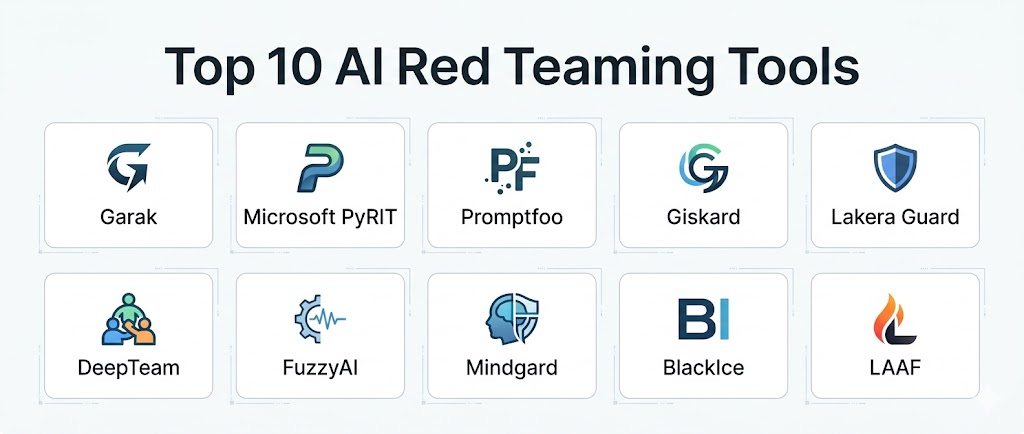
Interesting comparison highlighting AI red teaming tools and how they help evaluate model behavior, uncover weaknesses, and improve the resilience of AI systems.